Business Information SystemsUnit 79 min read
E-Commerce Models, Digital Markets, Security & Payment Systems
Unit 7 of Business Information Systems: Covers e-commerce definitions, B2B/B2C/C2C models, digital market structures, electronic payment systems, security challenges, and the strategic impact of digital markets on Nepali and global businesses.
Key points
- E-commerce is not just online selling; it includes B2B supply chains, C2C marketplaces, and digital service delivery.
- Digital markets rely on network effects, where value increases as more users join the platform.
- Electronic payment systems (eSewa, Khalti, Cards) reduce transaction costs but introduce cybersecurity risks.
- Security is the primary barrier to adoption; trust mechanisms like SSL and digital signatures are essential.
- In Nepal, mobile-first e-commerce is driving growth in services like Pathao and Daraz, bypassing traditional desktop limitations.
7.1 Introduction to E-Commerce
E-commerce (Electronic Commerce) is the buying and selling of goods and services, or the transmitting of funds or data, over the Internet. It is a subset of Electronic Business (E-Business), which includes all business processes conducted over electronic networks.
Key Distinction
- E-Business: Broader term. Includes internal processes (ERP, HR) and external interactions (supply chain, customer service).
- E-Commerce: Specific to the transactional aspect—buying and selling.
mindmap
  root((E-Business))
    E-Commerce
      B2B
      B2C
      C2C
    Internal Operations
      ERP
      HRM
    Supply Chain
      SCM
      Logistics
7.2 E-Commerce Models
The structure of e-commerce is defined by who is buying and who is selling. The three dominant models are B2B, B2C, and C2C.
1. Business-to-Business (B2B)
Transactions between businesses. This is the largest segment of e-commerce by volume.
- Examples: A manufacturer selling raw materials to a wholesaler; a software company selling licenses to a corporation.
- Characteristics: High transaction value, long-term relationships, complex negotiation, automated ordering systems.
2. Business-to-Consumer (B2C)
Transactions between a business and an individual consumer.
- Examples: Buying a phone from Daraz, ordering food from Pathao, booking a flight on Nepal Airlines.
- Characteristics: Low transaction value, high volume, impulse buying, focus on user experience (UX) and brand loyalty.
3. Consumer-to-Consumer (C2C)
Transactions between individuals, facilitated by a third-party platform.
- Examples: Selling a used laptop on Hamrobazar, peer-to-peer lending.
- Characteristics: Platform acts as a marketplace (escrow), lower prices due to no middleman markup, trust issues are higher.
Comparison of Models
| Feature | B2B | B2C | C2C |
|---|---|---|---|
| Participants | Business to Business | Business to Consumer | Consumer to Consumer |
| Transaction Size | Large (Bulk) | Small (Single unit) | Variable |
| Relationship | Long-term, contractual | Short-term, transactional | One-off, anonymous |
| Decision Making | Rational, committee-based | Emotional, individual | Price-driven |
| Nepal Example | Chaudhary Group supplying to retailers | Daraz, SastoDeal | Hamrobazar, Facebook Marketplace |
7.3 Digital Markets and Network Effects
A Digital Market is a marketplace where goods and services are exchanged electronically. Unlike physical markets, digital markets are characterized by Network Effects.
Network Effects
The value of a networked product or service increases as the number of users increases.
- Direct Network Effect: The benefit to a user increases directly with the number of other users (e.g., WhatsApp: more friends on it, the more useful it is).
- Indirect Network Effect: The benefit to one group of users increases as the number of users in another group increases (e.g., Daraz: more sellers attract more buyers, and more buyers attract more sellers).
flowchart LR
    A["More Sellers"] -->|"Indirect Effect"| B["More Buyers"]
    B -->|"Indirect Effect"| A
    C["More Users"] -->|"Direct Effect"| D["Higher Utility"]
    D --> C
Winner-Takes-All: Due to network effects, digital markets often tend toward monopoly or oligopoly. The first major player often dominates (e.g., Facebook in social media, Daraz in e-commerce in Nepal).
7.4 Electronic Payment Systems
E-commerce requires secure and efficient payment mechanisms. Traditional cash is not feasible for online transactions.
Major Payment Methods
- Credit/Debit Cards: Visa, Mastercard. Global standard, high trust, but high fraud risk.
- Digital Wallets (E-Wallets): Store payment info on a device.
- Nepal Context: eSewa, Khalti, IME Pay. These are dominant because they solve the "last mile" problem of cash collection in areas with low card penetration.
- Mobile Banking: Direct transfer from bank account via mobile app (e.g., Nabil Mobile Banking, Ncell eSewa integration).
- Cryptocurrency: Decentralized digital currency (Bitcoin, Ethereum). Not yet widely regulated or used for mainstream retail in Nepal.
The Payment Flow (Worked Example)
Consider a student buying a textbook from Daraz using Khalti.
- Initiation: Student selects "Khalti" at checkout.
- Redirection: Daraz server sends a secure request to Khalti's payment gateway.
- Authentication: Student logs into Khalti app and enters PIN.
- Verification: Khalti checks balance and verifies with the issuing bank (if linked).
- Authorization: Bank approves the transaction.
- Confirmation: Khalti sends a "Success" token to Daraz.
- Settlement: Funds are moved from Student's account to Daraz's merchant account (usually T+1 or T+2 days).
sequenceDiagram
    participant S as Student
    participant D as Daraz
    participant K as Khalti
    participant B as Bank
    S->>D: Selects Khalti Payment
    D->>K: Redirects to Khalti Gateway
    S->>K: Enters PIN
    K->>B: Request Authorization
    B-->>K: Approved
    K-->>D: Payment Success Token
    D-->>S: Order Confirmed
7.5 Security and Privacy in E-Commerce
Security is the biggest hurdle for e-commerce adoption. If users do not trust the platform, they will not buy.
Key Security Technologies
- SSL/TLS (Secure Sockets Layer/Transport Layer Security): Encrypts data in transit. The "padlock" icon in the browser indicates this.
- Digital Signatures: Used to verify the identity of the sender and ensure data integrity.
- Firewalls: Protect internal networks from unauthorized access.
- Two-Factor Authentication (2FA): Requires two forms of identification (e.g., password + SMS code).
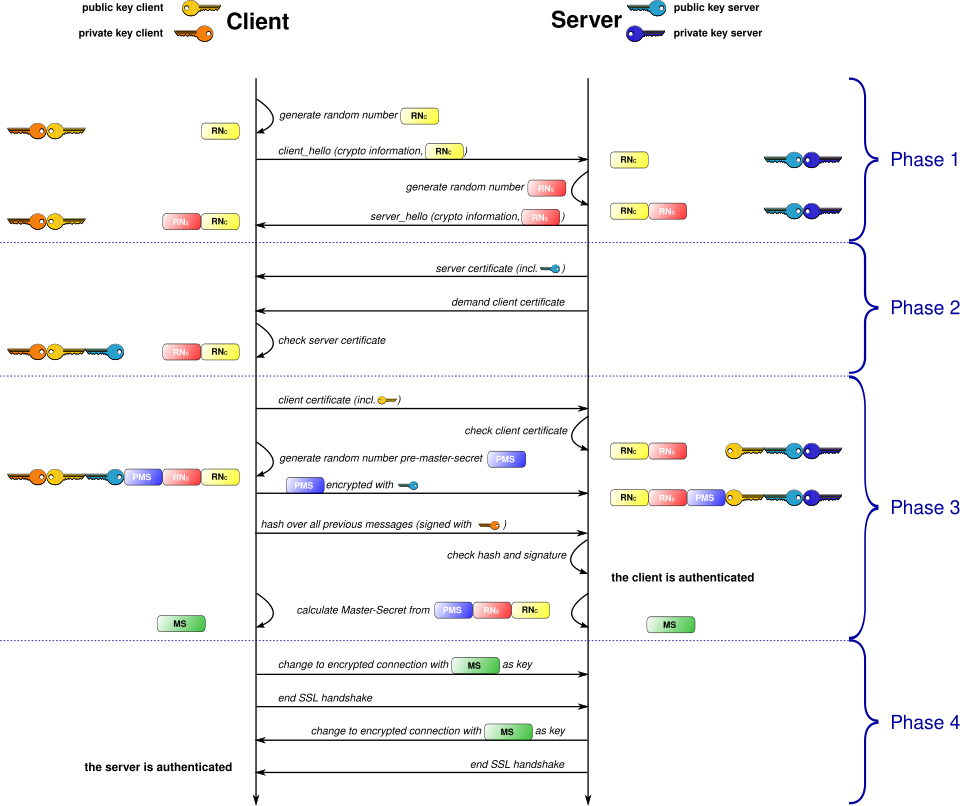 Typical SSL/TLS handshake securing e‑commerce transactions (Image: Essich, CC BY 3.0, via Wikimedia Commons)
Common Threats
- Phishing: Fake emails/websites to steal credentials.
- SQL Injection: Malicious code inserted into web forms to access database.
- Man-in-the-Middle (MitM): Attacker intercepts communication between buyer and seller.
7.6 Strategic Impact of E-Commerce
E-commerce changes business strategy in three ways:
- Reduced Transaction Costs: No need for physical stores, fewer staff, 24/7 operation.
- Global Reach: A small business in Pokhara can sell to customers in the USA.
- Data-Driven Decisions: Every click, view, and purchase is recorded. This data allows for personalized marketing (e.g., "Customers who bought X also bought Y").
In the real world
- Daraz Nepal (B2C & Logistics): Daraz uses a Hub-and-Spoke logistics model. Orders from Kathmandu are sorted at a central hub and distributed to regional spokes (Pokhara, Biratnagar). This reduces delivery costs. The platform uses Collaborative Filtering (an algorithm) to recommend products. If you buy a laptop, it shows you laptop bags and chargers. This increases the "Average Order Value" (AOV).
- eSewa (Digital Wallet & Financial Inclusion): eSewa solves the problem of Cash-on-Delivery (COD) fraud and high return rates. By allowing users to pay digitally, eSewa reduces the risk for merchants. It also provides Micro-financing services, allowing small shopkeepers to take loans based on their transaction history. This is a real-world application of Big Data in credit scoring.
- Pathao (C2C Service Marketplace): Pathao is not just a ride-hailing app; it is a Service Marketplace. It connects drivers (supply) with riders (demand) using Dynamic Pricing (Surge Pricing). During rain or peak hours, the price increases to balance supply and demand. This is a classic application of Market Equilibrium in a digital context.
Case Study: Himalayan Java and Digital Transformation
Himalayan Java is a leading coffee chain in Nepal. Initially, it was a traditional brick-and-mortar business.
The Problem:
- Limited reach to only physical locations.
- No data on customer preferences.
- High operational costs for staffing.
The E-Commerce Solution:
- Online Ordering: Launched a website and app for pre-ordering coffee and beans.
- Loyalty Program: Digital loyalty points that can be redeemed online or in-store.
- Data Analytics: They track which products are bought together. For example, they found that customers who buy "Ethiopian Yirgacheffe" often buy "Ceramic Mugs." They now bundle these products in their online store.
Result:
- Increased customer retention by 20%.
- Reduced inventory waste by predicting demand based on online sales data.
- Expanded brand awareness to customers who do not live near a physical store.
This case shows how E-Commerce is not just about selling online, but about integrating digital channels with physical operations to create a seamless customer experience.
Exam tip
- Focus on Models: Be able to clearly distinguish between B2B, B2C, and C2C with examples. Examiners often ask for "differences" or "characteristics."
- Network Effects: This is a high-yield concept. Understand direct vs. indirect network effects and how they lead to "Winner-Takes-All" markets.
- Payment Systems: Know the flow of a digital payment (especially eSewa/Khalti). Be ready to draw a simple sequence diagram or describe the steps.
- Security: Do not just list "firewalls." Explain why SSL is needed (encryption in transit) and how phishing works (social engineering).
- Nepal Context: Always tie your answers to Nepali examples (Daraz, eSewa, Pathao, Hamrobazar). This shows practical understanding and scores higher marks in TU/PU exams.
- Strategic Impact: Be prepared to discuss how e-commerce reduces costs and enables data-driven decision making. Use the Himalayan Java case as a reference.
Based on the TU BIM syllabus for Business Information Systems (IT245), unit 7.
Discussion
Loading…