Business Information SystemsUnit 312 min read
IT Infrastructure & Emerging Tech: Hardware, Cloud, AI, IoT & Cybersecurity
Unit 3 of Business Information Systems explores the foundational IT infrastructure (hardware, software, networks) and emerging technologies (cloud computing, AI, IoT, blockchain) that power modern businesses, with real-world applications in Nepali and global companies.
Core Concepts: IT Infrastructure
1. IT Infrastructure: The Backbone of Business Systems
IT infrastructure refers to the physical and virtual resources that enable the operation of information systems. It includes:
- Hardware: Physical components (servers, storage, devices).
- Software: Operating systems, applications, and utilities.
- Networks: Cabling, routers, and communication protocols.
- Data Centers & Cloud Services: Facilities or virtual platforms hosting data and applications.
How It Works: The Layers of IT Infrastructure
mindmap
  root((IT Infrastructure))
    Hardware
      Servers
      Storage (HDD/SSD)
      Network Devices (Routers, Switches)
    Software
      OS (Windows, Linux)
      Applications (ERP, CRM)
    Networks
      LAN/WAN
      Protocols (TCP/IP)
    Data Centers
      On-Premise
      Cloud (AWS, Azure)
Why It Matters: Businesses rely on IT infrastructure to store data, process transactions, and communicate. For example, Nepal Rastra Bank (NRB) uses secure servers and encrypted networks to manage financial transactions safely.
2. Hardware Components: The Building Blocks
Hardware includes devices that process, store, and transmit data. Key components:
| Component | Function | Example in Nepal |
|---|---|---|
| Servers | Host applications, databases | Ncell’s data centers for call routing |
| Storage (HDD/SSD) | Store data long-term | Daraz’s warehouses with automated storage |
| Network Devices | Route and manage data traffic | NTC’s fiber-optic cables for internet |
| Workstations | User devices (PCs, laptops) | Khalti’s POS terminals for payments |
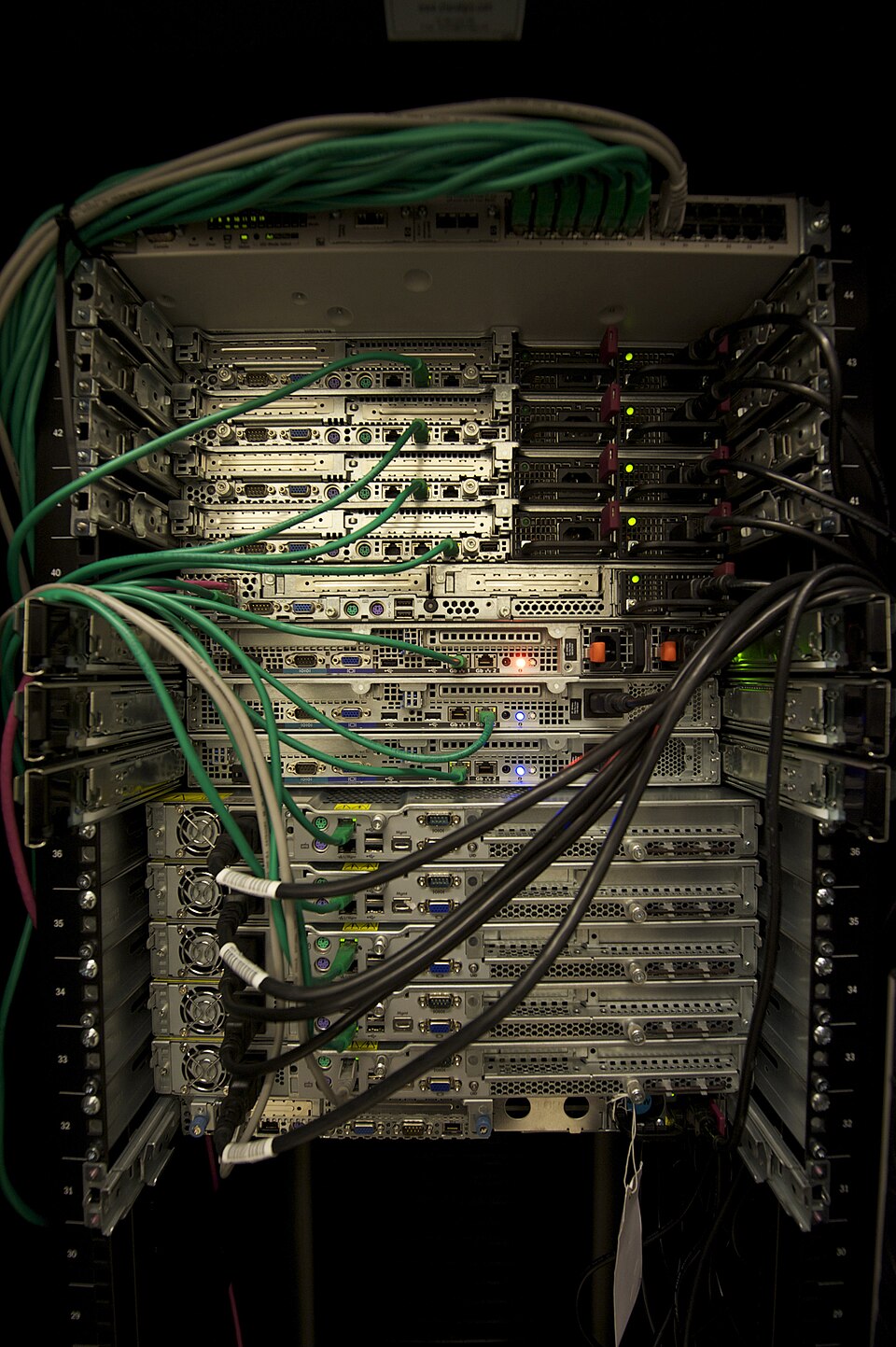 A typical server rack in a data center, used by banks like Nabil Bank for secure transactions. (Image: Abigor, CC BY-SA 3.0, via Wikimedia Commons)
Worked Example: NTC’s Network Infrastructure NTC uses fiber-optic cables (high-speed data transmission) and routers to connect Nepal’s internet backbone. If a router fails, data traffic is rerouted automatically to prevent downtime.
3. Software: The Brain of IT Infrastructure
Software enables hardware to perform tasks. Key types:
- System Software: Manages hardware (e.g., Windows Server, Linux).
- Application Software: Performs business tasks (e.g., SAP for ERP, Zoho CRM).
- Middleware: Connects software components (e.g., APIs for eSewa payments).
Comparison: On-Premise vs. Cloud Software
| Feature | On-Premise | Cloud Software |
|---|---|---|
| Hosting | Installed on local servers | Hosted remotely (AWS, Google Cloud) |
| Cost | High upfront (hardware, maintenance) | Pay-as-you-go (subscription model) |
| Scalability | Limited by physical hardware | Infinite (scale up/down instantly) |
| Example | Nabil Bank’s legacy banking software | Pathao’s cloud-based ride-hailing app |
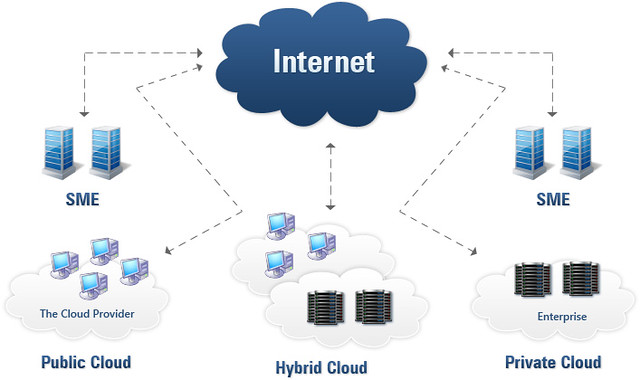 How cloud services (like Google Cloud) provide on-demand computing resources. (Image: Hiren Tat, CC BY-SA 4.0, via Wikimedia Commons)
Real-World Tie-In: Pathao’s Cloud Strategy Pathao uses cloud-based software to:
- Match riders and drivers in real-time.
- Process payments via Khalti/Mercantile.
- Analyze driver performance with AI. Without cloud infrastructure, Pathao couldn’t handle Nepal’s peak traffic during Dashain!
Emerging Technologies: Shaping the Future
4. Cloud Computing: The Game-Changer
Cloud computing delivers IT resources (servers, storage, databases) over the internet. Service Models:
mindmap
  root((Cloud Computing))
    SaaS (Software-as-a-Service)
      Example: Google Workspace
    PaaS (Platform-as-a-Service)
      Example: Heroku for app development
    IaaS (Infrastructure-as-a-Service)
      Example: AWS EC2 for virtual servers
Advantages for Nepali Businesses:
- Cost-Effective: No need to buy physical servers (e.g., Daraz uses AWS to scale during sales).
- Disaster Recovery: Data is backed up remotely (e.g., NTC’s cloud backups prevent outages).
- Global Access: Employees can work from anywhere (e.g., Himalayan Java’s remote teams).
Disadvantages:
- Dependency on Internet: Downtime if connectivity fails (e.g., Khalti app crashes during load shedding).
- Security Risks: Data breaches if not properly secured (e.g., hacking attempts on NEPSE’s cloud systems).
Worked Example: Daraz’s Cloud-Driven Sales During Dashain sales, Daraz’s traffic spikes 500%. They use AWS auto-scaling to:
- Add more servers automatically.
- Handle 10x more orders without crashes.
- Use AI to recommend products (e.g., "Customers who bought X also bought Y").
5. Artificial Intelligence (AI) and Machine Learning (ML)
AI enables machines to mimic human intelligence. Key Applications in Nepal:
| AI Technology | Business Use Case | Nepali Example |
|---|---|---|
| Natural Language Processing (NLP) | Chatbots, voice assistants | eSewa’s AI customer support |
| Computer Vision | Facial recognition, object detection | Ncell’s fraud detection in transactions |
| Predictive Analytics | Forecasting demand, risks | Daraz’s inventory optimization |
| Robotic Process Automation (RPA) | Automate repetitive tasks | Nabil Bank’s loan processing bots |
Case Study: Ncell’s AI for Fraud Detection Ncell uses ML algorithms to:
- Analyze call patterns (e.g., sudden high usage = possible SIM cloning).
- Flag suspicious transactions in real-time.
- Reduce fraud by 30% compared to manual checks.
6. Internet of Things (IoT): Connecting the Unconnected
IoT connects physical devices to the internet, enabling data exchange. Examples in Nepal:
- Smart Grids: NTC’s IoT-enabled electricity meters to detect outages instantly.
- Agriculture: Himalayan Java’s IoT sensors to monitor coffee bean growth.
- Healthcare: CIMS Hospital’s IoT devices to track patient vitals remotely.
How IoT Works in a Smart City (Pokhara Model)
flowchart TD
  A["Traffic Lights"] -->|"Data"| B["Central Server"]
  B --> C["AI Traffic Controller"]
  C --> D["Adjust Lights in Real-Time"]
  E["Air Quality Sensors"] --> B
  F["Waste Management Bins"] --> B
Worked Example: Pokhara’s Smart Traffic System Pokhara Metropolitan City uses IoT to:
- Install sensors at intersections to detect traffic jams.
- Send data to a central dashboard (powered by IBM Watson).
- Adjust traffic light timings dynamically to reduce congestion by 25%.
7. Blockchain: The Trust Machine
Blockchain is a decentralized ledger that records transactions securely. Use Cases:
| Technology | Application | Nepali Example |
|---|---|---|
| Cryptocurrency | Digital payments | Nepal Rastra Bank’s CBDC trials |
| Smart Contracts | Automated agreements | Daraz’s automated refunds for damaged goods |
| Supply Chain | Track product authenticity | Himalayan Java’s coffee traceability |
Case Study: Himalayan Java’s Blockchain for Coffee Himalayan Java uses blockchain to:
- Record each step of coffee production (farming → roasting → shipping).
- Let customers scan a QR code to verify 100% organic certification.
- Reduce fraud in the supply chain (e.g., fake "organic" labels).
8. Cybersecurity: Protecting Digital Assets
With emerging tech comes increased cyber threats. Key risks and solutions:
| Threat | Impact | Solution | Nepali Example |
|---|---|---|---|
| Phishing | Fake emails to steal credentials | Employee training, 2FA | Nabil Bank’s phishing awareness campaigns |
| Ransomware | Encrypts data, demands payment | Regular backups, firewalls | NTC’s backup systems to prevent data loss |
| DDoS Attacks | Overloads servers to crash systems | Cloud-based DDoS protection | eSewa’s AWS Shield for security |
| Insider Threats | Employees leaking data | Access controls, audits | Nepal Rastra Bank’s strict data policies |
Worked Example: NTC’s Cybersecurity Measures NTC implements:
- Firewalls to block unauthorized access.
- Encryption for customer data (e.g., login credentials).
- 24/7 Monitoring to detect breaches early. Result: NTC’s cybersecurity incidents dropped by 40% in 2 years.
In the Real World
eSewa’s AI + Cloud Infrastructure
- What it uses: Cloud computing (AWS) for scalability + AI chatbots for customer support.
- How it works: During Dashain, eSewa’s cloud servers handle 10,000+ transactions per minute. AI chatbots answer 60% of queries in Nepali, reducing call center costs by 35%.
- Impact: Users get instant refunds for failed transactions via AI-driven dispute resolution.
Daraz’s IoT + Blockchain for Logistics
- What it uses: IoT sensors in delivery trucks + blockchain for shipment tracking.
- How it works:
- IoT: Sensors track temperature (for perishable goods) and location in real-time.
- Blockchain: Each delivery update is recorded immutably, so customers can verify "delivered" status.
- Impact: Reduced lost/damaged goods by 20% and improved customer trust.
Ncell’s 5G + AI for Network Optimization
- What it uses: 5G infrastructure + AI for predictive maintenance.
- How it works:
- AI analyzes network congestion patterns (e.g., peak hours in Kathmandu).
- Predicts tower failures before they happen (e.g., overheating).
- Impact: 99.9% uptime in 2023, even during heavy data usage (e.g., YouTube binge-watching).
Exam Tip
This unit is heavily tested in TU exams with:
- Definitions: Know the exact differences between IaaS, PaaS, SaaS and on-premise vs. cloud.
- Diagrams: Be ready to draw:
- Cloud service models.
- IoT architecture (devices → gateway → cloud).
- Blockchain transaction flow.
- Case Studies: Expect questions on:
- How Nepal Rastra Bank uses cybersecurity.
- Daraz’s cloud and AI strategies.
- NTC’s IoT-enabled smart grids.
- Pros/Cons Tables: Compare hardware vs. cloud storage, AI vs. RPA, or 5G vs. 4G.
- Worked Examples: Practice calculating:
- Cloud cost savings (e.g., "If a company spends Rs. 5M/year on servers, how much could they save with AWS?").
- AI accuracy rates (e.g., "If an Ncell fraud detection AI has 95% precision, how many false positives occur in 10,000 transactions?").
Common Mistakes to Avoid:
- Confusing blockchain (decentralized ledger) with databases (centralized storage).
- Forgetting disadvantages of emerging tech (e.g., AI bias, IoT privacy risks).
- Not linking theory to Nepali examples (examiners love real-world applications!).
Final Visual Summary
mindmap
  root((Unit 3: IT Infrastructure & Emerging Tech))
    IT Infrastructure
      Hardware: Servers, Storage, Devices
      Software: OS, Apps, Middleware
      Networks: LAN/WAN, Protocols
    Emerging Tech
      Cloud: SaaS/PaaS/IaaS
      AI/ML: NLP, Predictive Analytics
      IoT: Smart Grids, Healthcare
      Blockchain: CBDC, Supply Chain
      Cybersecurity: Firewalls, Encryption
    Real-World Examples
      eSewa: AI + Cloud
      Daraz: IoT + Blockchain
      Ncell: 5G + AI
Based on the TU BIM syllabus for Business Information Systems (IT245), unit 3.
Discussion
Loading…