IT Ethics and CybersecurityUnit 412 min read
Intellectual Property Rights – Copyright, Patent, Trademark, Trade Secrets, and More
Unit 4 of IT Ethics and Cybersecurity: explores the nature, scope, and enforcement of intellectual property rights, covering copyright, patents, trademarks, trade secrets, industrial designs, and geographical indications, with Nepalese legal context and real‑world applications.
Key points
- IP rights protect creations of the mind, ensuring creators can control use and benefit.
- Copyright covers literary, artistic, and software works; patents protect inventions; trademarks protect brand identifiers.
- Trade secrets safeguard confidential business information; industrial designs protect product appearance; geographical indications link products to specific regions.
- Registration, duration, and enforcement mechanisms differ across IP types, influencing strategy for businesses and individuals.
- Nepal’s IP framework aligns with international treaties (TRIPS, Berne, Paris, Madrid) and local statutes (Copyright Act 2000, Patents Act 2004, Trade Marks Act 2005).
Unit 4: Intellectual Property Rights
Intellectual Property Rights (IPR) are legal mechanisms that grant creators exclusive control over their creations, encouraging innovation and creativity. The unit is divided into six core categories:
- Copyright – protection for literary, artistic, musical, and software works.
- Patent – protection for inventions that are novel, non‑obvious, and industrially applicable.
- Trademark – protection for distinctive signs that identify goods or services.
- Trade Secrets – protection for confidential business information that confers competitive advantage.
- Industrial Design – protection for the visual design of objects.
- Geographical Indication – protection for products linked to a specific region.
Each category has its own registration process, duration, scope, and enforcement mechanisms.
1. Copyright
Definition
Copyright is an automatic right that arises the moment a creative work is fixed in a tangible medium. It grants the creator exclusive rights to reproduce, distribute, display, perform, and create derivative works.
Key Features
- Scope: Literary, musical, dramatic, choreographic, pictorial, graphic, sculptural, audiovisual, and software works.
- Duration: Life of the author plus 70 years (for works of joint authorship, 70 years from the death of the last surviving author).
- Automatic Protection: No registration required for protection, but registration provides legal evidence and facilitates enforcement.
Registration Process in Nepal
- Complete the application form (Form C‑1).
- Attach a copy of the work and a declaration of originality.
- Pay the prescribed fee.
- The Copyright Office issues a certificate of registration.
Enforcement
- Civil action for damages and injunctions.
- Criminal penalties for willful infringement (up to 5 years imprisonment and fines).
Worked Example – Software Licensing
A Nepali startup, CodeCraft, develops a mobile app. They register the source code under copyright. They license the app to a client for a one‑year period, charging a royalty of 5 % of the client’s revenue from the app.
| Item | Amount (Rs) |
|---|---|
| Client revenue from app | 10,00,000 |
| Royalty (5 %) | 50,000 |
| Net to CodeCraft | 50,000 |
The license agreement includes a clause that prohibits the client from reverse‑engineering the code, protecting the trade secret embedded in the algorithm.
Advantages
- Encourages creative expression.
- Provides economic incentives for creators.
Disadvantages
- Limited to the original expression, not ideas.
- Enforcement can be costly and time‑consuming.
Real Picture The © symbol used to denote copyright protection (Image: 1esha 76, Public domain, via Wikimedia Commons)
2. Patent
Definition
A patent grants an inventor exclusive rights to an invention for 20 years from the filing date, provided it is novel, non‑obvious, and industrially applicable.
Key Features
- Scope: Processes, machines, manufactures, compositions of matter, and improvements thereof.
- Duration: 20 years from filing.
- Requirement: Must disclose the invention in sufficient detail (enablement).
Registration Process in Nepal
- Conduct a prior art search.
- File a patent application (Form P‑1) with the Patent Office.
- Pay filing and examination fees.
- Examination by the Patent Office.
- Grant of patent if all requirements met.
Enforcement
- Civil action for infringement.
- Criminal penalties for willful infringement (up to 7 years imprisonment).
Worked Example – Agricultural Innovation
A farmer in Pokhara develops a new seed‑mixing machine that increases yield by 15 %. He files a patent application. After examination, the Patent Office grants the patent. He licenses the machine to a regional cooperative, receiving a fixed fee of Rs 2,00,000 per unit sold.
| Item | Amount (Rs) |
|---|---|
| Units sold | 50 |
| License fee per unit | 2,00,000 |
| Total revenue | 1,00,00,000 |
Advantages
- Protects technical innovations.
- Enables licensing and commercialization.
Disadvantages
- High cost of filing and maintenance.
- Requires public disclosure, potentially revealing trade secrets.
Real Picture
3. Trademark
Definition
A trademark is a distinctive sign (word, logo, sound, or combination) that identifies the source of goods or services.
Key Features
- Scope: Words, logos, slogans, sounds, colors, and combinations.
- Duration: 10 years from registration, renewable indefinitely.
- Protection: Prevents consumer confusion and protects brand reputation.
Registration Process in Nepal
- Conduct a trademark search.
- File an application (Form T‑1) with the Trademark Office.
- Pay the filing fee.
- Examination for distinctiveness and non‑conflict.
- Publication in the Gazette.
- Registration upon acceptance.
Enforcement
- Civil action for infringement.
- Criminal penalties for counterfeiting (up to 5 years imprisonment).
Worked Example – Brand Expansion
Ncell registers the “Ncell” logo and the color scheme used in its mobile plans. When a new competitor launches a similar logo, Ncell files an infringement suit. The court issues an injunction, preventing the competitor from using the logo.
Advantages
- Protects brand identity.
- Enhances consumer trust.
Disadvantages
- Requires continuous renewal.
- Registration does not protect the underlying idea or product.
Real Picture
4. Trade Secrets
Definition
Trade secrets are confidential business information that provides a competitive edge, such as formulas, processes, or customer lists.
Key Features
- Protection: No registration; protection lasts as long as secrecy is maintained.
- Enforcement: Civil action for misappropriation; criminal penalties for theft.
Common Examples
- Pathao’s delivery‑routing algorithm.
- eSewa’s payment gateway security protocol.
Advantages
- No registration cost.
- Unlimited duration if secrecy is preserved.
Disadvantages
- Vulnerable to leaks.
- No legal protection if the secret becomes public.
Real Picture
5. Industrial Design
Definition
Industrial design protects the visual appearance of a product, such as its shape, pattern, or ornamentation.
Key Features
- Scope: Aesthetic aspects of a product.
- Duration: 15 years from registration in Nepal.
Registration Process
- File a design application (Form D‑1).
- Provide drawings or photographs.
- Pay fees.
- Examination and grant.
Worked Example – Consumer Electronics
A Nepali electronics firm designs a new smartphone with a unique curved back panel. They register the design, preventing competitors from copying the aesthetic.
Advantages
- Protects product appearance.
- Enhances market differentiation.
Disadvantages
- Does not protect functional aspects.
Real Picture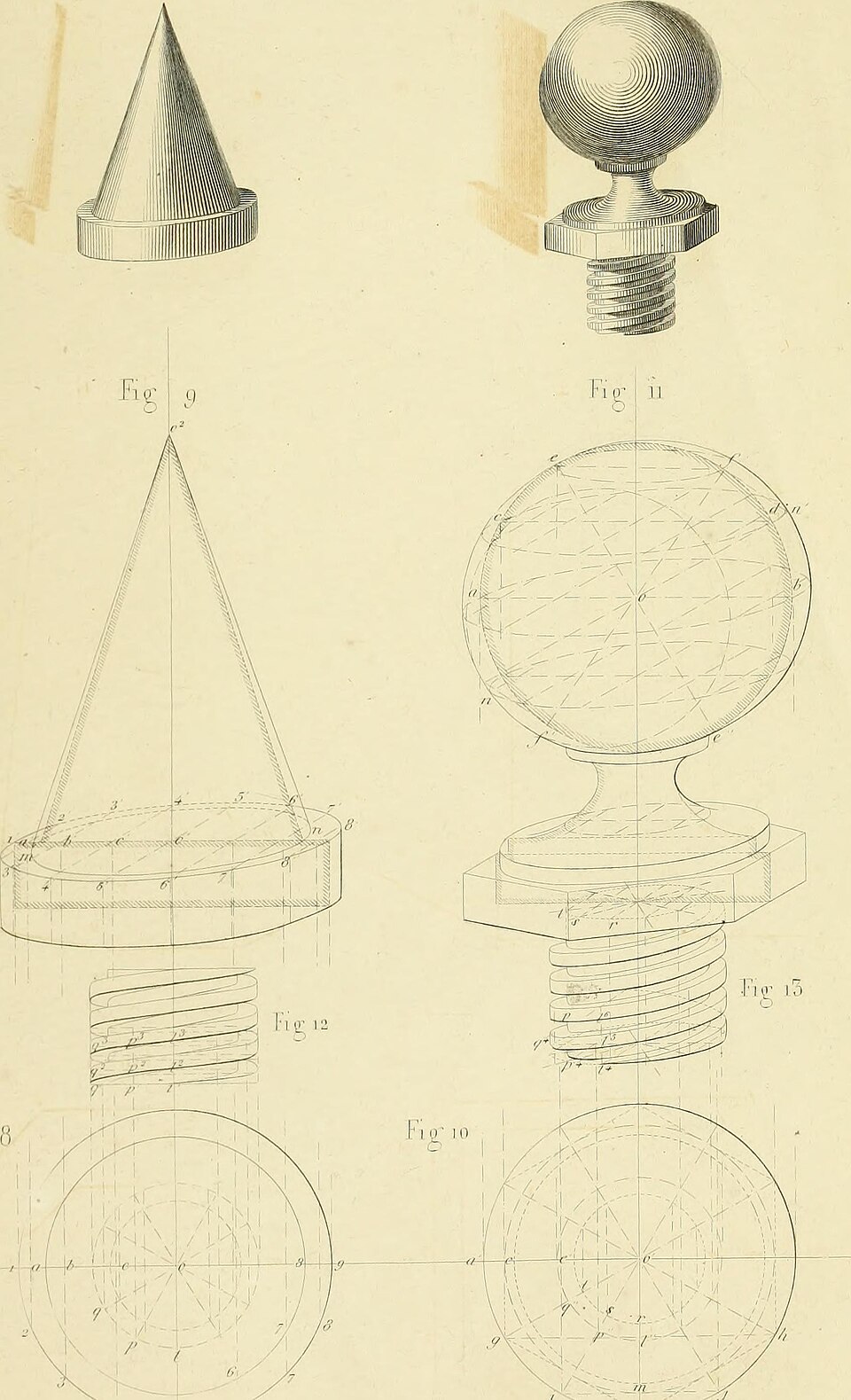 A detailed drawing of a product’s industrial design (Image: Internet Archive Book Images, No restrictions, via Wikimedia Commons)
6. Geographical Indication
Definition
A geographical indication (GI) identifies a product as originating from a specific region, where its quality or reputation is linked to that location.
Key Features
- Scope: Agricultural products, foodstuffs, handicrafts, and more.
- Duration: Indefinite, as long as the GI is maintained.
Registration Process
- Submit an application to the GI Registry.
- Provide evidence of the link between product and region.
- Pay fees.
- Grant upon approval.
Worked Example – Kathmandu Tea
A tea estate in Kathmandu registers “Kathmandu Tea” as a GI. This protects the brand from imitation and allows the estate to command premium prices.
Advantages
- Protects regional heritage.
- Supports local economies.
Disadvantages
- Requires continuous monitoring.
Real Picture A label indicating a product’s geographical indication (Image: European Commission, CC0, via Wikimedia Commons)
7. International Treaties and Nepal’s IP Framework
| Treaty | Key Provisions | Nepal’s Alignment |
|---|---|---|
| Berne Convention | Minimum copyright protection, no formalities | Nepal ratified 2000, aligns with 70‑year rule |
| Paris Convention | Patent, industrial design, and trademark protection | Nepal follows 20‑year patent term, 15‑year design term |
| TRIPS Agreement | Minimum standards for IP protection | Nepal’s IP laws meet TRIPS requirements |
| Madrid Protocol | International trademark registration | Nepal is a member, enabling global trademark protection |
| WIPO Copyright Treaty | Digital rights and protection of works online | Nepal has implemented digital copyright provisions |
Advantages
- Harmonizes IP protection across borders.
- Facilitates international trade and licensing.
Disadvantages
- Compliance costs for businesses operating internationally.
8. IP in the Digital Age
Digital technologies have transformed how IP is created, distributed, and infringed. Key issues include:
- Digital Rights Management (DRM): Encryption and licensing controls for digital media.
- Open Source Licensing: GPL, MIT, Apache licenses allow free use but impose conditions.
- Cloud Computing: Data stored in the cloud may be subject to multiple jurisdictions.
- Artificial Intelligence: AI‑generated content raises questions about authorship and ownership.
Real‑World Example – YouTube
YouTube uses DRM to protect copyrighted videos, while also providing a platform for user‑generated content under the YouTube Terms of Service.
9. In the Real World
- eSewa – Uses a registered trademark for its logo and brand name. The trademark protects the brand identity across all digital payment services, ensuring users recognize the service and preventing counterfeit apps.
- Google – Holds thousands of patents on search algorithms and cloud infrastructure. These patents enable Google to license its technology to other companies and to maintain a competitive edge in the global market.
- Pathao – Protects its delivery‑routing algorithm as a trade secret. By keeping the algorithm confidential, Pathao prevents competitors from replicating its efficient dispatch system, thereby maintaining market leadership in Kathmandu’s logistics sector.
10. Exam Tip
- Understand the differences between the six IP categories: scope, duration, registration requirements, and enforcement mechanisms.
- Memorize key Nepalese statutes (Copyright Act 2000, Patents Act 2004, Trade Marks Act 2005) and their alignment with international treaties.
- Practice diagrammatic representation of the IP registration process using mermaid flowcharts.
- Prepare short worked examples for each IP type, focusing on real‑world scenarios (software licensing, patent licensing, trademark infringement).
- Answer multiple‑choice questions by identifying the correct IP type for a given scenario (e.g., a new mobile app, a novel machine, a brand logo).
Mermaids and Visuals
flowchart TD
    A["Idea Generation"] --> B["Prior Art Search"]
    B --> C["Draft Application"]
    C --> D["File with Office"]
    D --> E["Examination"]
    E --> F["Grant / Rejection"]
    F --> G["Publication"]
Figure 1 – Flowchart of the patent registration process in Nepal.
flowchart TD
    A["Infringer"] --> B["Unauthorized Use"]
    B --> C["Notice of Infringement"]
    C --> D["Court Filing"]
    D --> E["Injunction / Damages"]
Figure 2 – Typical infringement litigation flow.
11. Summary
Intellectual Property Rights form the backbone of modern innovation ecosystems. By understanding the nuances of copyright, patents, trademarks, trade secrets, industrial designs, and geographical indications, students can navigate legal landscapes, protect their creations, and contribute responsibly to Nepal’s digital economy.
Based on the TU BIM syllabus for IT Ethics and Cybersecurity (IT246), unit 4.
Discussion
Loading…