Digital EconomyUnit 16 min read
Digital Economy Basics: Definitions, Drivers & Global Impact
Unit 1 of Digital Economy explores the core concepts of the digital economy—its definition, key drivers (AI, IoT, cloud), economic impact (GDP growth, job shifts), and real-world applications in Nepal (eSewa, Daraz) and globally (Google, Alibaba). Includes visual breakdowns of digital transformation stages, economic mo
Core Concepts of the Digital Economy
What is the Digital Economy?
The digital economy refers to economic activity enabled by digital technologies (internet, mobile, AI, blockchain, cloud computing). It transforms how goods/services are produced, distributed, and consumed.
Key Characteristics:
- Digitization: Converting physical assets into digital formats (e.g., e-books, digital payments).
- Digitalization: Using digital tools to improve processes (e.g., online banking, AI-driven customer service).
- Digital Transformation: Fundamental change in business models (e.g., Netflix replacing DVD rentals).
flowchart TD
    A["Digitization"] -->|"Physical to Digital"| B["Digitalization"]
    B -->|"Process Improvement"| C["Digital Transformation"]
    C -->|"New Business Models"| D["Digital Economy"]
Drivers of the Digital Economy
1. Technology Enablers
| Technology | Role in Digital Economy | Example in Nepal |
|---|---|---|
| AI & Machine Learning | Automates tasks, personalizes services. | Khalti’s fraud detection. |
| IoT (Internet of Things) | Connects devices for real-time data. | NTC’s smart grid monitoring. |
| Cloud Computing | Enables scalable storage and computing. | Daraz’s inventory management. |
| Blockchain | Secures transactions without intermediaries. | NEPSE’s digital share trading (pilot). |
| 5G & Edge Computing | Faster data processing for apps. | Pathao’s real-time ride matching. |
2. Economic Impact
The digital economy contributes ~15% of global GDP (McKinsey, 2021) and is growing at ~10% annually. In Nepal:
- GDP Contribution: Digital services (IT, fintech) account for ~5% of Nepal’s GDP (2023).
- Job Creation: 200,000+ employed in IT/ITES sectors (Nepal Rastra Bank).
- Remittance Boost: Digital payment apps (eSewa, Khalti) reduce remittance costs by 2-3% (World Bank).
Digital Economy Models
1. Digital Business Models
| Model | Description | Nepal Example |
|---|---|---|
| Subscription | Recurring revenue (e.g., SaaS). | eSewa’s monthly transaction fees. |
| Freemium | Free basic service, paid premium. | Khalti’s free transfers (up to Rs. 1,000). |
| Marketplace | Connects buyers/sellers (commission-based). | Daraz, Sastodeal. |
| Data Monetization | Selling user data (anonymized). | NTC’s anonymized traffic data to urban planners. |
| Platform Economy | Two-sided networks (e.g., gig work). | Pathao’s driver-passenger platform. |
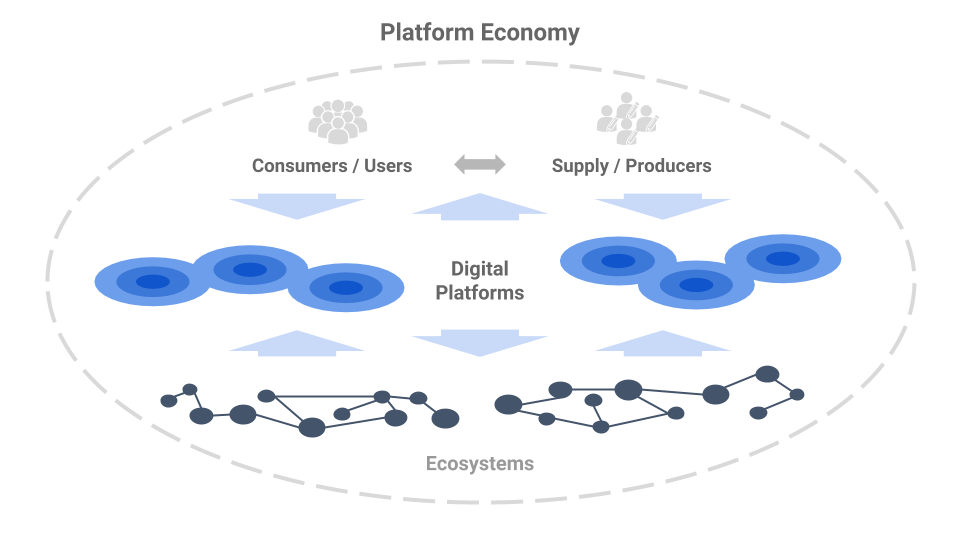 A two-sided market showing Pathao’s drivers (supply) and passengers (demand) with network effects. (Image: Vc20, CC BY-SA 4.0, via Wikimedia Commons)
2. Digital Divide and Inclusion
- Global Divide: 90% of developed nations have >80% internet penetration; Nepal’s is ~50% (NTA, 2023).
- Nepal’s Challenges:
- Rural connectivity: Only 30% of rural areas have 4G (NTC).
- Digital literacy: <40% of adults can use digital payments (World Bank).
- Solutions:
- Government’s Digital Nepal Vision 2025 (free Wi-Fi in public spaces).
- NGOs like Digital Nepal training rural youth in coding.
Case Study: eSewa’s Digital Payment Revolution
How eSewa Uses Digital Economy Principles:
- Digitization: Replaced cash with mobile payments.
- Platform Model: Connects merchants, banks, and users (two-sided market).
- Network Effects: More users → more merchants → more users.
- Data Monetization: Uses transaction data to offer loans (eSewa Loan).
Worked Example: Cost Savings for a Merchant
- Traditional: Rs. 500/customer for cash handling + Rs. 200/transaction fee.
- eSewa: Rs. 5/transaction + no cash risk.
- Savings: 98% reduction in operational costs for 100 transactions/month.
In the Real World
Google’s Ad Revenue Model:
- Uses data monetization and AI-driven ads to generate $200B/year.
- How it works: Tracks user searches → targets ads → charges advertisers per click.
- Nepal Link: Google Ads is used by 90% of Nepal’s top 100 businesses for digital marketing.
Khalti’s Network Effects:
- Direct Network Effect: More users → more merchants → more users.
- Example: When Khalti added Ncell as a partner, its user base grew by 40% in 3 months.
- Indirect Effect: Merchants like Daraz and Foodmandu now accept Khalti, increasing its utility.
NTC’s Smart Grid:
- Uses IoT sensors to monitor electricity usage in real time.
- Impact: Reduced power theft by 30% in Kathmandu (2022).
- Digital Economy Principle: Digitalization of infrastructure for efficiency.
Exam Tip
This unit is conceptual but heavily tested on applications. Expect:
- Definitions: Be ready to explain digitization vs. digitalization vs. transformation (often in short-answer questions).
- Case Studies: Link theories to Nepal examples (eSewa, Daraz, NTC). Memorize one case study per model (e.g., Khalti’s network effects).
- Diagrams: Sketch digital economy models (e.g., two-sided markets) in exams. Label all parts.
- Data Questions: Calculate cost savings (like the eSewa example) or GDP impact from given data.
- Critical Thinking: Discuss challenges of the digital divide in Nepal (e.g., rural connectivity, literacy).
Common Pitfalls:
- Confusing digital economy with just e-commerce (it’s broader: includes AI, IoT, etc.).
- Ignoring network effects in platform questions (always ask: Does adding one user attract more?).
- Overlooking real-world examples in answers (examiners love Nepal-specific cases).
Visual Summary:
mindmap
  root((Digital Economy))
    Drivers
      AI & ML
      IoT
      Cloud
      Blockchain
    Models
      Subscription
      Marketplace
      Platform
    Impact
      GDP Growth
      Job Creation
      Digital Divide
    Nepal Examples
      eSewa
      Khalti
      Daraz
      NTC Smart Grid
Based on the TU BIM syllabus for Digital Economy (IT250), unit 1.
Discussion
Loading…