MathematicsUnit 37 min read
Differentiation – definitions, rules, implicit differentiation, applications
Unit 3 of Mathematics: introduces the derivative, fundamental differentiation rules, implicit differentiation, higher‑order derivatives and real‑world applications, with step‑by‑step examples and visual aids for exam preparation.
Key points
- The derivative measures instantaneous rate of change and is defined as a limit of difference quotients.
- Product, quotient, chain and implicit differentiation rules extend basic differentiation to complex expressions.
- Higher‑order derivatives describe curvature, acceleration and other physical quantities.
- Mastery of differentiation enables solving tangent‑line problems, related‑rates, optimisation and modelling tasks.
1. What is a derivative?
The derivative of a function at a point is the limit
provided the limit exists. Geometrically it is the slope of the tangent line to the curve at .
Key idea: The derivative converts a static relationship into a dynamic one – it tells how fast the output changes when the input changes by an infinitesimal amount.
2. Basic differentiation rules
| Rule | Formula | When to use |
|---|---|---|
| Constant | Any constant term | |
| Power | Polynomial terms | |
| Constant multiple | A constant factor outside | |
| Sum/Difference | Linear combination | |
| Product | Two factors multiplied | |
| Quotient | One factor divided by another | |
| Chain | Composite functions |
flowchart LR
    A["Basic rules"] --> B["Constant"]
    A --> C["Power"]
    A --> D["Constant multiple"]
    A --> E["Sum/Difference"]
    A --> F["Product"]
    A --> G["Quotient"]
    A --> H["Chain"]
Example 1 – Using the power and constant‑multiple rules
Find .
Hence .
3. Implicit differentiation
When a relation between and is given implicitly (e.g. ), we differentiate both sides with respect to , treating as a function of (i.e. ). Apply the chain rule to every term containing .
Worked example (exam style)
Problem: Define implicit differentiation and find the slope of the circle at the point .
Solution:
- Differentiate both sides w.r.t. :
- Solve for :
- Substitute the point :
Thus the slope of the tangent line at is .
The tangent line equation can be written as
4. Differentiation of trigonometric, exponential and logarithmic functions
| Function | Derivative |
|---|---|
Example 2 – Chain rule with trig‑exponential
Differentiate .
5. Higher‑order derivatives
The second derivative is the derivative of . It measures curvature or acceleration.
- If on an interval, the graph is concave up (shaped like a cup).
- If , the graph is concave down.
Example 3 – Motion interpretation
A car’s position is (metres).
At s, m/s and m/s.
6. Applications of differentiation
| Application | What the derivative tells you |
|---|---|
| Tangent & normal lines | Slope of curve (tangent) and perpendicular direction (normal). |
| Related rates | Connect rates of change of linked quantities (e.g., ladder sliding). |
| Optimization | Critical points () give maxima/minima for cost, profit, etc. |
| Curve sketching | Use to locate increasing/decreasing intervals, inflection points. |
| Physics | Velocity = ; acceleration = . |
Example 4 – Optimization (max profit)
A small shop sells units per day, earning profit .
Set → .
Second derivative → maximum.
Maximum profit occurs when 30 units are sold per day.
7. Real‑world connections
In the real world
eSewa transaction fee – eSewa charges a fee that follows a piecewise linear cost function:
The marginal fee NPR per additional rupee for amounts above 500 NPR. This derivative tells the system how much extra charge to add for each extra rupee transferred, enabling real‑time fee calculation.
Daraz order‑processing queue – Daraz models the number of orders processed per hour as (orders/hour, where is hours after a peak). The rate of change shows the queue is slowing down by 5 orders each hour, helping the logistics team allocate extra staff before the queue collapses.
Bank loan interest (compound) – For a loan amount (continuous compounding, rate ), the derivative gives the instantaneous interest accrued at any moment. A bank uses this to compute the exact interest to credit to the borrower’s account each day.
Worked‑example tie‑in: The bank’s interest formula is identical to the exponential differentiation rule . Understanding this rule lets a student instantly write the marginal interest without re‑deriving it.
8. Summary of differentiation rules (quick reference)
classDiagram
    class "Basic Rules"{
        +Constant
        +Power
        +ConstantMultiple
        +SumDifference
    }
    class Product{
        +Rule: (fg)'=f'g+fg'
    }
    class Quotient{
        +Rule: (f/g)'=(f'g-fg')/g^2
    }
    class Chain{
        +Rule: (f∘g)'=f'(g)·g'
    }
    BasicRules <|-- Product
    BasicRules <|-- Quotient
    BasicRules <|-- Chain
9. Common pitfalls and how to avoid them
| Pitfall | Remedy |
|---|---|
| Forgetting to multiply by when differentiating a term containing (implicit differentiation). | Write “” explicitly each time. |
| Sign errors in the quotient rule numerator. | Memorise as “low‑d(high) – high‑d(low)”. |
| Mis‑applying the chain rule to nested functions. | Identify the outer and inner functions before differentiating. |
| Assuming means a maximum/minimum. | Check the sign of or use the first‑derivative test. |
Exam tip
- Read the question carefully: if a point is given, substitute before simplifying the derivative; this avoids algebraic mistakes (as in the implicit‑circle problem).
- Write the rule name (e.g., “using the chain rule”) before the algebra; examiners award marks for method.
- For related‑rates problems, list all variables, write a relation, differentiate implicitly, then plug in the known rates.
- Check units: derivatives have units of “output per input” (e.g., m/s for position vs. time). A mismatched unit signals an error.
- Time‑saving shortcut: memorize the standard derivatives of ; they appear in >70 % of questions.
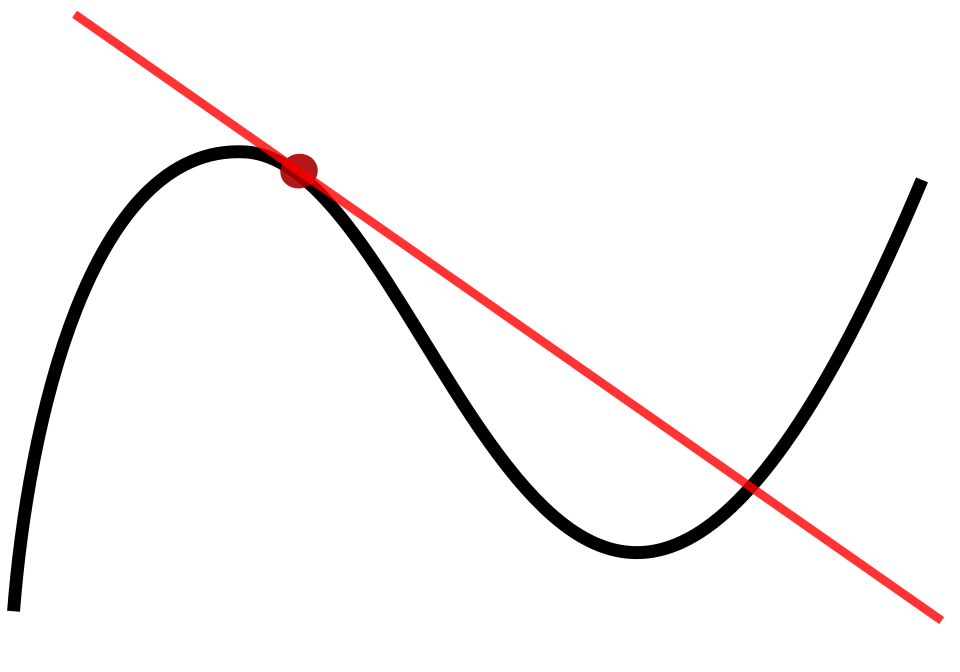 Tangent line illustrating the derivative as slope (Image: Jacj at English Wikipedia / Later versions were uploaded by , Public domain, via Wikimedia Commons)
Based on the TU BIT syllabus for Mathematics (MTH104), unit 3.
Discussion
Loading…