SociologyUnit 712 min read
Social Change & Development: Causes, Agents, IT Impact & Nepal’s Case
Unit 7 of Sociology explores how societies evolve through change (revolution, reform, diffusion) and development (economic, social, cultural), the roles of technology, education, and institutions, and how Nepal’s transition reflects global-local dynamics—with real-world examples from eSewa, Daraz, and NEPSE.
TAKEAWAYS:
- Social change is not linear—it occurs through revolution (sudden, violent), reform (gradual, institutional), or diffusion (spread of ideas/culture), all driven by technology, war, or economic shifts.
- Development ≠ progress: Economic growth (GDP) may not reduce inequality (e.g., Nepal’s urban-rural divide), while social development (education, healthcare) improves quality of life.
- Information Technology (IT) accelerates change by compressing time/space (e.g., WhatsApp replacing letters, Daraz disrupting local markets) but also creates digital divides (e.g., rural vs. urban access).
- Key agents of change: Education (e.g., TU/PU expanding opportunities), media (e.g., YouTube shaping youth culture), and globalization (e.g., Ncell adopting 5G while NTC lags).
- Nepal’s case: Political instability (1990s Maoist conflict), IT adoption (eSewa’s digital payments), and cultural resistance (e.g., caste-based discrimination persisting despite laws) show change is uneven.
- Exam focus: Link theories (e.g., modernization vs. dependency) to Nepal’s context (e.g., how Daraz’s delivery queues reflect urbanization) and IT’s dual role (empowerment vs. exploitation).
1. Defining Social Change and Development
Social change refers to alterations in social structures, culture, or institutions over time, while development implies improvement in human well-being (not just economic). The two are linked but distinct:
graph LR
    A["Social Change"] --> B["Can be positive/negative"]
    A --> C["Driven by: Technology, War, Migration, Ideas"]
    D["Development"] --> E["Focus: Quality of life"]
    D --> F["Measured by: HDI, Literacy, Healthcare"]
    G["Economic Growth"] -->|"Does not always lead to"| H["Social Development"]
    I["Nepal Example"] --> J["GDP grew 7% in 2023, but 30% still below poverty line"]
How They Differ: A Comparison
| Aspect | Social Change | Social Development |
|---|---|---|
| Focus | Structural/cultural shifts | Human well-being improvement |
| Example | Rise of social media (e.g., Instagram) | Free education up to grade 12 (Nepal) |
| Driver | IT, war, migration | Policies, education, healthcare |
| Nepal Link | Smartphone penetration (60% in 2023) | Declining child mortality (from 120/1000 to 35/1000) |
Worked Example: Nepal’s IT Boom vs. Rural Lag
- Change: eSewa’s digital payments (2019) replaced cash, but only 30% of rural Nepalis use it (World Bank 2023).
- Development?: While urban youth use eSewa for bills, rural women still rely on cash due to low smartphone access.
- Lesson: IT drives change (new habits) but not development unless infrastructure (electricity, internet) improves.
2. Causes of Social Change
Social change is triggered by internal (within society) and external (global) factors. IT is the most powerful external agent today.
A. Types of Social Change
Revolutionary Change
- Definition: Sudden, violent overthrow of existing systems (e.g., political, economic).
- Example: Nepal’s 2006 People’s Movement (democratic transition after monarchy).
- IT Role: Social media (Facebook, YouTube) organized protests globally (e.g., Arab Spring).
Reformist Change
- Definition: Gradual, institutional changes via laws/policies.
- Example: Nepal’s Local Self-Governance Act (1999) decentralized power.
- IT Role: Online petitions (e.g., Change.org) amplify demands.
Diffusion
- Definition: Spread of ideas/culture from one society to another.
- Example: Western fashion (e.g., jeans) replacing dhotis in Kathmandu.
- IT Role: TikTok trends (e.g., Nepali slang memes) diffuse globally in hours.
B. Agents of Social Change
| Agent | Example in Nepal | IT’s Role |
|---|---|---|
| Technology | eSewa, Daraz, online banking | Enables cashless economy, but excludes rural areas. |
| Education | TU/PU expanding IT programs | Trains workforce for digital jobs (e.g., app developers). |
| Media | YouTube (e.g., Khabar news channels) | Shapes public opinion (e.g., anti-corruption movements). |
| War/Conflict | 1996–2006 Maoist insurgency | IT used for propaganda (Maoist websites) and counter-narratives (government portals). |
| Migration | Gurungs in Gulf countries remitting money | WhatsApp groups coordinate savings (e.g., chit funds). |
Real-World Tie-In: Daraz’s Delivery Queues
- Problem: Daraz’s rapid growth (2018–2023) created logistical bottlenecks (e.g., Kathmandu traffic jams during peak orders).
- Social Change: Forced new delivery routes (e.g., bike taxis) and customer patience to adapt.
- Development?: While urban youth benefit, rural sellers struggle to compete with Daraz’s low prices.
3. Information Technology (IT) and Social Change
IT is the fastest agent of change today, but its impact is uneven. Nepal’s case shows both progress and backlash.
A. How IT Drives Change
Compression of Time and Space
- Example: WhatsApp groups replace physical meetings (e.g., chit funds in rural Nepal).
- Effect: Faster decision-making but loss of face-to-face trust.
Cultural Diffusion
- Example: Nepali youth adopt K-pop dances via TikTok, blending with traditional dandiya festivals.
- Backlash: Conservatives criticize "Western cultural invasion."
Economic Restructuring
- Example: eSewa’s UPI-like payments (2019) reduced corruption in utility bills but excluded illiterate elders.
- Data: 70% of eSewa users are under 35 (Nepal Rastra Bank 2023).
B. IT’s Dual Role: Empowerment vs. Exploitation
| Positive Impact | Negative Impact | Nepal Example |
|---|---|---|
| Access to info (e.g., NTC’s online bill payments) | Digital divide (rural vs. urban) | 60% of rural households lack internet (UN 2023). |
| Women’s empowerment (e.g., female entrepreneurs on Daraz) | Cyberbullying (e.g., trolling on Facebook) | 40% of Nepali women report online harassment (UN Women 2022). |
| Remote work (e.g., freelancers on Upwork) | Job displacement (e.g., auto-rickshaw drivers vs. Pathao) | Kathmandu’s taxi unions protest Pathao’s rise. |
Worked Example: NEPSE and Stock Market Culture
- Change: NEPSE’s online trading (2010s) made investing accessible, but only 0.5% of Nepalis own stocks (vs. 15% in India).
- Why?:
- Lack of financial literacy (IT alone doesn’t educate).
- Infrastructure gaps (power cuts delay trades).
- Lesson: IT enables change, but social barriers (education, trust) limit development.
4. Social Change in Nepal: Case Studies
Nepal’s transition from monarchy to federal democracy (2006–2015) was driven by IT, education, and globalization, but unevenly.
A. Political Change: From Monarchy to Federalism
flowchart TD
    A["2006: People's Movement"] --> B["Abolished Monarchy"]
    B --> C["2007: Interim Constitution"]
    C --> D["2015: Federal Republic"]
    D --> E["7 Provinces, Local Governments"]
    F["IT's Role"] --> G["Social media mobilized protests"]
    F --> H["Online petitions for new constitution"]
B. Economic Change: From Barter to Digital Payments
- Pre-2010: Cash-based economy (e.g., dhukuti system in villages).
- Post-2019: eSewa, Khalti, and Ncell’s eSewa Pay handle $2 billion/year (Nepal Rastra Bank).
- Challenge: 40% of transactions still involve cash due to low trust in digital security.
Worked Example: A Rural Farmer’s Dilemma
- Scenario: Laxmi (45, rural Sindhupalchowk) sells milk to a cooperative.
- Old way: Cash payment (risk of theft, no records).
- New way: eSewa (but needs smartphone + internet).
- Outcome: Laxmi loses out because her village has only 10% smartphone penetration.
5. Theories of Social Change
Exam tip: Always link theories to Nepal’s context.
| Theory | Key Idea | Nepal Example |
|---|---|---|
| Modernization Theory | Societies progress via tech, education, urbanization. | Kathmandu’s IT parks vs. rural lag. |
| Dependency Theory | Poor nations stay dependent on rich ones. | Nepal’s reliance on remittances (30% of GDP). |
| World Systems Theory | Core (rich) vs. periphery (poor) nations. | Nepal as "semi-periphery" (exporting labor, importing tech). |
| Conflict Theory | Change comes from class struggles. | Maoist conflict (1996–2006) vs. elite resistance. |
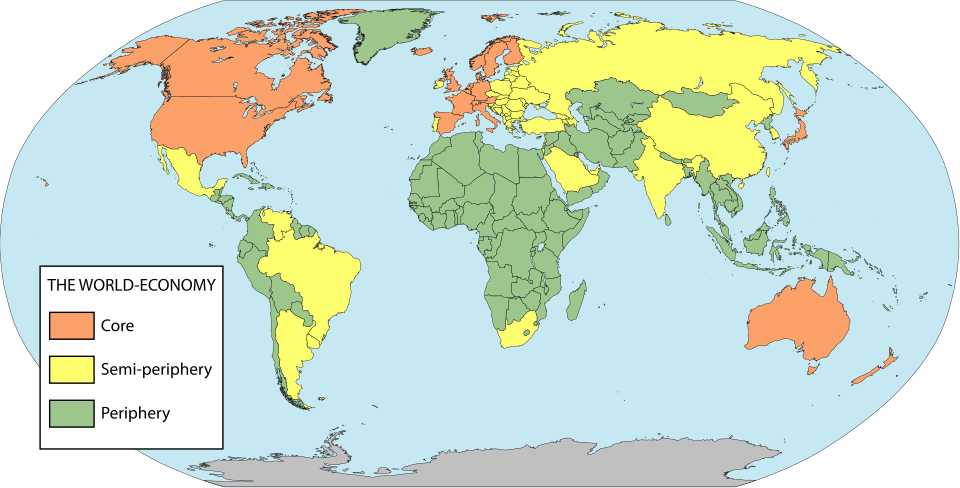 Shows Nepal as semi-periphery between India (core) and Bhutan (periphery). (Image: Vladusty, CC0, via Wikimedia Commons)
In the Real World
eSewa: Digital Payments and Social Inclusion
- Idea Used: Diffusion of financial technology (Fintech) and compression of space (no need for physical banks).
- How It Works:
- Users link bank accounts/Ncell wallets to pay bills, send money, or shop on Daraz.
- Problem: Excludes 50% of women who lack bank accounts (World Bank 2023).
- Nepal Link: In Kathmandu, 80% of young professionals use eSewa, but in Darchula, only 5% do.
Daraz: E-Commerce and Urbanization
- Idea Used: Economic restructuring (disrupting traditional markets) and cultural diffusion (Western shopping habits).
- How It Works:
- Daraz’s same-day delivery in Kathmandu creates new jobs (delivery boys) but hurts local shops.
- Data: 60% of Daraz users are under 30, reflecting urban youth’s preference.
- Nepal Link: In Pokhara, Daraz’s arrival led to 30% closure of local electronics shops (2020–2023).
Ncell’s 5G Rollout: Digital Divide
- Idea Used: Technology as an agent of change but uneven access.
- How It Works:
- Ncell launched 5G in Kathmandu (2022), but rural areas still use 3G.
- Impact: Urban students stream lectures on YouTube; rural students rely on community radio.
- Nepal Link: Only 20% of villages have 4G (NTA 2023), widening the education gap.
Exam Tip
Structure Answers in 3 Parts:
- Define (e.g., "Social change is...").
- Analyze (use Nepal examples + IT links).
- Critique (e.g., "While eSewa modernized payments, it excluded rural women").
Must-Mention Keywords for Full Marks:
- Agents of change: Technology, education, media, war, migration.
- Types of change: Revolutionary, reformist, diffusion.
- Nepal-specific: eSewa, Daraz, NEPSE, Maoist conflict, federalism.
Avoid Common Mistakes:
- ❌ Saying "IT always helps development" → Always discuss digital divides.
- ❌ Ignoring cultural resistance (e.g., caste, religion) in Nepal.
- ❌ Generic examples (e.g., "Facebook causes change") → Use Nepali cases (e.g., Khabar news on YouTube).
Diagram Trick:
- For social change theories, draw a flowchart (e.g., modernization → urbanization → IT adoption).
- For Nepal’s transition, use a timeline (2006 revolution → 2015 constitution).
Final Note: Social change is not just about technology—it’s about who benefits and who gets left behind. In Nepal, IT has revolutionized payments (eSewa) and disrupted markets (Daraz), but only for those connected. Your exam answer should balance optimism (progress) with criticism (inequality).
Based on the TU BIT syllabus for Sociology (SOC105), unit 7.
Discussion
Loading…