Discrete StructureUnit 47 min read
Counting Principles, Permutations, Combinations & Advanced Techniques
Unit 4 of Discrete Structure covers fundamental counting principles (addition/multiplication), permutations/combinations with/without repetition, advanced techniques (inclusion-exclusion, generating functions), and real-world applications in algorithms, cryptography, and probability.
TAKEAWAYS:
- Counting Basics: The Addition Principle (OR) and Multiplication Principle (AND) solve disjoint vs. sequential counting problems.
- Permutations vs. Combinations: Permutations () order matters; combinations () do not—use factorials () to compute.
- Advanced Techniques: Inclusion-Exclusion Principle (for overlapping sets) and Generating Functions (for complex counting problems).
- Real-World Links: Used in Nepal’s Ncell (call routing), Daraz (order fulfillment), and Khalti (transaction security).
- Exam Focus: Prove counting formulas, solve word problems, and distinguish between scenarios requiring permutations vs. combinations.
1. Fundamental Counting Principles
1.1 Addition Principle (OR Rule)
Definition: If a task can be done in ways or in ways, and these ways are mutually exclusive, the total number of ways is .
Example:
- Scenario: You can reach Kathmandu from Pokhara by bus (5 routes) or flight (3 routes). How many total ways?
- Solution: (since bus and flight routes are distinct).
- Visual:
flowchart TD
  A["Start"] --> B["Bus: 5 ways"]
  A --> C["Flight: 3 ways"]
  B --> D["Kathmandu"]
  C --> D
Real-World Tie-In:
- eSewa: When you pay bills, you choose online (credit/debit card) or offline (bank counter). The Addition Principle counts total payment methods.
1.2 Multiplication Principle (AND Rule)
Definition: If a task requires sequential steps, where the step has options, the total number of ways is the product of all options: .
Example:
- Scenario: A Daraz order has:
- 3 product choices,
- 2 shipping methods,
- 4 payment options.
- Solution: total possible orders.
- Visual:
flowchart TD
  A["Order"] --> B["Product: 3"]
  B --> C["Shipping: 2"]
  C --> D["Payment: 4"]
  D --> E["Total: 24"]
Real-World Tie-In:
- Ncell: Your 10-digit phone number is assigned by:
- 7-digit prefix (e.g., 98xxxxxx),
- 3-digit suffix (000–999). Total possible numbers: (though not all are used).
2. Permutations and Combinations
2.1 Permutations (): Order Matters
Definition: The number of ways to arrange items from distinct items where order is important. Formula:
Example:
- Scenario: How many ways can 3 friends (A, B, C) stand in a line for a Pathao ride?
- Solution:
- Visual:
flowchart TD
  A["ABC"] --> B["ACB"]
  A --> C["BAC"]
  A --> D["BCA"]
  A --> E["CAB"]
  A --> F["CBA"]
Real-World Tie-In:
- NEPSE: Stock traders care about the order of trades. If you buy 3 stocks (A, B, C), the sequence matters for tax calculations.
2.2 Combinations (): Order Doesn’t Matter
Definition: The number of ways to choose items from without regard to order. Formula:
Example:
- Scenario: How many ways can you pick 2 fruits from 3 (apple, banana, orange) for a snack?
- Solution:
- Visual:
flowchart TD
  A["Apple + Banana"] --> B["Apple + Orange"]
  A --> C["Banana + Orange"]
Real-World Tie-In:
- Khalti: When you transfer money to 2 friends out of 5, the order doesn’t matter—only the group does.
2.3 Permutations vs. Combinations: Comparison Table
| Feature | Permutations () | Combinations () |
|---|---|---|
| Order Matters? | Yes | No |
| Formula | ||
| Example | Passwords, races, rankings | Lottery picks, committees |
| Real-World Use | Ncell call routing (order of digits) | Daraz customer feedback groups |
3. Advanced Counting Techniques
3.1 Inclusion-Exclusion Principle
Definition: Counts the number of elements in overlapping sets without double-counting. Formula (for 2 sets): Example:
- Scenario: In a class of 30 students:
- 18 like math,
- 12 like physics,
- 5 like both.
- Solution:
- Visual:
Real-World Tie-In:
- NTC: Counting subscribers who use both landline and mobile services without duplication.
3.2 Generating Functions (Introductory)
Definition: A formal power series where coefficients represent counts of combinations. Example:
- Scenario: Count the number of ways to make ₹5 using ₹1 and ₹2 coins.
- Solution:
- Let represent ₹1, represent ₹2.
- Generating function: .
- Coefficient of gives the count (here, 3 ways: 5×₹1, 2×₹2+₹1, 1×₹2+3×₹1).
Visual:
graph LR
  A["₹1 coins"] --> B["₹2 coins"]
  B --> C["Total: ₹5"]
Real-World Tie-In:
- Daraz: Calculating discount combinations (e.g., 10% off + free shipping) for orders.
4. Recursive Counting and Trees
4.1 Recursive Definitions
Definition: A problem defined in terms of smaller versions of itself. Example:
- Scenario: Count the number of binary trees with nodes.
- Solution:
- Base case: 1 tree for (empty tree).
- Recursive step: For nodes, choose a root (1 ≤ ≤ ), then combine left and right subtrees.
- Formula: .
Visual:
Real-World Tie-In:
- WhatsApp: Message thread hierarchies (replies form recursive trees).
Exam Tip
Memorize Formulas:
- Inclusion-Exclusion:
Practice Word Problems:
- Permutation: "Arrange," "order," "rank."
- Combination: "Choose," "select," "group."
Draw Diagrams:
- Use Venn diagrams for inclusion-exclusion.
- Use trees for recursive counting.
Real-World Scenarios:
- Ncell: Phone number generation (Multiplication Principle).
- Khalti: Transaction groups (Combinations).
- Daraz: Order fulfillment (Permutations).
Common Pitfalls:
- Forgetting order matters in permutations.
- Misapplying inclusion-exclusion (overlapping sets).
- Confusing with/without repetition in combinations.
 A labelled binary tree showing recursive node splitting. (Image: Public domain, via Wikimedia Commons)
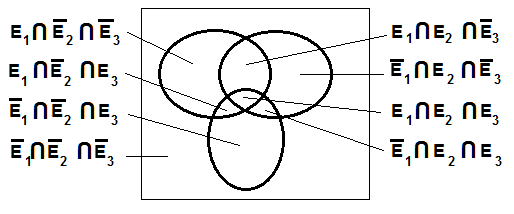 Overlapping circles for inclusion-exclusion. (Image: Sommacal alfonso, CC BY-SA 3.0, via Wikimedia Commons)
Based on the TU BIT syllabus for Discrete Structure (BIT152), unit 4.
Discussion
Loading…