EconomicsUnit 512 min read
Price Elasticity & Demand Analysis: Types, Methods & Market Applications
Unit 5 of Economics explores price elasticity of demand (PED), its measurement methods (proportional, percentage, arc), determinants, and real-world applications in Nepal (eSewa, Daraz) and global markets (Google Ads). Learn how firms use PED to set prices, how governments intervene via taxes/ceilings, and how to calcu
Core Concepts
1. Definition and Importance of Price Elasticity of Demand (PED)
Price elasticity of demand (PED) measures how responsive the quantity demanded is to a change in price. It is calculated as:
Why does it matter?
- Helps businesses set optimal prices (e.g., Daraz discounts vs. premium products).
- Guides government policies (e.g., tax on cigarettes vs. essential medicines).
- Explains market efficiency (e.g., why NTC raises electricity prices cautiously).
2. Types of Price Elasticity of Demand
The value of PED determines whether demand is elastic, inelastic, or unitary elastic.
| Type | PED Value | Graph Shape | Example (Nepal) | Real-World Impact |
|---|---|---|---|---|
| Perfectly Elastic | ∞ | Horizontal line | Gold (if price rises slightly, demand drops to zero) | Even a small price hike makes buyers switch to substitutes. |
| Elastic (E > 1) | > 1 | Flatter slope | Smartphones (e.g., iPhone vs. Samsung) | If price rises, demand falls more than proportionally (e.g., Daraz sales drop sharply after price hike). |
| Unitary Elastic | = 1 | 45° slope | Luxury watches (e.g., Rolex in Kathmandu) | % change in price = % change in quantity (revenue remains constant). |
| Inelastic (E < 1) | < 1 | Steeper slope | Salt, petrol, life-saving drugs | Price rise leads to smaller % drop in demand (e.g., NTC raises electricity tariff by 20%, but usage drops only 5%). |
| Perfectly Inelastic | 0 | Vertical line | Insulin for diabetics | No matter the price, demand stays the same. |
3. Methods to Calculate PED
Three common methods are used in exams:
A. Proportional (Geometric) Method
Worked Example (Nepal Context): Suppose Ncell reduces its prepaid plan price from Rs. 200 to Rs. 150, and demand rises from 10,000 to 15,000 users.
Interpretation:
- PED = -1.4 (elastic demand).
- If Ncell raises the price by 10%, demand will fall by 14%.
- Business implication: Ncell should keep prices low to attract more users.
B. Percentage (Point) Method
Worked Example (Daraz Discounts): Daraz offers a Rs. 500 discount on a product priced at Rs. 2000, increasing sales from 500 to 800 units.
Interpretation:
- Highly elastic (E = 2.4) → Daraz should increase discounts to boost sales.
C. Arc (Mid-Point) Method (Most Accurate)
Worked Example (NTC Electricity Tariff): NTC increases tariff from Rs. 6/kWh to Rs. 8/kWh, reducing consumption from 1000 units to 800 units.
Interpretation:
- Inelastic (E = -0.78) → NTC can increase prices without losing many customers.
4. Determinants of Price Elasticity of Demand
Factors that influence whether demand is elastic or inelastic:
| Factor | Explanation | Nepal Example |
|---|---|---|
| Availability of Substitutes | More substitutes → more elastic demand. | Tea vs. Coffee (if tea price rises, people switch to coffee easily). |
| Necessity vs. Luxury | Necessities (e.g., medicine) → inelastic; luxuries (e.g., iPhone) → elastic. | Insulin (inelastic) vs. Smartphones (elastic). |
| Proportion of Income Spent | If a good takes a large % of income, demand is more elastic. | Petrol (elastic) vs. Salt (inelastic). |
| Time Period | Long-run demand is more elastic (consumers find substitutes). | Electric vehicles (demand becomes elastic as alternatives emerge). |
| Durability of the Good | Durable goods (e.g., cars) have more elastic demand than perishables. | Cars (elastic) vs. Rice (inelastic). |
In the Real World
eSewa & Khalti (Digital Payments)
- Elastic Demand for Mobile Recharge:
If Ncell raises recharge prices by 10%, users may switch to NTC or SmartCell (elastic).
- PED ≈ 1.5 (if price rises, demand drops significantly).
- Inelastic Demand for Essential Payments: If eSewa charges a transaction fee, users still pay bills (inelastic, PED ≈ 0.3).
- Elastic Demand for Mobile Recharge:
If Ncell raises recharge prices by 10%, users may switch to NTC or SmartCell (elastic).
Daraz & Amazon (E-Commerce Pricing)
- Discounts on Electronics: Daraz offers seasonal sales (e.g., -50% on laptops) because demand is highly elastic (PED > 2).
- Essential Groceries: Rice or cooking oil has inelastic demand (PED < 1), so Daraz keeps prices stable.
NTC & NEPSE (Government & Stock Market)
- Electricity Tariff Hikes: NTC increases tariffs by 15%, but consumption drops only 5% (inelastic, PED ≈ 0.3).
- NEPSE Stock Prices: If NMB Bank stock price rises by 20%, demand may drop by 10% (elastic, PED ≈ 0.5).
5. Price Elasticity of Demand in Action: Worked Example (Khalti vs. eSewa)
Suppose Khalti reduces its transaction fee from Rs. 10 to Rs. 5, increasing transactions from 50,000 to 70,000 per day.
Calculate PED using the proportional method:
Interpretation:
- Inelastic (PED = -0.5 < 1) → Even though Khalti reduced fees, the increase in transactions was less than proportional.
- Business Strategy:
- Khalti should focus on marketing (not just fees) to grow users.
- eSewa (competitor) may not lower fees because demand is inelastic.
Government Intervention & Elasticity
Governments use price controls (ceilings, floors) and taxes based on elasticity.
A. Price Ceiling (Maximum Price)
- Effective only if demand is inelastic.
- Example: Nepal government sets a maximum rent control in Kathmandu.
- If demand for housing is inelastic (PED < 1), landlords reduce supply, causing shortages.
- If demand is elastic (PED > 1), people find alternatives (e.g., move to Bhaktapur).
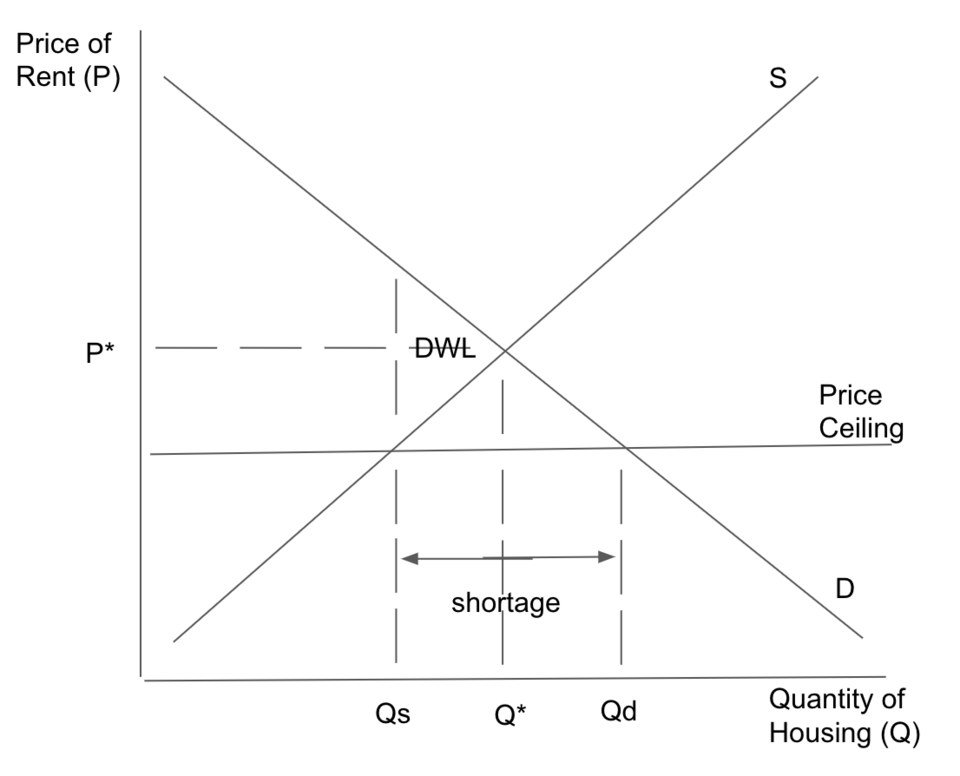 Supply and demand curves with a price ceiling below equilibrium, showing shortage. (Image: Karinnna13, CC BY-SA 4.0, via Wikimedia Commons)
B. Price Floor (Minimum Price)
- Effective only if demand is inelastic.
- Example: Nepal sets a minimum wage for daily laborers.
- If demand for labor is inelastic (PED < 1), unemployment increases (firms hire less).
- If demand is elastic (PED > 1), firms adjust wages naturally.
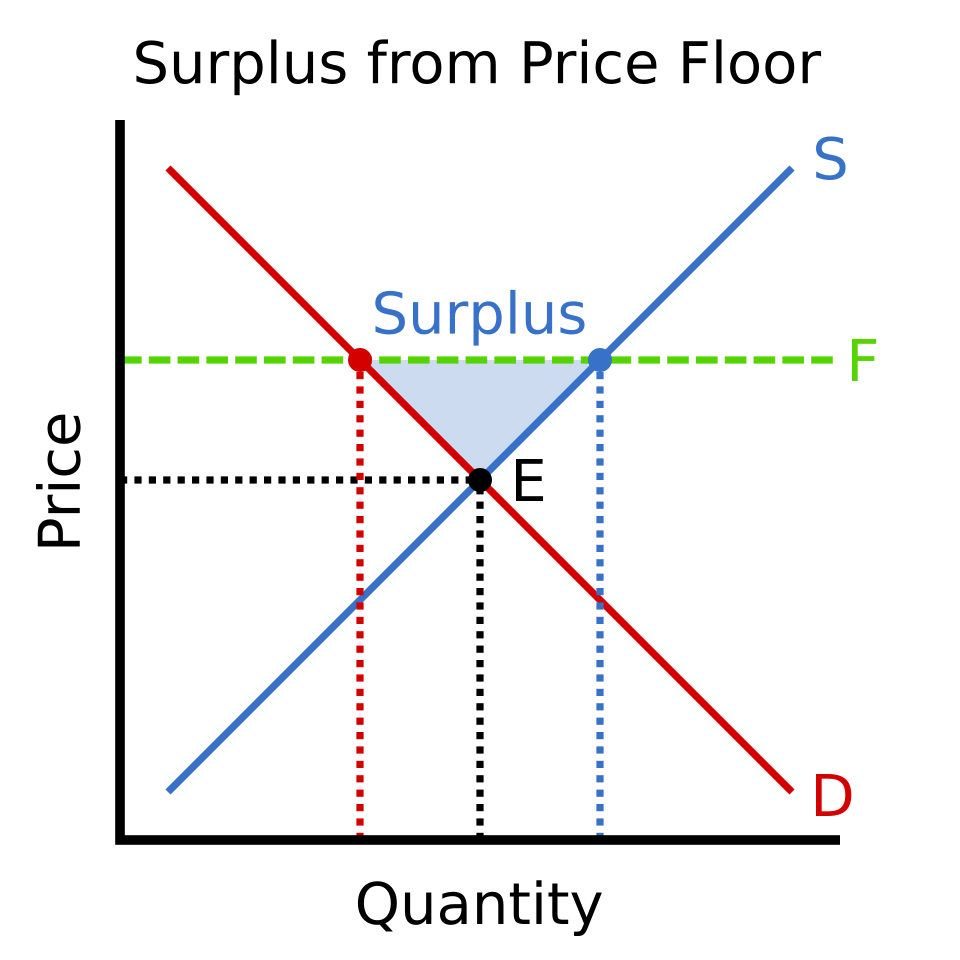 Supply and demand curves with a price floor above equilibrium, showing surplus. (Image: Kbolino (talk), Public domain, via Wikimedia Commons)
C. Taxation & Elasticity
- If demand is elastic (e.g., cigarettes), consumers bear less tax burden.
- If demand is inelastic (e.g., salt), consumers bear most of the tax.
- Example: Nepal government imposes a Rs. 50 tax per pack of cigarettes.
- Cigarettes (elastic, PED ≈ 1.2) → Smokers reduce consumption (tax revenue increases but demand drops).
- Salt (inelastic, PED ≈ 0.1) → Consumers keep buying, government earns more tax revenue.
Exam Tip
What Examiners Look For
✅ Correct Formula Application:
- Always use the arc method unless specified otherwise.
- Sign matters! PED is negative (price ↑ → quantity ↓).
✅ Interpretation:
- Elastic (E > 1): "Firms should lower prices to increase revenue."
- Inelastic (E < 1): "Firms can raise prices without losing many customers."
✅ Real-World Links:
- Nepal examples: Ncell, Daraz, NTC, Khalti, NEPSE.
- Global examples: Google Ads (elastic demand for keywords), Uber (price elasticity of ride demand).
✅ Diagrams:
- Always draw:
- Demand curves for elastic vs. inelastic goods.
- Price ceiling/floor effects (shortage/surplus).
- Tax incidence (who bears the burden).
❌ Common Mistakes to Avoid:
- Forgetting to take absolute value of PED (though sign is important).
- Misapplying percentage vs. proportional method.
- Ignoring units (e.g., % change, not raw numbers).
Quick Revision Table for Exam
| Concept | Formula | Example | Key Takeaway |
|---|---|---|---|
| Proportional PED | Ncell price cut → demand rise | Use when data points are symmetric. | |
| Percentage PED | Daraz discount → sales jump | Simple but can overstate elasticity. | |
| Arc (Mid-Point) PED | NTC tariff hike → consumption drop | Most accurate for non-linear demand. | |
| Elastic Demand | PED > 1 | Luxury cars, smartphones | Revenue changes inversely with price. |
| Inelastic Demand | PED < 1 | Petrol, medicine, salt | Revenue changes directly with price. |
Final Worked Example (Exam-Style Question)
Question: The demand schedule for Khalti transactions is given below:
| Price (Rs.) | 10 | 8 | 6 | 4 | 2 |
|---|---|---|---|---|---|
| Quantity (Units) | 500 | 750 | 1250 | 2000 | 3250 |
Calculate PED when price changes: i) From Rs. 8 to Rs. 6 ii) From Rs. 6 to Rs. 4
Solution:
i) Price Change: Rs. 8 → Rs. 6
Using arc method: Interpretation: Elastic (E = -1.75) → Khalti should lower fees to increase transactions.
ii) Price Change: Rs. 6 → Rs. 4
Interpretation: Elastic but less so (E = -1.15) → Still beneficial to lower prices, but effect is smaller.
Summary of Key Formulas
| Concept | Formula |
|---|---|
| Price Elasticity (Proportional) | |
| Price Elasticity (Percentage) | |
| Price Elasticity (Arc) | |
| Total Revenue (TR) | |
| Revenue Maximization |
Last-Minute Checklist Before Exam
✔ Can you calculate PED using all three methods? ✔ Do you know when to use elastic vs. inelastic examples? ✔ Can you draw and explain price ceiling/floor effects? ✔ Do you remember real-world Nepal examples (Ncell, Daraz, NTC)? ✔ Can you interpret PED values (e.g., E = 0.5 vs. E = 2)?
Good luck! This unit is highly examinable—practice numerical problems daily. 🚀
Based on the TU BIT syllabus for Economics (ECO155), unit 5.
Discussion
Loading…