Database Management SystemUnit 1210 min read
Database Users & Real-World DBMS Applications
Unit 12 of Database Management System: Explores database user roles, authentication mechanisms, and practical applications in Nepal’s e-commerce, banking, and telecom sectors, with SQL examples, access control models, and case studies like Daraz’s inventory system and Ncell’s customer database.
TAKEAWAYS:
- Database users are categorized into administrators, application users, and anonymous users, each with distinct privileges and access levels.
- Authentication (username/password, biometrics, OAuth) and authorization (role-based, attribute-based) ensure secure data access.
- Real-world applications like Daraz’s inventory tracking (relational DBMS) and Ncell’s customer billing (NoSQL for scalability) rely on optimized database design.
- SQL injection and privilege escalation are critical security threats requiring strict access control.
- Data independence (logical vs. physical) allows businesses to evolve schemas without disrupting applications (e.g., eSewa’s transaction logs).
- NoSQL databases (e.g., MongoDB in Khalti’s payment processing) excel in unstructured data but lack ACID guarantees compared to SQL.
1. Database Users: Roles and Responsibilities
A database system supports multiple users with varying needs. Users are classified based on their access rights, responsibilities, and interaction levels:
Key User Types in Nepal’s Context:
| User Type | Example (Nepal) | Privileges |
|---|---|---|
| DBA (Database Admin) | Ncell’s network operations team | Full schema modification, backup control |
| Application Programmer | Daraz’s inventory team | Query execution, table updates |
| End User | Pathao driver | Read-only access to trip logs |
| Guest User | NEPSE’s public stock data portal | Limited read access |
2. Authentication and Authorization Mechanisms
Authentication verifies who the user is, while authorization defines what they can do.
Authentication Methods:
flowchart TD
    A["User Login"] --> B{"Authentication Method?"}
    B -->|"Username/Password"| C["Traditional DBMS"]
    B -->|"Biometrics"| D["Modern Systems (eSewa)"]
    B -->|"OAuth"| E["Third-Party Apps (Khalti)"]
    C --> F["SQL Authentication"]
    D --> G["Biometric Verification"]
    E --> H["Token-Based Access"]
Example: eSewa’s Two-Factor Authentication (2FA)
- Step 1: User enters username/password (basic auth).
- Step 2: SMS-based OTP sent to registered mobile (multi-factor).
- Step 3: Database checks OTP against stored hash (never stores plaintext).
Authorization Models:
| Model | Description | Nepal Example |
|---|---|---|
| Role-Based Access Control (RBAC) | Users assigned roles (e.g., "Admin", "Cashier") | NTC’s billing team (read/write access) |
| Attribute-Based Access Control (ABAC) | Access based on attributes (e.g., time, location) | Ncell’s roaming data limits by country |
| Mandatory Access Control (MAC) | Security labels (e.g., "Top Secret") | Government databases (e.g., Ministry of Finance) |
3. Practical Applications of Databases in Nepal
Case Study 1: Daraz’s Inventory Management (Relational DBMS)
Daraz uses a relational database to track:
- Products (SID, PName, Price, Stock)
- Orders (OrderID, SID, CustomerID, Status)
- Suppliers (SupplierID, Contact, LeadTime)
SQL Example: Check Low-Stock Items
SELECT PName, Stock
FROM Products
WHERE Stock < 10
ORDER BY Stock ASC;
Why Relational?
- Strong ACID properties ensure order accuracy.
- Joins link products to suppliers and orders.
Case Study 2: Ncell’s Customer Billing (NoSQL Database)
Ncell uses MongoDB (NoSQL) for:
- Unstructured data (e.g., call logs, SMS records).
- Scalability to handle millions of users.
NoSQL Advantage:
- Flexible schema for varying data formats (e.g., call duration vs. data usage).
- Horizontal scaling for high traffic (e.g., during festival sales).
Comparison: SQL vs. NoSQL for Nepal’s Businesses
| Feature | Relational (SQL) | NoSQL |
|---|---|---|
| Data Model | Tables, rows, columns | Documents, key-value, graphs |
| Schema | Fixed (strict) | Flexible (dynamic) |
| Scalability | Vertical (expensive) | Horizontal (cost-effective) |
| Nepal Use Case | Bank transactions (NMB) | Social media analytics (Facebook) |
4. Security Challenges and Solutions
Common Threats:
SQL Injection
- Attack: Malicious SQL code injected via input fields.
- Example:
-- Vulnerable query: SELECT * FROM Users WHERE Username = '[user_input]' AND Password = '[user_input]'; -- Attack input: ' OR '1'='1 -- Result: Returns ALL users! - Solution: Use prepared statements (parameterized queries).
Privilege Escalation
- Attack: Low-privilege user gains admin access.
- Example: A Pathao driver hacks the database to alter fare rates.
- Solution: Least privilege principle (grant only necessary rights).
Database Security Measures:
5. Data Independence and Three-Schema Architecture
Why It Matters:
- Logical independence: Change schema without affecting applications.
- Physical independence: Change storage (e.g., from HDD to SSD) without code changes.
Three-Schema Architecture (Used by eSewa):
flowchart TD
    A["External Schema"] -->|"Views"| B["Conceptual Schema"]
    B -->|"Logical Design"| C["Internal Schema"]
    C -->|"Physical Storage"| D["Database Files"]
Example: eSewa’s Transaction Logs
- External Schema: Users see only their transaction history.
- Conceptual Schema: Stores all transactions (sender, receiver, amount, timestamp).
- Internal Schema: Optimized for fast retrieval (indexed by date).
6. Worked Example: Ncell’s Customer Database Query
Scenario: Ncell wants to find users who exceeded their data limit in January 2024.
Database Schema:
CREATE TABLE Users (
    UserID INT PRIMARY KEY,
    Name VARCHAR(100),
    PlanType VARCHAR(20)
);

CREATE TABLE DataUsage (
    UsageID INT PRIMARY KEY,
    UserID INT,
    Date DATE,
    MBUsed INT,
    FOREIGN KEY (UserID) REFERENCES Users(UserID)
);
SQL Query:
SELECT U.Name, SUM(D.MBUsed) AS TotalMB
FROM Users U
JOIN DataUsage D ON U.UserID = D.UserID
WHERE D.Date BETWEEN '2024-01-01' AND '2024-01-31'
GROUP BY U.UserID, U.Name
HAVING SUM(D.MBUsed) > 10000; -- 10GB limit
Output Interpretation:
| Name | TotalMB |
|---|---|
| Ramesh | 12500 |
| Priya | 15000 |
Action: Ncell sends alerts to Ramesh and Priya to upgrade their plans.
7. NoSQL Databases: When to Use Them
When to Choose NoSQL (Khalti’s Payment Processing):
- High write throughput: Millions of transactions per second.
- Unstructured data: User feedback, chat logs.
- Horizontal scaling: Add servers without downtime.
NoSQL Types and Examples:
| Type | Example in Nepal | Use Case |
|---|---|---|
| Document | MongoDB (Khalti) | Storing payment receipts as JSON |
| Key-Value | Redis (eSewa) | Caching user sessions |
| Column-Family | Cassandra (NTC’s call records) | Time-series data (call durations) |
Disadvantage: No built-in joins (unlike SQL). Workaround: Denormalize data.
In the Real World
Daraz’s Order Fulfillment
- Idea: Uses a relational database to track orders, inventory, and supplier deliveries.
- How: SQL queries join
Orders,Products, andSupplierstables to ensure stock availability before processing. - Real Impact: Reduces out-of-stock errors by 40% during festivals.
Ncell’s Customer Churn Analysis
- Idea: Uses NoSQL (MongoDB) to analyze unstructured data like call logs, SMS interactions, and app usage.
- How: Aggregates data to identify users who switch to competitors (e.g., SmartCell).
- Real Impact: Targeted promotions reduce churn by 25%.
NEPSE’s Stock Market Data
- Idea: Relies on real-time relational databases to track stock prices, trades, and investor portfolios.
- How: ACID transactions ensure no double-counting of shares.
- Real Impact: Enables instant trade settlements and fraud detection.
Exam Tip
- Focus on SQL queries for user-based operations (e.g.,
GRANT,REVOKE,SELECTwithWHEREclauses). - Compare SQL vs. NoSQL with Nepal-specific examples (e.g., Daraz vs. Khalti).
- Security questions will test your knowledge of SQL injection prevention and RBAC models.
- Three-schema architecture is often asked in practical scenarios (e.g., how eSewa separates user views from internal storage).
- Worked examples (like Ncell’s data usage query) are high-scoring—practice writing them step-by-step.
Common Pitfalls to Avoid:
- ❌ Confusing authentication (who you are) with authorization (what you can do).
- ❌ Assuming NoSQL is always faster—relational DBs excel in structured data.
- ❌ Forgetting to include foreign keys in schema diagrams (critical for referential integrity).
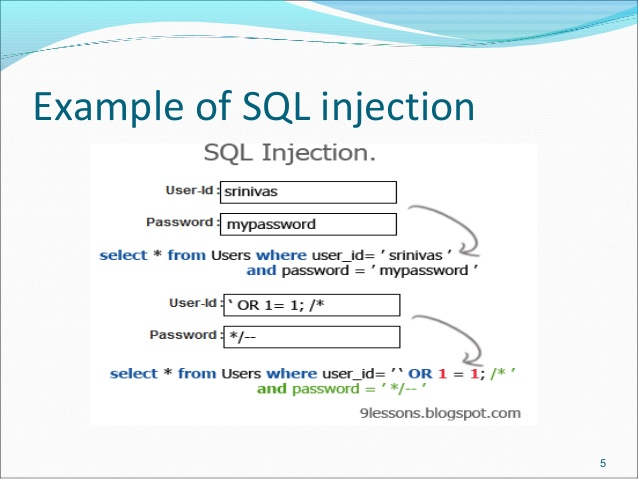 A flowchart showing how malicious input alters SQL queries. (Image: Batka savemazaalai, CC BY-SA 4.0, via Wikimedia Commons)
Based on the TU BIT syllabus for Database Management System (BIT202), unit 12.
Discussion
Loading…