Artificial IntelligenceUnit 315 min read
Knowledge Representation: Logics, Frames, Scripts & State Spaces
Unit 3 of Artificial Intelligence covers how to encode real-world knowledge into machine-readable formats—logical rules, semantic networks, frames, scripts, and state spaces—so AI agents can reason, plan, and act intelligently. This note explains each representation, their structures, trade-offs, and real-world uses in
TAKEAWAYS:
- Knowledge representation is the bridge between raw data and AI reasoning, using structures like predicates, frames, and graphs to model facts and relationships.
- Logical representations (propositional, first-order) enable formal reasoning but struggle with uncertainty and large-scale knowledge.
- Semantic networks and frames organize knowledge hierarchically (e.g.,
Animal → Dog → Labrador) for efficient inheritance and querying. - Scripts model sequences of events (e.g., "restaurant visit") while state spaces represent all possible configurations of a problem (e.g., chessboard positions).
- Constraint satisfaction problems (CSPs) use variables and domains to solve puzzles like scheduling or Sudoku.
- Real-world AI (e.g., eSewa’s transaction rules, Pathao’s route planning) relies on these representations to automate decisions.
Core Concepts: What Is Knowledge Representation?
Knowledge representation (KR) is how we encode information so that an AI agent can:
- Store facts (e.g., "Ram is a student").
- Infer new facts (e.g., "Ram must pay tuition").
- Act based on those facts (e.g., "Send a reminder").
Without KR, AI is just a calculator—KR gives it common sense.
Why Does KR Matter?
- Efficiency: A well-structured knowledge base avoids redundant computations.
- Scalability: Hierarchies (e.g.,
Vehicle → Car → Tesla) let AI reuse information. - Reasoning: Logical rules (e.g., "If X then Y") enable problem-solving.
1. Logical Representations: Rules and Predicates
Logics are the mathematical backbone of AI reasoning. They let us define facts and rules precisely.
A. Propositional Logic
- Atoms: Simple statements like
Raining,TrafficJam. - Connectives:
¬(not),∧(and),∨(or),→(implies). - Example:
Raining → TrafficJammeans "If it rains, there will be a traffic jam."
Worked Example: eSewa Transaction Rules Suppose eSewa’s logic for a successful payment is:
(ConnectedToInternet ∧ ValidUser ∧ SufficientBalance) → PaymentSuccess
If all three atoms are true, the payment goes through.
B. First-Order Logic (FOL)
Extends propositional logic with:
- Predicates:
Likes(X, Y)= "X likes Y". - Quantifiers:
∀(for all),∃(there exists). - Example:
∀x (Student(x) → PaysTuition(x))= "All students pay tuition."
Worked Example: NEPSE Stock Rules NEPSE’s trading system might use FOL to enforce:
∀s (Listed(s) ∧ HighVolume(s) → AlertTrader(s))
= "Alert traders if a listed stock has high volume."
C. Resolution: How AI "Proves" Things
Resolution is a method to derive new facts from a knowledge base. Steps:
- Convert all statements to clauses (disjunctions of literals).
AvaLikes(Fruit)→AvaLikes(X) ∨ ¬Fruit(X)
- Apply modus ponens: If
P → QandPare true, thenQis true. - Repeat until the goal is found or all possibilities are exhausted.
Worked Example: Proving "Ava Likes Watermelon" Knowledge Base:
AvaLikes(X) ∨ ¬Fruit(X)(Ava likes all fruits)Fruit(Apple) ∧ Fruit(Watermelon)(Apple and watermelon are fruits)AvaEats(X) → AvaLikes(X)(If Ava eats X, she likes X)
Goal: Prove AvaLikes(Watermelon)
Resolution Steps:
- From KB2:
Fruit(Watermelon)is true. - Substitute into KB1:
AvaLikes(Watermelon) ∨ ¬Fruit(Watermelon)→AvaLikes(Watermelon) ∨ False→AvaLikes(Watermelon). Conclusion: Ava likes watermelon!
2. Semantic Networks: Nodes and Arcs
Semantic networks represent knowledge as nodes (concepts) connected by arcs (relationships). Example:
Doctor ---(is-a)---> Person
Doctor ---(treats)---> Patient
Types of Arcs:
| Arc Type | Example | Meaning |
|---|---|---|
is-a |
Dog is-a Animal |
Hierarchical classification |
part-of |
Wheel part-of Car |
Composition |
has-a |
Car has-a Engine |
Attributes |
used-for |
Screwdriver used-for Fixing |
Purpose |
Worked Example: Pathao’s Route Planning Pathao’s AI uses semantic networks to model:
Kathmandu ---(connected-by)---> Road1 ---(has-speed-limit)---> 60km/h
Road1 ---(leads-to)---> Destination
This helps it avoid congested roads by querying relationships.
3. Frames: Slots and Defaults
Frames are templates for objects with:
- Slots: Attributes (e.g.,
color,size). - Default values: Assumed if not specified.
- Facets: Constraints (e.g.,
color ∈ {red, green, blue}).
Example: A Car Frame
classDiagram
    class Car {
        +make: string
        +model: string
        +color: string [default: "red"]
        +topSpeed: number [range: 0-300]
        +isElectric: boolean [default: false]
    }
Worked Example: Daraz’s Product Catalog Daraz uses frames to store product details:
Frame: Laptop
  Slots:
    - brand: "Dell"
    - ram: 16GB [default: 8GB]
    - price: 89999 [currency: NPR]
    - inStock: true
Inheritance in Frames
Frames can inherit slots from parent frames. Example:
Frame: Vehicle
  Slots: wheels: 4, color: "black"

Frame: Car extends Vehicle
  Slots: topSpeed: 200
Here, Car inherits wheels and color from Vehicle.
4. Scripts: Sequences of Events
Scripts represent stereotypical sequences of actions (e.g., "going to a restaurant"). Structure:
- Props: Objects involved (e.g.,
menu,bill). - Roles: Participants (e.g.,
customer,waiter). - Scenes: Ordered steps.
- Enter: Customer walks in.
- Order: Customer gives menu to waiter.
- Serve: Waiter brings food.
- Pay: Customer pays bill.
Worked Example: eSewa Transaction Script
Script: OnlinePayment
  Props: phone, internet, bankAccount
  Roles: user, eSewaServer, bank
  Scenes:
    1. User opens eSewa app.
    2. User enters amount and selects bank.
    3. eSewaServer requests bank for verification.
    4. Bank approves/declines transaction.
    5. User receives confirmation.
5. State Spaces: All Possible Worlds
A state space represents all possible configurations of a problem, with states (configurations) and operators (actions that change states). Example: Chess has ~10⁴³ possible states!
Components:
- Initial State: Starting configuration.
- Goal State: Desired configuration.
- Operators: Legal moves (e.g., in chess:
movePawn,castle).
Worked Example: Kathmandu Traffic Routes Imagine modeling traffic as a state space:
- States: Positions of all vehicles on a road.
- Operators:
moveCar,changeLane,stopAtSignal. - Goal: Minimize travel time from A to B.
6. Constraint Satisfaction Problems (CSPs)
CSPs solve problems by assigning values to variables under constraints. Example: Scheduling exams so no student has overlapping classes.
Components:
| Term | Example |
|---|---|
| Variables | Exam1_time, Exam2_time |
| Domains | Exam1_time ∈ {9AM, 1PM, 3PM} |
| Constraints | Exam1_time ≠ Exam2_time |
Worked Example: NTC’s Internet Slot Allocation NTC must assign internet slots to users without overloading servers.
- Variables:
User1_slot,User2_slot, ... - Domains:
Morning,Afternoon,Evening - Constraints:
User1_slot ≠ User2_slot(no overlap)Total_users_in_slot ≤ ServerCapacity
7. Issues in Knowledge Representation
No representation is perfect. Common challenges:
| Issue | Description | Example |
|---|---|---|
| Incompleteness | Missing facts (e.g., "Does a penguin fly?"). | AI might assume Bird(X) → CanFly(X). |
| Ambiguity | Same phrase means different things. | "Bank" = river side or financial institution. |
| Inconsistency | Contradictory facts (e.g., Height(X) = 5ft ∧ Height(X) = 6ft). |
Database errors. |
| Scalability | Performance degrades with large knowledge bases. | Google’s search index. |
| Representation Gap | Cannot express all real-world knowledge (e.g., "common sense"). | "If it’s raining, take an umbrella." |
In the Real World
AI systems in Nepal and globally rely on these representations daily:
eSewa’s Transaction Logic
- What it uses: Propositional logic for rules like
(Connected ∧ ValidUser ∧ SufficientBalance) → Success. - How: Encodes every step of a payment as a logical clause to ensure fraud detection and smooth processing.
- What it uses: Propositional logic for rules like
Pathao’s Route Planning
- What it uses: Semantic networks for roads, constraints for traffic, and state spaces for possible paths.
- How: Models Kathmandu’s roads as nodes, traffic rules as arcs, and dynamically updates routes based on real-time data.
NEPSE’s Trading System
- What it uses: First-order logic for stock rules (e.g.,
∀s (HighVolume(s) → AlertTrader(s))) and CSPs for order matching. - How: Ensures no two buyers/sellers get the same stock at conflicting prices.
- What it uses: First-order logic for stock rules (e.g.,
Khalti’s Fraud Detection
- What it uses: Frames for user profiles (e.g.,
User {name, transactionHistory, riskScore}) and scripts for transaction flows. - How: Flags unusual patterns (e.g., sudden large transactions) by comparing against default user behaviors.
- What it uses: Frames for user profiles (e.g.,
NTC’s Network Management
- What it uses: CSPs to allocate bandwidth and state spaces to model network states.
- How: Prevents overload by assigning slots dynamically, like a traffic cop for data packets.
Visualizing Knowledge Representation
1. Game Tree: Minimax Algorithm (Chess)
flowchart TD
    A["Root: White to move"] --> B["Move 1: e4"]
    B --> C["Black responds: e5"]
    C --> D["White: Nf3"]
    D --> E["Black: Nc6"]
    D --> F["Black: Bc5"]
    E --> G["Game continues..."]
    F --> H["Game continues..."]
Explored Path: White plays e4, Black responds e5, and White moves Nf3. The tree grows as the game progresses.
2. Neural Network Layers (Simplified)
Real Picture:
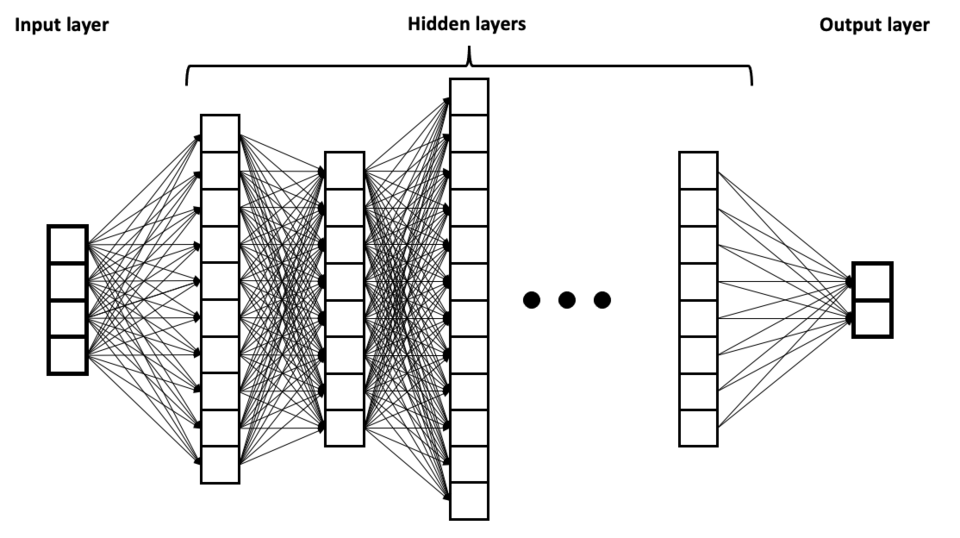 A labelled diagram showing input neurons, hidden layers with weights, and output neurons. (Image: BrunelloN, CC BY-SA 4.0, via Wikimedia Commons)
3. Decision Tree for Loan Approval (Bank)
Worked Example: Nabil Bank Loan
- Input: Income = 60k, Credit Score = 650.
- Path:
Income > 50k?→ Yes.Credit Score > 700?→ No.Check Collateral?→ If Yes, loan approved; else denied.
4. State Space: 8-Puzzle (Sliding Tiles)
Real Picture:
Comparison Table: Knowledge Representations
| Representation | Strengths | Weaknesses | Best For |
|---|---|---|---|
| Propositional Logic | Simple, efficient for small problems | No variables, poor scalability | Rule-based systems (eSewa) |
| First-Order Logic | Expresses relationships, quantifiers | Computationally expensive | Databases, NEPSE rules |
| Semantic Networks | Intuitive, hierarchical | No formal reasoning | Pathao’s route graphs |
| Frames | Inheritance, default values | Rigid structure | Daraz’s product catalog |
| Scripts | Models sequences well | Inflexible for variations | eSewa’s transaction flows |
| State Spaces | Exhaustive search | Explosion of states (e.g., chess) | Game AI, traffic simulation |
| CSPs | Solves complex constraints | Hard to define constraints | NTC’s slot allocation |
Exam Tip: How to Score Full Marks
Define Clearly: Always start with precise definitions. For example:
"A frame is a data structure that represents stereotypical objects with slots (attributes) and facets (constraints), enabling inheritance and default values."
Use Diagrams: Draw one diagram per question if asked to represent knowledge. For example:
- For scripts, show scenes as arrows.
- For semantic networks, label nodes and arcs.
- For state spaces, mark initial, goal, and explored states.
Show Step-by-Step Reasoning: For resolution or CSPs, write each inference or assignment explicitly. Examiners reward clarity.
Relate to Real World: Mention one Nepalese example (e.g., eSewa, Pathao) per concept. For instance:
"Like Pathao’s route planner, semantic networks help AI navigate relationships between roads and traffic rules."
Highlight Trade-offs: Compare representations by listing advantages and disadvantages in a table (as shown above).
Practice Past Questions:
- For script representation, expect questions like "Represent ‘buying groceries’ as a script."
- For resolution, expect proofs like "Show that ‘Ava likes watermelon’ using the given KB."
- For CSPs, expect problems like "Schedule exams for 3 classes with no overlaps."
Common Pitfalls to Avoid
- Overcomplicating Logics: Stick to propositional or first-order logic unless the question specifies otherwise.
- Ignoring Constraints in CSPs: Always list variables, domains, and constraints explicitly.
- Assuming Inheritance: In frames, not all slots are inherited—only those not overridden.
- Missing the Goal State: In state spaces, always identify the goal before searching.
Summary Checklist
Before the exam, ensure you can: ✅ Define logical representations, semantic networks, frames, scripts, and state spaces. ✅ Draw a semantic network for a given scenario (e.g., "family relationships"). ✅ Write a frame for an object (e.g., "Laptop") with slots and defaults. ✅ Represent a script (e.g., "restaurant visit") with props, roles, and scenes. ✅ Solve a resolution problem step-by-step. ✅ Model a CSP (e.g., "schedule 3 exams") with variables, domains, and constraints. ✅ Explain one real-world application (e.g., Pathao uses semantic networks).
Based on the TU BIT syllabus for Artificial Intelligence (BIT252), unit 3.
Discussion
Loading…