Systems Analysis and DesignUnit 29 min read
Systems Planning: Feasibility, Scope, Alternatives & Project Management
Unit 2 of Systems Analysis and Design covers the critical planning phase where IT projects are evaluated for feasibility, scope is defined, alternative solutions are compared, and project management frameworks (like Agile and Waterfall) are selected to ensure successful system development.
TAKEAWAYS:
- Feasibility studies assess whether a project is technically, economically, and operationally viable using four key criteria: technical, economic, operational, and legal.
- Scope definition clarifies project boundaries, deliverables, and constraints through tools like context diagrams and use case diagrams to avoid scope creep.
- Alternative solutions (e.g., custom-built vs. off-the-shelf software) are evaluated using cost-benefit analysis and SWOT matrices to select the best fit.
- Project management methodologies (Waterfall, Agile, Spiral) determine how tasks, timelines, and resources are structured—each suits different project needs.
- Risk management identifies potential threats (e.g., budget overruns, vendor delays) and mitigation strategies early in planning.
- Stakeholder analysis ensures alignment between project goals and user/business needs via tools like RACI matrices or stakeholder maps.
1. Why Planning Matters: The Foundation of Success
Planning is the bridge between business needs and technical execution. Without it, projects fail due to:
- Unclear goals (e.g., a bank’s digital loan system without defined user roles).
- Budget overruns (e.g., NTC’s fiber-optic expansion costing 3x estimates).
- Misaligned stakeholders (e.g., Daraz’s app updates ignored by rural sellers).
2. Feasibility Studies: Can We Build This?
Feasibility studies answer: "Is this project worth pursuing?" They evaluate four dimensions:
| Feasibility Type | Key Questions | Example in Nepal |
|---|---|---|
| Technical | Do we have the tech skills/tools? | Can Ncell develop a 5G network with its current infrastructure? |
| Economic | Will costs justify benefits? | Is Khalti’s QR-based payment system cheaper than traditional banking for merchants? |
| Operational | Will users accept it? | Will Pathao drivers adopt an AI route-optimization tool without training? |
| Legal | Does it comply with laws? | Does eSewa’s data storage meet Nepal’s Electronic Transactions Act (2008)? |
Worked Example: Feasibility of a Hospital Management System (HMS) for a Private Clinic
- Technical: Clinic lacks IT staff → Outsource to a vendor (e.g., Sofware Nepal).
- Economic: Costs ₹500K vs. savings of ₹800K/year in manual errors → Feasible.
- Operational: Doctors resist digital records → Pilot with 1 department first.
- Legal: Must comply with Health Information Privacy Act → Encrypt patient data.
3. Defining Scope: What’s In, What’s Out?
Scope defines what the system will (and won’t) do. Poor scope leads to:
- Scope creep (e.g., NEPSE’s trading app adding crypto support mid-project).
- Delays (e.g., Kathmandu Metro’s budget ballooning due to undefined routes).
Tools to Define Scope
Context Diagram (DFD Level 0) Shows the system as a single process interacting with external entities.
flowchart TD
  A["Patient"] -->|"Registers"| B["Hospital Management System"]
  B -->|"Generates Bill"| C["Accounting System"]
  B -->|"Sends Alerts"| D["Doctor App"]
  B -->|"Stores Data"| E["Database"]
Caption: Context diagram for a hospital’s HMS.Use Case Diagram Maps user interactions (e.g., Pathao rider vs. customer workflows).
Scope Statement Template Project Name: NTC’s Smart Meter Rollout Deliverables: 50,000 meters installed by 2025, mobile app for readings. Exclusions: Customer billing software (handled by a third party). Constraints: Budget = ₹2B, must integrate with existing grid.
4. Evaluating Alternatives: Build vs. Buy vs. Hybrid
Not all solutions require custom development. Compare options using:
| Alternative | Pros | Cons | Example in Nepal |
|---|---|---|---|
| Custom-Built | Tailored to needs | High cost, long development time | Ncell’s in-house app development |
| Off-the-Shelf | Fast deployment, lower cost | May lack features (e.g., Zoho CRM for a bank) | Khalti using Stripe’s payment API |
| Hybrid | Balances cost and customization | Integration challenges | Daraz using Shopify + custom plugins |
Worked Example: Choosing a Payment Gateway for a Nepalese Startup
- Option 1: Custom-built (₹500K, 12 months).
- Option 2: Khalti API (₹50K/year, 1 month setup).
- Decision: Hybrid—use Khalti for payments + custom dashboard.
5. Project Management Methodologies
The methodology dictates how work is structured. Choose based on:
- Project size (small vs. large).
- Uncertainty (high vs. low).
- Stakeholder needs (flexibility vs. control).
| Methodology | When to Use | Phases | Example in Nepal |
|---|---|---|---|
| Waterfall | Well-defined requirements, low risk | Requirements → Design → Implementation → Testing → Maintenance | NTC’s fiber-optic network expansion |
| Agile | Changing requirements, iterative work | Sprints (2–4 weeks) with feedback loops | Pathao’s app updates |
| Spiral | High-risk, complex projects | Prototyping + risk analysis in cycles | Nepal Rastra Bank’s core banking system |
Visual Comparison: Waterfall vs. Agile
flowchart LR
    subgraph Waterfall
        A["Requirements"] --> B["Design"] --> C["Implementation"] --> D["Testing"] --> E["Maintenance"]
    end
    subgraph Agile
        F["Sprint 1"] --> G["Review"] --> H["Sprint 2"] --> I["Review"] --> J["Sprint 3"]
    end
Caption: Linear (Waterfall) vs. iterative (Agile) development.6. Risk Management: Anticipating the Unexpected
Risks in IT projects include:
- Technical: System crashes (e.g., Nepal’s power outages during e-voting).
- Financial: Budget overruns (e.g., Kathmandu Metro’s cost escalation).
- Operational: User resistance (e.g., elderly avoiding digital banking).
Risk Management Steps:
- Identify: List risks (e.g., "Vendor delay in delivering servers").
- Analyze: Assess impact/probability (use a risk matrix).
- Mitigate: Plan responses (e.g., "Have backup vendors").
- Monitor: Track risks (e.g., weekly status reports).
7. Stakeholder Analysis: Keeping Everyone Happy
Stakeholders include:
- Users (e.g., Daraz customers).
- Developers (e.g., Sofware Nepal’s team).
- Investors (e.g., Nepal Investment Bank).
Tools:
- RACI Matrix: Assigns Responsible, Accountable, Consulted, Informed roles.
| Stakeholder | Requirements | Design | Testing | | Developer Team | Consulted | Accountable | Responsible | | Business Owner | Accountable | Consulted | Informed | | End Users | Informed | Informed | Consulted |
- Stakeholder Map:
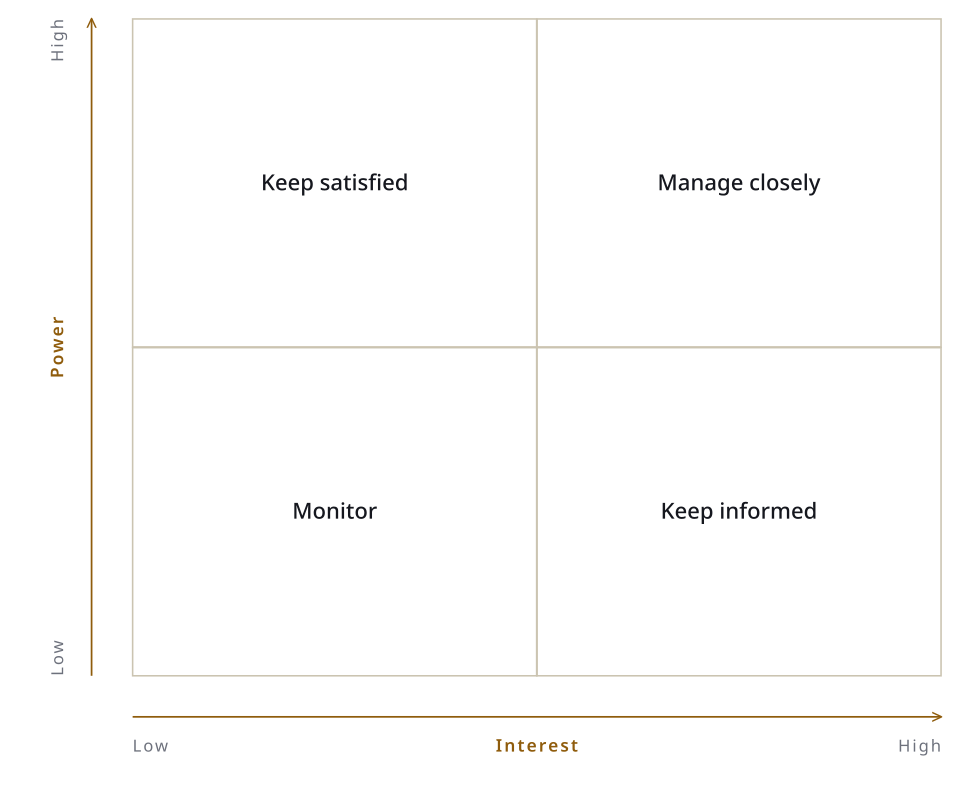 A quadrant chart categorizing stakeholders by power vs. interest (e.g., Ncell’s board = high power/high interest). (Image: Peter Gladdish, CC BY 4.0, via Wikimedia Commons)
In the Real World
Khalti’s Payment Gateway
- Feasibility: Economic (low transaction fees) and technical (integrated with banks).
- Scope: Initially for online payments, later expanded to retail QR codes.
- Risk: Fraud → Mitigated by two-factor authentication (OTP + fingerprint).
Pathao’s Driver App
- Alternative: Built custom (not off-the-shelf) to handle Nepal’s traffic and terrain.
- Agile Methodology: Weekly updates based on driver feedback (e.g., adding toll booth alerts).
NTC’s Smart Meter Project
- Feasibility Study: Technical challenge (rural connectivity) → Pilot in Kathmandu first.
- Stakeholders: NTC engineers, customers, government regulators.
- Risk: Data privacy → Encrypted meters and GDPR-compliant storage.
Exam Tip
- Feasibility: Always evaluate all four types (technical, economic, operational, legal). Partial answers lose marks.
- Scope: Draw a context diagram or use case diagram in exams—it’s worth 5–10 marks.
- Alternatives: Compare at least two options (e.g., custom vs. off-the-shelf) with pros/cons.
- Methodologies: Know when to use Waterfall (stable projects) vs. Agile (dynamic needs). Mention iterative development for Agile.
- Risk Management: Use a risk matrix or mitigation table—examiners love structured answers.
- Stakeholders: A RACI matrix or stakeholder map can earn easy marks if labeled correctly.
Common Pitfalls:
- Ignoring legal feasibility (e.g., forgetting data privacy laws).
- Vague scope (e.g., "build a website" → specify features like user login, payment gateway).
- Choosing a methodology without justification (e.g., "We’ll use Agile" → explain why).
Final Checklist Before Submission: ✅ Did I cover all four feasibility types? ✅ Did I compare at least two alternatives? ✅ Did I draw a diagram (context diagram, use case, or risk matrix)? ✅ Did I link to a real-world example (e.g., Khalti, Pathao, NTC)?
Based on the TU BIT syllabus for Systems Analysis and Design (BIT253), unit 2.
Discussion
Loading…