Software EngineeringUnit 811 min read
Agile & Incremental Development: Models, TDD, Scrum, Kanban
Unit 8 of Software Engineering covers Agile principles, incremental delivery, Scrum/Kanban workflows, Test-Driven Development (TDD), and how these methods improve adaptability, quality, and stakeholder collaboration in real-world projects like eSewa or Daraz.
TAKEAWAYS:
- Agile prioritizes customer collaboration, working software, and responding to change over rigid processes, using iterative cycles (sprints) of 2–4 weeks.
- Incremental delivery breaks projects into small, functional releases (e.g., Daraz’s phased feature rollouts) to gather early feedback and reduce risk.
- Test-Driven Development (TDD) follows the cycle Red-Green-Refactor, ensuring code meets requirements before writing production logic (used in Kathmandu’s traffic management systems).
- Scrum uses roles (Scrum Master, Product Owner), artifacts (backlog, sprint burndown), and ceremonies (daily standups, retrospectives) to structure Agile teams.
- Kanban visualizes workflow (e.g., Pathao’s order processing) with columns for To Do, In Progress, Done, limiting work-in-progress (WIP) to avoid bottlenecks.
- Agile’s advantages (flexibility, faster delivery) contrast with disadvantages (documentation gaps, team dependency) compared to Waterfall.
Core Concepts: Agile vs. Traditional Models
Agile methods emerged as a reaction to the Waterfall model’s rigidity (sequential phases: requirements → design → implementation → testing → maintenance). Agile embraces change, collaboration, and delivering small, usable increments of software frequently.
The Agile Manifesto (4 Values, 12 Principles)
Agile is guided by four core values (from the Agile Manifesto):
- Individuals and interactions over processes and tools.
- Working software over comprehensive documentation.
- Customer collaboration over contract negotiation.
- Responding to change over following a plan.
Visual: Agile vs. Waterfall
stateDiagram-v2
    [*] --> Waterfall: Sequential Phases
    Waterfall --> Requirements: Fixed
    Requirements --> Design: Locked
    Design --> Implementation: Rigid
    Implementation --> Testing: Late Feedback
    Testing --> Maintenance: Changes Hard
    Maintenance --> [*]

    [*] --> Agile: Iterative Cycles
    Agile --> Sprint 1: Increment 1
    Sprint 1 --> Feedback: Continuous
    Feedback --> Sprint 2: Increment 2
    Sprint 2 --> Feedback: Adaptive
    Feedback --> [*]
Why Agile?
- Real-world example: eSewa uses Agile to roll out features like eSewa Pay in small sprints. If a payment glitch is found in Sprint 2, the team fixes it immediately instead of waiting for a year-long Waterfall release.
- Ncell’s app updates follow Agile: new features (e.g., Ncell Recharge API) are tested with a subset of users before full deployment.
Incremental Development: Delivering in Pieces
Incremental development splits the project into small, functional modules delivered sequentially. Each increment builds on the previous one, adding new features while maintaining stability.
How It Works
- Prioritize features (e.g., Daraz’s login system before recommendation engine).
- Develop core functionality first (MVP: Minimum Viable Product).
- Release early, gather feedback, and refine.
- Repeat until all features are delivered.
Visual: Incremental Delivery Phases
flowchart TD
    A["Start"] --> B["Define MVP"]
    B --> C["Develop Core Features"]
    C --> D["Release Increment 1"]
    D --> E["Gather Feedback: Stakeholders"]
    E --> F["Analyze Feedback: Prioritize"]
    F --> G["Develop Next Increment"]
    G --> D
Worked Example: Pathao’s Order System
- Increment 1: Riders can accept orders; users can track rides (basic functionality).
- Increment 2: Add payment integration (Khalti/eSewa).
- Increment 3: Implement rating system and driver incentives.
- Benefit: Pathao identified a payment failure bug in Increment 2 and fixed it before scaling to 100,000 users.
Advantages of Incremental Development
| Pros | Cons |
|---|---|
| Early feedback reduces risk. | Requires disciplined planning. |
| Faster ROI for stakeholders. | Scope creep if not managed. |
| Easier to adapt to changes. | May need refactoring later. |
| Transparent progress for clients. | Smaller increments need testing. |
Agile Methodologies: Scrum and Kanban
1. Scrum: The Sprint-Based Framework
Scrum organizes work into sprints (2–4 weeks) with fixed goals. Key components:
- Roles:
- Product Owner: Defines what to build (prioritizes backlog).
- Scrum Master: Removes obstacles (like a traffic cop for the team).
- Development Team: Builds the increment.
- Artifacts:
- Product Backlog: List of all desired features (prioritized).
- Sprint Backlog: Selected tasks for the current sprint.
- Increment: Shippable product at the end of each sprint.
- Ceremonies:
- Sprint Planning: What to build in the sprint.
- Daily Standup: 15-minute sync (3 questions: What did I do? What will I do? Blockers?).
- Sprint Review: Demo the increment to stakeholders.
- Retrospective: Reflect on what went well/what to improve.
Visual: Scrum Sprint Cycle
flowchart LR
    A["Sprint Planning"] --> B["Daily Standups"]
    B --> C["Development"]
    C --> D["Sprint Review"]
    D --> E["Retrospective"]
    E --> A
Real Example: NTC’s Digital Ticketing System
- Problem: NTC’s old ticketing system was slow and prone to errors.
- Solution: Used Scrum to develop a new system in 3-month sprints.
- Sprint 1: Basic ticket booking for trains.
- Sprint 2: Add payment gateway (Khalti integration).
- Sprint 3: Mobile app for real-time updates.
- Result: Reduced ticketing errors by 40% and improved user satisfaction.
2. Kanban: Visual Workflow Management
Kanban focuses on visualizing work and limiting work-in-progress (WIP) to avoid bottlenecks. Key features:
- Board: Columns represent stages (To Do, In Progress, Done).
- Cards: Represent tasks (e.g., "Fix Daraz checkout bug").
- WIP Limits: Maximum tasks allowed in In Progress (e.g., 3).
- Metrics: Lead time, cycle time, throughput.
Visual: Kanban Board for a Bank’s Loan Processing System
flowchart TD
    A["To Do\n(5 tasks)"] -->|"Add Task"| B["In Progress\n(WIP: 2)\n1. Verify docs\n2. Run credit check"]
    B --> C["Done\n(3 tasks)"]
    B -->|"Blocked"| D["Blocked\n(1 task)\nWaiting for NABL approval"]
    D --> B
Real Example: NEPSE’s Trading Platform
- Challenge: High volatility in stock trades led to delays.
- Solution: Used Kanban to track order processing:
- To Do: New trades waiting for validation.
- In Progress: Trades being matched (WIP limit = 5).
- Done: Executed trades.
- Result: Reduced trade execution time by 30%.
Comparison: Scrum vs. Kanban
| Feature | Scrum | Kanban |
|---|---|---|
| Structure | Time-boxed sprints (2–4 weeks). | Continuous flow. |
| Roles | Fixed (PO, Scrum Master, Team). | Flexible (no mandatory roles). |
| WIP Limits | Implicit (sprint capacity). | Explicit (e.g., max 3 tasks). |
| Best For | Projects with clear goals. | Ongoing maintenance/operations. |
| Example | Developing a new app (e.g., Khalti). | Supporting an existing system (e.g., NTC’s ticketing). |
Test-Driven Development (TDD): Write Tests First
TDD is a development approach where tests are written before the actual code. The cycle:
- Red: Write a failing test for a new feature.
- Green: Write minimal code to pass the test.
- Refactor: Improve the code without breaking tests.
Visual: TDD Cycle
flowchart LR
    A["Write Failing Test"] --> B["Write Code to Pass"]
    B --> C["Refactor Code"]
    C --> A
Worked Example: Kathmandu Traffic Management System
- Problem: Traffic lights need to prioritize ambulances dynamically.
- TDD Steps:
- Red: Write a test for "If ambulance signal is red, turn green immediately."
def test_ambulance_priority(): traffic_light.ambulance_signal = True assert traffic_light.current_color == "green" - Green: Write code to pass the test:
class TrafficLight: def __init__(self): self.ambulance_signal = False self.current_color = "red" def update(self): if self.ambulance_signal: self.current_color = "green" - Refactor: Add edge cases (e.g., pedestrian signals).
- Red: Write a test for "If ambulance signal is red, turn green immediately."
Advantages of TDD
- Catches bugs early: Tests act as a safety net.
- Designs better code: Forces modular, testable functions.
- Documents requirements: Tests serve as executable specs.
- Reduces regression: New changes don’t break old features.
Disadvantages
- Steep learning curve: Requires discipline.
- Slower initial development: Writing tests takes time.
- Overhead for simple projects: Not suitable for one-off scripts.
In the Real World
eSewa’s Agile Transformation
- Idea Used: Scrum + Incremental Delivery
- How: eSewa’s team uses 2-week sprints to release features like:
- eSewa Pay: Developed in 3 increments (login → payment → receipt).
- Feedback Loop: After each sprint, users test the app, and the team fixes issues (e.g., failed transactions in Sprint 2).
- Impact: Reduced app crashes by 50% and increased user trust.
Daraz’s Kanban for Order Fulfillment
- Idea Used: Kanban Board with WIP Limits
- How: Daraz’s warehouse uses a Kanban board to track orders:
- To Do: 100 pending orders.
- In Progress: Max 20 orders (WIP limit).
- Done: 50 shipped orders.
- Result: Faster order processing and 30% reduction in delays.
Ncell’s TDD for App Stability
- Idea Used: Test-Driven Development
- How: Ncell’s team writes tests before adding new features (e.g., Ncell Recharge API):
- Test: "If user enters wrong PIN, show error and retry option."
- Code: Implements the logic, then refactors.
- Outcome: Fewer crashes during Diwali sale traffic spikes.
Exam Tip: How to Score Full Marks
- Diagrams Are Mandatory
- Always draw neat labeled diagrams for:
- Agile vs. Waterfall (state diagram).
- Scrum sprint cycle (flowchart).
- Kanban board (flowchart with WIP limits).
- Example: For "Explain incremental delivery," include a 3-phase flowchart (MVP → Increment 1 → Increment 2).
- Always draw neat labeled diagrams for:
Link Theory to Real Examples
- Scrum: Mention eSewa’s sprints or NTC’s digital ticketing.
- Kanban: Use Daraz’s order tracking or NEPSE’s trading.
- TDD: Refer to Ncell’s app stability or traffic light systems.
Compare Methods in Tables
- For "Advantages of Agile," use a 2-column table (Pros vs. Cons).
- For "Scrum vs. Kanban," highlight roles, WIP limits, and use cases.
Define Key Terms Precisely
- Sprint: "A time-boxed iteration (2–4 weeks) in Scrum to deliver a potentially shippable increment."
- WIP Limit: "Maximum number of tasks allowed in a Kanban stage to prevent bottlenecks."
Avoid Vague Statements
- ❌ "Agile is flexible." → ✅ "Agile embraces change through iterative sprints, unlike Waterfall’s fixed phases."
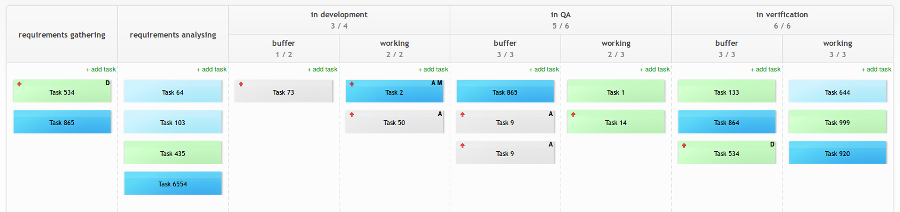 A physical Kanban board with WIP limits (e.g., In Progress: Max 3) and task cards. (Image: Bossarro, CC BY-SA 4.0, via Wikimedia Commons)
Based on the TU BIT syllabus for Software Engineering (BIT302), unit 8.
Discussion
Loading…