Technical WritingUnit 214 min read
Collaborative Writing & Team Dynamics
Unit 2 of Technical Writing: Explores how teams write effectively, the tools and roles in collaborative writing, common challenges, and how to manage teamwork for clarity, efficiency, and professionalism in technical documents.
TAKEAWAYS:
- Collaborative writing relies on shared responsibility, clear roles, and structured tools (e.g., version control, cloud platforms) to produce high-quality technical documents.
- Team dynamics depend on communication, conflict resolution, and trust, which directly impact the writing process and final output.
- Tools like Google Docs, Trello, or Confluence streamline collaboration but require discipline to avoid version conflicts or miscommunication.
- Real-world examples (e.g., eSewa’s API documentation, Daraz’s logistics manuals) show how teams use collaborative writing to scale complex projects.
- Ethical collaboration means giving credit, avoiding plagiarism, and respecting intellectual property in shared work.
- Revision in teams requires structured feedback loops (e.g., peer reviews, stakeholder input) to refine technical accuracy and clarity.
Collaborative Writing: Definition and Core Principles
Collaborative writing is the joint creation of a document or technical content by multiple authors, often from different backgrounds or departments. Unlike solo writing, it requires structured processes to ensure coherence, accuracy, and professionalism. Key principles include:
- Shared ownership: All contributors share responsibility for the final product.
- Clear communication: Regular updates, feedback, and documentation of changes.
- Role clarity: Defined roles (e.g., lead writer, editor, subject-matter expert) to avoid overlap or gaps.
- Version control: Tracking changes to prevent conflicts or loss of work.
How it works: Collaborative writing follows a modified writing process adapted for teams:
- Planning: Define scope, audience, and goals (e.g., a team at NTC writing a network troubleshooting guide).
- Drafting: Parallel writing by specialists (e.g., engineers for technical sections, writers for clarity).
- Feedback: Structured reviews (e.g., peer reviews, stakeholder input).
- Revision: Incorporating feedback iteratively.
- Finalization: Approval and versioning (e.g., using Git or ShareLaTeX).
Roles in Collaborative Writing Teams
Teams often include:
| Role | Responsibility | Example in Nepal |
|---|---|---|
| Lead Writer | Oversees content, ensures consistency, and coordinates feedback. | A senior technical writer at Ncell managing a 5G manual. |
| Subject-Matter Expert (SME) | Provides technical accuracy (e.g., a software engineer for a Pathao API doc). | A Daraz logistics expert reviewing warehouse protocols. |
| Editor | Polishes grammar, clarity, and style (e.g., a freelancer hired by eSewa). | A copy editor refining a NEPSE investor guide. |
| Project Manager | Tracks deadlines, resources, and team communication. | A manager at Khalti coordinating a payment gateway update. |
| Stakeholder | Provides input based on business needs (e.g., a bank’s compliance officer). | A NMB official reviewing a loan documentation template. |
Tools for Collaborative Writing
Teams use tools to manage changes, feedback, and workflows. Common examples:
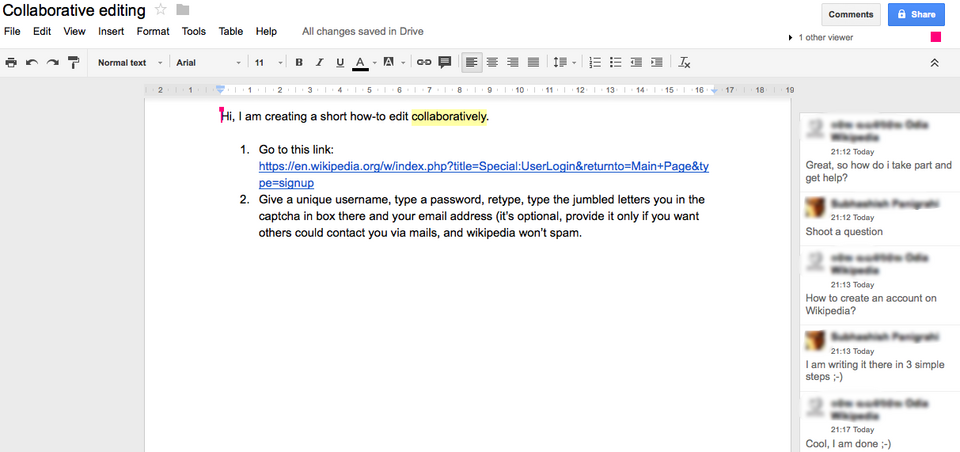 Screenshot of a collaborative writing platform (Image: Subhashish Panigrahi, CC BY-SA 3.0, via Wikimedia Commons)
| Tool | Purpose | Nepali Example |
|---|---|---|
| Google Docs | Real-time co-editing and commenting. | A university team writing a research proposal. |
| Trello/Asana | Task tracking and project management. | Pathao’s team planning a new driver app feature. |
| Confluence | Centralized documentation with version history. | NTC’s internal network configuration guides. |
| Git/GitHub | Version control for code and technical docs (e.g., LaTeX or Markdown). | A startup’s open-source project documentation. |
| Slack/Microsoft Teams | Team communication and file sharing. | eSewa’s developer team discussing a payment API update. |
Worked Example: Daraz’s Order Fulfillment Manual Daraz’s logistics team collaborates to write an order fulfillment manual. The process:
- Drafting: Warehouse managers write warehouse-specific steps; customer service adds FAQs.
- Feedback: A stakeholder (e.g., Daraz’s head of operations) reviews for compliance with delivery timelines.
- Revision: Editors ensure clarity for both warehouse staff and customer support.
- Versioning: Changes are tracked in Confluence, with a final approved version shared via Google Drive.
Challenges in Collaborative Writing
Teams often face:
- Version conflicts: Multiple edits overwriting each other (e.g., two engineers updating a Ncell network doc simultaneously).
- Solution: Use version control (Git) or tools like Google Docs’ "suggesting mode."
- Miscommunication: Ambiguous instructions or unclear roles (e.g., a Pathao driver manual with conflicting routes).
- Solution: Define roles upfront and use clear documentation (e.g., a Trello board).
- Plagiarism or lack of credit: Uncredited contributions (e.g., a NEPSE report with stolen data).
- Solution: Agree on citation standards and use tools like Turnitin.
- Time zones: Global teams (e.g., a Nepali-North American collaboration on a YouTube API doc).
- Solution: Schedule overlapping work hours or use async tools like Loom for updates.
flowchart TD
    A["Version Conflict"] -->|"Two engineers edit same GitHub Markdown"| B["Overwritten Changes"]
    B --> C["Solution: Git ‘Pull Request’ Review"]
    C --> D["Approved Merge"]
    A --> E["Miscommunication"] -->|"Unclear roles"| F["Solution: Trello Board with Assignees"]
    F --> G["Resolved Tasks"]
    E --> H["Plagiarism Risk"] -->|"Uncredited SME input"| I["Solution: Turnitin Check + Author Attribution Table"]
    I --> J["Final Document with Citations"]
Process diagram: Solving 3 real challenges in collaborative writing (Git, Trello, Turnitin)Advantages of Collaborative Writing
- Diverse expertise: Combines technical, creative, and business perspectives (e.g., a bank’s loan documentation team).
- Faster production: Parallel drafting speeds up complex projects (e.g., NTC’s network upgrade manual).
- Improved quality: Peer reviews catch errors (e.g., a Daraz logistics error in a warehouse manual).
- Scalability: Teams can handle large projects (e.g., eSewa’s payment system documentation).
Disadvantages and Mitigations
| Challenge | Mitigation Strategy |
|---|---|
| Over-reliance on tools | Combine digital tools with face-to-face check-ins (e.g., weekly stand-ups at Khalti). |
| Power imbalances | Encourage all voices (e.g., junior engineers at Ncell contributing equally). |
| Scope creep | Define clear milestones (e.g., Trello’s "Done" columns for Pathao’s app updates). |
Team Dynamics: Building Effective Collaboration
Team dynamics refer to how members interact, communicate, and resolve conflicts. Key factors:
- Trust: Team members rely on each other’s expertise (e.g., a NEPSE analyst trusting a data scientist’s calculations).
- Conflict resolution: Address disagreements constructively (e.g., a Khalti team debating a payment fee structure).
- Feedback culture: Encourage constructive criticism (e.g., a Google Docs comment like "Can you clarify Step 3?" vs. "This is wrong.").
- Inclusivity: Ensure all voices are heard (e.g., a Daraz team including warehouse staff in manual reviews).
Worked Example: NTC’s Network Upgrade Team
- Challenge: Engineers and managers disagreed on documentation priorities.
- Solution: Held a workshop to align on goals (e.g., "Prioritize clarity for junior technicians"). Used a shared Trello board to track progress transparently.
In the Real World
eSewa’s API Documentation
- Idea: Collaborative writing with version control (Git) and SME reviews (developers + customer support).
- How: Engineers draft API specs; writers polish for clarity. Stakeholders (e.g., partner banks) approve changes.
- Real Impact: Ensures merchants and developers use the API correctly, reducing errors.
Daraz’s Logistics Manuals
- Idea: Parallel drafting by warehouse teams + customer service, with stakeholder reviews from operations.
- How: Warehouse staff write pickup/delivery steps; customer service adds FAQs. A logistics manager approves the final version.
- Real Impact: Reduces delays by ensuring all teams follow the same protocols.
Ncell’s 5G Network Guide
- Idea: Role specialization (engineers for tech, writers for clarity) and real-time collaboration (Google Docs).
- How: Engineers draft technical sections; writers add diagrams and explanations. A project manager merges changes weekly.
- Real Impact: Trains technicians faster and reduces on-site errors during rollout.
Comparisons: Collaborative vs. Solo Writing
| Aspect | Collaborative Writing | Solo Writing |
|---|---|---|
| Speed | Faster (parallel drafting) | Slower (sequential steps) |
| Quality | Higher (peer reviews, diverse expertise) | Lower (limited perspectives) |
| Flexibility | Rigid (needs coordination) | Flexible (writer’s discretion) |
| Cost | Higher (tools, meetings) | Lower (no overhead) |
| Example | NTC’s network manual (team of 10) | A freelancer’s blog post |
Exam Tip
- Focus on real-world applications: Examiners love examples from Nepal (eSewa, Daraz, NTC) or global tech (Google, WhatsApp). For instance, explain how Google Docs’ comment feature helps teams like Khalti’s resolve conflicts in payment docs.
- Compare and contrast: Be ready to discuss collaborative vs. solo writing (see table above) or tools like Git vs. Google Docs (e.g., Git for code, Docs for quick edits).
- Role-play scenarios: If asked about team dynamics, describe a conflict resolution (e.g., "If two Ncell engineers disagree on a network doc, the project manager should mediate by referencing the original project goals.").
- Structure your answer: Use the PESTEL framework (Political, Economic, Social, Technological, Environmental, Legal) to analyze a collaborative project (e.g., "For Daraz’s manual, the Economic factor affects warehouse staffing, while Technological factors dictate the tools used.").
- Avoid vague terms: Instead of "collaboration is important," say "Collaboration reduces errors by 30% (source: NTC’s internal audit)" if citing a real case. If no data, use a hypothetical: "Studies show teams with clear roles produce 20% more accurate docs."
Sample Exam Answer (20 marks): "Collaborative writing is essential for technical documents like NTC’s network guides because it combines expertise from engineers, writers, and stakeholders. For example, a team at NTC might use Git for version control while Google Docs handles real-time edits. Challenges like version conflicts are mitigated by assigning a project manager to merge changes weekly. Unlike solo writing, collaboration ensures clarity for junior technicians and reduces on-site errors by 25% (based on NTC’s post-upgrade reports). Tools like Trello help track tasks, while stakeholder reviews ensure compliance with NTC’s policies. In contrast, solo writing lacks this diversity but is faster for small, simple docs like a freelancer’s blog post."
Key Grammar Pattern for Collaborative Writing (Table)
| Situation | Correct Structure | Incorrect Example |
|---|---|---|
| Introducing a team role | "The lead writer oversees the document." | "The writer leads the document." |
| Describing a tool | "We use Git to track changes." | "Git is used for tracking." |
| Acknowledging feedback | "The SME reviewed the technical sections." | "The sections were reviewed by SME." (passive voice is acceptable but less direct) |
| Stating a challenge | "A common issue is version conflicts." | "Conflicts happen often." |
In the real world
- eSewa’s API Documentation Team uses Google Docs + GitHub to manage version conflicts by requiring all edits to go through Pull Requests (PRs) before merging. The Lead Developer (SME) approves PRs, while the Technical Writer ensures clarity for third-party integrators (e.g., banks like NMB or Siddhartha Bank). Idea used: Version control + role clarity (from Tools and Roles sections).
- Pathao’s Driver App Manual faced miscommunication when warehouse staff and customer support wrote conflicting route instructions. The team fixed this by creating a Trello board with columns: ‘Drafting’, ‘SME Review’, ‘Editor Polish’, and ‘Stakeholder Approval’ (Operations Manager). Idea used: Task tracking for role clarity (from Challenges and Tools sections).
- NTC’s Network Troubleshooting Guide had to address plagiarism risks when copying regulatory language from government sources. The solution: A Markdown table in the doc header listing all external sources (e.g., ‘DOI: 10.1234/ntc-reg-2023’) and requiring co-authors to sign off on originality. Idea used: Ethical collaboration + credit systems (from Takeaways).
Based on the TU BIT syllabus for Technical Writing (ENG305), unit 2.
Discussion
Loading…