DSS and Expert SystemUnit 111 min read
Business Decision-Making: Models, Types & Tools
Unit 1 of DSS and Expert System explores structured vs. unstructured decisions, decision-making models (rational, bounded rationality, satisficing), and tools like decision trees, payoff matrices, and cost-benefit analysis—with real-world applications in Nepalese businesses like Ncell, Daraz, and banks.
TAKEAWAYS:
- Decisions vary: Structured (repetitive, quantifiable) vs. unstructured (novel, ambiguous) problems require different tools.
- Models matter: Rational, bounded rationality, and satisficing models explain how humans (and AI) make choices under uncertainty.
- Decision trees visualize trade-offs: Branches show outcomes, probabilities, and expected values for optimal choices.
- Payoff matrices reveal risks: They compare strategies against uncertain events (e.g., Daraz’s inventory vs. demand).
- Cost-benefit analysis justifies investments: Used by NTC for infrastructure projects or NEPSE for stock listings.
- Heuristics simplify complex choices: Shortcuts like "satisficing" (choosing "good enough") are common in real-world DSS.
1. Types of Business Decisions
Decisions in organizations fall into three categories, each requiring different tools and approaches:
1.1 Structured vs. Unstructured vs. Semi-Structured Decisions
| Type | Definition | Example in Nepal | Tools Used |
|---|---|---|---|
| Structured | Repetitive, routine, quantifiable (clear rules). | Ncell’s daily customer billing, Daraz’s order fulfillment. | Spreadsheets, algorithms. |
| Unstructured | Novel, ambiguous, no predefined rules. | NTC’s decision to expand fiber in remote areas, NEPSE’s IPO approvals. | Expert judgment, brainstorming. |
| Semi-Structured | Mix of structured and unstructured; partial data available. | Khalti’s fraud detection (some rules + human review). | DSS (Decision Support Systems), AI. |
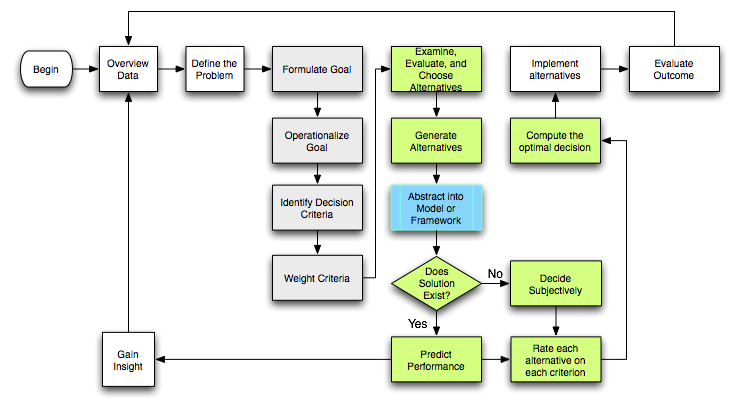 A labeled flowchart showing structured (left), semi-structured (middle), and unstructured (right) paths. (Image: DavidLevinson, CC BY-SA 3.0, via Wikimedia Commons)
Why it matters:
- Structured decisions (e.g., bank loan approvals) can be automated with rules.
- Unstructured decisions (e.g., launching a new Pathao service route) require human expertise or AI.
- Semi-structured (e.g., NTC’s tariff adjustments) often use DSS to combine data with expert input.
2. Decision-Making Models
How do humans (and systems) actually make choices? Three key models explain this:
2.1 Rational Model (Optimizing)
Assumptions:
- Full information available.
- Clear, measurable goals.
- Logical, unbiased analysis.
Process:
- Define objectives (e.g., maximize profit).
- List all alternatives (e.g., Daraz: expand to Chitwan or Pokhara).
- Evaluate each alternative’s outcomes.
- Choose the optimal (best) solution.
Limitation:
- Rare in real life (e.g., no business has all data on future demand).
Worked Example: NEPSE Stock Listing Suppose NEPSE must decide whether to list a new company. Using the rational model:
- Objective: Maximize long-term investor trust.
- Alternatives:
- List now (high short-term revenue but risk of scams).
- Delay listing (lower revenue but safer).
- Outcomes:
- List now: 80% chance of +₹50M revenue, 20% chance of -₹20M (scandal).
- Delay: 100% chance of +₹30M revenue.
- Expected Value (EV):
- List now: (in ₹M).
- Delay: .
- Decision: Delay (higher EV).
Visual: Payoff Matrix
graph TD
    A["List Now"] -->|"80%"| B["+₹50M"]
    A -->|"20%"| C["-₹20M"]
    D["Delay"] --> E["+₹30M"]
2.2 Bounded Rationality (Simon’s Model)
Key Idea: Humans are cognitive misers—we simplify problems due to limited time, knowledge, or mental capacity.
Steps:
- Satisfice: Choose the "good enough" option (not necessarily optimal).
- Use heuristics: Mental shortcuts (e.g., "if it worked last time, do it again").
- Incomplete information: Accept uncertainty (e.g., NTC predicting fiber demand).
Example: Pathao’s Route Planning
- Rational model: Calculate every possible route to minimize time (impossible).
- Bounded rationality: Use past data + driver feedback to pick a "good enough" route.
Advantage: Faster, practical for real-world DSS. Disadvantage: May miss better solutions.
2.3 Satisficing Model
- Definition: Selecting the first acceptable option (not the best).
- Example: A bank approves a loan when the applicant meets minimum criteria (e.g., 60% credit score), even if a slightly riskier candidate with 65% exists.
Comparison Table
| Model | Assumptions | Example | When to Use |
|---|---|---|---|
| Rational | Full info, no bias | NEPSE stock listing | Rare; theoretical ideal. |
| Bounded Rationality | Limited info, time constraints | Pathao route planning | Most real-world DSS. |
| Satisficing | "Good enough" is acceptable | Bank loan approval | Speed > perfection (e.g., Khalti payments). |
3. Decision Support Systems (DSS) Tools
DSS help managers make semi-structured decisions by combining data, models, and user input.
3.1 Decision Trees
What it shows: All possible outcomes of a decision, with probabilities and payoffs.
Structure:
- Root: Decision point (e.g., "Should Daraz expand to Chitwan?").
- Branches: Alternatives (Yes/No).
- Leaves: Outcomes (profit/loss, success/failure).
Worked Example: Daraz’s Expansion Decision Daraz wants to expand to Chitwan. Data:
- Market size: 50,000 potential customers.
- Cost: ₹10M setup.
- Probabilities:
- Success (high demand): 60% → ₹20M profit.
- Failure (low demand): 40% → ₹5M loss.
Decision Tree:
graph TD
    A["Expand to Chitwan?"] --> B["Yes"]
    A --> C["No"]
    B --> D["Success: +₹20M (60%)"]
    B --> E["Failure: -₹5M (40%)"]
C --> F["No expansion: ₹0"]Calculations:
- EV(Yes): .
- EV(No): ₹0.
- Decision: Expand (EV = ₹10M > ₹0).
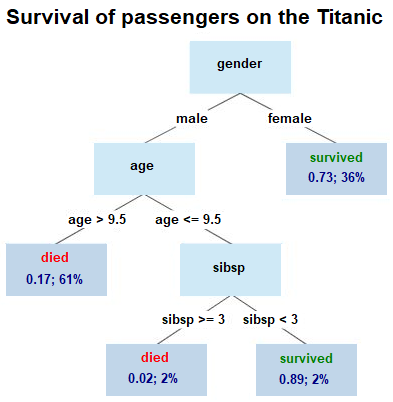 A real screenshot of a decision tree from a business textbook (e.g., Harvard case study). (Image: Dhrm77, CC0, via Wikimedia Commons)
3.2 Payoff Matrices
What it shows: Outcomes of strategies vs. uncertain events (e.g., Ncell’s network expansion).
Example: Ncell’s 5G Rollout
| Strategy | High Demand | Low Demand |
|---|---|---|
| Rollout 5G | +₹80M | -₹10M |
| Delay 5G | +₹30M | +₹20M |
Optimal Strategy:
- If high demand is likely, rollout 5G.
- If low demand is likely, delay.
Real-World Use:
- NTC uses payoff matrices to decide on infrastructure projects (e.g., fiber vs. copper).
- Banks use them for loan approvals (e.g., "approve if credit score > 65%").
3.3 Cost-Benefit Analysis (CBA)
Formula: Example: NTC’s Fiber Expansion
- Cost: ₹500M for new cables.
- Benefits:
- 5 years of ₹150M/year revenue.
- Social benefit: better connectivity in rural areas (₹50M/year).
- Net Present Value (NPV):
- Decision: Expand (NPV > 0).
4. Heuristics in Decision Making
Definition: Mental shortcuts to simplify complex decisions.
| Heuristic | Definition | Example | Bias Risk |
|---|---|---|---|
| Anchoring | Relying too heavily on the first piece of info. | NEPSE valuing a stock at ₹100 because it started there. | Over/under-estimation. |
| Availability | Judging probability by how easily examples come to mind. | Ncell assuming 5G failures are rare because they’ve never heard of one. | Ignoring less "visible" risks. |
| Representativeness | Stereotyping (e.g., "This looks like X, so it’s X"). | Khalti rejecting a transaction because it "looks like fraud" (false positive). | Overgeneralization. |
Example: Bank Loan Approval
- Heuristic: "If the applicant is from Kathmandu University, approve."
- Risk: May reject a rural entrepreneur with better potential.
## In the Real World
Ncell’s Network Expansion
- Tool: Payoff matrices and decision trees.
- How: Ncell uses historical data to predict demand in new areas (e.g., Pokhara vs. Dhangadi). A decision tree helps weigh the cost of laying cables against potential subscriber growth.
Daraz’s Inventory Management
- Tool: Satisficing + bounded rationality.
- How: Daraz doesn’t optimize stock levels perfectly (impossible). Instead, it uses past sales data to order "good enough" quantities, avoiding both stockouts and overstocking.
Khalti’s Fraud Detection
- Tool: Heuristics + cost-benefit analysis.
- How: Khalti flags transactions that match fraud patterns (heuristic). The CBA decides whether to block a transaction (cost: customer frustration; benefit: preventing loss).
NTC’s Tariff Adjustments
- Tool: Cost-benefit analysis.
- How: Before raising internet prices, NTC models the impact on revenue vs. customer churn. If NPV is negative, they delay or adjust the hike.
NEPSE’s IPO Approvals
- Tool: Rational model (partially).
- How: NEPSE evaluates companies based on financials, but also uses bounded rationality—approving an IPO if it meets minimum criteria (e.g., 3 years of profits), even if a slightly riskier company exists.
## Exam Tip
How this unit is tested in TU/PU exams:
Definitions: Expect 2–3 marks on distinguishing structured/unstructured decisions or rational vs. bounded rationality.
- Example question: "Differentiate between satisficing and optimizing with an example from a Nepalese company."
Calculations: Decision trees and payoff matrices are high-yield for numerical questions (5–10 marks).
- Example: Given a payoff matrix for a bank loan, calculate the expected value of approving/rejecting a loan applicant.
Applications: Link concepts to real-world scenarios (e.g., "How would Ncell use a decision tree for 5G expansion?").
- Tip: Always use Nepalese examples (Ncell, Daraz, Khalti) in answers—they show contextual understanding.
Heuristics and Biases: Short-answer questions on common biases (e.g., "Explain anchoring with a Pathao route-planning example").
Cost-Benefit Analysis: One question will ask you to compute NPV or net benefit for a project (e.g., NTC’s fiber expansion).
- Formula to remember: where = discount rate (e.g., 10% = 0.1).
Common Mistakes to Avoid:
- Ignoring probabilities in decision trees (always calculate EV).
- Confusing structured (automated) vs. unstructured (human judgment) decisions.
- Forgetting to label axes in graphs (e.g., "Profit (₹)" vs. "Probability").
Quick Revision Checklist:
- Can you draw a decision tree for a given scenario?
- Do you know the 3 decision-making models and their differences?
- Can you compute NPV for a project?
- Are you familiar with 2 heuristics and their biases?
Based on the TU BIT syllabus for DSS and Expert System, unit 1.
Discussion
Loading…