E CommerceUnit 216 min read
E-Commerce Business Models & Capital Raising: Types, Models & Funding
Unit 2 of E-Commerce explores core business models (B2B, B2C, C2C, C2B) and capital-raising strategies (bootstrapping, venture capital, crowdfunding) with real-world examples from Nepal (eSewa, Daraz) and global platforms (Amazon, Alibaba). Learn how to analyze revenue streams, cost structures, and funding trade-offs f
Core Concepts: What is an E-Commerce Business Model?
A business model defines how a company creates, delivers, and captures value in digital markets. Unlike traditional models, e-commerce models leverage technology, scalability, and network effects to reduce costs and expand reach.
Key Components of an E-Commerce Business Model
Types of E-Commerce Business Models
E-commerce models are classified based on who buys/sells and how transactions occur. Below are the 4 primary models with Nepalese and global examples:
| Model | Definition | Nepalese Example | Global Example | Revenue Model |
|---|---|---|---|---|
| B2B | Business sells to another business (wholesale, bulk orders). | Daraz B2B (suppliers to retailers) | Alibaba | Transaction fees, subscriptions |
| B2C | Business sells directly to consumers (retail). | eSewa (government services) | Amazon, Flipkart | Sales revenue, ads |
| C2C | Consumer sells to another consumer (marketplace). | Sano Sano (second-hand goods) | eBay, OLX | Commission per sale |
| C2B | Consumer sells products/services to businesses (reverse auction). | Freelance platforms (e.g., Upwork) | Priceline (hotel/flight deals) | Bid-based pricing |
| B2G | Business sells to government agencies. | NTC (online procurement) | Govt. e-tendering portals | Fixed-price contracts |
| C2G | Consumer interacts with government (e-services). | eSewa (bill payments) | Estonia’s digital services | Service fees |
Worked Example: Daraz’s B2B and B2C Hybrid Model
Daraz operates as both a B2B (selling to retailers in bulk) and B2C (direct-to-consumer sales) platform. Let’s trace how it captures value:
- B2B Revenue: Suppliers pay a 10–15% commission on bulk orders placed via Daraz’s wholesale portal.
- B2C Revenue:
- Sales margin: Daraz marks up products by 20–50% (e.g., a ₹1,000 product sells for ₹1,500).
- Advertising: Brands pay ₹500–₹5,000/month for sponsored listings.
- Logistics: Daraz charges ₹50–₹300 for delivery (integrated with Pathao/Khalti).
- Data Monetization: Uses customer purchase data to offer targeted ads (e.g., "Frequently bought together").
Why This Works in Nepal:
- Low infrastructure cost: Digital transactions reduce physical store overhead.
- Trust: Khalti/eSewa integrations enable secure payments.
- Scalability: Same platform serves rural and urban customers.
Capital Raising for E-Commerce Ventures
Funding an e-commerce business requires balancing speed, control, and scalability. Below are 5 common methods with pros/cons:
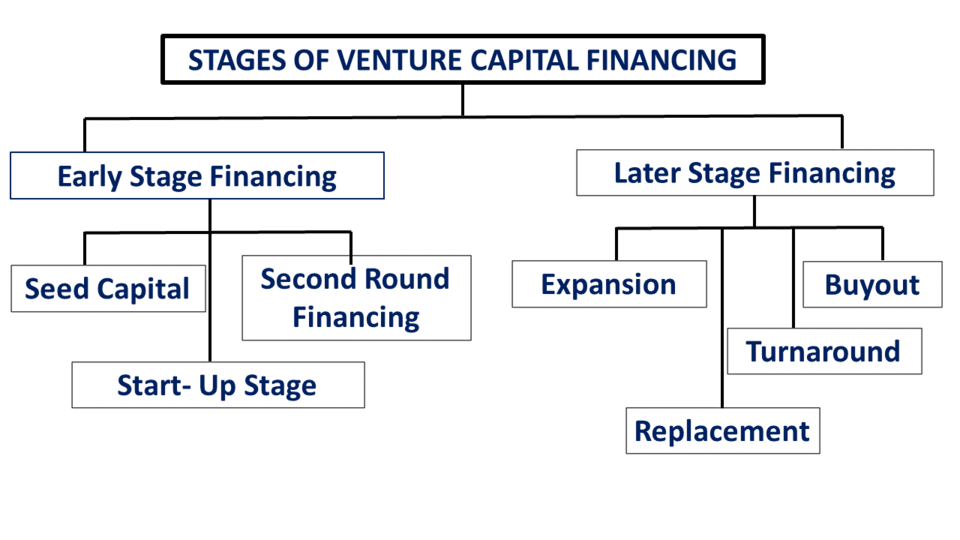 Typical VC investment phases (e.g., Khalti’s journey from bootstrapping to IPO) (Image: Lalita Mutreja, CC BY-SA 4.0, via Wikimedia Commons)
| Funding Method | How It Works | Nepalese Example | Pros | Cons |
|---|---|---|---|---|
| Bootstrapping | Self-funding using personal savings or revenue. | Local kirana shops using WhatsApp for orders | Full control, no debt | Slow growth, limited resources |
| Venture Capital (VC) | Investors provide capital in exchange for equity. | Daraz (backed by Alibaba) | High growth funding, expertise | Loss of control, high pressure |
| Bank Loans | Traditional loans with collateral (e.g., inventory, property). | NMB Bank SME loans for e-commerce | Structured repayment, lower equity loss | High interest (12–18% in Nepal), collateral risk |
| Crowdfunding | Raising small amounts from many people (e.g., Kickstarter). | Local artisans on Patreon | Validates demand, builds community | Time-consuming, requires strong marketing |
| Angel Investors | Wealthy individuals invest in early-stage startups. | Khalti (early investors) | Mentorship + funding, flexible terms | May demand board seats |
| Grants | Non-repayable funds from government/NGOs (e.g., for women-led businesses). | Nepal Investment Bank’s SME grants | No repayment, prestige | Competitive, bureaucratic hurdles |
Worked Example: Khalti’s Capital Raising Journey
Khalti, Nepal’s leading digital wallet, raised capital in 3 phases:
- Bootstrapping (2011–2015):
- Founders used personal savings and revenue from early adopters (e.g., Ncell, NTC).
- Challenge: Limited to Kathmandu; needed infrastructure for nationwide expansion.
- Angel Investment (2016):
- Raised ₹10 million from local angels (e.g., Nirdhan Utthan Bank).
- Use: Hired tech team, expanded to Pokhara/Biratnagar.
- Venture Capital (2018–2020):
- Secured ₹2 billion from Antler (global VC) and Nepal Investment Bank.
- Use: Built UPI-like Khalti Pay, acquired competitors (eSewa integration).
- IPO Prep (2023):
- Exploring ₹10 billion IPO to fund AI-driven fraud detection and rural expansion.
Key Lesson:
- Early-stage: Use bootstrapping/grants to validate the model.
- Growth-stage: VC/angel funding for scaling (but dilute equity wisely).
- Maturity: IPO or strategic partnerships (e.g., Khalti + Ncell) for liquidity.
E-Commerce Business Model Innovations
1. Subscription Models
Definition: Customers pay recurring fees for access to products/services (e.g., monthly boxes, SaaS). Nepalese Example:
- Bookworm Nepal: Monthly book subscription boxes (₹1,500–₹3,000).
- Fitness apps: Monthly gym memberships via Khalti (e.g., Fitness Nepal).
How It Works:
flowchart TD
    A["Customer Subscribes\n(₹X/month)"] --> B["Platform Delivers\nProduct/Service"]
    B --> C["Recurring Revenue\n(No one-time sales)"]
    C --> D["Data Collection\n(Personalize offers)"]
D --> E["Upsell Add-ons\n(e.g., premium content)"]Advantages:
- Predictable revenue.
- Higher customer lifetime value (LTV).
Disadvantages:
- High churn risk (customers cancel).
- Requires strong customer support.
2. Marketplace Models (Multi-Sided Platforms)
Definition: A platform connects buyers and sellers and earns via commissions/ads. Global Example: Amazon (takes 15% of each sale). Nepalese Example: Sano Sano (second-hand marketplace).
Revenue Streams:
- Commission: 10–20% per transaction.
- Listing Fees: ₹50–₹500/month for premium visibility.
- Ads: Sellers pay to boost listings (e.g., "Sponsored" tag).
- Data: Selling anonymized trends to brands (e.g., "Top 10 searched phones in Kathmandu").
3. Freemium Models
Definition: Free basic service + paid premium features. Nepalese Example:
- Khalti: Free wallet for basic transfers; charges 1.99% for business transactions.
- Fitness Apps: Free workout plans; premium for personalized coaching.
Psychological Trigger:
- Free trial → Habit formation → Upsell to premium.
4. Direct-to-Consumer (D2C) Models
Definition: Brands sell directly to customers, cutting out retailers. Global Example: Warby Parker (eyewear), Dove (skincare). Nepalese Example: Himalayan Coffee House (online orders via Daraz).
Why D2C?:
- Higher margins (no middleman).
- Customer data (personalized marketing).
- Brand control (no retailer altering packaging).
Challenge in Nepal:
- Logistics: Rural delivery costs (e.g., Pathao charges ₹200+ to remote areas).
- Payment barriers: Many still prefer cash-on-delivery (COD).
In the Real World
1. eSewa: Government as a B2G and C2G Platform
- Model: C2G (citizens pay bills) + B2G (businesses pay taxes online).
- How It Uses This Unit’s Ideas:
- Business Model: Hybrid transaction fee (₹10–₹50 per payment) + advertising (banks promote eSewa).
- Capital Raising: Initially bootstrapped by Nepal Rastra Bank; later acquired by Global IME Bank (2019) for ₹1.2 billion.
- Security: Uses Nepal Government’s PKI (Public Key Infrastructure) for non-repudiation (proof of payment).
- Worked Example:
- A user pays ₹500 electricity bill via eSewa.
- eSewa takes ₹10 fee → ₹490 goes to NTC.
- NTC’s revenue model: Uses eSewa’s data to target ads (e.g., "Pay your bill early, save 5%").
2. Daraz: B2B + B2C + Logistics Integration
- Model: Multi-sided marketplace (sellers, buyers, logistics partners like Pathao).
- Capital Raising:
- 2018: Alibaba invested $500 million (51% stake).
- 2021: Raised $100 million from Tiger Global for AI-driven inventory.
- Revenue Streams:
- B2B: Suppliers pay 12% commission on bulk orders.
- B2C: 15% fee on consumer sales + ₹50–₹300 delivery charges.
- Ads: Brands pay ₹1,000–₹10,000/month for "Featured" listings.
- Real-World Impact:
- Problem Solved: Small retailers (e.g., Thapathali’s mobile shops) can sell nationwide.
- Challenge: Counterfeit goods (Daraz now uses AI image verification).
3. Pathao: Asset-Light Logistics (Gig Economy Model)
- Model: C2C + B2C delivery (like Uber for parcels).
- Business Model:
- No inventory: Uses partner drivers (no trucks owned).
- Dynamic pricing: ₹50–₹500 per delivery (surge pricing in peak hours).
- Subscription: Pathao Pro (₹999/month) for businesses to get priority slots.
- Capital Raising:
- 2015: Bootstrapped by two brothers (₹500,000 initial capital).
- 2018: Raised $10 million from Y Combinator and Sequoia Capital.
- Real-World Example:
- Daraz’s delivery bottleneck: Before Pathao, Daraz used Nepal Post (slow, ₹300+).
- Solution: Pathao now handles 60% of Daraz’s last-mile delivery at ₹100–₹200 per parcel.
Exam Tip: How to Score Full Marks
1. Define Clearly
- Example: If asked "What is a B2C model?", start with:
"A B2C (Business-to-Consumer) model is an e-commerce framework where a business sells products/services directly to end consumers via digital channels (e.g., websites, apps)."
- Avoid: Vague answers like "selling to customers."
2. Use Real-World Examples
- Example Question: "Discuss capital-raising methods for e-commerce."
- Weak Answer: "Bootstrapping, loans, VC."
- Strong Answer:
"Khalti used bootstrapping initially (2011–2015) to validate its digital wallet model in Kathmandu. Later, it secured ₹10 million from angel investors (2016) to expand to provinces. In 2018, it raised ₹2 billion from Antler VC to develop Khalti Pay, enabling UPI-like transactions. This phased approach balanced growth speed (VC) with founder control (bootstrapping)."
3. Compare Models in Tables
- Example Question: "Differentiate B2B and B2C models."
Use a 2-column table with:
- Customers (B2B: Businesses; B2C: Individuals)
- Order Volume (B2B: Bulk; B2C: Single units)
- Revenue Model (B2B: Commission/subscription; B2C: Sales margin)
- Nepalese Example (B2B: Daraz Wholesale; B2C: eSewa)
4. Explain Trade-Offs
- Example Question: "Why might a startup choose bootstrapping over VC?"
"Bootstrapping offers full equity control and no repayment pressure, but limits scaling speed. For example, a Kathmandu-based organic grocery delivery startup might bootstrap to retain 100% profits and avoid VC demands for aggressive expansion. However, this risks losing market share to VC-backed competitors like Daraz Grocery."
5. Link to Nepal’s Context
- Example Question: "How does Nepal’s digital payment ecosystem support e-commerce?"
*"Nepal’s low internet penetration (45%) and preference for COD (60% of e-commerce sales) pose challenges, but Khalti/eSewa integrations enable:
- Trust: PKI-based authentication ensures non-repudiation (e.g., no bill payment disputes).
- Reach: ₹10–₹50 transaction fees make micro-payments viable (e.g., ₹200 delivery charges on Pathao).
- Regulation: Nepal Rastra Bank’s digital payment guidelines provide legal clarity for B2C transactions (e.g., refund policies). Limitation: High mobile data costs (₹100/GB) hinder rural adoption, but USSD-based payments (e.g., #123#) offer a workaround."
Common Pitfalls to Avoid
- Generic Definitions: Don’t say "e-commerce is buying and selling online"—explain the business model (e.g., "a B2C model where revenue comes from sales margins and ads").
- Ignoring Nepal’s Constraints: Always relate examples to payment methods (COD vs. digital), internet speeds, or local platforms (eSewa, Daraz).
- Overlooking Security/Legal: Even in business models, mention trust mechanisms (e.g., "Khalti uses Nepal’s PKI for non-repudiation").
- Assuming Global = Local: Amazon’s marketplace model works in Nepal, but logistics costs are 3x higher due to terrain.
Based on the TU BIT syllabus for E Commerce (BIT403), unit 2.
Discussion
Loading…