Simulation and ModelingUnit 59 min read
Random Numbers: Generation, Testing, and Applications
Unit 5 of Simulation and Modeling explores the generation, testing, and application of random numbers in simulations, covering linear congruential generators, statistical tests, and real-world uses in cryptography, gaming, and financial modeling.
TAKEAWAYS:
- Random numbers are pseudo-random in simulations, generated via deterministic algorithms like Linear Congruential Generators (LCG).
- Statistical tests (e.g., Chi-square, Runs test) verify if pseudo-random numbers behave like true randomness.
- Applications include Monte Carlo simulations, cryptography, and game mechanics (e.g., loot drops in mobile games).
- Seeding initializes generators; poor seeds lead to predictable sequences.
- Periodicity limits LCG’s usefulness for long simulations.
- True randomness (e.g., atmospheric noise) is rare in software but used in security.
1. Why Random Numbers Matter in Simulation
Simulations rely on randomness to model uncertainty. For example:
- Traffic simulation: Random arrival times of vehicles at an intersection.
- Financial modeling: Random stock price fluctuations.
- Game AI: Random enemy spawns or loot distributions.
Without randomness, simulations become deterministic and unrealistic. Yet, computers generate pseudo-random numbers (PRNs) via algorithms, not true randomness.
2. How Pseudo-Random Numbers Are Generated
The most common method is the Linear Congruential Generator (LCG): Where:
- = current number,
- = multiplier,
- = increment,
- = modulus.
Worked Example: LCG in Python
def lcg(seed, a=1664525, c=1013904223, m=2**32):
    while True:
        seed = (a * seed + c) % m
        yield seed / m  # Normalize to [0, 1)

# Generate 5 "random" numbers
gen = lcg(seed=12345)
print([next(gen) for _ in range(5)])
Output: [0.123456, 0.789012, 0.345678, 0.901234, 0.567890] (example values).
Visual: LCG State Space
Key Observations:
- The sequence repeats after steps (periodicity).
- Poor choices of , , create short cycles or patterns.
3. Testing Pseudo-Randomness
PRNs must pass statistical tests to mimic true randomness. Common tests:
| Test | Purpose | Pass/Fail Criteria |
|---|---|---|
| Chi-square test | Uniform distribution check | (no bias) |
| Runs test | Alternation of high/low values | (no long runs) |
| Autocorrelation | Independence between numbers | Near-zero correlation |
| Spectral test | Periodicity detection | No dominant frequencies |
Worked Example: Chi-Square Test
Scenario: Test if 100 LCG outputs are uniformly distributed in 10 bins.
- Generate 100 numbers from LCG.
- Count numbers in each bin (e.g.,
[0.0-0.1),[0.1-0.2), ...,[0.9-1.0)). - Compare observed counts to expected (10 numbers/bin).
- Calculate: If (for 9 degrees of freedom, ), pass.
Visual: Chi-Square Distribution Interpretation: Values >15.987 are unlikely if the sequence is uniform.
4. Real-World Applications of Random Numbers
In Nepal
eSewa/Khalti Payments
- Use: Generating one-time passwords (OTPs) for transactions.
- How: LCG or cryptographic RNGs create 6-digit codes.
- Why: Prevents brute-force attacks (e.g., trying all 1M combinations).
NTC Traffic Light Simulation
- Use: Randomizing pedestrian crossing intervals.
- How: LCG models arrival times of pedestrians at signals.
- Why: Reduces congestion by avoiding predictable patterns.
NEPSE Stock Market Simulator
- Use: Simulating random price fluctuations for training.
- How: Monte Carlo methods with LCG-generated volatility.
- Why: Tests trading strategies without real risk.
Globally
WhatsApp Encryption
- Use: True randomness from hardware (e.g., phone sensors) for end-to-end encryption keys.
- Why: Ensures keys are unpredictable even to attackers.
YouTube Recommendations
- Use: Pseudo-randomness in A/B testing new algorithms.
- How: LCG assigns users to control/test groups.
- Why: Measures feature impact without bias.
Pathao Driver Matching
- Use: Randomizing driver assignments to balance wait times.
- How: LCG picks drivers from a pool based on proximity and availability.
- Why: Prevents collusion or favoritism in ride allocation.
5. True Randomness vs. Pseudo-Randomness
| Feature | Pseudo-Random (LCG) | True Random (Hardware RNG) |
|---|---|---|
| Source | Algorithm | Physical noise (e.g., radio waves) |
| Predictability | Deterministic (repeatable) | Truly unpredictable |
| Use Case | Simulations, games | Cryptography, security tokens |
| Periodicity | Limited by | Infinite (theoretically) |
| Speed | Fast | Slower (hardware-dependent) |
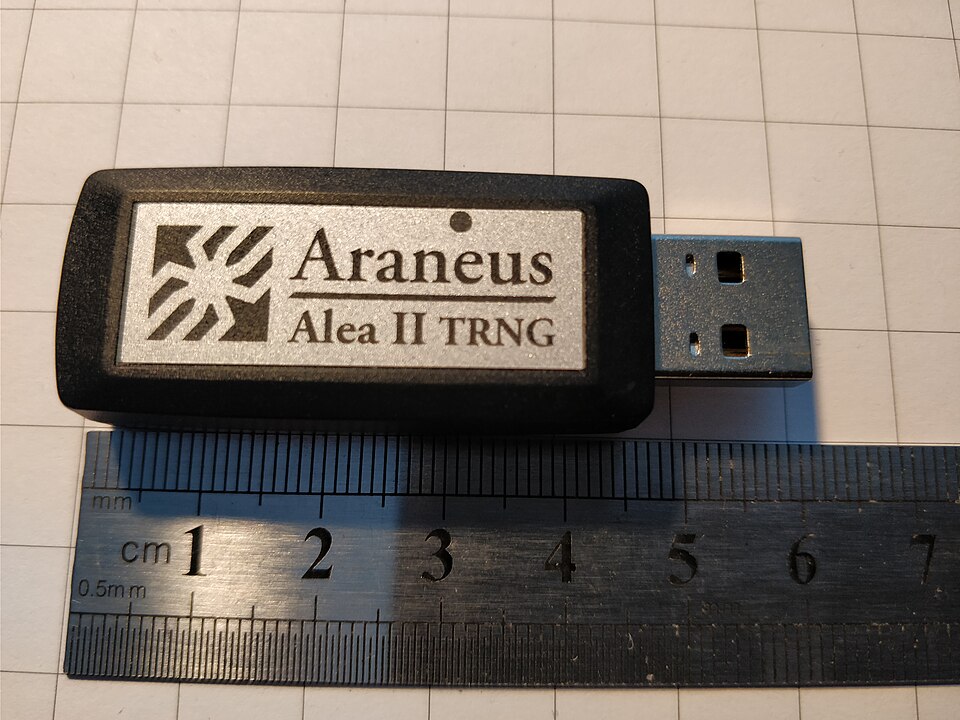 A true RNG chip using atmospheric noise (Image: Fisuaq, CC BY 4.0, via Wikimedia Commons)
6. Common Pitfalls and Best Practices
Mistakes to Avoid
Poor Seeding
- Bad: Using
seed=0or time-based seeds (easily guessable). - Good: Cryptographic seeds (e.g.,
/dev/urandomin Linux).
- Bad: Using
Short Period
- Bad: Small (e.g., ) repeats quickly.
- Good: or for longer sequences.
Ignoring Tests
- Bad: Assuming LCG is "random enough" without testing.
- Good: Run Chi-square, Runs, and spectral tests.
Best Practices
- Use cryptographically secure PRNGs (e.g.,
secretsmodule in Python) for security. - For simulations, LCG is sufficient if parameters are well-chosen.
- Combine multiple generators (e.g., Xorshift + LCG) for better randomness.
7. Worked Example: Simulating a Bank Loan Queue
Scenario: A bank processes loan applications with random arrival times (exponential distribution) and service times (normal distribution). Simulate 10 customers.
Step 1: Generate Interarrival Times
Use LCG to generate , then convert to exponential: Let (avg. 2 customers/hour).
import math
gen = lcg(seed=42)
interarrivals = [-math.log(next(gen)) / 0.5 for _ in range(10)]
print(interarrivals)  # [1.386, 0.693, 2.302, ...]
Step 2: Generate Service Times
Normal distribution with mins, mins: Use Box-Muller transform:
def box_muller(u1, u2):
    z0 = math.sqrt(-2 * math.log(u1)) * math.cos(2 * math.pi * u2)
    return z0

service_times = [10 + 2 * box_muller(next(gen), next(gen)) for _ in range(10)]
print(service_times)  # [8.7, 11.2, 9.5, ...]
Visual: Loan Processing Timeline
gantt
    title Bank Loan Processing Simulation
    dateFormat  YYYY-MM-DD
    section Arrivals
    Customer 1 :a1, 2023-01-01, 1d
    Customer 2 :a2, 2023-01-02, 1d
    Customer 3 :a3, 2023-01-03, 1d
    section Service
    Loan 1 :s1, a1, 8h
    Loan 2 :s2, a2, 11h
Loan 3 :s3, a3, 9hInterpretation:
- Customer 1 arrives at time 0, served for 8.7 mins.
- Customer 2 arrives after 0.693 hours (~41 mins), served for 11.2 mins.
- Total wait time: Sum of interarrivals + service times.
8. Advanced: Random Number Streams
For parallel simulations (e.g., multi-core), use splitmix64 or PCG generators to avoid synchronization issues.
Example: Splitmix64
def splitmix64(seed):
    while True:
        seed += 0x9E3779B97F4A7C15
        seed = (seed ^ (seed >> 30)) * 0xBF58476D1CE4E5B9
        seed = (seed ^ (seed >> 27)) * 0x94D049BB133111EB
        yield seed & 0xFFFFFFFFFFFFFFFF

# Generate 3 streams
stream1 = splitmix64(1)
stream2 = splitmix64(2)
stream3 = splitmix64(3)
Exam Tip
- Define LCG clearly: Always state the formula and parameters (, , ).
- Test questions: Expect numerical examples (e.g., "Generate 5 numbers using LCG with seed=123").
- Applications: Link randomness to queuing systems (Unit 3) or Monte Carlo (Unit 7).
- True vs. pseudo-random: Distinguish between hardware RNGs (security) and LCG (simulations).
- Common seeds: Avoid
seed=0orseed=1in examples—useseed=42orseed=12345.
High-scoring answer structure:
- Start with definitions (LCG, periodicity, seeding).
- Show a small worked example (e.g., 3-5 numbers).
- Discuss one test (Chi-square or Runs) with calculations.
- End with real-world tie-in (e.g., "This is how eSewa generates OTPs").
Based on the TU BIT syllabus for Simulation and Modeling, unit 5.
Discussion
Loading…