Introduction to TelecommunicationsUnit 27 min read
Signals, Spectrum, Bandwidth, Modulation & Noise
Unit 2 of Introduction to Telecommunications explains how signals carry information, how the electromagnetic spectrum is divided for telecom, and how noise and bandwidth affect data transmission. Covers analog/digital signals, frequency bands, modulation techniques, and real-world applications like Wi-Fi and mobile net
Key Concepts and Definitions
Signals: The Foundation of Communication
A signal is a physical quantity (voltage, light, sound) that varies with time or space to represent data. Signals can be:
- Analog: Continuous variation (e.g., human voice, temperature).
- Digital: Discrete levels (e.g., binary 0s and 1s in computers).
Worked Example: Voice Signal
- Analog Voice: A microphone converts sound pressure waves into an electrical voltage signal (continuous).
- Digital Voice: A codec (e.g., in a phone) samples the analog signal at 8 kHz, quantizes it to 8-bit values, and encodes it as binary (e.g., for VoIP).
The Electromagnetic Spectrum: Where Signals Live
The electromagnetic spectrum is divided into bands based on frequency (Hz) and wavelength (m). Telecom uses:
- Radio waves (3 kHz–300 GHz): AM/FM radio, Wi-Fi, Bluetooth, cellular.
- Microwaves (1–300 GHz): Satellite links, radar, 5G.
- Infrared (300 GHz–430 THz): Remote controls, fiber optics.
- Visible light (430–750 THz): Li-Fi, optical fibers.
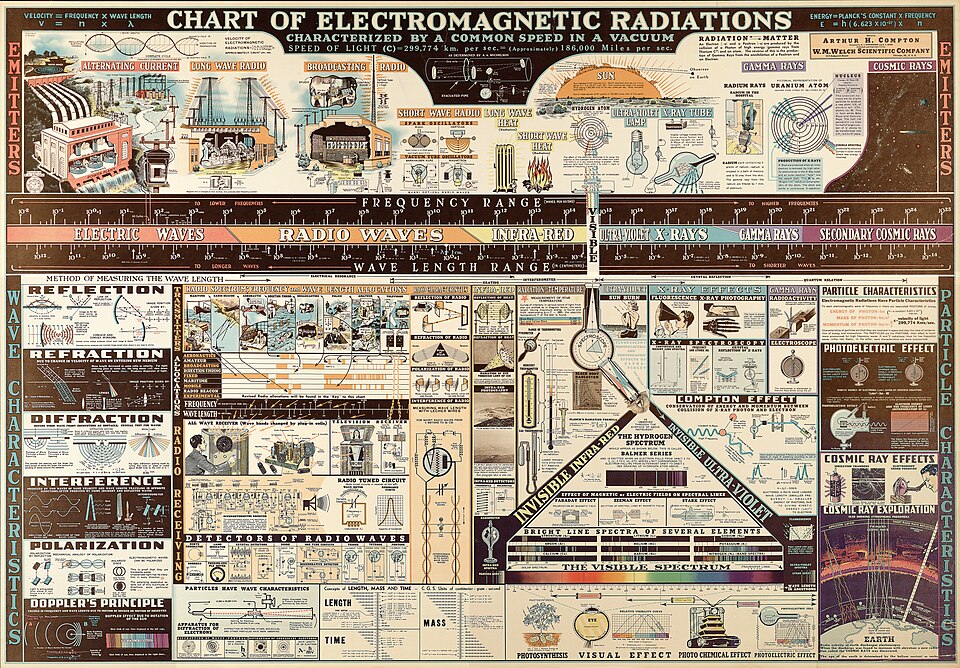 Frequency bands used in telecommunications. (Image: W.M Welch Scientific Company, Public domain, via Wikimedia Commons)
Real-World Example: Wi-Fi and Cellular Bands
- Wi-Fi (IEEE 802.11): Uses 2.4 GHz (ISM band) and 5 GHz (unlicensed) for wireless LANs.
- 4G/5G Cellular: Operates in 600 MHz–3.5 GHz (sub-6 GHz) and mmWave (24–100 GHz) for high-speed data.
Signal Parameters: Amplitude, Frequency, Phase
Every signal is defined by three key parameters:
| Parameter | Definition | Example |
|---|---|---|
| Amplitude | Strength of the signal (peak value) | Loudness of a voice signal. |
| Frequency | Number of cycles per second (Hz) | Pitch of a sound (e.g., 440 Hz = A4). |
| Phase | Position in the cycle (degrees) | Synchronization in CDMA. |
Worked Example: AM Radio
- A 1 MHz carrier wave is modulated by a 1 kHz audio signal.
- The amplitude of the carrier varies with the audio signal’s amplitude.
- Frequency remains 1 MHz; only amplitude changes.
sequenceDiagram participant Audio as Audio Signal (1 kHz) participant Carrier as Carrier Wave (1 MHz) Audio->>Carrier: Modulates
  Carrier-->>Carrier: Original (1 MHz)
  Carrier-->>Carrier: Amplitude-modulated (1 kHz envelope)
  Carrier-->>Receiver: Transmitted AM Signal
  Carrier-->>Receiver: Frequency remains constant
Bandwidth: The Capacity of a Signal
Bandwidth is the range of frequencies a signal occupies (measured in Hz). It determines:
- Data rate: Higher bandwidth = more data per second (e.g., 100 MHz = 100 Mbps in digital).
- Signal quality: Narrowband (e.g., voice) vs. broadband (e.g., HD video).
Types of Bandwidth
| Type | Definition | Example |
|---|---|---|
| Narrowband | < 300 Hz | Telephone voice (300–3400 Hz). |
| Voiceband | 300–3400 Hz | POTS (Plain Old Telephone Service). |
| Broadband | > 1 MHz | Internet (DSL, fiber). |
| Ultra-wideband | > 500 MHz (or > 20% of center freq) | UWB radar, 5G mmWave. |
Worked Example: Internet Bandwidth
- A 100 Mbps connection means 100 MHz of bandwidth (assuming 1 bit/Hz).
- Nepal’s NTC offers broadband up to 1 Gbps (1000 MHz bandwidth) via fiber.
Modulation: Encoding Data onto Signals
Modulation encodes digital data onto analog signals for transmission. Key techniques:
1. Amplitude Modulation (AM)
- Varies amplitude of the carrier wave.
- Pros: Simple, long-range (e.g., AM radio).
- Cons: Susceptible to noise.
2. Frequency Modulation (FM)
- Varies frequency of the carrier wave.
- Pros: Better noise immunity (e.g., FM radio, Wi-Fi).
- Cons: More complex circuitry.
3. Phase Modulation (PM)
- Varies phase of the carrier wave.
- Pros: High data rates (e.g., digital TV, 5G).
| Modulation | Parameter Changed | Noise Resistance | Example Use Case |
|---|---|---|---|
| AM | Amplitude | Low | AM radio, old TV |
| FM | Frequency | High | FM radio, Wi-Fi |
| PM | Phase | Very High | Digital TV, 5G |
Worked Example: FM Radio in Nepal
- A 100 MHz carrier wave’s frequency shifts ±75 kHz for audio (deviation).
- Nepal’s Radio Nepal uses FM for clear sound over long distances.
Noise and Its Impact
Noise is unwanted interference that distorts signals. Types:
- Additive Noise: Random signals added to the original (e.g., thermal noise).
- Multiplicative Noise: Distorts amplitude/frequency (e.g., fading in wireless).
- Impulse Noise: Sudden spikes (e.g., lightning).
Signal-to-Noise Ratio (SNR)
Measures signal quality:
- SNR > 20 dB: Good (e.g., clear voice call).
- SNR < 0 dB: Unusable (e.g., static on a bad line).
Worked Example: Mobile Call in Kathmandu Traffic
- Scenario: A Pathao rider calls while driving in heavy traffic.
- Noise Sources:
- Engine noise (multiplicative).
- Other vehicles’ signals (interference).
- Solution: 4G/5G uses OFDM (Orthogonal Frequency-Division Multiplexing) to reduce interference.
In the Real World
eSewa and Khalti (Digital Payments)
- Use digital modulation (e.g., QAM in fiber optics) to transmit transaction data securely over the internet.
- Bandwidth: High-speed broadband (100 Mbps+) ensures low latency for payments.
Ncell and NTC (Mobile/Internet Services)
- 4G/5G networks use frequency bands like 1800 MHz and 2600 MHz for data.
- Noise cancellation: Advanced antennas reduce interference in crowded areas like Thamel.
Daraz and Online Shopping
- Packet transmission: Orders travel as digital packets over fiber (optical signals) or wireless (microwaves).
- Bandwidth: High-speed links ensure fast loading of product pages.
Exam Tip
- Memorize the spectrum: Know which bands are used for AM/FM, cellular, Wi-Fi, and satellite.
- Compare AM/FM/PM: Be ready to explain pros/cons and real-world uses (e.g., AM for long-range, FM for clarity).
- Calculate SNR: Given signal/noise power, compute SNR in dB.
- Bandwidth vs. Data Rate: Relate bandwidth (Hz) to data rate (bits/sec) using Nyquist’s theorem:
- Real-world applications: Link concepts to Nepalese services (e.g., NTC’s fiber uses optical modulation).
Based on the TU BIT syllabus for Introduction to Telecommunications, unit 2.
Discussion
Loading…