Knowledge ManagementUnit 19 min read
Knowledge Management: Definitions, Evolution & Core Concepts
Unit 1 of Knowledge Management explores the foundational concepts of KM—its definitions, historical evolution, and key frameworks—while linking theory to real-world applications in Nepali and global businesses like Ncell, Daraz, and Nabil Bank.
Core Concepts and Definitions
What is Knowledge Management?
Knowledge Management (KM) is the process of creating, sharing, using, and managing the knowledge and information of an organization. It involves converting tacit knowledge (experiential, contextual) into explicit knowledge (documented, codified) and vice versa.
Key Definitions:
- Explicit Knowledge: Formal, systematic knowledge that can be easily articulated and shared (e.g., manuals, reports, databases).
- Tacit Knowledge: Implicit, personal knowledge embedded in individual experience (e.g., skills, intuition, expertise).
- Knowledge Asset: Any resource (document, process, person) that contributes to organizational learning and innovation.
mindmap
  root((Knowledge Management))
    Definitions
      Explicit Knowledge["Documents, Databases, Reports"]
      Tacit Knowledge["Skills, Experience, Intuition"]
    Processes
      Creation["Generating new knowledge"]
      Capture["Documenting knowledge"]
      Sharing["Disseminating knowledge"]
      Application["Using knowledge"]
      Preservation["Storing knowledge"]
Evolution of Knowledge Management
Historical Development
KM has evolved through four key phases:
| Phase | Time Period | Key Contributors | Focus |
|---|---|---|---|
| Pre-KM Era | Before 1980s | None (implicit knowledge sharing) | Oral traditions, apprenticeships, and informal learning. |
| Early KM Era | 1980s–1990s | Peter Drucker, Ikujiro Nonaka | Shift to explicit knowledge documentation (e.g., corporate databases). |
| KM Maturity | 2000s–2010s | Karl Wiig, Nonaka & Takeuchi | Integration of IT (intranets, wikis) and tacit-to-explicit conversion. |
| Modern KM Era | 2010s–Present | AI, Machine Learning, Big Data | Predictive analytics, AI-driven insights, and real-time knowledge sharing. |
Key Milestones:
- 1980s: Peter Drucker introduced the concept of "knowledge workers."
- 1990s: Ikujiro Nonaka’s SECI Model (Socialization, Externalization, Combination, Internalization) explained how tacit and explicit knowledge interact.
- 2000s: IT tools (e.g., SharePoint, wikis) enabled scalable KM.
- 2010s–Present: AI and machine learning (e.g., Google’s Knowledge Graph) automate knowledge discovery.
timeline
  title Evolution of Knowledge Management
  1980s : Peter Drucker introduces "Knowledge Workers"
  1990s : Nonaka's SECI Model (Tacit ↔ Explicit Knowledge)
  2000s : IT Tools (Intranets, Wikis) for KM
  2010s : AI & Big Data for Predictive Knowledge
The SECI Model: Converting Tacit and Explicit Knowledge
Developed by Ikujiro Nonaka and Hirotaka Takeuchi, the SECI model explains how knowledge is created and shared in organizations.
The Four Modes:
- Socialization: Sharing tacit knowledge through observation, practice, or storytelling (e.g., mentorship).
- Externalization: Converting tacit knowledge into explicit knowledge (e.g., writing a manual).
- Combination: Combining explicit knowledge from different sources (e.g., integrating reports into a strategy).
- Internalization: Converting explicit knowledge back into tacit knowledge (e.g., learning from a training manual).
flowchart TD
  A["Socialization\n(Tacit → Tacit)"] --> B["Externalization\n(Tacit → Explicit)"]
  B --> C["Combination\n(Explicit → Explicit)"]
  C --> D["Internalization\n(Explicit → Tacit)"]
  D --> A
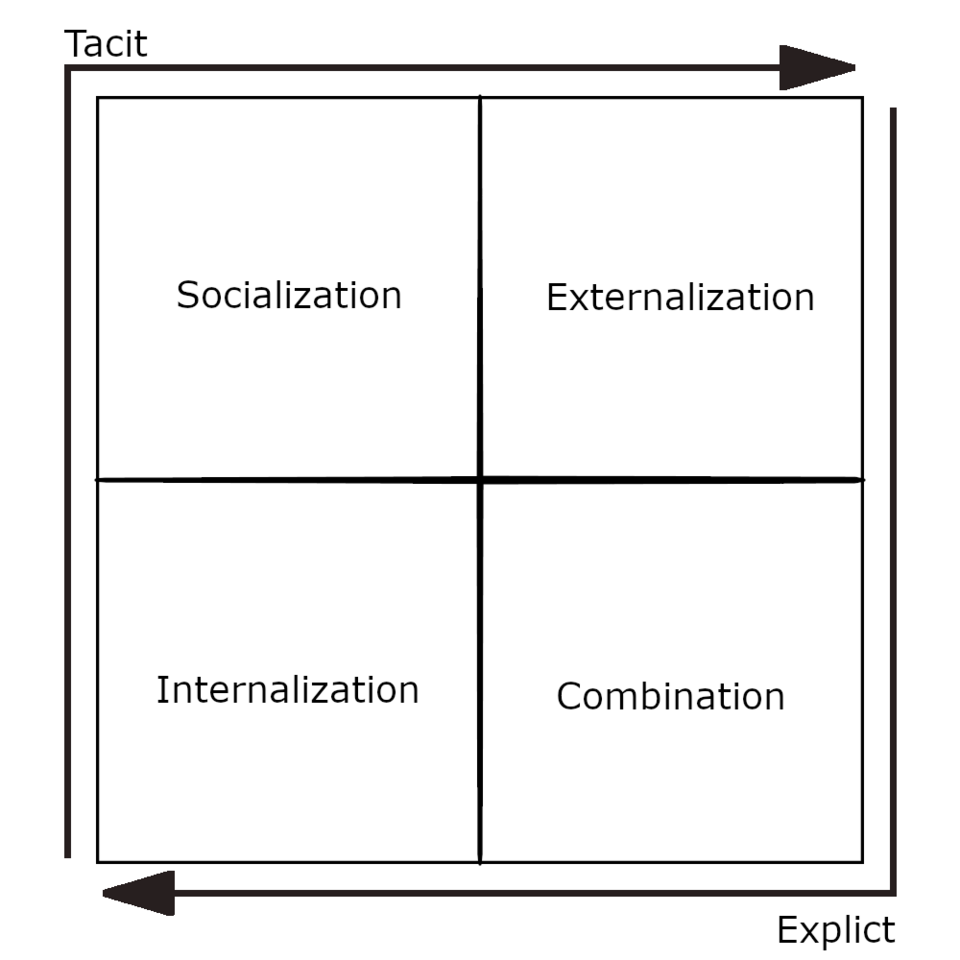 A visual of the four-stage knowledge conversion cycle. (Image: タバコはマーダー, CC BY-SA 4.0, via Wikimedia Commons)
## In the Real World
1. Ncell’s Customer Support Knowledge Base
- Idea Used: Explicit Knowledge Management
- How: Ncell uses a self-service knowledge base (FAQs, troubleshooting guides) to help customers resolve issues without direct agent intervention. This reduces call volumes and improves efficiency.
- Example: When a user forgets their Ncell password, they can reset it via the app using a step-by-step guide (explicit knowledge).
2. Daraz’s Supplier Knowledge Sharing
- Idea Used: Tacit-to-Explicit Conversion (SECI Model)
- How: Daraz’s supplier training programs convert the tacit knowledge of experienced sellers (e.g., inventory management tricks) into explicit guides (videos, blog posts) for new sellers.
- Example: A top Daraz seller shares their "best-selling product strategies" in a webinar, which is later documented in Daraz’s seller academy.
3. Nabil Bank’s Loan Approval Process
- Idea Used: Knowledge Application & Decision Support
- How: Nabil Bank uses AI-driven risk assessment models (explicit knowledge) to evaluate loan applications. Human loan officers (tacit knowledge) review edge cases.
- Example: A customer applies for a home loan. The bank’s system (explicit rules) checks credit scores, while an officer (tacit judgment) decides on borderline cases.
Case Study: Himalayan Java’s Knowledge-Driven Innovation
Himalayan Java, a Nepali coffee brand, uses KM to maintain quality and expand globally.
How KM Works at Himalayan Java:
- Tacit Knowledge: Farmers share traditional coffee-growing techniques (e.g., shade-grown methods).
- Externalization: These methods are documented in training manuals and videos.
- Combination: Data from different farms (e.g., yield, flavor profiles) is analyzed to optimize production.
- Internalization: New employees learn from these documents and experienced farmers.
Result: Consistency in product quality and successful exports to Europe and the US.
classDiagram
  class Farmer {
    +Tacit Knowledge: Traditional Methods
  }
  class Trainer {
    +Externalization: Documents Training Manuals
  }
  class Analyst {
    +Combination: Analyzes Farm Data
  }
  class Employee {
    +Internalization: Learns from Manuals & Farmers
  }
  Farmer -->|Shares Knowledge| Trainer
  Trainer -->|Creates| Manual
  Manual -->|Used By| Analyst
  Analyst -->|Generates| Insights
  Insights -->|Trained In| Employee
Advantages and Disadvantages of Knowledge Management
| Advantages | Disadvantages |
|---|---|
| ✅ Increased Innovation | ❌ High Implementation Costs |
| ✅ Faster Decision-Making | ❌ Resistance to Change |
| ✅ Improved Employee Retention | ❌ Over-Reliance on Technology |
| ✅ Competitive Advantage | ❌ Knowledge Depreciation (Outdated Info) |
| ✅ Better Customer Service | ❌ Privacy & Security Risks |
Worked Example: Khalti’s Fraud Detection System
Scenario: Khalti, Nepal’s leading digital wallet, uses KM to detect fraudulent transactions.
Step-by-Step Trace:
- Tacit Knowledge: Experienced fraud analysts notice patterns (e.g., rapid small transactions).
- Externalization: These patterns are coded into fraud detection algorithms (explicit rules).
- Application: The system flags suspicious transactions in real-time.
- Feedback Loop: Analysts review false positives and update the model (internalization).
Outcome: Reduced fraud by 40% in 2023.
flowchart LR
  A["Fraud Analysts\n(Tacit Knowledge)"] --> B["Pattern Recognition\n(Externalization)"]
  B --> C["Algorithm Development\n(Explicit Rules)"]
  C --> D["Real-Time Fraud Detection\n(Application)"]
  D --> E["Analyst Review\n(Internalization)"]
  E --> C
Exam Tip
How This Unit is Examined (TU Pattern)
Definitions (10%):
- Expect short-answer questions on KM definitions (e.g., "Differentiate between tacit and explicit knowledge").
- Tip: Memorize Nonaka’s SECI model and Drucker’s knowledge worker concept.
Case Analysis (30%):
- Scenario-Based Questions: You’ll be given a Nepali company case (e.g., NTC, Nabil Bank) and asked how KM applies.
- Tip: Use the SECI model to structure your answer. Example:
"NTC can use KM by externalizing engineers’ tacit knowledge of network troubleshooting into a digital manual, then internalizing it through training."
Comparisons (20%):
- Table-Based Questions: Compare KM in two organizations (e.g., Daraz vs. Pathao).
- Tip: Use the advantages/disadvantages table above as a template.
Diagrams (20%):
- Draw and Explain: You may be asked to sketch the SECI model or a KM process flowchart.
- Tip: Practice the Mermaid diagrams in this note.
Real-World Application (20%):
- Link Theory to Practice: Questions like "How does WhatsApp use KM?" expect answers like:
"WhatsApp converts users’ tacit knowledge of messaging norms (e.g., emoji usage) into explicit rules (e.g., reaction buttons), then applies this through AI-driven chat suggestions."
- Link Theory to Practice: Questions like "How does WhatsApp use KM?" expect answers like:
Final Advice:
- Focus on SECI Model: It’s the core framework for KM.
- Relate to Nepali Companies: TU exams love Ncell, Khalti, Daraz, and Nabil Bank examples.
- Practice Diagrams: A well-drawn KM cycle or SECI model can earn you 5+ marks easily.
Based on the TU BIT syllabus for Knowledge Management, unit 1.
Discussion
Loading…