Network and System AdministrationUnit 1110 min read
Bandwidth Management & Multicast: QoS, Traffic Shaping, Multicast Protocols
Unit 11 of Network and System Administration explores how networks optimize data flow through bandwidth management techniques (QoS, traffic shaping, policing) and multicast communication (IGMP, PIM, multicast routing), with real-world examples from NTC’s video streaming and NEPSE’s stock feeds.
TAKEAWAYS:
- Bandwidth management ensures fair resource allocation using QoS (Quality of Service) policies like prioritizing VoIP over file transfers.
- Traffic shaping delays or buffers excess traffic to prevent congestion, while policing drops non-compliant packets.
- Multicast sends one copy of data to multiple receivers (e.g., live sports streams), saving bandwidth vs. unicast.
- IGMP registers multicast group members, while PIM (Protocol Independent Multicast) handles routing between routers.
- Multicast routing protocols (DVMRP, MOSPF) differ in scalability and network topology support.
- Real-world impact: NTC uses multicast for IPTV to deliver TV channels efficiently, while NEPSE’s stock tickers rely on multicast for low-latency updates.
Core Concepts: Bandwidth Management
What is Bandwidth Management?
Bandwidth management controls how network resources are allocated among users/applications to prevent congestion, ensure fairness, and meet Service Level Agreements (SLAs). Without it, critical traffic (e.g., VoIP calls) may starve during peak hours.
Key Techniques:
Quality of Service (QoS)
- Prioritizes traffic based on type (voice/video/data), source/destination, or contractual guarantees.
- Uses DSCP (Differentiated Services Code Point) in IP headers to mark packets.
- Example: Skype (VoIP) gets higher priority than a large file download.
Traffic Shaping
- Delays or buffers excess traffic to smooth out bursts, ensuring compliance with bandwidth limits.
- Uses queues (FIFO, Priority, WFQ) and token bucket algorithms.
- Example: A university blocks YouTube during exams but allows gradual uploads via shaping.
Traffic Policing
- Drops or marks packets exceeding agreed limits (no buffering).
- Example: ISPs police torrent traffic to prevent congestion.
Worked Example: NTC’s IPTV Bandwidth Allocation
Scenario: NTC provides IPTV to 10,000 households. Each channel requires 4 Mbps, but the backbone link is 1 Gbps. How does NTC manage bandwidth?
QoS Prioritization:
- Assign DSCP EF (Expedited Forwarding) to IPTV packets.
- Limit P2P traffic to 10% of bandwidth using policing.
Traffic Shaping:
- During peak hours (7–10 PM), shape non-IPTV traffic to 300 Mbps (leaving 700 Mbps for IPTV).
- Use a token bucket with rate = 300 Mbps, burst size = 500 Mbps.
Result:
- IPTV streams remain smooth (no buffering).
- Households experience throttled speeds for downloads but no drops.
Multicast: Efficient One-to-Many Communication
How Multicast Works
Multicast sends one copy of data to a group of interested receivers using multicast addresses (224.0.0.0–239.255.255.255). Routers replicate packets only where needed, saving bandwidth.
Key Components:
Multicast Groups:
- Defined by IP multicast addresses (e.g., 224.0.1.1 for all routers).
- Hosts join using IGMP (Internet Group Management Protocol).
Multicast Routing Protocols:
- PIM (Protocol Independent Multicast): Most common; works with any unicast routing protocol.
- DVMRP (Distance Vector Multicast Routing Protocol): Older, uses flooding.
- MOSPF (Multicast OSPF): Extends OSPF for multicast.
Multicast Forwarding:
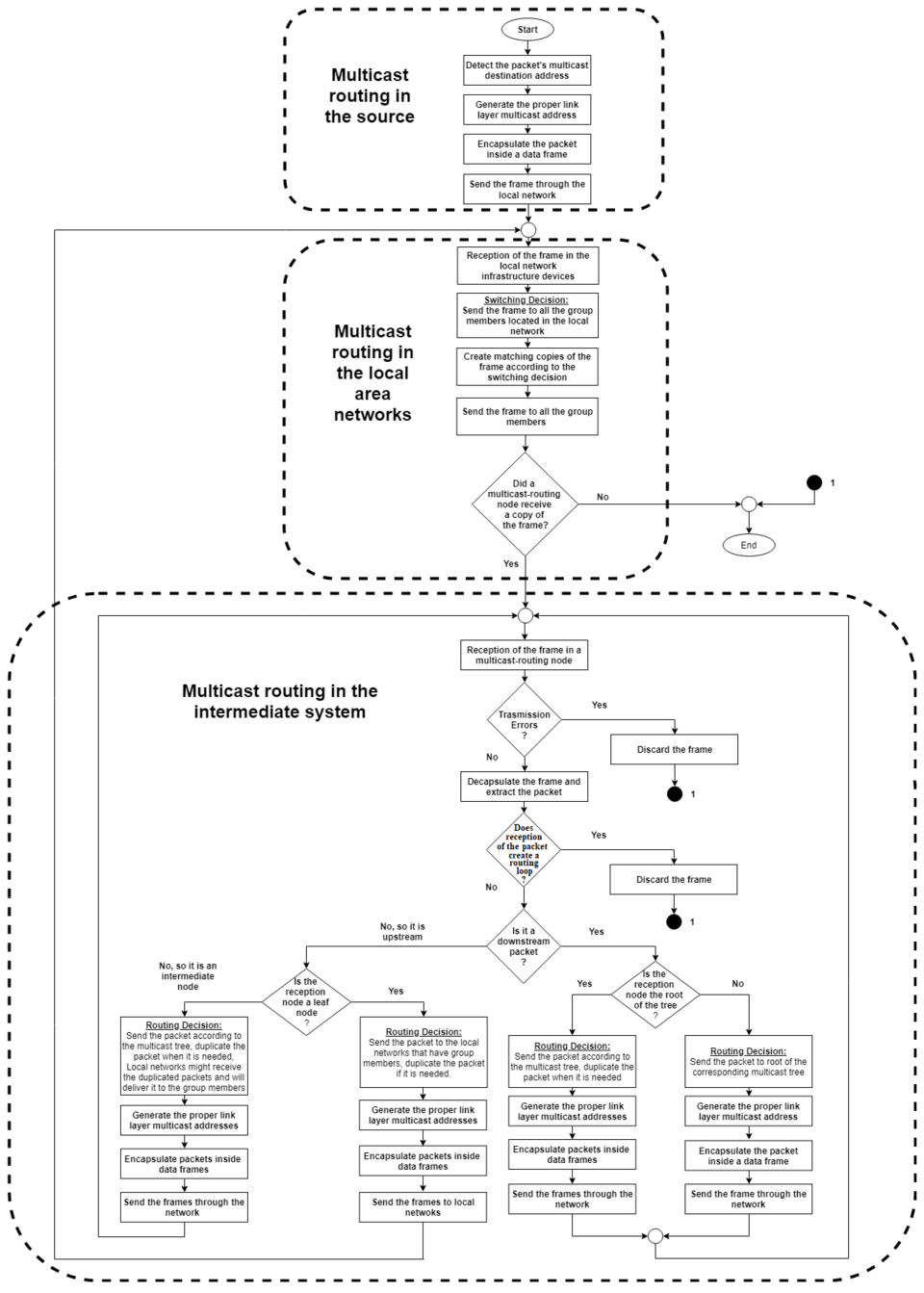
- Routers use Reverse Path Forwarding (RPF) to avoid loops.
- Multicast Distribution Trees:
- Source Tree (Shortest Path Tree): Direct from source to receivers.
- Shared Tree (Core-Based Tree): All receivers share a common root (e.g., PIM-SM).
sequenceDiagram
    participant Host as Multicast Sender (224.0.1.1)
    participant Router1 as Router A
    participant Router2 as Router B
    participant Host1 as Receiver 1
    participant Host2 as Receiver 2
    Host->>Router1: IGMP Join (Host1)
    Host->>Router1: IGMP Join (Host2)
    Router1->>Router2: PIM Join Tree
    Host->>Router1: Multicast Packet
    Router1->>Router2: Forward Packet (RPF Check)
    Router2->>Host1: Deliver Packet
    Router2->>Host2: Deliver Packet
Real-World Multicast Examples
NTC’s IPTV:
- Uses multicast to deliver 50+ TV channels over a single backbone link.
- Without multicast, unicast would require 50× the bandwidth.
NEPSE Stock Tickers:
- Brokers receive real-time stock updates via multicast (239.0.0.1) instead of polling servers.
WhatsApp Group Calls:
- Uses multicast-like techniques to sync audio/video streams to all participants.
 A network showing PIM-SM shared trees for multicast groups. (Image: Michel Bakni, CC BY-SA 4.0, via Wikimedia Commons)
Comparing Unicast, Multicast, and Broadcast
| Feature | Unicast | Multicast | Broadcast |
|---|---|---|---|
| Recipients | One | Multiple (group) | All |
| Address | Destination IP | 224.0.0.0–239.255.255.255 | 255.255.255.255 |
| Bandwidth | High (N× copies) | Low (1× copy) | High (floods network) |
| Use Case | Web browsing | Live streams, stock feeds | DHCP, ARP |
| Protocol | TCP/UDP | IGMP + PIM/DVMRP | Limited scope |
Multicast Protocols Deep Dive
1. IGMP (Internet Group Management Protocol)
- Purpose: Registers hosts to multicast groups.
- Versions:
- IGMPv1/v2: Uses membership queries/reports.
- IGMPv3: Allows source filtering (join specific sources).
Example Trace:
- Host sends IGMP Join for 224.0.1.1.
- Router sends IGMP Query to check group members.
- Host responds with IGMP Report.
- Router adds the host to its Multicast Forwarding Table.
stateDiagram-v2
    [*] --> Host: Idle
    Host --> Join: IGMP Join (224.0.1.1)
    Join --> Query: Router sends IGMP Query
    Query --> Report: Host sends IGMP Report
    Report --> Active: Router updates MFIB
2. PIM (Protocol Independent Multicast)
- Modes:
- PIM-DM (Dense Mode): Floods first, prunes later (inefficient for sparse groups).
- PIM-SM (Sparse Mode): Uses a Rendezvous Point (RP) for shared trees (scalable).
- PIM-SSM (Source-Specific Multicast): Receivers specify exact sources.
Example: NEPSE’s Multicast Stock Feed
- RP: NEPSE’s central router (224.0.0.1).
- Sources: Stock exchange servers (192.168.1.10).
- Receivers: Broker terminals (join 239.0.0.1).
- Flow:
- Broker sends PIM Join to RP for (S,G) = (192.168.1.10, 239.0.0.1).
- RP builds a shared tree to all brokers.
- Stock updates are sent once, replicated only where needed.
Bandwidth Management in Action: Pathao’s Ride-Hailing
Scenario: Pathao’s servers handle 10,000 ride requests/sec during Diwali. How does it manage bandwidth?
QoS Policies:
- Priority 1: Ride confirmation messages (UDP, low latency).
- Priority 2: Driver location updates (TCP, periodic).
- Priority 3: Chat messages (best-effort).
Traffic Shaping:
- Limits driver apps to 5 Mbps upload (to prevent GPS spam).
- Uses Hierarchical Token Bucket (HTB) to isolate traffic.
Multicast for Notifications:
- Uses multicast (239.192.0.1) to send promotions to all active users simultaneously.
Result:
- 99.9% uptime during peak hours.
- No single user can congest the network.
Exam Tip: How This Unit is Tested
Definitions & Comparisons (3–5 marks):
- Differentiate QoS vs. Traffic Shaping vs. Policing.
- Explain multicast vs. broadcast with examples.
Scenario-Based Questions (5–8 marks):
- Given a network diagram, design QoS policies for VoIP + file transfers.
- Trace IGMP/PIM messages for a multicast group join.
Calculations (4–6 marks):
- Calculate bandwidth savings if NTC switches from unicast to multicast for IPTV.
- Determine token bucket parameters for traffic shaping.
Real-World Applications (2–4 marks):
- Explain how NEPSE uses multicast for stock feeds.
- Describe Pathao’s QoS strategy for ride requests.
Common Pitfalls:
- Confusing PIM-DM (flood-and-prune) with PIM-SM (shared tree).
- Forgetting that multicast requires IGMP on hosts + PIM on routers.
- Ignoring RPF checks in multicast routing (leads to loops).
Quick Revision Table
| Topic | Key Idea | Real-World Use Case |
|---|---|---|
| QoS | Prioritize traffic using DSCP markings | Ncell VoIP calls |
| Traffic Shaping | Buffer excess traffic to meet SLAs | NTC IPTV during peak hours |
| Traffic Policing | Drop packets exceeding limits | ISPs throttling torrent traffic |
| IGMP | Hosts join multicast groups | NEPSE stock feed subscribers |
| PIM-SM | Shared trees for scalable multicast | WhatsApp group video calls |
| Multicast Savings | 1× copy vs. N× copies (unicast) | YouTube live streams |
Final Checklist for Exams
- Can you draw a multicast distribution tree (shared vs. source)?
- Do you know the IGMP message flow for joining a group?
- Can you calculate bandwidth savings for multicast vs. unicast?
- Are you familiar with QoS tools (DSCP, CBQ, HTB)?
- Can you explain PIM-DM vs. PIM-SM with a diagram?
Based on the TU BIT syllabus for Network and System Administration (BIT451), unit 11.
Discussion
Loading…