Basic MathematicsUnit 58 min read
Integration – Definite, Indefinite, and Applications
Unit 5 of Basic Mathematics: a comprehensive guide to integration, covering antiderivatives, definite integrals, techniques such as substitution, integration by parts, partial fractions, and trigonometric substitution, with real‑world applications and exam strategies.
Key points
- Integration is the inverse operation of differentiation, yielding antiderivatives and areas under curves.
- Definite integrals compute exact areas, while indefinite integrals provide families of antiderivatives.
- Key techniques—substitution, integration by parts, partial fractions, trigonometric substitution—are chosen based on the integrand’s structure.
- Integration underpins continuous compounding, area calculations, and modeling of physical and economic systems.
- Mastery of integration requires practice with limits, algebraic manipulation, and method selection.
Overview
Integration is the mathematical process of finding the accumulation of quantities. In calculus, it is the inverse of differentiation. Two primary forms are used in the syllabus:
| Type | Symbol | Purpose | Example |
|---|---|---|---|
| Indefinite Integral | Find a family of antiderivatives . | ||
| Definite Integral | Compute exact area under from to . |
The unit is structured into five sections:
- Antiderivatives and Indefinite Integration
- Definite Integration and the Fundamental Theorem of Calculus
- Techniques of Integration
- Applications of Integration
- Integration in Real‑World Contexts
1. Antiderivatives and Indefinite Integration
An antiderivative of is a function such that . The indefinite integral is written as
where is an arbitrary constant.
Worked Example 1 – Polynomial Antiderivative
Find .
Hence
2. Definite Integration and the Fundamental Theorem of Calculus
The definite integral gives the net signed area between the curve and the -axis over .
Fundamental Theorem of Calculus (Part 1)
If is an antiderivative of on , then
Worked Example 2 – Computing a Definite Integral
Evaluate .
Antiderivative: .
Apply the theorem:
Figure: Graph of from to and the area under the curve
3. Techniques of Integration
| Technique | When to Use | Example |
|---|---|---|
| Substitution | Integrand contains a function and its derivative | |
| Integration by Parts | Product of two functions | |
| Partial Fractions | Rational function with linear/quadratic factors | |
| Trigonometric Substitution | Integrals involving , , |
3.1 Substitution
Let . Then .
Example 3 – Substitution
Set , .
3.2 Integration by Parts
Example 4 – Integration by Parts
Choose , . Then , .
3.3 Partial Fractions
Decompose into simpler fractions.
Example 5 – Partial Fractions
Decompose:
Solve: , .
3.4 Trigonometric Substitution
Use substitutions like to simplify square roots.
Example 6 – Trigonometric Substitution
Let , .
Since , .
4. Applications of Integration
| Application | Integration Concept | Real‑World Example |
|---|---|---|
| Continuous compounding | derived from | Bank interest calculations |
| Area of irregular shapes | Definite integrals over curves | Calculating land area for property tax |
| Work done by a variable force | Engineering: force along a beam | |
| Population growth | Epidemiology: spread of disease |
Worked Example 7 – Continuous Compounding
A student deposits $10,000 in a savings account with an annual interest rate of 5 % compounded continuously. Find the amount after 3 years.
5. Integration in Real‑World Contexts
In the real world
- eSewa – Continuous Interest on Credit
eSewa calculates interest on credit balances using continuous compounding. The formula is an integral of the instantaneous growth rate . - Daraz – Order Queue Modeling
The average number of orders in the queue over time is modeled by , where is the arrival rate. Integration gives total orders processed. - Kathmandu Traffic – Travel Time Estimation
Travel time along a stretch with variable speed is . Integration sums infinitesimal time intervals over distance.
Concrete Worked Example – Kathmandu Traffic
Assume speed varies as km/h over a 20 km stretch ( in km). Compute travel time.
Let , , .
Visuals
Figure: Definite Integral of from 0 to 3
Figure: Number Line Showing Limits of Integration
Figure: Bar Chart of Integration Techniques
Mermaid Flowchart – Choosing an Integration Technique
flowchart TD
    A["Start"] --> B{"Is integrand a product?"}
    B -->|"Yes"| C["Use Integration by Parts"]
    B -->|"No"| D{"Is integrand a rational function?"}
    D -->|"Yes"| E["Use Partial Fractions"]
    D -->|"No"| F{"Does integrand contain sqrt(a^2 - x^2)?"}
    F -->|"Yes"| G["Use Trig Substitution"]
    F -->|"No"| H["Use Substitution"]
Advantages and Disadvantages of Integration Techniques
| Technique | Advantage | Disadvantage |
|---|---|---|
| Substitution | Simplifies integrals with composite functions | Requires recognition of inner function |
| Integration by Parts | Handles products of algebraic and transcendental functions | Can lead to recursive integrals |
| Partial Fractions | Breaks down rational functions into simple terms | Only works for rational functions |
| Trig Substitution | Handles square roots of quadratic expressions | Requires trigonometric identities |
Exam tip
- Identify the type of integral: Indefinite vs. definite.
- Select the appropriate technique: Use the flowchart above as a quick reference.
- Check limits carefully: For definite integrals, evaluate the antiderivative at upper and lower limits.
- Simplify before integrating: Factor, expand, or rationalize to reduce complexity.
- Show all steps: Partial credit is awarded for method selection and intermediate steps.
- Practice with real‑world problems: Continuous compounding, area calculations, and work problems are common.
Real pictures
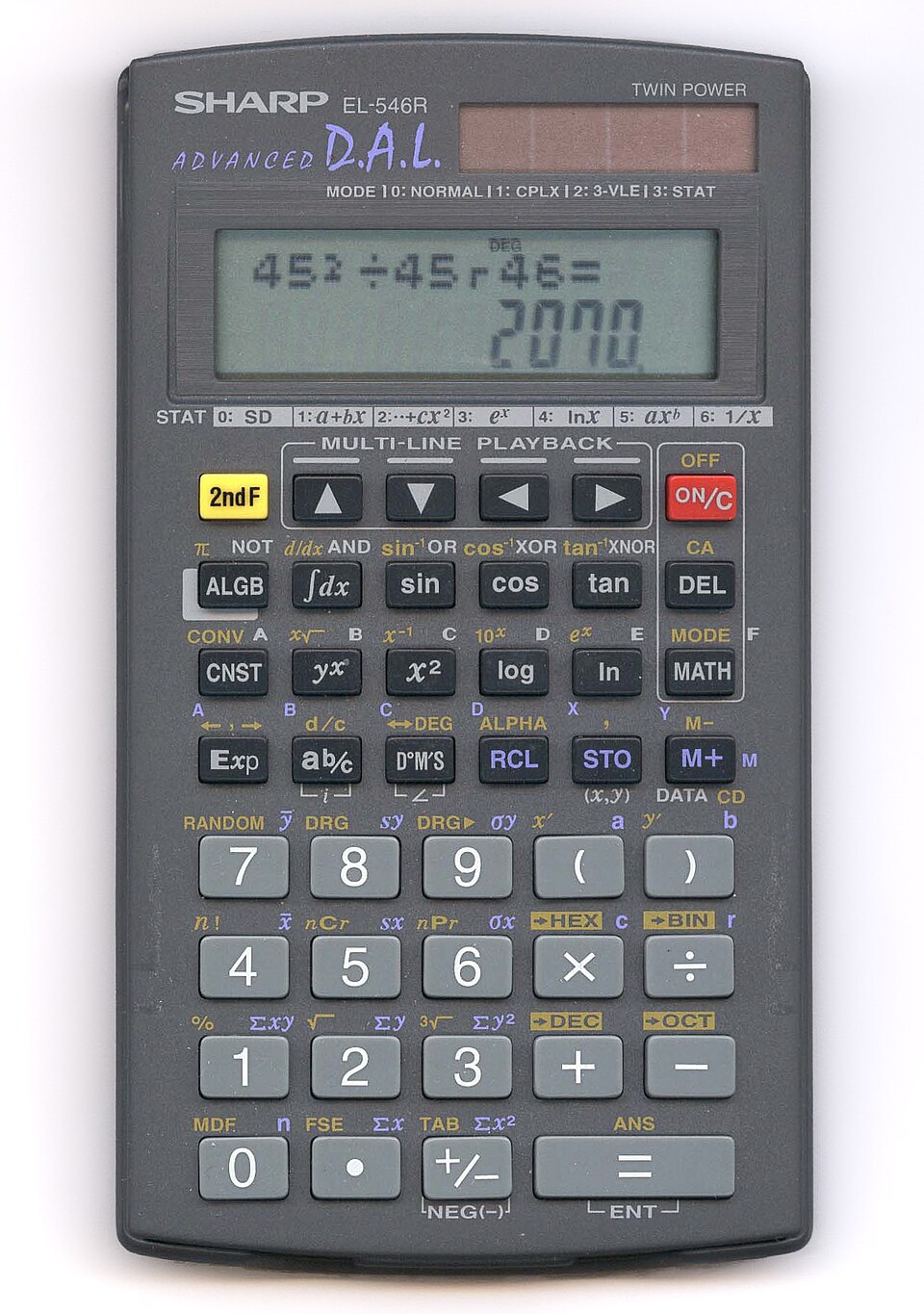 A scientific calculator used for integration calculations (Image: Matti Blume, CC BY-SA 2.0, via Wikimedia Commons)
 Graph paper for sketching functions and integration limits (Image: Mikus, CC BY-SA 4.0, via Wikimedia Commons)
Based on the TU BITM syllabus for Basic Mathematics (MTH204), unit 5.
Discussion
Loading…