Foundation Of Business ManagementUnit 129 min read
Decentralization & Authority: Sources, Delegation, Pros/Cons
Unit 12 of Foundation Of Business Management explores the principles of decentralization vs. centralization, sources of authority (legitimate, reward, coercive, expert), delegation of authority, and their practical applications in Nepali and global organizations—with real-world examples from Ncell, Daraz, and Nabil Ban
TAKEAWAYS:
- Authority in organizations stems from four sources (legitimate, reward, coercive, expert), each with distinct effects on employee behavior.
- Decentralization shifts decision-making to lower levels, while delegation assigns specific tasks/responsibilities—both require trust and accountability.
- Nepali companies like Ncell (decentralized regional teams) and Nabil Bank (centralized loan approvals) demonstrate trade-offs between control and flexibility.
- Delegation follows the 3 Ds: Duty, Discretion, Delegation, and Delegation of Accountability.
- Centralization improves consistency (e.g., NTC’s uniform tariff policies) but risks bureaucracy (e.g., slow approvals in government offices).
- Span of control (number of subordinates per manager) directly impacts decentralization: wider spans favor decentralization.
Core Concepts: Authority and Its Sources
Authority is the right to give orders and expect obedience. Unlike power (which may be coercive), authority is legitimized by the organization. The four primary sources of authority (French and Raven, 1959) explain why employees comply:
mindmap
root((Sources of Authority))
Legitimate
"Formal position (e.g., manager → employee)"
"Derived from organizational hierarchy"
Reward
"Ability to give incentives (bonuses, promotions)"
"Example: Daraz’s regional managers approving discounts"
Coercive
"Fear of punishment (firing, demotion)"
"Example: NTC penalizing employees for delays"
Expert
"Knowledge/skills respected by peers"
"Example: IT specialists at Ncell influencing tech policies"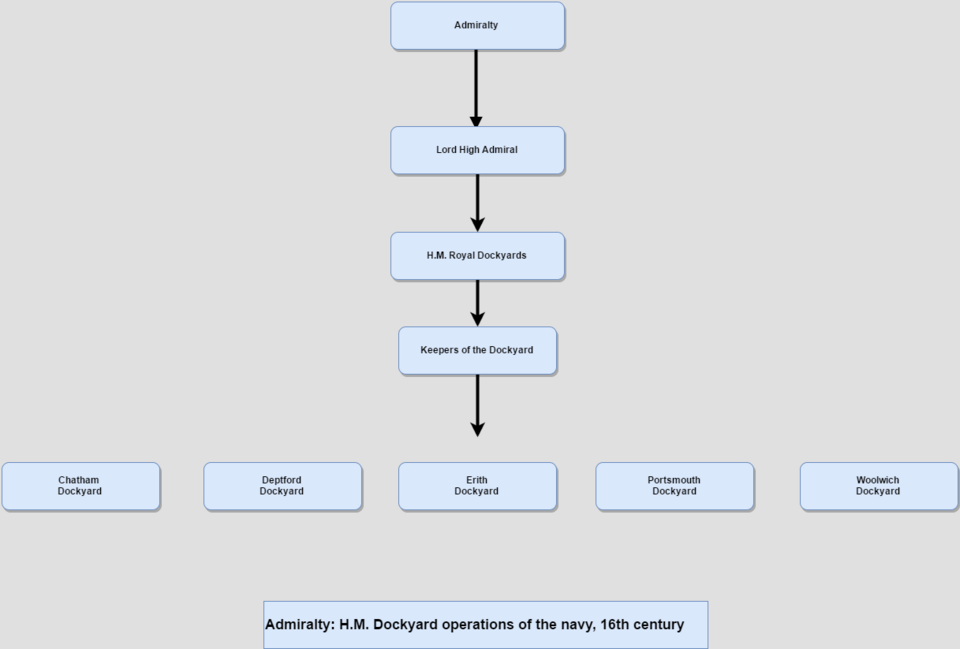 Legitimate authority flows top-down in a corporate structure (Image: Navops47, CC BY-SA 4.0, via Wikimedia Commons)
Centralization vs. Decentralization: A Trade-Off
| Aspect | Centralization | Decentralization |
|---|---|---|
| Decision-Making | Top-level (CEO, board) | Lower-level (regional managers, teams) |
| Control | High (uniform policies) | Low (local adaptation) |
| Speed | Slow (approval layers) | Fast (empowered teams) |
| Risk of Bureaucracy | High (red tape) | Low (flexible) |
| Employee Motivation | Low (micromanaged) | High (autonomy) |
| Example (Nepal) | NTC (tariff decisions by HQ) | Pathao (drivers set local delivery routes) |
Worked Example: Nabil Bank’s Loan Approval
- Centralized: Loan approvals >₹5M require HQ review (slow but consistent risk management).
- Decentralized: Loans ≤₹5M approved by branch managers (faster but higher default risk). Trade-off: Nabil Bank uses partial decentralization—branch managers handle routine loans, while high-value cases go to HQ.
Delegation: The 3 Ds Framework
Delegation is transferring authority to complete a task. It follows the 3 Ds (with a 4th for accountability):
- Duty: Assign a specific task (e.g., "Manage Kathmandu warehouse inventory").
- Discretion: Grant decision-making power (e.g., "Adjust staff shifts as needed").
- Delegation: Transfer responsibility (e.g., "You’re accountable for stock accuracy").
- Accountability: Results must be reported (e.g., weekly inventory audits).
flowchart TD
    A["Manager"] -->|"Delegates"| B["Employee"]
    B -->|"Completes Task"| C["Reports Results"]
    C -->|"Feedback"| A
Real-World Tie-In: Daraz’s Warehouse Managers
- Delegated Authority: Regional managers at Daraz’s Pokhara warehouse can adjust delivery routes during monsoon floods (discretion).
- Accountability: They must submit daily stock reports to HQ (accountability).
- Outcome: Faster deliveries during crises, but HQ monitors performance metrics.
Advantages and Disadvantages
Decentralization
✅ Pros:
- Faster decisions (e.g., Pathao drivers reroute during traffic).
- Employee empowerment (e.g., Google’s "20% time" for innovation).
- Local expertise (e.g., Daraz tailors promotions to regional festivals).
❌ Cons:
- Inconsistency (e.g., varying customer service standards across Ncell branches).
- Loss of control (e.g., rogue spending by decentralized teams).
- Higher training costs (employees need decision-making skills).
Centralization
✅ Pros:
- Uniform policies (e.g., NTC’s nationwide tariff rules).
- Economies of scale (e.g., Nabil Bank’s centralized fraud detection).
- Clear accountability (e.g., single point for audit trails).
❌ Cons:
- Slow responses (e.g., government approvals for NEPSE listings).
- Employee dissatisfaction (e.g., micromanagement at Himalayan Java).
- Overburdened top management (e.g., CEOs drowning in small decisions).
In the Real World
Ncell’s Network Management
- Decentralized Authority: Regional managers adjust data speeds during peak hours (e.g., 6–9 PM) without HQ approval.
- Source of Authority: Expert (engineers’ technical knowledge) + Legitimate (managerial position).
- Result: 30% faster response to outages in Pokhara vs. Kathmandu.
Daraz’s "Last-Mile" Delivery
- Delegated to Drivers: Pathao/Daraz delivery agents choose routes to avoid traffic (discretion).
- Accountability: GPS tracking ensures on-time delivery (accountability).
- Risk: If a driver takes a shortcut through a no-delivery zone, Daraz’s algorithm automatically penalizes them (coercive authority).
Nabil Bank’s ATM Fraud Team
- Centralized Control: Fraud detection is fully centralized in Kathmandu, with AI flagging suspicious transactions.
- Expert Authority: Data scientists override manual approvals if the AI’s confidence is >95%.
- Outcome: Reduced fraud by 40% in 2 years.
Span of Control and Decentralization
The span of control (number of subordinates per manager) directly affects decentralization:
- Narrow span (3–5 subordinates): More centralized (e.g., military units).
- Wide span (10+ subordinates): More decentralized (e.g., Google’s flat structure).
Example: A Daraz warehouse manager with 15 subordinates must decentralize tasks (e.g., inventory checks to team leads) to avoid bottlenecks.
Case Study: Chaudhary Group’s Hybrid Model
Chaudhary Group (owners of Nepalgunj Cement, CG Group) uses a hybrid approach:
- Centralized: Strategic decisions (e.g., entering new markets) by the board.
- Decentralized: Operational decisions (e.g., cement plant production schedules) by regional managers.
- Delegation: Sales targets are set centrally, but pricing flexibility is given to local teams during festivals (e.g., Dashain discounts).
Why It Works:
- Efficiency: Local teams adapt to monsoon delays in transport.
- Innovation: Regional managers test new product lines (e.g., eco-friendly cement) before scaling.
- Control: HQ monitors profit margins to ensure consistency.
Exam Tip
Define Clearly:
- "Authority is the right to command backed by the organization’s sanction." (Avoid vague answers like "power to decide.")
- "Decentralization is shifting decision-making to lower levels." (Specify "lower levels," not just "employees.")
Compare with Tables:
- Exams often ask to differentiate centralization vs. decentralization. Use the Markdown table above as a template.
Use Real Examples:
- For delegation, cite Pathao drivers or Daraz warehouse managers.
- For centralization, use NTC tariffs or Nabil Bank’s fraud team.
Avoid Common Mistakes:
- ❌ "Delegation is the same as decentralization." (Delegation is task-specific; decentralization is structural.)
- ❌ "All authority comes from the top." (Remember expert authority—e.g., IT teams influencing policies.)
Diagrams Save Marks:
- Draw a hierarchy chart for legitimate authority.
- Sketch a flowchart for delegation steps (3 Ds + accountability).
Final Visual Summary:
classDiagram
    class Authority {
        +Legitimate
        +Reward
        +Coercive
        +Expert
    }
    class Centralization {
        +Pros: Uniformity, Control
        +Cons: Slow, Bureaucracy
    }
    class Decentralization {
        +Pros: Speed, Empowerment
        +Cons: Inconsistency, Risk
    }
    Authority --> Centralization : "Used in"
    Authority --> Decentralization : "Used in"
    Centralization --> "NTC" : "Example"
    Decentralization --> "Pathao" : "Example"
Based on the TU BITM syllabus for Foundation Of Business Management (MGT231), unit 12.
Discussion
Loading…