Foundation Of Information TechnologyUnit 1314 min read
Decision Support Systems, Business Applications & Emerging Tech
Unit 13 of Foundation Of Information Technology explores how IT-driven decision-making tools (DSS, DSS components, groupware) transform business operations, with real-world examples from Nepalese companies like eSewa, Ncell, and Daraz, plus emerging technologies (IoT, AI, blockchain) that enhance efficiency, security,
TAKEAWAYS:
- Decision Support Systems (DSS) combine data, models, and user interaction to help managers make semi-structured decisions (e.g., eSewa’s fraud detection).
- Business applications of IT include automation (Khalti’s payment routing), analytics (Ncell’s customer segmentation), and multimedia (Daraz’s product catalogs).
- Emerging technologies like IoT (NTC’s smart grids), AI (Pathao’s dynamic pricing), and blockchain (NEPSE’s secure trading) redefine operational efficiency.
- Group Decision Support Systems (GDSS) enable collaborative problem-solving (e.g., government policy workshops using digital platforms).
- Multimedia in business improves engagement (YouTube ads for Daraz) and training (bank staff simulations).
- Ethical considerations (privacy, bias in AI) are critical when deploying these tools in Nepal’s context.
1. Decision Support Systems (DSS): Definition and Components
A Decision Support System (DSS) is an interactive IT-based system that helps managers make decisions by combining data, models, and user input. Unlike transaction processing systems (TPS), DSS focuses on semi-structured or unstructured problems (e.g., "Should we expand our warehouse in Kathmandu?").
Key Components of DSS
classDiagram
    class DSS {
        +Data Management
        +Model Management
        +User Interface
        +Dialog System
    }
    class DataManagement {
        +Databases
        +Data Warehouses
        +External Data Sources
    }
    class ModelManagement {
        +Optimization Models
        +Simulation Models
        +Statistical Models
    }
    class UserInterface {
        +Dashboards
        +Query Tools
        +Report Generators
    }
    DSS --> DataManagement : "Uses"
    DSS --> ModelManagement : "Applies"
    DSS --> UserInterface : "Uses"
    DSS --> DialogSystem : "Facilitates"
    class DialogSystem {
        +Natural Language Processing
        +Expert Systems
    }
Types of DSS
| Type | Description | Example in Nepal |
|---|---|---|
| Model-Driven DSS | Uses mathematical models (e.g., linear programming) to optimize decisions. | Ncell’s network expansion planning. |
| Data-Driven DSS | Relies on historical data (e.g., sales trends) to predict outcomes. | Daraz’s demand forecasting for products. |
| Document-Driven DSS | Organizes and retrieves unstructured data (e.g., contracts, emails). | Law firms using AI to analyze legal documents. |
| Communication-Driven DSS | Supports group decision-making (e.g., video conferencing + shared data). | Government policy committees using GDSS tools. |
How DSS Works: A Worked Example
Problem: NTC wants to decide whether to invest in solar-powered substations in rural Nepal.
- Data Collection: Gather electricity demand data, solar irradiation maps, and cost estimates.
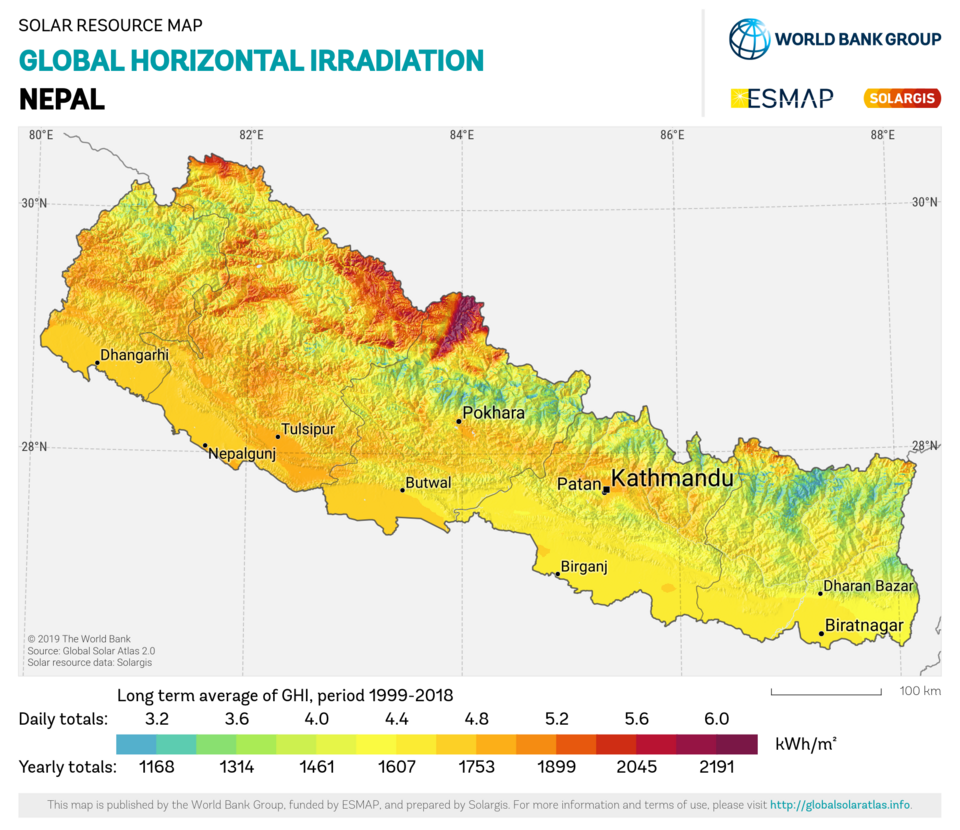 Shows regions with high/low solar potential. (Image: © 2019 The World Bank, Source: Global Solar Atlas 2.0, Solar, CC BY 4.0, via Wikimedia Commons)
 - Model Application: Use a cost-benefit analysis model to compare solar vs. diesel generators.
- User Interaction: NTC engineers adjust assumptions (e.g., fuel price hikes) and see real-time impact on ROI.
- Output: A dashboard recommends Phulbari and Dang as optimal locations, with a 12% higher ROI than diesel.
2. Business Applications of IT
IT transforms businesses through automation, analytics, and innovation. Below are critical applications with Nepalese examples:
A. Electronic Commerce (e-Commerce)
Definition: Buying/selling goods/services online (B2B, B2C, C2C). How IT Helps:
- Inventory Management: Daraz uses RFID tags to track stock in real time.
- Payment Gateways: Khalti integrates with UPI and credit cards for seamless transactions.
- Customer Analytics: eSewa’s churn prediction models identify users likely to stop paying bills.
B. Customer Relationship Management (CRM)
Definition: Systems to manage interactions with customers (e.g., sales, support). Example: Ncell’s CRM System
- Uses AI chatbots to resolve 60% of customer queries (e.g., "My data usage is exhausted").
- Predictive analytics identifies high-value customers for targeted promotions.
- Social media integration tracks complaints on Twitter/Instagram in real time.
C. Enterprise Resource Planning (ERP)
Definition: Integrates business processes (finance, HR, supply chain) into one system. Example: F1Soft (Nepal’s ERP provider) for manufacturing firms
- Supply Chain Module: Tracks raw material orders from China to factories in Chitwan.
- Financial Module: Automates tax filings for VAT and income tax (compliant with Nepal’s Revenue Act).
- HR Module: Manages employee attendance via fingerprint biometrics.
flowchart TD
    A["ERP System"]
    B["Supply Chain Module"]
    C["Financial Module"]
    D["HR Module"]
    E["CRM Module"]
    A -->|"Tracks"| B
    A -->|"Manages"| C
    A -->|"Handles"| D
    A -->|"Integrates"| E
Shows finance, HR, supply chain, and CRM modules interconnected. (Image: Shing Hin Yeung, CC BY-SA 3.0, via Wikimedia Commons)D. Multimedia in Business
Applications:
- Marketing: Daraz uses 360° product videos to reduce return rates.
- Training: Nabil Bank’s VR simulations train tellers on fraud detection.
- Customer Support: Pathao’s interactive FAQ videos explain ride-sharing policies.
3. Emerging Technologies in Business
These technologies are reshaping industries in Nepal and globally.
A. Internet of Things (IoT)
Definition: Network of physical devices ("things") embedded with sensors, software, and connectivity. Nepalese Examples:
| Company | IoT Application | Impact |
|---|---|---|
| NTC | Smart meters in Kathmandu Valley | Reduces power theft by 20%. |
| Ncell | IoT-enabled tractors for farmers | Monitors soil moisture via sensors. |
| Hotel Industry | Smart room keys (RFID) at Thamal Hotels | Eliminates lost keys; tracks guest entry. |
How IoT Works:
sequenceDiagram
    participant Sensor as Soil Moisture Sensor
    participant Gateway as IoT Gateway
    participant Cloud as Ncell Cloud
    participant Farmer as Farmer's Phone
    Sensor->>Gateway: Sends data (humidity, temp)
    Gateway->>Cloud: Transmits via 4G
    Cloud->>Farmer: Alerts via SMS: "Water your crops!"
B. Artificial Intelligence (AI) and Machine Learning (ML)
Applications in Nepal:
- Fraud Detection: eSewa’s AI flags unusual transaction patterns (e.g., a single user paying 10 utility bills in one hour).
- Dynamic Pricing: Pathao adjusts ride prices based on demand and traffic (like Uber).
- Healthcare: Manipal Teaching Hospital uses AI to detect tuberculosis in X-rays.
C. Blockchain
Definition: Decentralized ledger for secure, transparent transactions. Nepalese Examples:
- NEPSE (Nepal Stock Exchange): Piloting blockchain for secure share trading to reduce fraud.
- Khalti: Exploring blockchain for cross-border remittances (e.g., Nepali migrants in the Gulf).
- Land Records: Government’s Digital Property Rights Project uses blockchain to prevent land disputes.
How Blockchain Secures Data:
graph LR
    A["Transaction: User A sends 5,000 NRs to User B"] --> B["Block Created"]
    B --> C["Hash Generated: abc123..."]
    C --> D["Added to Blockchain"]
    D --> E["Verified by Nodes"]
    E --> F["New Block Added"]
D. Cloud Computing
Why Businesses Adopt Cloud:
- Cost Savings: Ncell reduced IT costs by 40% by migrating to AWS.
- Scalability: Daraz handles Black Friday traffic spikes via cloud servers.
- Collaboration: Government offices use Google Workspace for real-time policy drafting.
Cloud Service Models:
| Model | Description | Nepalese Example |
|---|---|---|
| IaaS | Rent virtual machines (e.g., servers). | NTC’s disaster recovery on AWS. |
| PaaS | Platform for app development. | F1Soft’s ERP built on Heroku. |
| SaaS | Ready-to-use software. | Khalti’s payment API. |
4. Group Decision Support Systems (GDSS)
Definition: IT tools that facilitate collaborative decision-making by multiple stakeholders. Components:
mindmap
  root((GDSS))
    Data Sharing
    Anonymous Input
    Structured Debate
    Voting Tools
    Real-Time Chat
Example: Nepal’s Electricity Crisis Task Force
- Problem: Decide whether to build new hydropower plants or import coal.
- GDSS Tools Used:
- Miro/FigJam: Shared whiteboards for brainstorming.
- Slido: Anonymous polling on preferences.
- Zoom + AI Transcripts: Records discussions for later review.
Advantages of GDSS: ✅ Reduces groupthink (anonymous inputs encourage dissent). ✅ Saves time (no need for physical meetings). ✅ Tracks decision rationale for accountability.
5. Ethical and Legal Considerations
Deploying DSS and emerging tech raises challenges:
| Issue | Example in Nepal | Solution |
|---|---|---|
| Data Privacy | eSewa’s user data leaks in 2022. | Comply with Nepal’s Data Privacy Act (2018). |
| AI Bias | Ncell’s loan approval AI rejects more women. | Audit models for gender/region bias. |
| Job Displacement | Khalti’s chatbots replace customer service agents. | Reskill workers for tech-adjacent roles. |
| Cybersecurity | Daraz’s website hacked in 2021. | Use blockchain for transaction logs. |
In the Real World
eSewa’s Fraud Detection DSS
- Idea Used: Data-driven DSS with ML models.
- How It Works: eSewa’s system flags suspicious transactions (e.g., a user paying 50 bills in one hour) using anomaly detection algorithms. In 2023, this prevented Rs. 200 million in fraud.
- Real Impact: Reduced false positives by 30% by integrating behavioral biometrics (typing speed, mouse movements).
Ncell’s IoT-Enabled Tractors
- Idea Used: IoT + Cloud Analytics.
- How It Works: Farmers in Bara District rent tractors equipped with GPS and soil sensors. The cloud analyzes data to suggest optimal plowing times and fertilizer use.
- Real Impact: Increased crop yield by 15% and reduced fuel costs by 25%.
Pathao’s Dynamic Pricing with AI
- Idea Used: AI-driven DSS.
- How It Works: Pathao’s algorithm adjusts ride prices based on:
- Demand (e.g., +50% during Dashain).
- Traffic (Google Maps API data).
- Driver availability (real-time GPS tracking).
- Real Impact: Surge pricing during Kathmandu traffic jams ensures 90% driver occupancy.
Exam Tip
Define Clearly:
- Start answers with precise definitions (e.g., "A Decision Support System is an interactive IT tool that...").
- Avoid: Vague terms like "helps in decision-making" without specifying how.
Use Nepalese Examples:
- Examiners love local context. Always tie theories to eSewa, Ncell, Daraz, or NTC.
- Example: For "emerging tech," say:
"Nepal’s NEPSE is piloting blockchain to secure share trading, reducing fraud risks by eliminating single points of failure."
Diagrams = Extra Marks:
- Draw component diagrams (DSS, ERP) or flowcharts (IoT data flow) in exams.
- Pro Tip: Label every box and arrow. Even if the diagram is simple, clarity > complexity.
Compare and Contrast:
- Questions often ask to differentiate (e.g., DSS vs. TPS, IoT vs. Cloud).
- Use tables for quick comparisons:
Feature DSS TPS (e.g., POS System) Purpose Semi-structured decisions Structured transactions Output "Should we expand?" (Yes/No) "Order #1234 processed" Example Ncell’s network planning Daraz’s checkout system
Ethical/Legal Questions:
- Always end with one ethical concern and one solution.
- Example:
"While AI in banking (e.g., Nabil Bank’s loan approval) improves efficiency, it risks discriminating against rural applicants due to limited credit histories. To mitigate this, banks should use alternative data sources like utility bill payments."
Avoid Common Mistakes:
- ❌ "DSS is used for structured decisions." (Wrong! DSS handles semi-structured decisions.)
- ❌ "Blockchain is only for cryptocurrency." (Wrong! It’s used for land records, supply chains, and voting in Nepal.)
Final Checklist Before Submitting: ✔ 1 definition per key term (DSS, ERP, IoT). ✔ 2 Nepalese examples per technology (e.g., IoT: NTC + Ncell). ✔ 1 diagram per major concept (DSS components, IoT flow). ✔ Ethical/legal discussion in every answer. ✔ Tables for comparisons (e.g., DSS types, cloud models).
Based on the TU BITM syllabus for Foundation Of Information Technology (IT231), unit 13.
Discussion
Loading…