Discrete StructureUnit 57 min read
Sequences, Recurrence Relations & Binomial Theorem
Unit 5 of Discrete Structure covers sequences (arithmetic/geometric), recurrence relations (homogeneous/non-homogeneous, solving via characteristic equations), and the binomial theorem (Pascal’s triangle, binomial coefficients). Learn to derive terms, solve real-world problems (e.g., loan interest, population growth),
TAKEAWAYS
- Sequences are ordered lists defined explicitly (e.g., ) or recursively (e.g., ).
- Recurrence relations model dynamic systems (e.g., Fibonacci, compound interest) and are solved via characteristic equations for linear relations.
- The binomial theorem expands using coefficients from Pascal’s triangle, with applications in probability and combinatorics.
- Homogeneous vs. non-homogeneous relations differ in their solution structure (complementary + particular solutions for non-homogeneous).
- Induction proves statements for all by showing a base case and inductive step (used in binomial proofs).
- Real-world ties: Recurrence relations model loan repayments (banks), traffic flow (NTC), and app growth (Pathao’s ride demand).
1. Sequences: Definitions and Types
A sequence is an ordered list of numbers defined by a rule. Sequences can be:
- Explicit: Direct formula for the th term (e.g., ).
- Recursive: Defined based on previous terms (e.g., , ).
Key Types
| Type | Example | General Form | Sum of First Terms |
|---|---|---|---|
| Arithmetic | 2, 5, 8, 11, ... | ||
| Geometric | 3, 6, 12, 24, ... | ||
| Fibonacci | 1, 1, 2, 3, 5, ... | No simple closed form |
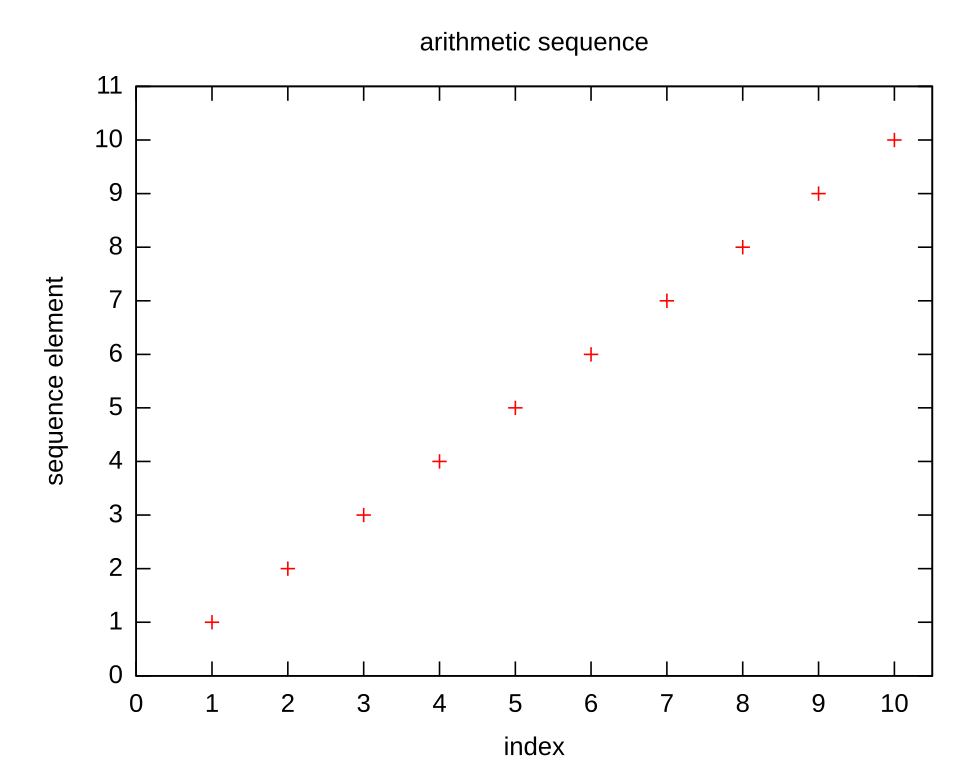 Arithmetic sequence with common difference . (Image: Sascha Lill took the figures from Wikibooks and edited the c, CC BY-SA 4.0, via Wikimedia Commons)
Worked Example: Loan Repayment (Arithmetic Sequence)
A bank offers a loan with monthly payments of Rs. 5,000 increasing by Rs. 200 each month. Find the total repayment after 12 months.
- Solution:
- First term , common difference , .
- Sum: .
- Answer: Total repayment = Rs. 73,200.
2. Recurrence Relations: Solving Dynamic Problems
A recurrence relation defines each term based on prior terms. Types:
- Homogeneous: All terms depend on previous terms (e.g., ).
- Non-homogeneous: Has an external input (e.g., ).
Solving Homogeneous Linear Recurrence Relations
Step-by-Step Method:
- Write the characteristic equation (replace with ).
- Solve for roots .
- General solution:
- Distinct roots: .
- Repeated roots: .
- Use initial conditions to find constants .
Example: Fibonacci Sequence Recurrence: , , .
- Characteristic equation: → Roots: .
- Solution: .
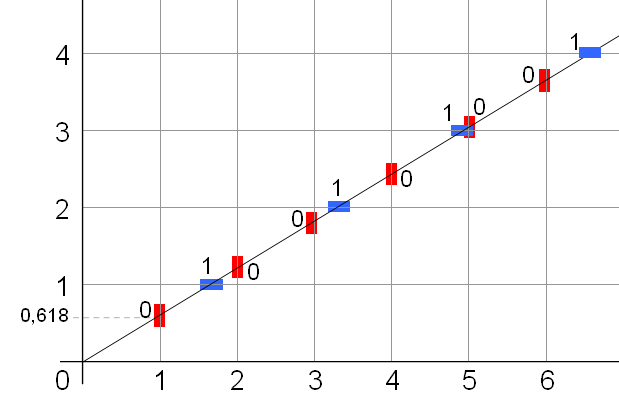 Plot of vs. showing exponential growth. (Image: Prokofiev, CC BY-SA 3.0, via Wikimedia Commons)
Non-Homogeneous Relations: Particular Solutions
For , :
- Homogeneous solution: .
- Particular solution: Guess (since is the non-homogeneous term).
- Substitute into recurrence: → .
- General solution: .
- Use to find . Final solution: .
3. Binomial Theorem: Expansions and Combinations
The binomial theorem states: where is the binomial coefficient.
Pascal’s Triangle and Binomial Coefficients
Each entry is the sum of the two above it. Row gives coefficients for :
Row 0:        1
Row 1:      1   1
Row 2:    1   2   1
Row 3:  1   3   3   1
...
Example: Expand :
Proof Using Induction (Exam Tip!)
Statement: Sum of first positive integers . Proof:
- Base case (): . ✔️
- Inductive step: Assume true for , i.e., . For : Thus, true for . By induction, the formula holds for all .
4. Applications in the Real World
A. Recurrence Relations in Nepal
Loan Interest (Nepal Banks)
- Problem: A loan of Rs. 1,00,000 is repaid in 5 years with monthly payments increasing by Rs. 500 (arithmetic sequence).
- Solution: Use arithmetic series sum formula to calculate total repayment.
- Why it matters: Helps borrowers predict total cost.
Traffic Flow (NTC)
- Problem: Number of vehicles at a junction follows (geometric + constant).
- Solution: Solve non-homogeneous recurrence to forecast congestion.
App Growth (Pathao)
- Problem: Daily rides grow as (word-of-mouth + marketing).
- Solution: Recurrence models user acquisition for scaling.
B. Binomial Theorem in Probability
- Example: Probability of exactly 3 heads in 5 coin tosses:
- Used by: Khalti (fraud detection via binomial probability of transaction patterns).
5. Exam Tips
For sequences:
- Memorize arithmetic/geometric sum formulas.
- In exams, always check initial terms when given a recurrence.
For recurrence relations:
- Homogeneous: Solve characteristic equation first.
- Non-homogeneous: Guess particular solution based on the input term (e.g., → ).
- Common mistakes: Forgetting initial conditions or misapplying roots.
For binomial theorem:
- Pascal’s triangle is your friend for small .
- Induction proofs require clear base case and inductive step.
- Exam trick: For , write terms in order of descending .
Real-world connections:
- Loans/interest: Arithmetic/geometric sequences.
- Network traffic: Recurrence relations (e.g., packet delays).
- Probability: Binomial coefficients (e.g., NEPSE stock success rates).
Final Note: Practice deriving recurrence relations from word problems (e.g., "A population grows by 10% annually with 500 new births each year"). Master this unit, and you’ll ace problems on sequences, expansions, and dynamic systems!
Based on the TU BITM syllabus for Discrete Structure (IT235), unit 5.
Discussion
Loading…