Cost and Management AccountingUnit 220 min read
Cost Concepts & Classifications: Types, Methods & Applications
Unit 2 of Cost and Management Accounting explores cost definitions, classifications (direct/indirect, fixed/variable, controllable/uncontrollable), cost behavior analysis, and real-world applications in Nepali businesses like Daraz, Ncell, and local retail shops. Learn how costs are traced, allocated, and controlled wi
TAKEAWAYS:
- Costs are classified into direct/indirect, fixed/variable, controllable/uncontrollable, and product/period to aid decision-making and financial reporting.
- Cost behavior (fixed vs. variable) is critical for break-even analysis, pricing, and budgeting in businesses like Pathao (fleet costs) or NTC (infrastructure costs).
- Direct costs (e.g., raw materials in a Kathmandu garment factory) are traced to products, while indirect costs (e.g., factory rent) are allocated using methods like job order costing or process costing.
- Marginal costing (variable costing) helps businesses like Daraz optimize pricing, while absorption costing ensures compliance with Nepali accounting standards (NAS 2).
- Controllable vs. uncontrollable costs guide managers in cost control (e.g., a shop owner can control electricity bills but not inflation).
- Opportunity costs (e.g., renting a shop space vs. investing in inventory) are invisible in financial statements but critical for strategic decisions.
1. Definitions: What is a Cost?
Cost is the sacrifice of resources (money, time, effort) to achieve a specific objective, typically measured in monetary terms. In accounting, costs are classified based on their traceability, behavior, and controllability to aid decision-making.
Key Cost Definitions
| Term | Definition | Example (Nepal Context) |
|---|---|---|
| Explicit Cost | Direct monetary payments for resources (e.g., salaries, rent). | Salary of a Daraz delivery agent: ₹18,000/month. |
| Implicit Cost | Opportunity cost of using owned resources (e.g., using a shop owner’s capital). | If a shop owner uses their own money instead of taking a loan, the interest forgone is an implicit cost. |
| Historical Cost | Actual cost incurred in the past (used in financial statements). | Purchase cost of a machine in 2020: ₹500,000. |
| Replacement Cost | Current cost to replace an asset (used for decision-making). | Replacing an old sewing machine in a Kathmandu factory: ₹250,000 (2024 price). |
| Sunk Cost | Past cost that cannot be recovered (irrelevant for future decisions). | ₹50,000 spent on a failed marketing campaign in 2023. |
| Opportunity Cost | Benefit lost by choosing one alternative over another. | If Ncell invests in 5G instead of expanding 4G, the lost revenue from 4G is the opportunity cost. |
2. Classification of Costs
Costs are categorized based on traceability, behavior, controllability, and accounting treatment. Below are the most critical classifications with visual aids and real-world examples.
A. By Traceability: Direct vs. Indirect Costs
Direct Costs can be traced to a specific product, service, or department. Indirect Costs cannot be traced directly and must be allocated using methods like job order costing or process costing.
graph LR
    A["Costs"] --> B["Direct Costs"]
    A --> C["Indirect Costs"]
    B --> D["Raw Materials"]
    B --> E["Direct Labor"]
    C --> F["Factory Rent"]
    C --> G["Depreciation"]
    C --> H["Utilities"]
    D -->|"Example"| I["Cloth for a Kathmandu garment"]
    E -->|"Example"| J["Stitching labor in a factory"]
F -->|"Example"| K["Rent of a Daraz warehouse"]| Direct Costs | Indirect Costs |
|---|---|
| Raw Materials (e.g., rice for a Kathmandu restaurant). | Factory Overheads (e.g., factory rent for a Daraz warehouse). |
| Direct Labor (e.g., wages of a tailor in a garment factory). | Depreciation (e.g., wear and tear of a printing press). |
| Traceable Expenses (e.g., packaging for a Daraz order). | Utilities (e.g., electricity for a Ncell data center). |
Why it matters:
- Direct costs are easily assigned to products (e.g., the cost of a phone in a Ncell inventory).
- Indirect costs require allocation methods (e.g., spreading factory rent across all products made in a month).
B. By Behavior: Fixed vs. Variable vs. Semi-Variable Costs
Costs behave differently with changes in production volume or activity level.
| Type | Definition | Example (Nepal) | Graph Behavior |
|---|---|---|---|
| Fixed Costs | Remain constant regardless of production volume. | Rent of a Kathmandu shop: ₹50,000/month. | Horizontal line (y = constant). |
| Variable Costs | Change proportionally with production volume. | Cost of raw materials for a Daraz order. | Straight upward slope (y = mx). |
| Semi-Variable | Fixed + variable component (e.g., electricity bill with a minimum charge). | Ncell’s data charges: ₹500 base + ₹5/MB. | Stepwise linear graph. |
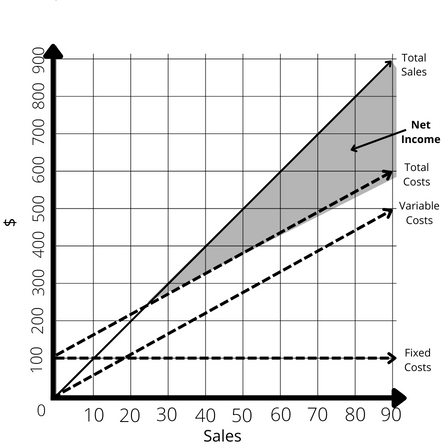 A CVP graph showing fixed costs (horizontal line), variable costs (sloped line), and total costs (combined). (Image: Slade74, CC0, via Wikimedia Commons)
Worked Example: Kathmandu Retail Shop Suppose Shop Kathmandu sells traditional Newari thalis. Its costs for 100 thalis/month are:
- Fixed Costs: Rent (₹20,000), Salaries (₹15,000).
- Variable Costs: Ingredients (₹50/thali), Packaging (₹5/thali).
| Volume | Fixed Costs | Variable Costs (₹/thali) | Total Variable Costs | Total Costs |
|---|---|---|---|---|
| 100 | ₹35,000 | ₹55 × 100 | ₹5,500 | ₹40,500 |
| 200 | ₹35,000 | ₹55 × 200 | ₹11,000 | ₹46,000 |
Key Insight:
- Fixed costs per unit decrease as volume increases (e.g., ₹350/thali at 100 units vs. ₹175/thali at 200 units).
- Variable costs per unit remain constant (₹55/thali).
Real-World Link:
- Pathao has fixed costs (fleet maintenance, app development) and variable costs (driver wages per ride).
- NTC has fixed costs (road infrastructure) and variable costs (fuel for buses).
C. By Controllability: Controllable vs. Uncontrollable Costs
| Type | Definition | Example (Nepal) | Who Controls It? |
|---|---|---|---|
| Controllable | Can be influenced by management in the short term. | Electricity bill of a Daraz warehouse. | Warehouse manager. |
| Uncontrollable | Beyond management’s control (e.g., inflation, taxes). | Increase in NPR exchange rate affecting import costs. | Government/Market forces. |
| Partially Controllable | Can be influenced but not entirely (e.g., labor strikes). | Overtime payments in a garment factory. | HR + Factory manager. |
Why it matters:
- Managers focus on controllable costs (e.g., a shop owner reducing waste in a Kathmandu restaurant).
- Uncontrollable costs (e.g., sudden fuel price hikes) require hedging strategies (e.g., Ncell locking fuel prices with suppliers).
D. By Accounting Treatment: Product vs. Period Costs
| Type | Definition | Example (Nepal) | Treatment in Financial Statements |
|---|---|---|---|
| Product Costs | Costs attached to inventory and expensed when sold. | Cost of a phone in Ncell’s inventory. | Shown as Asset → COGS when sold. |
| Period Costs | Expensed immediately (not tied to inventory). | Advertising for a Daraz sale. | Shown as Expense in Income Statement. |
flowchart TD
    A["Raw Materials"] --> B["Work in Progress (WIP)"]
    B --> C["Finished Goods Inventory"]
    C --> D["Cost of Goods Sold (COGS)"]
    D --> E["Income Statement"]
    F["Period Costs"] --> E
Worked Example: Ncell’s Phone Inventory
- Product Costs:
- Purchase cost of a phone: ₹25,000.
- Packaging: ₹500.
- Total Product Cost: ₹25,500 (recorded as inventory until sold).
- Period Costs:
- Advertising the phone: ₹5,000 (expensed immediately).
When sold:
- COGS (Product Cost): ₹25,500 (moved from Balance Sheet to Income Statement).
- Advertising (Period Cost): ₹5,000 (already expensed).
E. Other Classifications
| Classification | Examples | Use Case |
|---|---|---|
| Prime Costs | Direct Materials + Direct Labor. | Used in job costing (e.g., custom furniture orders). |
| Conversion Costs | Direct Labor + Manufacturing Overheads. | Helps in process costing (e.g., oil refineries). |
| Out-of-Pocket Costs | Actual cash outflows (vs. opportunity costs). | Used in capital budgeting (e.g., NTC’s new bus purchase). |
| Committed Costs | Long-term fixed costs (e.g., lease agreements). | Critical for long-term planning (e.g., Daraz’s warehouse lease). |
| Discretionary Costs | Optional costs (e.g., training programs). | Managers decide annually (e.g., Ncell’s employee training budget). |
3. Cost Behavior Analysis: Fixed vs. Variable Costing
A. Break-Even Analysis
Break-even point (BEP) is where Total Revenue = Total Costs (no profit, no loss). Used by retailers (Daraz), service providers (Pathao), and manufacturers (garment factories).
Formula:
Worked Example: Kathmandu Tea Shop
- Fixed Costs (monthly): ₹40,000 (rent, salaries).
- Variable Cost per cup: ₹20 (tea leaves, milk, sugar).
- Selling Price per cup: ₹50.
Interpretation:
- The shop must sell 1,334 cups/month to cover costs.
- At 2,000 cups/month:
Real-World Link:
- Daraz uses BEP to decide minimum order quantities for sellers.
- Ncell calculates BEP for new SIM plans to ensure profitability.
B. Marginal Costing vs. Absorption Costing
| Feature | Marginal Costing (Variable Costing) | Absorption Costing (Full Costing) |
|---|---|---|
| Included Costs | Fixed + Variable Production Costs. | Fixed + Variable Production Costs + Allocated Overheads. |
| Treatment of Fixed Overheads | Treated as period costs (expensed immediately). | Capitalized in inventory (added to product cost). |
| Profit Impact | Profit fluctuates with production volume. | Profit smoother (fixed costs spread over units). |
| Compliance | Not allowed under NAS 2 (Nepali Accounting Standards). | Required for financial statements. |
| Decision-Making Use | Best for short-term decisions (e.g., pricing, make/buy). | Used for long-term reporting. |
Worked Example: Garment Factory in Kathmandu
- Production Data:
- Units Produced: 1,000 shirts.
- Variable Costs: ₹200/shirt.
- Fixed Overheads: ₹100,000.
- Selling Price: ₹500/shirt.
| Scenario | Marginal Costing Profit | Absorption Costing Profit | Difference |
|---|---|---|---|
| 1,000 units sold | (500 - 200) × 1,000 - 100,000 = ₹300,000 | Same as marginal (all units sold). | No difference. |
| 800 units sold | (500 - 200) × 800 - 100,000 = ₹60,000 | Fixed overhead per unit: ₹100. COGS = (200 + 100) × 800 = ₹240,000. Profit = (500 × 800) - 240,000 - (100,000 - 100 × 200) = ₹160,000. | Absorption shows higher profit because unsold units absorb fixed costs. |
Why it matters:
- Marginal costing helps in short-term pricing (e.g., Daraz’s discount strategies).
- Absorption costing is mandatory for financial statements (e.g., NEPSE-listed companies like Nabil Bank).
4. Cost-Volume-Profit (CVP) Analysis
CVP analysis helps businesses predict profits at different sales volumes.
Key Terms:
- Contribution Margin (CM): Selling Price - Variable Cost.
- Contribution Margin Ratio (CMR): CM / Selling Price.
- Profit Volume (PV) Ratio: CM / Selling Price (same as CMR).
Formula:
Worked Example: Ncell’s New Plan
- Selling Price per SIM: ₹1,500.
- Variable Cost per SIM: ₹500 (packaging, subsidies).
- Fixed Costs (monthly): ₹5,000,000.
- Target Profit: ₹2,000,000.
Real-World Link:
- Pathao uses CVP to decide minimum ride prices to cover costs.
- Daraz applies CVP to seller commission structures.
5. Opportunity Costs: The Invisible Cost
Opportunity cost is the benefit lost by choosing one alternative over another. Not recorded in financial statements but critical for strategic decisions.
Examples:
Ncell’s 5G Investment:
- Option 1: Spend ₹10 billion on 5G.
- Option 2: Expand 4G coverage (₹5 billion).
- Opportunity Cost: Lost revenue from 4G expansion if 5G is chosen.
Kathmandu Shop Owner:
- Option 1: Rent out shop space for ₹20,000/month.
- Option 2: Use space for inventory (opportunity cost: ₹20,000/month).
Worked Example: Daraz’s Warehouse Decision
- Option A: Build a new warehouse (₹50 million, 5-year lease).
- Option B: Rent a warehouse (₹10 million/year).
- Opportunity Cost of Building:
- Lost rental income: ₹10M × 5 = ₹50 million.
- But: Building may allow long-term cost savings (e.g., no rent hikes).
6. Exam Tip: How This Unit is Tested
This unit is heavily tested in TU/PU exams with:
Definitions & Differences (2-3 marks):
- Distinguish between direct vs. indirect costs, fixed vs. variable costs.
- Example question: "Explain the difference between historical cost and replacement cost with an example from a Nepali business."
Numerical Problems (5-10 marks):
- Break-even analysis (e.g., calculate BEP for a Kathmandu restaurant).
- Marginal vs. absorption costing (compare profits in different scenarios).
- CVP analysis (e.g., "How many units must Daraz sell to achieve ₹1M profit?").
Scenario-Based Questions (3-5 marks):
- "A garment factory in Kathmandu has fixed costs of ₹200,000 and variable costs of ₹50/shirt. If the selling price is ₹150/shirt, how many shirts must be sold to break even? What if the price drops to ₹120?"
Short Notes & Applications (2-4 marks):
- "How does Ncell use cost-volume-profit analysis to set SIM prices?"
- "Explain the importance of opportunity costs in a Daraz seller’s decision to outsource production."
Common Mistakes to Avoid:
- Mixing fixed and variable costs in calculations.
- Ignoring opportunity costs in decision-making questions.
- Not reconciling absorption and marginal costing differences in inventory scenarios.
- Forgetting to state units (e.g., "₹ per unit" vs. "total ₹").
Recommended Approach:
- Memorize formulas (BEP, CMR, contribution margin).
- Practice numericals from past TU/PU question papers.
- Relate to Nepali businesses (Daraz, Ncell, local shops) for better understanding.
In the Real World
Daraz (E-Commerce Platform)
- Cost Classification: Daraz uses variable costing to determine seller commissions (e.g., 10% of product cost for groceries, 15% for electronics).
- Break-Even Analysis: Daraz calculates the minimum order volume for sellers to cover platform fees (e.g., a seller must sell 500 units/month to break even after paying Daraz’s 12% commission).
Pathao (Ride-Hailing App)
- Fixed vs. Variable Costs:
- Fixed: App development, customer support salaries.
- Variable: Driver wages per ride, fuel costs.
- Pricing Strategy: Pathao uses marginal costing to set dynamic pricing during peak hours (e.g., adding ₹50 to a ride if demand is high).
- Fixed vs. Variable Costs:
Ncell (Telecom Provider)
- Opportunity Cost: When Ncell decided to invest in 5G, the opportunity cost was the lost revenue from expanding 4G coverage in rural areas (where 5G ROI is lower).
- Absorption Costing: Ncell’s financial statements use absorption costing to allocate network infrastructure costs to different services (voice, data, IoT).
Local Kathmandu Retail Shop (e.g., Newari Thali Restaurant)
- Direct Costs: Ingredients (dal, rice, meat), waiter wages.
- Indirect Costs: Rent, electricity, kitchen equipment depreciation.
- Break-Even Point: A shop serving 200 thalis/day with ₹300 fixed costs and ₹100 variable cost per thali breaks even at: Realistic Scenario: If the shop sells thalis at ₹200 each, BEP = 2 thalis/day (but fixed costs are likely higher in reality).
NTC (Transport Corporation)
- Fixed Costs: Bus depots, maintenance workshops.
- Variable Costs: Fuel, driver salaries, tire replacements.
- Decision: NTC uses CVP analysis to decide whether to increase bus fares or reduce fuel costs (e.g., switching to CNG).
Final Summary Table
| Cost Type | Example (Nepal) | Key Formula/Concept | Exam Focus |
|---|---|---|---|
| Direct Costs | Cloth for a garment factory. | Traceable to products. | Differentiate from indirect costs. |
| Indirect Costs | Factory rent for Daraz. | Allocated via methods (e.g., machine hours). | Allocation bases (e.g., labor hours). |
| Fixed Costs | Ncell’s data center rent. | Constant regardless of volume. | BEP, CVP analysis. |
| Variable Costs | Ingredients for a Kathmandu shop. | Change with volume. | Marginal costing. |
| Product Costs | Cost of a phone in Ncell’s inventory. | Capitalized until sold. | COGS calculation. |
| Period Costs | Advertising for Daraz. | Expensed immediately. | Income statement treatment. |
| Opportunity Cost | Lost revenue from 4G if Ncell invests in 5G. | Not in financial statements. | Strategic decision-making. |
Last Tip:
- Always label units (₹/unit, total ₹) in numerical answers.
- Show workings for BEP/CVP questions (examiners reward method marks).
- Use Nepali examples (Daraz, Ncell, local shops) to make answers relatable and score extra marks.
Based on the TU BITM syllabus for Cost and Management Accounting (ACC202), unit 2.
Discussion
Loading…