Economics for BusinessUnit 916 min read
Money, Banking, Inflation: Functions, Tools, and Nepal’s Challenges
Unit 9 of Economics for Business explores the role of money as a medium of exchange, the structure and functions of banks (commercial, central, and development), how inflation erodes purchasing power, and how Nepal’s monetary policy (via NRB) tackles these issues—with real-world examples from Ncell, NMB Bank, and eSewa
TAKEAWAYS
- Money’s three core functions (medium of exchange, store of value, unit of account) explain why digital wallets like Khalti or eSewa dominate Nepal’s cashless economy.
- Commercial banks create credit via fractional reserve banking (e.g., NMB Bank lending ₹100 crore while holding only ₹10 crore in reserves), while the Nepal Rastra Bank (NRB) controls money supply through open market operations and repo rates.
- Inflation in Nepal (measured by CPI) is caused by demand-pull (e.g., post-earthquake reconstruction) or cost-push (e.g., fuel price hikes by NTC), and the NRB uses quantitative easing or tightening to stabilize it.
- Velocity of money () shows why Pathao’s rapid growth (high transaction volume) keeps Nepal’s money supply dynamic despite low interest rates.
- Banking regulations (e.g., Basel III compliance by global banks like SBI Nepal) ensure stability, but moral hazard (e.g., Everest Bank’s 2019 crisis) highlights the need for stricter oversight.
- Nepal’s inflation targeting (aiming for 6±1%) clashes with remittance-driven demand (₹10+ billion monthly inflows), forcing the NRB to balance growth and price stability.
1. Money: Definition, Functions, and Types
Money is anything universally accepted as a medium of exchange, store of value, and unit of account. In Nepal, Nepalese Rupees (NPR) is the legal tender, but digital wallets (eSewa, Khalti) and foreign currencies (USD, INR) also serve these functions.
Three Key Functions of Money
mindmap
  root((Money's Functions))
    medium["Medium of Exchange"]
      example1["eSewa for Daraz orders"]
      example2["Khalti for Pathao rides"]
    store["Store of Value"]
      example1["Savings in NMB Bank FD"]
      example2["Gold as hedge against inflation"]
    unit["Unit of Account"]
      example1["Price tags in NPR"]
      example2["Loan EMIs calculated in NPR"]
Types of Money
| Type | Example in Nepal | How It Works |
|---|---|---|
| Commodity Money | Gold, Silver | Physical asset with intrinsic value (e.g., gold jewelry as savings). |
| Fiat Money | Nepalese Rupee (NPR) | Declared legal tender by NRB (no intrinsic value). |
| Near Money | Bank Deposits (Savings Account) | Can be converted to cash on demand (e.g., withdrawing from SBI Nepal). |
| Cryptocurrency | Bitcoin (limited use) | Decentralized, volatile (e.g., used by tech-savvy Nepalese for remittances). |
2. Banking System in Nepal
Nepal’s banking system consists of:
- Central Bank: Nepal Rastra Bank (NRB) – Controls monetary policy.
- Commercial Banks: NMB, Global IME, Standard Chartered Nepal – Profit-driven, offer loans/deposits.
- Development Banks: Agricultural Development Bank (ADB) – Focus on specific sectors (e.g., agriculture).
- Finance Companies: FinanceOne, Nirdhan Utthan – Provide microloans (e.g., to small businesses).
How Banks Create Money (Fractional Reserve Banking)
Banks lend out only a fraction of deposits (e.g., reserve ratio = 5%). When a borrower spends the loan, the money circulates, multiplying the money supply.
Worked Example: NMB Bank’s Money Creation
- Initial Deposit: ₹1,00,000 in NMB Bank.
- Reserve Ratio: 5% (₹5,000 kept, ₹95,000 lent).
- First Round: Borrower spends ₹95,000 → deposited in Global IME.
- Global IME’s Action: Keeps ₹4,750 (5%), lends ₹90,250.
- Total Money Created: (theoretical maximum).
3. Functions of Commercial Banks
| Function | Example in Nepal |
|---|---|
| Accepting Deposits | NMB Bank’s Savings Account (4% interest), Fixed Deposit (7-8% interest). |
| Granting Loans | Home Loans (8-10% interest), Business Loans (12% interest). |
| Credit Creation | Pathao’s working capital loan (₹50 lakh to drivers). |
| Foreign Exchange | Ncell’s forex services (buying USD at ₹120/NPR). |
| Agency Services | NMB issuing demand drafts, Global IME’s bill payments. |
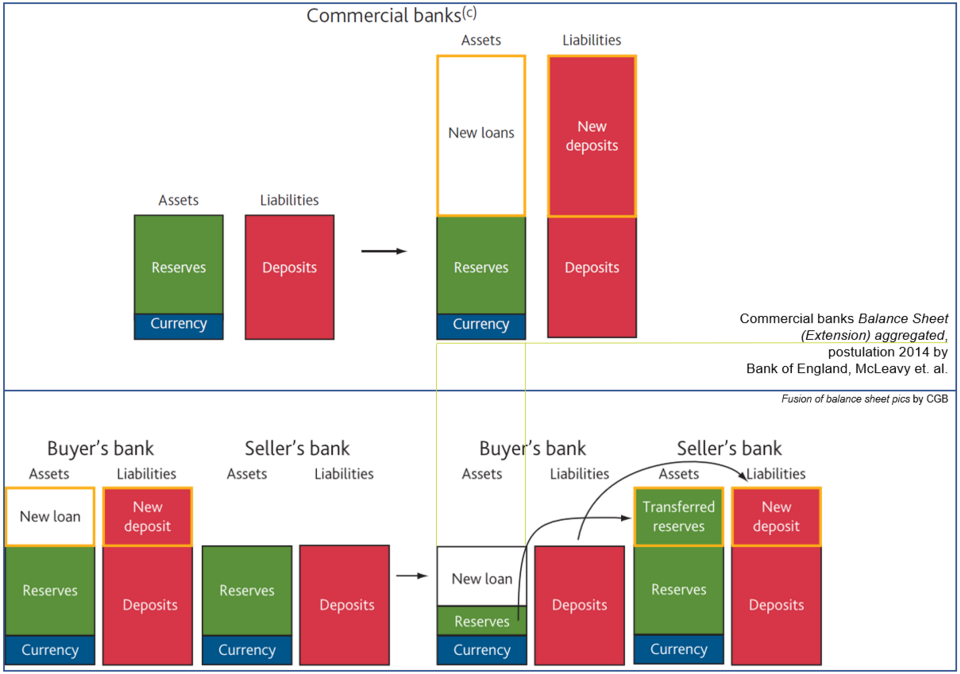 Assets (loans, reserves) vs. Liabilities (deposits, borrowings). (Image: Michael McLeavy, Amar Radia, Ryland Thomas & Monetary An, Public domain, via Wikimedia Commons)
4. Central Bank (NRB) and Monetary Policy Tools
The Nepal Rastra Bank (NRB) controls money supply to stabilize inflation (target: 6±1%) and promote economic growth.
Key Tools of NRB
| Tool | How It Works | Nepal Example (2023) |
|---|---|---|
| Repo Rate | NRB lends to banks at this rate (currently 7.5%). | 2023 hike to 7.5% to curb inflation after fuel price surges. |
| Reverse Repo Rate | Banks park excess cash with NRB (currently 6.5%). | Banks deposit ₹200 billion to meet reserve requirements. |
| Open Market Operations | NRB buys/sells government securities to adjust liquidity. | Sold ₹50 billion bonds to reduce money supply in 2022. |
| Cash Reserve Ratio (CRR) | % of deposits banks must keep with NRB (currently 3%). | Raised from 2% to 3% in 2023 to tighten liquidity. |
| Statutory Liquidity Ratio (SLR) | % of assets banks must hold in liquid form (e.g., gold, govt. bonds). | Banks hold ₹150 billion in SLR-compliant assets. |
5. Inflation: Causes, Types, and Effects
Inflation is the sustained rise in general price level, reducing purchasing power.
Causes of Inflation in Nepal
flowchart TD
  A["Inflation Causes"] --> B["Demand-Pull"]
  A --> C["Cost-Push"]
  A --> D["Built-in/Structural"]
  B --> B1["High remittances (₹10B/month) → More demand"]
  B --> B2["Post-earthquake reconstruction spending"]
  C --> C1["Fuel price hikes by NTC (₹20/litre → ₹100/litre)"]
  C --> C2["Imported inflation (USD depreciation → higher import costs)"]
  D --> D1["Wage-price spiral (trade unions demand hikes)"]
  D --> D2["Tax hikes (VAT increase from 13% to 15%)"]
Types of Inflation
| Type | Definition | Nepal Example |
|---|---|---|
| Demand-Pull | Excess demand over supply. | 2015 earthquake reconstruction → high demand for construction materials. |
| Cost-Push | Rising production costs (e.g., fuel, wages). | 2022 fuel price hike by NTC → transport costs up 30%. |
| Built-in | Workers demand wage hikes → firms raise prices → cycle repeats. | Trade unions’ 2023 strike → salary hikes → higher production costs. |
| Hyperinflation | Prices rise >50% per month. | Not in Nepal yet, but Zimbabwe (2008) had 500 billion% inflation. |
6. Measuring Inflation: CPI and WPI
| Index | What It Measures | Nepal’s 2023 Data | Limitations |
|---|---|---|---|
| CPI (Consumer Price Index) | Price of basket of goods (food, housing, transport). | 8.2% (highest in 5 years). | Excludes rural areas, underweights services. |
| WPI (Wholesale Price Index) | Price at wholesale level (raw materials). | 6.8% (lower than CPI). | Doesn’t reflect retail prices directly. |
Worked Example: Calculating Inflation Impact
- 2022: Salary = ₹50,000/month, CPI = 6%.
- 2023: Salary = ₹55,000 (10% hike), CPI = 8.2%.
- Real Wage Change: → Effective wage cut of ₹240/month.
7. Deflation and Disinflation
- Deflation: Falling price level (rare in Nepal, but seen in 2020 (-0.5%) due to COVID).
- Disinflation: Slower inflation (e.g., CPI drops from 8% to 5%).
Why Deflation is Dangerous in Nepal?
- Reduces consumption (people wait for lower prices).
- Increases real debt burden (e.g., farmers’ loans become harder to repay).
- Example: Japan’s "Lost Decade" (1990s deflation) led to stagnant growth.
8. Money Supply and Velocity
The Quantity Theory of Money states:
- = Money Supply
- = Velocity of Money (how often money changes hands)
- = Price Level
- = Real GDP
Worked Example: Pathao’s Money Velocity
- Pathao’s daily transactions: ₹50 crore.
- Average wallet balance: ₹500 per user (1 million users → ₹500 crore total).
- Velocity (V): (or 36 per year).
- Implication: High velocity means more economic activity per rupee.
9. Banking Regulations and Risks
Key Regulations in Nepal
| Regulation | Purpose | Nepal Example |
|---|---|---|
| Basel III Accords | Limits bank leverage, ensures liquidity. | NMB Bank holds 12% capital adequacy ratio (CAR). |
| Loan-to-Deposit Ratio (LDR) | Banks must lend 75% of deposits. | Global IME’s LDR = 80% (higher than required). |
| Non-Performing Loan (NPL) Limit | NPLs must be < 3% of total loans. | Everest Bank’s 2019 crisis (NPLs hit 15%) led to NRB intervention. |
Risks in Banking
| Risk | Cause | Nepal Example |
|---|---|---|
| Credit Risk | Borrowers default on loans. | 2019 Everest Bank collapse (₹20 billion loan defaults). |
| Liquidity Risk | Bank can’t meet withdrawal demands. | 2020 lockdown → panic withdrawals from NMB Bank. |
| Inflation Risk | High inflation erodes loan repayment value. | 2016 earthquake loans → repayment delays due to prolonged reconstruction. |
| Operational Risk | Fraud, cyberattacks. | 2021 Khalti hack (₹50 lakh stolen from user wallets). |
In the Real World
eSewa and Khalti (Digital Wallets)
- Idea Used: Medium of Exchange + Store of Value
- How It Works: Users link bank accounts to wallets, reducing cash dependency. 80% of Nepal’s digital transactions now use eSewa/Khalti.
- Impact: NRB reports 50% drop in cash transactions since 2020.
Ncell’s Mobile Banking (Ncell Money)
- Idea Used: Near Money + Financial Inclusion
- How It Works: USSD-based banking (no internet needed) allows 30% of rural Nepal to access loans/savings.
- Example: A farmer in Kathmandu Valley takes a ₹50,000 loan via Ncell Money to buy seeds, repays via mobile top-up.
Nepal Rastra Bank (NRB) vs. Inflation
- Idea Used: Monetary Policy Tools (Repo Rate, CRR)
- How It Works: When CPI hits 8% (2023), NRB raises repo rate to 7.5% to discourage borrowing and cool demand.
- Real Impact: Bank lending rates rise from 8% to 10% → Daraz’s sales growth slows (consumers delay purchases).
Daraz’s Supply Chain and Inflation
- Idea Used: Cost-Push Inflation
- How It Works: NTC’s fuel price hike (₹20 → ₹100/litre) increases Daraz’s logistics costs by 30% → product prices rise by 15%.
- Consumer Effect: A ₹5,000 phone now costs ₹5,750, reducing demand.
Nepal Investment Bank’s Fixed Deposits (FD)
- Idea Used: Store of Value vs. Inflation
- How It Works: FD at 8% interest vs. 8.2% inflation → real return = -0.2%.
- Why It Matters: Retirees lose purchasing power if FD rates < inflation.
Exam Tip
Diagrams Are Mandatory
- Always draw:
- Money multiplier process (fractional reserve banking).
- NRB’s monetary policy tools (repo rate, CRR, open market ops).
- Inflation types (demand-pull vs. cost-push).
- Example Question: "Explain how a 1% increase in CRR affects money supply. Draw a diagram."
- Always draw:
Numerical Problems
- Money Multiplier:
- Inflation Impact:
- Velocity of Money:
Case Study Approach
- Everest Bank Crisis (2019): Discuss NPLs, moral hazard, NRB’s role.
- Post-Earthquake Inflation (2015): Link demand-pull inflation, reconstruction spending.
- Digital Payment Boom (2020-23): Explain velocity increase, cashless economy.
Compare Nepal with Global Examples
- Nepal’s Inflation Target (6±1%) vs. India’s (4±2%).
- NRB’s Repo Rate (7.5%) vs. US Fed’s (5.25%).
- Basel III Compliance: How NMB Bank vs. HSBC Nepal differ.
Common Mistakes to Avoid
- Confusing CPI and WPI: CPI affects consumers, WPI affects producers.
- Ignoring Velocity: Money supply alone doesn’t determine inflation—velocity matters.
- Overlooking Real-World Data: Always cite Nepal’s CPI, repo rate, or bank NPLs in answers.
Final Summary Table
| Concept | Key Formula/Tool | Nepal’s Current Status (2023) | Exam Focus |
|---|---|---|---|
| Money Multiplier | RR = 5% → Multiplier = 20x | Calculate money created from ₹1 lakh deposit. | |
| Inflation Measurement | CPI = | CPI = 8.2% (2023) | Explain demand-pull vs. cost-push. |
| NRB’s Tools | Repo Rate (7.5%), CRR (3%) | Raised rates to curb inflation. | Impact of CRR hike on bank lending. |
| Banking Risks | NPLs, Liquidity Risk | Everest Bank’s NPLs = 15% (2019) | How NRB regulates banks. |
| Velocity of Money | High in digital wallets (eSewa, Khalti). | Calculate V for Pathao’s transactions. |
Based on the TU BITM syllabus for Economics for Business (ECO206), unit 9.
Discussion
Loading…