Operating SystemUnit 514 min read
Deadlocks: Conditions, Prevention, Avoidance, Detection & Recovery
Unit 5 of Operating System: Explores deadlocks—how they occur, their four necessary conditions (mutual exclusion, hold-and-wait, no preemption, circular wait), prevention/avoidance strategies, detection algorithms (Banker’s, Wait-For Graph), and recovery methods (abort, rollback, resource preemption). Includes real-wor
TAKEAWAYS:
- Deadlocks are circular wait scenarios where processes block each other indefinitely, requiring all four conditions (mutual exclusion, hold-and-wait, no preemption, circular wait) to occur simultaneously.
- Prevention (breaking one condition) is strict but simple; avoidance (e.g., Banker’s algorithm) is dynamic but computationally expensive; detection (e.g., Wait-For Graph) is reactive but risky.
- The Banker’s algorithm ensures safety by checking if resource allocation leaves the system in a deadlock-free state before granting requests.
- Recovery involves aborting processes, preempting resources, or rolling back transactions—each with trade-offs between cost and system stability.
- Real-world impact: Deadlocks cripple systems like Nepal’s NTC traffic control (mutual exclusion on road segments), Khalti payment queues (hold-and-wait on transaction locks), and Daraz order fulfillment (circular wait in inventory allocation).
- Exam focus: Expect scenario-based questions (e.g., "Why does a bank’s loan approval system deadlock?") and algorithm traces (e.g., "Apply Banker’s to a given resource allocation").
1. What is a Deadlock?
A deadlock is a state in which two or more processes are blocked forever, each waiting for a resource held by another. It arises when processes compete for limited resources in a way that creates a circular dependency.
Visual: Deadlock Scenario
graph LR
    A["Process P1"] -->|"Holds R1"| B["Resource R1"]
    B -->|"Requested by"| C["Process P2"]
    C -->|"Holds R2"| D["Resource R2"]
    D -->|"Requested by"| A
Key Idea: The cycle P1 → R1 → P2 → R2 → P1 traps both processes.
2. Four Necessary Conditions for Deadlock
For a deadlock to occur, all four conditions must hold simultaneously. Breaking any one prevents deadlocks.
| Condition | Definition | Example in Real Systems |
|---|---|---|
| Mutual Exclusion | At least one resource must be non-sharable (only one process can use it). | A printer in an office: only one process can print at a time. |
| Hold-and-Wait | A process holds a resource while waiting for another. | Khalti transaction: A user holds a "payment lock" while waiting for bank confirmation. |
| No Preemption | Resources cannot be forcibly taken from a process. | NTC traffic light: A car cannot be ejected from an intersection once it enters. |
| Circular Wait | A cycle exists in the resource allocation graph. | Daraz order system: Process A waits for inventory X (held by B), while B waits for Y (held by A). |
Real-World Tie-In:
- Nepal’s Traffic Jams (Circular Wait): Imagine two roads intersecting without roundabouts. Car A takes the north-south road, Car B takes the east-west road, and both now block each other from proceeding. This is a deadlock where mutual exclusion (road space) + circular wait (no forward progress) freeze the system.
3. Deadlock Prevention: Breaking the Conditions
Prevention eliminates one of the four conditions at the system design level. It is simple but restrictive.
Strategies
Eliminate Mutual Exclusion
- Allow sharing of resources where possible (e.g., read-only files).
- Downside: Not all resources can be shared (e.g., printers).
Eliminate Hold-and-Wait
- Require processes to request all resources at once (e.g., bank loans).
- Example: A customer must declare all assets before a loan is approved (no partial holds).
Allow Preemption
- Forcefully take resources from processes and restart them later.
- Example: If a process holds a printer but is stuck, the OS can kill it and reassign the printer.
Eliminate Circular Wait
- Impose a total ordering on resource types (e.g., always request resources in order: R1 → R2 → R3).
- Example: In a library system, books must be checked out in alphabetical order (no circular waits).
Comparison Table: Prevention vs. Avoidance
| Aspect | Prevention | Avoidance |
|---|---|---|
| Approach | Breaks one deadlock condition. | Dynamically ensures safety. |
| Complexity | Low (static rules). | High (runtime checks). |
| Flexibility | Rigid (may waste resources). | Adaptive (optimizes resource use). |
| Example | "No hold-and-wait" in loan systems. | Banker’s algorithm in OS resource allocation. |
4. Deadlock Avoidance: The Banker’s Algorithm
Avoidance dynamically checks if allocating a resource would lead to a deadlock. The Banker’s algorithm (Dijkstra, 1965) is the gold standard.
How It Works
Define:
- Available: Free resources.
- Maximum: Max resources a process can request.
- Allocation: Currently held by processes.
- Need:
Maximum - Allocation(remaining requests).
Safety Check:
- Simulate granting a request and check if the system can complete all processes without deadlock.
- If safe, grant the request; else, deny.
Example: Bank Loan Approval (Avoidance)
Scenario:
Resources: 3 types (R1: Land, R2: Capital, R3: Labor).
Processes: P0 (Farmer), P1 (Shopkeeper), P2 (Factory).
Current State: | Process | Allocation (R1,R2,R3) | Max Need (R1,R2,R3) | Available (R1,R2,R3) = (1,2,2) |
| P0 | (0,1,0) | (0,2,2) | | P1 | (2,0,0) | (3,3,3) | | P2 | (3,2,1) | (3,3,2) |
Request: P1 asks for (1,0,2). Steps:
- Tentative Allocation:
- New Allocation: P1 = (3,0,2).
- New Available: (0,2,0).
- Check Safety:
- Can P0 finish? Needs (0,1,2) → Available (0,2,0) cannot satisfy (needs 2 labor but only 0 available). Unsafe.
- Reject P1’s request.
Visual: Banker’s Algorithm Workflow
sequenceDiagram
    participant Process as Process
    participant OS as OS (Banker's Algorithm)
    Process->>OS: Request Resources
    OS->>OS: Check Safety (Simulate Completion)
    alt Safe?
        OS->>Process: Grant Request
    else Unsafe
        OS->>Process: Deny Request
    end
Real-World Example: Khalti Payment System
- Problem: Two users (A and B) try to transfer money simultaneously, each holding a partial lock.
- Solution: Khalti uses avoidance by:
- Locking all accounts involved in a transaction at once (no hold-and-wait).
- Rolling back if any step fails (e.g., insufficient balance).
5. Deadlock Detection
If prevention/avoidance is too costly, detect deadlocks after they occur using:
Wait-For Graph (WFG)
- Nodes = Processes/Resources.
- Edges =
P1 → R1(P1 waits for R1),R1 → P2(R2 holds R1). - Cycle = Deadlock.
Banker’s Algorithm (Detection Mode)
- Periodically check if the system is in a safe state.
Example: Daraz Order Fulfillment Deadlock
Scenario:
- Processes: P1 (Order #101), P2 (Order #102).
- Resources: R1 (Inventory A), R2 (Inventory B).
- Allocation:
- P1 holds R1, waits for R2.
- P2 holds R2, waits for R1.
Wait-For Graph:
graph TD
    P1["Process P1"] -->|"Waits for"| R2["Resource R2"]
    R2 -->|"Held by"| P2["Process P2"]
    P2 -->|"Waits for"| R1["Resource R1"]
R1 -->|"Held by"| P1Detection: The cycle P1 → R2 → P2 → R1 → P1 indicates a deadlock.
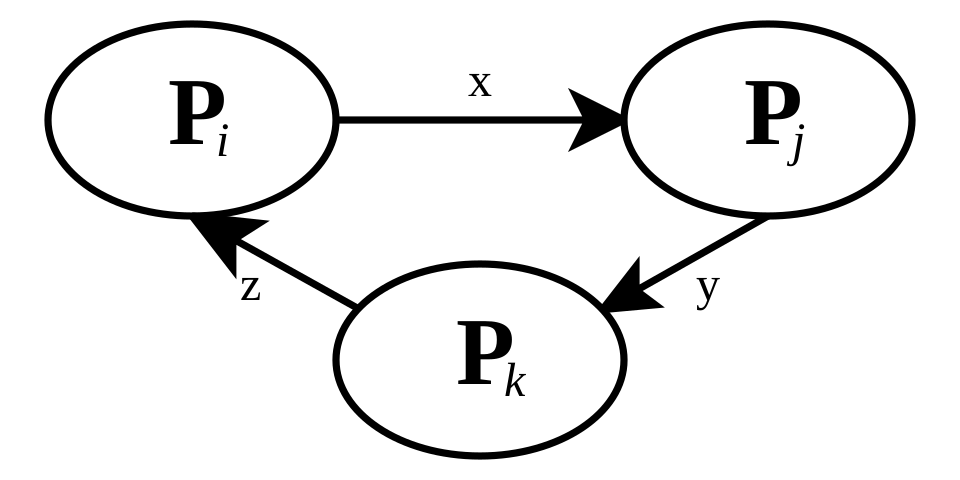 A labelled WFG showing processes and resources in a cycle. (Image: Kkaaii, CC BY-SA 4.0, via Wikimedia Commons)
6. Deadlock Recovery
Once detected, break the deadlock by:
- Process Termination
- Abort all deadlocked processes (brute force).
- Cost: High if processes are long-running.
- Resource Preemption
- Take resources from one process and give to another.
- Example: Kill P1 to free R1 for P2.
- Rollback
- Undo actions of deadlocked processes (e.g., revert database transactions).
Trade-off:
| Method | Pros | Cons |
|---|---|---|
| Abort | Simple. | Loses work. |
| Preemption | Saves some processes. | Complex rollback. |
| Rollback | Preserves state. | Overhead for logging. |
Real-World Example: NTC Traffic Control
- Deadlock: Two cars block each other at an intersection.
- Recovery:
- Preemption: Force one car to backtrack (like a traffic cop redirecting flow).
- Abort: Clear the intersection by stopping all traffic (rare, but used in emergencies).
7. Deadlock vs. Starvation vs. Livelock
| Issue | Definition | Key Difference |
|---|---|---|
| Deadlock | Processes block each other indefinitely. | Circular wait + all four conditions. |
| Starvation | A process never gets resources due to poor scheduling. | No blocking, but unfair resource allocation. |
| Livelock | Processes keep changing state but make no progress. | Like two people trying to pass in a hallway and keep moving backward. |
Example of Livelock: Two processes keep releasing and re-requesting the same resource in a loop:
stateDiagram-v2
    [*] --> P1: Request R1
    P1 --> P1a: Allocated R1
    P1a --> P1b: Release R1 (due to error)
    P1b --> P1: Request R1
    P1 --> P2: P2 holds R1
    P2 --> P2a: P2 releases R1
    P2a --> P2: P2 requests R1
In the Real World
Khalti Payment System (Hold-and-Wait + Circular Wait)
- Problem: Two users (A and B) initiate transfers simultaneously. A locks B’s account while waiting for its own balance update, and B does the same.
- Solution: Khalti uses atomic transactions (all locks acquired at once) to prevent deadlocks.
Daraz Order Fulfillment (Resource Preemption)
- Problem: Inventory for two orders (P1 and P2) is split across warehouses. P1 holds warehouse X’s stock while waiting for Y, and P2 holds Y while waiting for X.
- Solution: Daraz’s system preempts by canceling the less urgent order (P2) to free resources for P1.
Nepal’s NTC Traffic Lights (Mutual Exclusion + Circular Wait)
- Problem: At a 4-way intersection without roundabouts, cars from perpendicular roads block each other indefinitely.
- Solution: NTC’s smart traffic systems now use priority-based preemption (e.g., ambulances get green light by aborting other cars’ "hold").
Nepal Rastra Bank’s Loan System (Banker’s Algorithm)
- Problem: Banks must approve loans without causing deadlocks (e.g., two borrowers waiting for collateral from each other).
- Solution: The bank uses avoidance by checking if granting a loan leaves the system in a safe state (e.g., "Can all pending loans be fulfilled without deadlock?").
Pathao Driver Dispatch (Starvation vs. Deadlock)
- Problem: Drivers near the same pickup location may starve if the algorithm always picks the closest driver, or deadlock if two drivers wait for each other’s confirmation.
- Solution: Pathao uses timeouts (preemption) to abort stale requests and fair scheduling to prevent starvation.
Exam Tip
Scenario Questions (30% Weight)
- Format: "Process A holds R1 and waits for R2. Process B holds R2 and waits for R1. Draw the WFG and explain the deadlock."
- Key: Always label edges clearly (e.g., "P1 → R2" means P1 waits for R2).
- Common Pitfall: Forgetting to include resources as nodes in the WFG.
Banker’s Algorithm (25% Weight)
- Format: "Given a resource allocation table, check if a request is safe."
- Steps to Show:
- Calculate
Need = Max - Allocation. - Simulate completion for each process in order.
- If all can finish, it’s safe; else, unsafe.
- Calculate
- Example Trace:
Request: P1 asks for (1,0,2).
New Allocation: P1 = (3,0,2).
Available becomes (0,2,0).
Check P0: Needs (0,1,2) → Available (0,2,0) **cannot satisfy** (needs 2 labor, only 0 available).
→ **Unsafe**.
Prevention vs. Avoidance (20% Weight)
- Format: "How would you prevent deadlocks in a hospital’s blood bank system?"
- Answer Structure:
- Prevention: "Eliminate hold-and-wait by requiring doctors to request all blood types at once."
- Avoidance: "Use Banker’s algorithm to track blood inventory and patient needs."
Real-World Applications (15% Weight)
- Format: "Explain how deadlocks occur in Nepal’s NTC traffic system and suggest a solution."
- Must Mention:
- Conditions: Mutual exclusion (road space), circular wait (perpendicular roads).
- Solution: Roundabouts (break circular wait) or smart traffic lights (preemption).
Recovery Methods (10% Weight)
- Format: "If a deadlock is detected in a database transaction, what are three recovery options?"
- Answer:
- Abort all transactions involved.
- Preempt resources from the youngest transaction.
- Rollback to the last safe checkpoint.
Pro Tip for Diagrams:
- For WFG, always use two types of nodes: circles for processes, rectangles for resources.
- For Banker’s algorithm, show tables with columns: Process, Allocation, Max, Need, Available.
- For real-world examples, relate to Nepal: traffic, banking, e-commerce. Examiners love local context!
Based on the TU BITM syllabus for Operating System (IT241), unit 5.
Discussion
Loading…