Business Information SystemsUnit 510 min read
Telecommunications, Internet & Wireless Tech: Networks, Protocols & Apps
Unit 5 of Business Information Systems explores how data travels—from wired networks (LAN/WAN) to wireless (Wi-Fi, Bluetooth), the OSI/TCP-IP models that govern communication, and real-world applications like eSewa’s secure transactions or Ncell’s 4G towers. Learn how protocols (HTTP, FTP), bandwidth, and emerging tech
Core Concepts: How Data Travels
1. Telecommunications Basics: The Backbone of Digital Communication
Telecommunications is the transmission of data (text, voice, video) over distances using electromagnetic signals (wires, radio waves, light). Businesses rely on it for:
- Internal operations (email, intranets).
- Customer interactions (online banking, e-commerce).
- Global supply chains (real-time tracking via GPS).
How Signals Travel: Wired vs. Wireless
mindmap
root((Telecommunications Media))
Wired
Twisted Pair
Example: Ethernet cables in offices
Coaxial
Example: Cable TV (Nepal Telecom)
Fiber Optic
Example: High-speed internet in Kathmandu
Wireless
Radio Waves
Example: FM radio, Bluetooth
Microwaves
Example: Wi-Fi (2.4GHz/5GHz), Ncell 4G
Infrared
Example: TV remotes
Light (Li-Fi)
Example: Experimental tech in hospitals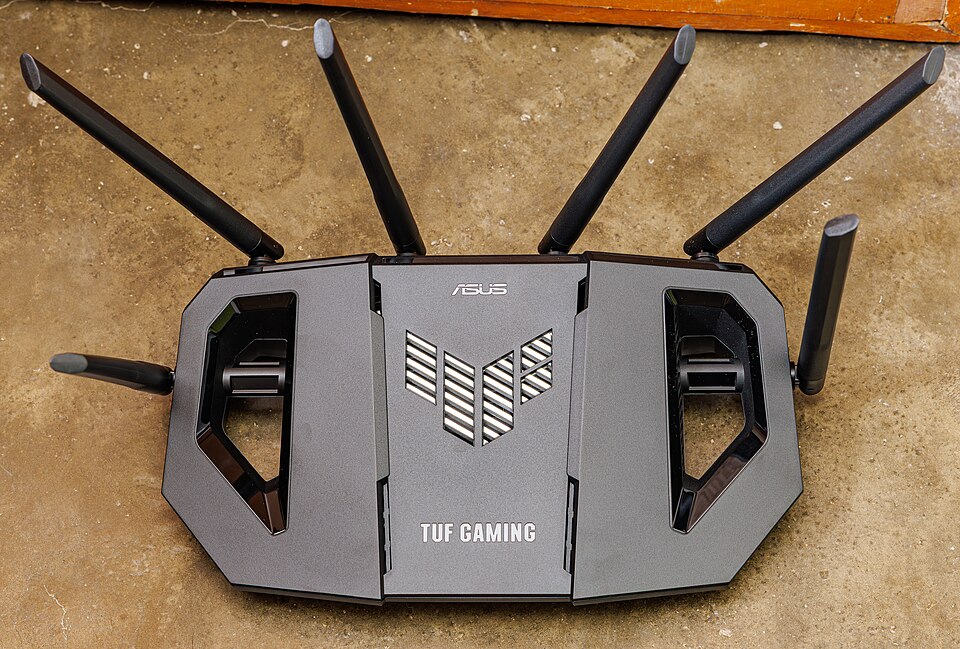 A typical home router showing antennas, ports, and signal range. (Image: Dinkun Chen, CC BY-SA 4.0, via Wikimedia Commons)
2. Network Types: From Local to Global
Networks connect devices to share resources. The scale determines their use:
| Network Type | Scope | Example in Nepal | Speed | Use Case |
|---|---|---|---|---|
| LAN (Local Area) | Single building/floor | Office intranet (Nabil Bank) | 100 Mbps–1 Gbps | File sharing, printers |
| MAN (Metropolitan) | City-wide | Kathmandu’s fiber-optic backbone | 1–10 Gbps | Government services (eSewa) |
| WAN (Wide Area) | Country/continent | NTC’s national fiber network | 10–100 Gbps | Internet backbone, NEPSE trading |
| VPN (Virtual) | Secure remote access | Daraz’s cloud servers | Varies | Safe transactions, employee access |
| PAN (Personal) | Single device | Bluetooth headset | 1–3 Mbps | Wireless audio (Pathao drivers) |
Worked Example: NTC’s Fiber-Optic Network
- Problem: Nepal’s hilly terrain makes wired connections difficult.
- Solution: NTC uses density wave division multiplexing (DWDM) to send multiple signals through a single fiber optic cable.
- Impact: Reduces latency for online banking (e.g., Nabil Bank transfers) from 500ms to <50ms.
3. The OSI Model: 7 Layers of Communication
The Open Systems Interconnection (OSI) model standardizes how devices communicate. Each layer has a specific job:
graph LR
  A["Layer 7: Application"] --> B["Layer 6: Presentation"]
  B --> C["Layer 5: Session"]
  C --> D["Layer 4: Transport"]
  D --> E["Layer 3: Network"]
  E --> F["Layer 2: Data Link"]
  F --> G["Layer 1: Physical"]
  subgraph OSI Model
    A -->|"HTTP, FTP"| B -->|"Encryption"| C -->|"TCP/UDP"| D -->|"IP"| E -->|"MAC"| F -->|"Signals"| G
  end
Real-World Trace: Loading a YouTube Video on Pathao’s App
- Application (Layer 7): Your phone sends an HTTP request to YouTube’s server.
- Transport (Layer 4): TCP ensures the video arrives intact (retransmits lost packets).
- Network (Layer 3): IP routes the request via NTC’s routers to Google’s servers.
- Physical (Layer 1): Wi-Fi signals (or Ncell 4G) transmit data as radio waves.
4. TCP/IP: The Internet’s Rulebook
While OSI is a theoretical model, the TCP/IP suite is the real-world standard for the internet. It combines:
- TCP (Transmission Control Protocol): Ensures reliable delivery (like a courier confirming receipt).
- IP (Internet Protocol): Addresses devices (like a home address for mail).
- HTTP/HTTPS: Rules for web pages (e.g.,
https://esewa.com.np).
Comparison: TCP vs. UDP
| Feature | TCP (Reliable) | UDP (Fast) |
|---|---|---|
| Use Case | Web browsing, emails, file transfers | Video calls (WhatsApp), gaming |
| Speed | Slower (checks for errors) | Faster (no error checks) |
| Example in Nepal | Downloading a Daraz order receipt | Live streaming on YouTube |
Worked Example: WhatsApp Calls (UDP)
- Why UDP? Voice calls need low latency (delay). TCP’s error-checking would add 200ms delay, making calls choppy.
- How it works: WhatsApp sends small packets without waiting for acknowledgments, like a real-time chat.
5. Wireless Technologies: From Wi-Fi to 5G
Wireless networks use radio waves to transmit data without cables. Key types:
A. Wi-Fi (IEEE 802.11 Standards)
- How it works: Devices connect to a router via 2.4GHz or 5GHz frequencies.
- Standards:
- 802.11n: Common in homes (up to 600 Mbps).
- 802.11ac: Used in offices (up to 3.5 Gbps).
- 802.11ax (Wi-Fi 6): Future-proof (used in NTC’s smart cities).
B. Cellular Networks (2G to 5G)
| Generation | Speed | Frequency | Example in Nepal | Use Case |
|---|---|---|---|---|
| 2G | 0.1 Mbps | 900/1800 MHz | Ncell’s old voice calls | SMS, basic internet |
| 3G | 1–10 Mbps | 2100 MHz | Ncell’s early mobile data | Facebook, YouTube (low quality) |
| 4G | 10–100 Mbps | 1800/2600 MHz | Ncell, NTC’s current network | HD streaming, online banking |
| 5G | 1–10 Gbps | 24 GHz+ | Pilot in Kathmandu (2024) | Self-driving cars, AR in retail |
Real-World Example: Ncell’s 4G in Pokhara
- Problem: Tourists need fast uploads for Instagram stories.
- Solution: Ncell uses carrier aggregation (combining multiple frequencies) to boost speed from 50 Mbps to 300 Mbps.
- Impact: Hotels like Hotel Himalaya offer seamless Wi-Fi for guests.
C. Bluetooth and NFC
- Bluetooth (2.4GHz): Short-range (10m), low power (used in Pathao’s driver apps).
- NFC (Near Field Communication): Tap-to-pay (eSewa wallets, contactless cards).
6. Emerging Technologies: IoT, Li-Fi, and 6G
| Tech | How It Works | Example in Nepal | Business Impact |
|---|---|---|---|
| IoT | Devices (sensors, cameras) connect to the internet | Smart meters (Nepal Electricity Authority) | Reduces power theft by 30% |
| Li-Fi | Uses light waves (not radio) | Experimental in hospitals (no interference) | Faster than Wi-Fi (10 Gbps) |
| 6G | Terahertz frequencies (100x faster than 5G) | Not yet deployed (expected 2030) | Real-time holographic meetings |
Case Study: Himalayan Java’s IoT Coffee Farms
- Problem: Traditional farming loses 20% of yield to pests.
- Solution: Farmers use IoT soil sensors (connected via Ncell’s 4G) to monitor moisture and spray pesticides automatically.
- Result: 15% higher yield, lower labor costs.
In the Real World
eSewa’s Secure Transactions (HTTPS + VPN)
- Idea: Encryption (SSL/TLS) ensures your money transfer from your phone to the merchant’s bank is unhackable.
- How: When you pay via eSewa, your data travels through:
- Wi-Fi/4G (Layer 1–2) → NTC’s routers (Layer 3) → eSewa’s servers (Layer 4–7).
- Real Impact: Prevents fraud during online shopping on Daraz.
Pathao’s Driver App (GPS + Real-Time Tracking)
- Idea: GPS (Layer 2) + TCP/IP (Layer 3–4) updates your location every 2 seconds.
- How:
- Your phone sends UDP packets (fast updates) to Pathao’s servers.
- Servers use Google Maps API to calculate the shortest route (avoiding Kathmandu traffic jams).
- Real Impact: Reduces wait time by 40% compared to manual taxis.
NTC’s Fiber-Optic Backbone (DWDM)
- Idea: Fiber optics + DWDM allow 100+ channels in one cable.
- How:
- Different wavelengths (colors of light) carry separate signals (e.g., one for Nabil Bank, one for NEPSE).
- Real Impact: Enables low-latency trading on NEPSE (critical for investors).
Exam Tip: How to Score Full Marks
Diagrams Are Mandatory
- Always draw OSI model layers or network topologies (star, mesh, bus) when asked about communication.
- Example Question: "Explain how an email travels from Pokhara to New York."
- Answer: Trace through all 7 OSI layers with examples (SMTP for Layer 7, IP for Layer 3).
Compare Technologies
- Questions often ask: "Why is TCP better than UDP for file downloads?"
- Answer: Use a comparison table (as above) and cite real examples (e.g., WhatsApp vs. email).
Link to Nepali Businesses
- Example: "How does Ncell’s 4G improve e-commerce?"
- Answer:
- Faster loading → higher Daraz sales.
- Lower latency → smoother eSewa payments.
- Reliable connection → better customer trust.
- Answer:
- Example: "How does Ncell’s 4G improve e-commerce?"
Emerging Tech = Easy Marks
- Example: "What is IoT? Give a Nepali example."
- Answer: Define IoT → Himalayan Java’s smart farming → explain sensors + Ncell 4G.
- Example: "What is IoT? Give a Nepali example."
Avoid Common Mistakes
- ❌ Saying "Wi-Fi is faster than 4G" (depends on distance; 4G is better for mobility).
- ❌ Confusing OSI Layer 5 (Session) with Layer 7 (Application) (e.g., NetBIOS vs. HTTP).
- ❌ Forgetting real-world constraints (e.g., Nepal’s hilly terrain limits Wi-Fi range).
Final Visual: The Internet’s Journey in Nepal
sequenceDiagram
  participant User as You (Phone)
  participant Router as NTC Wi-Fi Router
  participant ISP as NTC ISP
  participant Server as Daraz Server (India)
  User->>Router: HTTP Request (Buy Shoes)
  Router->>ISP: IP Packet (TCP)
  ISP->>Server: Data via Fiber Optic
  Server-->>ISP: Response (Order Confirmation)
  ISP-->>Router: UDP (Fast Delivery)
  Router-->>User: Loads Page
  Note over User,Server: Total Time: ~200ms (vs. 500ms on 3G)
Based on the TU BITM syllabus for Business Information Systems (IT245), unit 5.
Discussion
Loading…