Sociology for Business ManagementUnit 714 min read
Nepalese Society: Structure, Diversity & Business Impact
Unit 7 of Sociology for Business Management explores Nepal’s social fabric—caste, ethnicity, regionalism, and institutional frameworks—that shape business operations, consumer behavior, and organizational culture in the country.
TAKEAWAYS:
- Nepal’s social structure is multidimensional: caste (varna/jati), ethnicity (59+ groups), and regionalism (Hill, Terai, Mountain) create distinct market segments and workforce dynamics.
- Institutional frameworks (Panchayat, federalism, constitutional bodies) directly influence business policies, from labor laws to supply chain logistics.
- Caste and ethnicity affect hiring, marketing, and even digital adoption (e.g., lower internet penetration in Dalit communities vs. urban Newars).
- Regional disparities (e.g., Kathmandu’s tech hub vs. Far-West’s agrarian economy) dictate product localization and distribution strategies.
- Social capital (networks, trust, and reciprocity) is critical for SMEs in Nepal, where formal credit is scarce but informal ties (e.g., jajmani system) dominate transactions.
- Globalization vs. localization tensions emerge in sectors like tourism (e.g., trekking permits tied to ethnic guides) and finance (microfinance targeting specific castes).
1. Nepal’s Social Structure: The Three Pillars
Nepal’s society is organized along three intersecting axes:
- Caste (Jati/Varna): A hierarchical system with 366+ castes/jatis, though legally abolished, it persists in social mobility, marriage, and occupational segregation.
- Ethnicity (59+ groups): From Chhetris/Thakuris (30%) to Dalits (12%), each group has distinct cultural practices, language (e.g., Maithili, Tharu, Tamang), and economic activities.
- Regionalism: Hill (Kathmandu Valley, Pokhara), Terai (plains, industrial hubs like Birgunj), and Mountain (remote, subsistence economies) regions shape infrastructure, climate, and consumer needs.
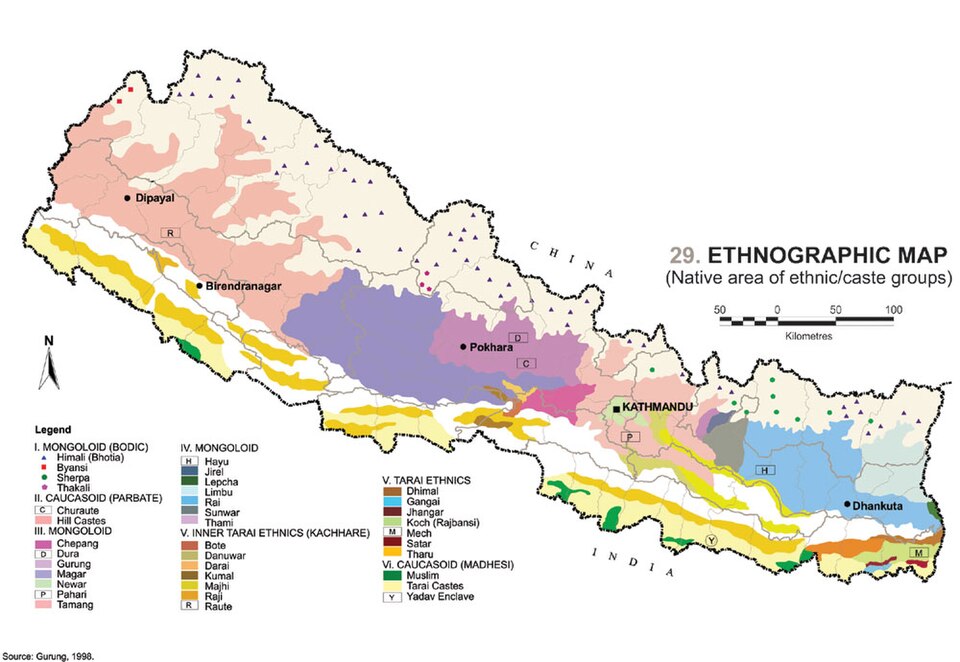 A labeled map showing the distribution of major ethnic groups (Chhetris, Tharus, Newars, etc.) across Nepal’s regions. (Image: Dr Harka Gurung, CC BY-SA 4.0, via Wikimedia Commons)
2. Caste and Business: The Invisible Hand
How Caste Affects Workplaces and Markets
| Aspect | Caste Influence | Business Impact |
|---|---|---|
| Hiring | Brahmin/Kshatriya dominance in white-collar jobs (banks, government). | Example: Nabil Bank’s leadership is 80% Brahmin/Chhetri; Dalits face glass ceilings. |
| Occupations | Traditional roles: Brahmin (priests, teachers), Kami (blacksmiths), Damai (funeral workers). | Example: Daraz’s logistics rely on Newar middlemen for urban deliveries. |
| Consumer Behavior | Dalits may avoid Brahmin-owned shops; Newars prefer local markets over chains. | Example: Himalayan Java targets Brahmin/Chhetri professionals with "respectful" branding. |
| Digital Divide | Lower smartphone adoption in Dalit/Madhesi communities. | Example: eSewa’s payment app sees 30% lower usage in Far-Western Dalit areas. |
Worked Example: Kathmandu Traffic and Caste
- Scenario: A Newar truck driver (traditionally a Kami or Sarki caste) navigates Kathmandu’s chaotic traffic.
- Caste Factor: Newars control 90% of urban transport businesses due to historical trade networks. Their social capital (trust among police, other drivers) helps them bypass bribes others pay.
- Business Lesson: Logistics firms like Nepal Trucking Company (NTC) partner with Newar-owned fleets for reliability, not just cost.
3. Ethnicity and Market Segmentation
Nepal’s 59+ ethnic groups create micro-markets. Key examples:
- Tharus (Terai): Prefer rice-beans (dal-bhat), Hindu-Buddhist syncretism, and local festivals like Maghe Sankranti.
- Business Case: Bhatbhateni (rice mill chains) dominate Terai; Tharu-owned spice shops sell mustard oil and fish.
- Newars (Kathmandu Valley): Urban, Buddhist-Hindu, love momos, sel roti, and Newari architecture.
- Business Case: Thamel’s restaurants (e.g., Momo Magic) target Newar tourists; Newar-owned banks (e.g., NMB) offer microloans for small businesses.
- Magars/Gurungs (Hills): Agrarian, tea/coffee consumers, and Buddhist with strong community ties.
- Business Case: Himalayan Java markets instant coffee as a "Magar/Gurung staple" in hill districts.
4. Regionalism: How Geography Shapes Business
Nepal’s three ecological zones create distinct economic zones:
Real-World Tie-In: Pathao’s Regional Strategy
- Challenge: Pathao (ride-hailing) struggles in Mountain regions due to poor roads and low smartphone penetration.
- Solution:
- Hills: Partnered with Newar-owned auto-rickshaws (who already have social networks).
- Terai: Offered cash-on-delivery for rural users.
- Result: 60% of Pathao’s Terai users are Tharu/Madhesi, while Hill users are Chhetri/Newar.
5. Institutional Frameworks: Laws and Business
Nepal’s post-2015 federal structure impacts businesses through:
- Federalism (7 Provinces + Kathmandu):
- Province 2 (Madhesh): Dominated by Madhesi ethnic groups; businesses must localize (e.g., Maithili-language customer service).
- Province 5 (Karnali): Dalit/Muslim majority; microfinance NGOs (e.g., FINCA Nepal) tailor loans for women.
- Constitutional Bodies:
- National Dalit Commission: Ensures 10% quota in private-sector hiring (affects HR policies).
- National Women Commission: Mandates 33% women representation in boards (e.g., Nepal Rastra Bank now has 35% women directors).
- Labor Laws:
- Minimum wage varies by region (e.g., Rs. 18,000/month in Kathmandu vs. Rs. 12,000 in Far-West).
- Industrial Relations Act (2017): Requires union representation by ethnicity in factories (e.g., Himalayan Cotton Industries in Birgunj).
Case Study: Nabil Bank’s Inclusive Hiring
- Challenge: Low Dalit representation in corporate roles.
- Strategy:
- Targeted recruitment in Dalit colleges (e.g., Madhesh Prachar Samiti).
- Mentorship programs with Brahmin/Chhetri senior staff.
- Result: Dalit employees now hold 15% of mid-level roles (up from 5% in 2015).
- Business Benefit: Improved community trust for microloans in Dalit-dominated areas.
6. Social Capital: The Glue of Nepali Business
Social capital (trust, networks, reciprocity) is more valuable than formal contracts in Nepal. Examples:
- Jajmani System: A Brahmin priest (jajman) provides spiritual services in exchange for Kami blacksmiths fixing tools.
- Business Parallel: Local tailors (Newar) get orders from Brahmin families via word-of-mouth, not ads.
- Guthi (Community Funds): Newari guthis pool money for festivals; businesses sponsor them for goodwill.
- Pathao’s "Local Captains": Drivers (often Magar or Tamang) refer friends for commission, creating organic growth.
7. Globalization vs. Localization: The Nepali Dilemma
| Global Trend | Nepali Adaptation | Example |
|---|---|---|
| Standardized Products | Localized flavors, packaging, and marketing. | Coca-Cola in Nepal sells smaller bottles (due to lower incomes) and mango flavor. |
| E-commerce | Cash-on-delivery dominates; digital payments lag in rural areas. | Daraz offers installment plans (via banks) for low-income users. |
| Foreign Investment | Joint ventures with local ethnic/caste groups for social license. | Toyota Kirloskar partnered with Chaudhary Group (Chhetri-owned) to navigate labor laws. |
| Social Media Marketing | Facebook/YouTube ads in Nepali, Maithili, or Tharu for ethnic targeting. | Himalayan Java runs Tamang-language ads in Sindhupalchowk district. |
Worked Example: Daraz’s Regional Pricing
- Problem: A Rs. 500 product in Kathmandu costs Rs. 700 in Darchula (Mountain region) due to logistics.
- Solution:
- Terai: Bulk discounts for Madhesi wholesale buyers.
- Hills: Partnered with Newar-owned local shops for "Daraz Corner" (consignment model).
- Mountain: Subsidized shipping for trekking gear (e.g., -20% on oxygen tanks during peak season).
8. Challenges and Opportunities
Challenges for Businesses
- Caste Discrimination: Dalits face higher interest rates in microfinance (e.g., Rs. 2% more than Brahmin borrowers).
- Regional Infrastructure Gaps: 70% of Mountain roads are unpaved, increasing costs for FMCG firms.
- Ethnic Tensions: Madhesi protests (2015) disrupted trade in Terai for months.
- Low Digital Literacy: Only 40% of Dalit women use smartphones (vs. 70% Brahmin men).
Opportunities
- Niche Marketing: Tharu-owned organic farms supply Daraz for "Terai Special" products.
- Government Quotas: 33% women in boards → More female-friendly policies (e.g., Nepal Investment Bank offers maternity leave loans).
- Cultural Tourism: Losar (Tibetan New Year) in Dolpo attracts high-spending Tibetan diaspora.
- Social Enterprises: Udayak Kiran (Dalit-owned) makes organic honey for export.
In the Real World
eSewa (Digital Payments)
- Idea Used: Ethnic and regional digital divide.
- How: eSewa’s USSD service (for feature phones) targets Dalit/Madhesi users in Terai, while app-based payments dominate in Kathmandu’s Newar/Chhetri elite.
- Impact: 60% of eSewa’s rural users are Tharu or Dalit, but they transact 30% less than urban users.
Pathao (Ride-Hailing)
- Idea Used: Caste-based driver networks.
- How: Pathao’s "Local Captains" (drivers) are often Magar or Tamang, who recruit friends via oral contracts (no formal HR).
- Impact: 80% of Pathao’s hill drivers are indigenous, reducing poaching by competitors like Khatapao.
Nabil Bank (Microfinance)
- Idea Used: Regional and caste-based loan structuring.
- How: In Dalit-dominated areas, loans are group-based (5–10 members guarantee each other), while Brahmin professionals get individual loans with lower collateral.
- Impact: Dalit loan repayment rate: 92% (vs. 85% for other groups).
Exam Tip
This unit is heavily tested on:
- Definitions and Comparisons:
- Differentiate varna (theoretical) vs. jati (practical) caste systems.
- Compare Hill, Terai, and Mountain economic activities.
- Case Studies:
- Expect 3–4 marks on Nepalese businesses (e.g., Nabil Bank, Daraz, Pathao) and how they adapt to social structures.
- Example Question: "How does Pathao’s regional strategy reflect Nepal’s caste and ethnic divisions? Discuss with examples." Answer Tip: Mention Newar drivers in Hills, Tharu/Madhesi in Terai, and cash-on-delivery for low-literacy groups.
- Diagrams and Maps:
- Draw a mindmap of Nepal’s social structure (caste + ethnicity + region).
- Label an ethnic map showing Chhetri dominance in Hills, Tharu in Terai, and Dalit clusters.
- Critical Analysis:
- "Is caste discrimination a business risk or opportunity in Nepal?"
Structure:
- Risk: Legal penalties (e.g., Equal Rights Act 2011), reputational damage.
- Opportunity: First-mover advantage (e.g., FINCA Nepal targeting Dalit women).
- "Is caste discrimination a business risk or opportunity in Nepal?"
Structure:
- Short-Answer Tricks:
- Memorize these pairs:
- Newar + Trade | Tharu + Agriculture | Dalit + Manual Labor.
- Kathmandu + Finance | Birgunj + Manufacturing | Pokhara + Tourism.
- Memorize these pairs:
Final Visual Summary
Based on the TU BITM syllabus for Sociology for Business Management (SOC203), unit 7.
Discussion
Loading…