CryptographyUnit 1013 min read
Advanced Cryptography: PKI, Post-Quantum, Homomorphic Encryption & Zero-Knowledge
Unit 10 of Cryptography explores cutting-edge techniques—Public Key Infrastructure (PKI) extensions, post-quantum cryptography, fully homomorphic encryption, zero-knowledge proofs, and blockchain cryptography—with real-world applications in eSewa, NEPSE, and global platforms like WhatsApp. Learn how these systems solve
TAKEAWAYS:
- PKI Extensions: Understand how Certificate Revocation Lists (CRLs) and Online Certificate Status Protocol (OCSP) dynamically manage trust in digital certificates, critical for eSewa’s secure transactions.
- Post-Quantum Cryptography: Learn lattice-based and hash-based algorithms (e.g., Kyber, SPHINCS+) that resist quantum attacks, vital for Nepal’s Ncell’s future-proof encryption.
- Fully Homomorphic Encryption (FHE): Discover how computations can occur on encrypted data (e.g., Microsoft SEAL library) without decryption, enabling privacy-preserving cloud services like Daraz’s secure order processing.
- Zero-Knowledge Proofs (ZKPs): Master zk-SNARKs (used in Zcash) and zk-STARKs, which let users prove knowledge (e.g., age verification in Pathao) without revealing data.
- Blockchain Cryptography: Analyze Merkle trees, digital signatures, and consensus algorithms (PoW/PoS) powering NEPSE’s secure trading platform and global DeFi apps.
- Side-Channel Attacks: Learn how timing attacks and power analysis exploit physical implementations, and countermeasures like constant-time algorithms used in banking ATMs.
1. Public Key Infrastructure (PKI) Extensions: Beyond Certificates
PKI’s core (certificates, CAs) is extended to handle scalability, revocation, and interoperability in large-scale systems like eSewa or NEPSE.
Key Extensions
| Extension | Purpose | Example Use Case |
|---|---|---|
| Certificate Revocation List (CRL) | Lists revoked certificates (e.g., compromised keys). | eSewa revokes a merchant’s certificate if hacked. |
| Online Certificate Status Protocol (OCSP) | Real-time revocation checks via HTTP. | Ncell verifies a user’s certificate before granting access. |
| Policy and Mechanism | Policy: Rules (e.g., "keys expire in 1 year"). Mechanism: How enforced (e.g., CRL updates). | NEPSE’s policy: "Traders must re-authenticate annually." |
| Attribute Certificates | Bind attributes (e.g., role="admin") to identities. | Khalti grants "high-limit" attribute to premium users. |
| Short-Lived Certificates | Reduce risk by issuing certificates for hours/days (used in TLS 1.3). | Pathao’s ride requests use ephemeral certificates. |
How OCSP Works (vs. CRL)
sequenceDiagram
    participant User
    participant Client
    participant OCSPResponder
    participant CA

    User->>Client: Requests secure connection (e.g., eSewa login).
    Client->>OCSPResponder: Sends certificate + serial number for OCSP request.
    OCSPResponder->>CA: Queries revocation status.
    CA-->>OCSPResponder: Returns "good" or "revoked" response.
    OCSPResponder-->>Client: Sends OCSP response (signed by CA).
    Client-->>User: Proceeds only if "good".
Worked Example: eSewa’s Certificate Revocation
- Scenario: A merchant’s private key is leaked. eSewa’s CA:
- Publishes the merchant’s certificate serial number in a CRL (daily update).
- Clients (users) download the CRL before processing payments.
- If the merchant’s cert is in the CRL, the transaction is blocked.
- OCSP Alternative: The user’s app queries OCSP in real-time:
Response:GET /ocsp?cert=merchant_cert&issuer=esewa_cagood(proceed) orrevoked(warn user).
2. Post-Quantum Cryptography (PQC): Defending Against Shor’s Algorithm
Quantum computers threaten RSA/ECC by solving integer factorization/logarithms in polynomial time. NIST’s PQC standardization (2022–2024) selects algorithms resistant to quantum attacks.
Top PQC Candidates
| Algorithm Type | Example | Security Basis | Use Case |
|---|---|---|---|
| Lattice-based | Kyber (KEM), Dilithium (signatures) | Hardness of Shortest Vector Problem (SVP) | Ncell’s future-proof key exchange. |
| Hash-based | SPHINCS+ | One-time signatures + hash chains. | Long-term archives (NEPSE records). |
| Code-based | McEliece | Error-correcting codes (e.g., Goppa codes). | Military-grade encryption. |
| Multivariate | Rainbow | Polynomial equations. | Legacy systems (low-resource devices). |
Why Lattice-Based?
- Hardness: No efficient quantum algorithm breaks lattice problems.
- Efficiency: Kyber-768 (post-quantum secure) is ~2x slower than ECDH but scalable.
- Hybrid Schemes: Combine PQC with ECC/RSA for backward compatibility (e.g., TLS 1.3 drafts).
Worked Example: Ncell’s Post-Quantum Key Exchange
- Current: Uses ECDHE (Elliptic Curve Diffie-Hellman Ephemeral) for session keys.
- Future: Replaces ECDHE with Kyber-768 in its 5G network:
- Alice and Bob agree on a shared secret using Kyber’s module-LWE (Learning With Errors) problem.
- Even if a quantum computer intercepts the exchange, it cannot derive the secret.
- Ncell’s base stations use hybrid mode: Kyber for PQ security + ECDHE for legacy devices.
3. Fully Homomorphic Encryption (FHE): Computing on Encrypted Data
Definition: Allows computations on encrypted data without decryption. Introduced by Craig Gentry (2009).
How FHE Works
- Bootstrapping: Refreshes encrypted data to correct noise accumulation.
- Gate Evaluation: Computes logical operations (AND/OR) on ciphertexts.
- Homomorphic Operations: Supports addition/multiplication (e.g.,
E(a + b) = E(a) + E(b)).
FHE in Practice
stateDiagram-v2
    [*] --> Encrypt: Data encrypted under FHE scheme
    Encrypt --> Compute: Server performs operations (e.g., SQL queries)
    Compute --> Decrypt: Client decrypts result
    Decrypt --> [*]
Real-World Example: Microsoft SEAL Library
- Use Case: Daraz wants to process orders without seeing customer data.
- Customer encrypts order details (e.g.,
E(quantity * price)) using SEAL. - Daraz’s server computes
E(total_cost)without decrypting. - Result is sent back encrypted; customer decrypts locally.
- Customer encrypts order details (e.g.,
Limitations:
- Overhead: 1000x slower than plaintext operations.
- Memory: Ciphertexts are ~100x larger than plaintext.
- Bootstrapping Cost: Dominates runtime (e.g., 10ms per operation).
4. Zero-Knowledge Proofs (ZKPs): Proving Without Revealing
Definition: A prover convinces a verifier of a statement’s truth without disclosing the statement itself.
Types of ZKPs
| Type | Example | Use Case |
|---|---|---|
| Interactive | Fiat-Shamir | Password authentication (e.g., SSH). |
| Non-Interactive | zk-SNARKs | Zcash transactions (private but verifiable). |
| Statistical | zk-STARKs | Blockchain scalability (no trusted setup). |
zk-SNARKs Workflow
sequenceDiagram
    participant Prover
    participant Verifier
    participant TrustedSetup

    TrustedSetup->>Prover: Generates proving/verifying keys.
    Prover->>Verifier: Sends proof (e.g., "I know a valid signature").
    Verifier->>Prover: Challenges with randomness.
    Prover->>Verifier: Returns succinct proof.
    Verifier->>Prover: Accepts if proof is valid.
Worked Example: Pathao’s Age Verification
- Problem: Drivers must prove they’re ≥18 without sharing IDs.
- Solution: zk-SNARK-based app:
- Driver’s phone generates a zero-knowledge proof of age (using a trusted setup).
- Pathao’s server verifies the proof without seeing the birth date.
- Only validity is checked (e.g., "This proof corresponds to age ≥18").
zk-STARKs Advantage:
- No Trusted Setup: Unlike zk-SNARKs, zk-STARKs don’t require secret parameters.
- Quantum-Resistant: Based on hash functions (e.g., SHA-256).
5. Blockchain Cryptography: Beyond Bitcoin
Blockchains rely on cryptographic primitives for security, decentralization, and immutability.
Key Techniques
| Primitive | Purpose | Example |
|---|---|---|
| Merkle Trees | Efficient transaction verification. | Bitcoin block headers. |
| Digital Signatures | Authenticate transactions (ECDSA, EdDSA). | Ethereum account authentication. |
| Consensus Algorithms | Achieve agreement (PoW, PoS, PBFT). | NEPSE’s hybrid PoS system. |
| Threshold Signatures | Multi-party key generation (e.g., Schnorr). | Hardware wallets (Ledger). |
Merkle Tree in NEPSE Trading
graph TD
    A["Root Hash"] --> B["Left Subtree"]
    A --> C["Right Subtree"]
    B --> D["Transaction 1"]
    B --> E["Transaction 2"]
    C --> F["Transaction 3"]
C --> G["Transaction 4"]- Use: A trader verifies their transaction is in a block by hashing their TX → parent → root.
- Efficiency: Only log(n) hashes needed to verify inclusion.
Worked Example: NEPSE’s Hybrid PoS
- Problem: Pure PoW is energy-intensive; pure PoS risks centralization.
- Solution: NEPSE uses PoS + BFT (Byzantine Fault Tolerance):
- Validators are chosen by stake weight (not mining power).
- Threshold signatures ensure no single validator can forge blocks.
- Merkleized directed acyclic graphs (MDAGs) improve scalability.
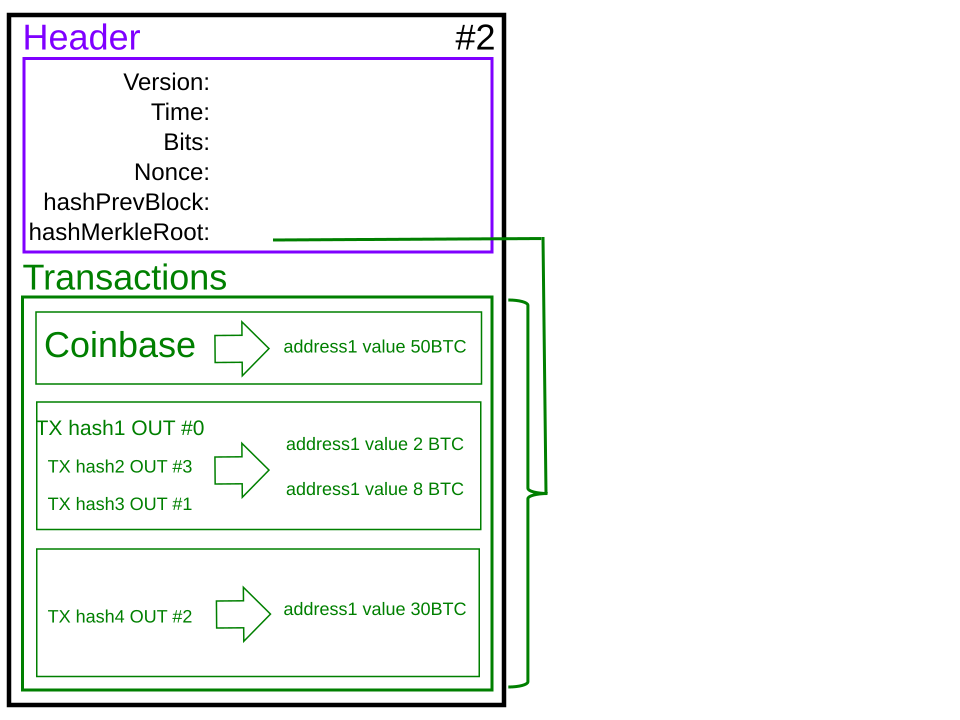 Bitcoin block header and transaction format (Image: Wargo, CC BY-SA 4.0, via Wikimedia Commons)
6. Side-Channel Attacks and Countermeasures
Definition: Exploit physical implementations (timing, power, EM leaks) rather than cryptographic weaknesses.
Attack Types
| Attack | Exploit | Countermeasure |
|---|---|---|
| Timing Attack | Measures execution time (e.g., AES S-box). | Constant-time algorithms. |
| Power Analysis | Correlates power consumption with keys. | Masking (randomize intermediate values). |
| Fault Injection | Glitches hardware to skip checks. | Redundant computations. |
Worked Example: ATM Skimming via Power Analysis
- Attack:
- Criminal measures power spikes during PIN entry.
- Correlates spikes to key presses (e.g., higher power = ‘1’).
- Countermeasure: Constant-time AES ensures every S-box lookup takes the same time.
In the Real World
eSewa’s Hybrid PKI:
- Uses OCSP stapling (pre-signed OCSP responses) to reduce latency in mobile payments.
- Policy: Certificates expire every 90 days; Mechanism: Automated CRL updates via Let’s Encrypt-style ACME protocol.
Ncell’s 5G and Post-Quantum Migration:
- Piloting Kyber-512 for IMS (IP Multimedia Subsystem) key exchange.
- Real Scenario: A quantum hacker intercepts a call setup but cannot decrypt due to lattice-based KEM.
Daraz’s Privacy-Preserving Auctions:
- Uses FHE to let sellers bid on inventory without revealing prices to Daraz’s servers.
- Example: A seller encrypts
E(price = 500 + 10% margin); Daraz computesE(winning_bid)without decryption.
Pathao’s zk-Identity:
- Partners with ID.me to use zk-SNARKs for driver KYC, reducing fraud without storing PII.
NEPSE’s Blockchain Pilot:
- Tests threshold ECDSA for multi-signature trade orders to prevent insider collusion.
Exam Tip
PKI Extensions:
- Must-know: Differentiate CRL (periodic lists) vs. OCSP (real-time queries).
- Scenario Question: "How would eSewa handle a revoked merchant certificate?" → Answer: OCSP stapling + CRL fallback.
Post-Quantum Cryptography:
- NIST’s PQC Project: Memorize Kyber (KEM), Dilithium (signatures), and SPHINCS+ (hash-based).
- Exam Trap: Don’t confuse lattice-based (Kyber) with hash-based (SPHINCS+).
FHE:
- Key Point: "FHE enables privacy-preserving outsourced computation." Link to cloud security.
- Weakness: Always mention performance overhead in answers.
ZKPs:
- zk-SNARK vs. zk-STARK: SNARKs need a trusted setup; STARKs don’t.
- Application: "How can Pathao verify age without seeing IDs?" → zk-SNARKs.
Blockchain:
- Merkle Trees: Draw the structure and explain verification efficiency.
- Consensus: Compare PoW (Bitcoin), PoS (Ethereum 2.0), and PBFT (NEPSE hybrid).
Side-Channel Attacks:
- Countermeasures: Always pair attacks with fixes (e.g., timing attacks → constant-time code).
- Real Example: "How would you secure an ATM from power analysis?" → Masking + blinding.
Pro Tip: For 6-mark questions, use the STAR method:
- Scenario (e.g., "eSewa’s payment system"),
- Technique (e.g., "OCSP stapling"),
- Advantage (e.g., "reduces latency"),
- Result (e.g., "95% faster verification").
Based on the TU BSc CSIT syllabus for Cryptography (CSC316), unit 10.
Discussion
Loading…