System Analysis and DesignUnit 19 min read
System Analysis & Design: Basics, Scope, and Process
Unit 1 of System Analysis and Design introduces core concepts like system definition, analysis vs. design phases, methodologies (waterfall, agile), and the role of stakeholders. Covers the SDLC overview, key deliverables, and real-world applications in Nepalese tech (eSewa, banks) with visuals for DFDs, use cases, and
Core Concepts and Definitions
What is a System?
A system is an interconnected set of components working together to achieve a common goal. In computing, it includes:
- Hardware (servers, routers, devices)
- Software (applications, databases, OS)
- Data (structured/unstructured)
- People (users, admins, developers)
- Processes (workflows, algorithms)
classDiagram
    class System {
        +Components: Hardware, Software, Data, People, Processes
        +Purpose: Achieve a defined goal
        +Types: Manual, Automated, Hybrid
    }
    class Hardware {
        +Examples: Servers, Routers, Mobile Devices
    }
    class Software {
        +Examples: ERP, CRM, Custom Apps
    }
    class Data {
        +Examples: Customer Records, Transaction Logs
    }
    class People {
        +Examples: End Users, IT Staff, Stakeholders
    }
    System --> Hardware
    System --> Software
    System --> Data
    System --> People
    System --> Processes
System Analysis vs. System Design
| System Analysis | System Design |
|---|---|
| Focus: Understanding what the system should do. | Focus: Defining how the system will work. |
| Activities: Gathering requirements, modeling processes (DFDs, use cases), identifying constraints. | Activities: Architectural design, database schema, UI/UX, system integration. |
| Deliverables: Requirements document, DFDs, use case diagrams. | Deliverables: System architecture, ER diagrams, prototypes, technical specs. |
| Example: "The eSewa app must allow users to pay bills online." | Example: "The eSewa backend will use a microservices architecture with Kafka for event streaming." |
| Tools: Interviews, surveys, observation, JAD sessions. | Tools: UML, CASE tools (Lucidchart, Visual Paradigm), prototyping tools. |
System Development Life Cycle (SDLC) Overview
SDLC is a structured process to develop, maintain, and replace information systems. The waterfall model (sequential phases) is the foundation, but modern approaches (agile, iterative) adapt it.
flowchart TD
    A["System Planning"] --> B["System Analysis"]
    B --> C["System Design"]
    C --> D["Implementation"]
    D --> E["Testing"]
    E --> F["Deployment"]
    F --> G["Maintenance"]
    G -->|"Feedback"| B
Phases Explained:
- Planning: Define scope, feasibility, and high-level requirements.
- Analysis: Gather detailed requirements (e.g., "Ncell’s billing system must support prepaid/postpaid customers").
- Design: Create blueprints (e.g., database schema for Daraz’s order management).
- Implementation: Code, configure, and integrate components.
- Testing: Validate functionality (unit, integration, system tests).
- Deployment: Roll out to users (e.g., NEPSE’s new trading platform).
- Maintenance: Fix bugs, update features (e.g., eSewa adding QR payments).
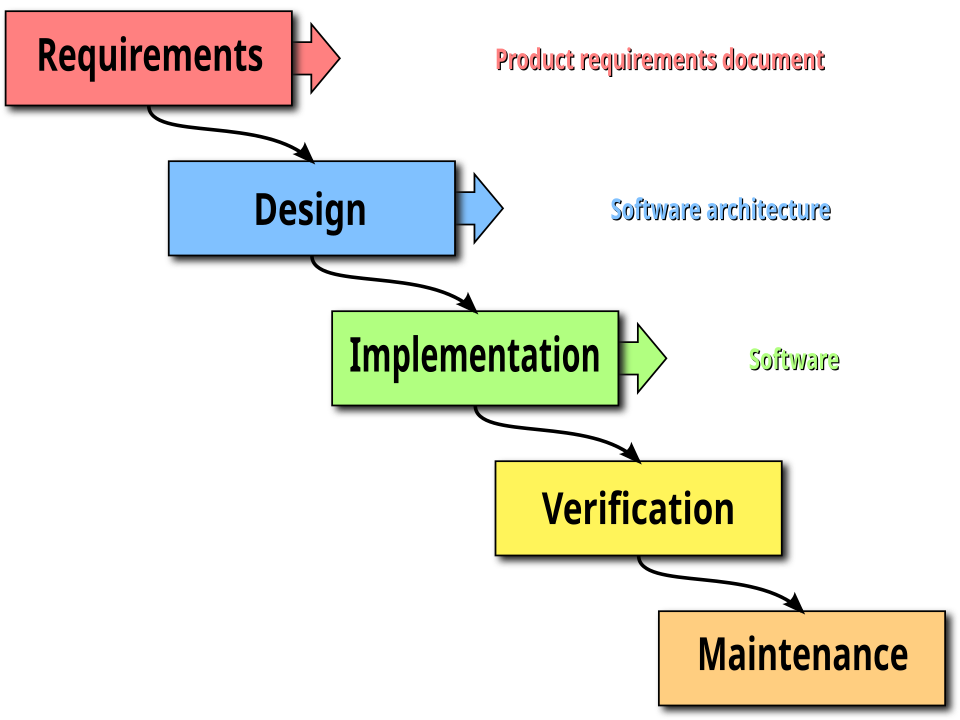 Traditional SDLC phases with feedback loops (Image: Peter Kemp / Paul Smith, CC BY 3.0, via Wikimedia Commons)
Methodologies: Waterfall vs. Agile
| Waterfall | Agile |
|---|---|
| Approach: Linear, sequential. | Approach: Iterative, incremental. |
| Flexibility: Low (changes hard after analysis). | Flexibility: High (adapts to feedback). |
| Delivery: Single release at the end. | Delivery: Frequent releases (sprints). |
| Best for: Stable requirements (e.g., government systems like NTC’s billing). | Best for: Dynamic projects (e.g., Pathao’s ride-hailing app). |
| Tools: Documents, DFDs, Gantt charts. | Tools: Scrum/Kanban boards, daily standups. |
| Risk: Late-stage surprises. | Risk: Scope creep if not managed. |
Worked Example:
- Nepal Rastra Bank’s Core Banking System:
- Waterfall: Used for initial design (stable regulatory requirements).
- Agile: Later phases for adding features like mobile banking (eSewa integration).
Stakeholders and Their Roles
Stakeholders are individuals/groups affected by the system. Key roles in a hospital management system (e.g., for a private clinic in Kathmandu):
| Stakeholder | Role | Example Interaction |
|---|---|---|
| Patients | End users; provide health data. | Fill online registration forms. |
| Doctors | Input diagnoses, prescribe treatments. | Access patient records via a secure portal. |
| Admins | Manage system, generate reports. | Run monthly billing reports for insurance claims. |
| IT Support | Troubleshoot issues, maintain servers. | Fix login failures during peak hours. |
| Government | Regulatory compliance (e.g., patient data privacy laws). | Audit system for HIPAA-like compliance. |
Requirements Gathering Techniques
Techniques to collect accurate requirements (critical for exams!):
- Interviews: One-on-one with stakeholders (e.g., interviewing a Daraz store owner about inventory needs).
- Surveys/Questionnaires: For large user bases (e.g., Ncell’s customer satisfaction surveys).
- Observation: Watch users interact with existing systems (e.g., observing traffic at a Kathmandu bank’s ATM).
- Document Analysis: Review existing manuals, reports (e.g., analyzing NTC’s old billing records).
- Joint Application Design (JAD): Collaborative workshops (e.g., Khalti’s team brainstorming payment flows).
- Prototyping: Create mockups for feedback (e.g., eSewa’s QR code payment demo).
Comparison Table:
| Technique | Pros | Cons | Best For |
|---|---|---|---|
| Interviews | Deep insights, tailored questions. | Time-consuming, biased. | Small teams, high-stakes projects. |
| Surveys | Scalable, quantitative data. | Low response rates, superficial. | Large user bases (e.g., YouTube). |
| Observation | Unbiased, real-world behavior. | Invasive, hard to scale. | Usability testing (e.g., Pathao app). |
| JAD | Fast, collaborative. | Requires skilled facilitator. | Cross-functional teams. |
In the Real World
eSewa’s Payment System:
- Concept: Layered Architecture (presentation, application, data layers).
- How: Users interact with the app (presentation layer), which communicates with payment gateways (application layer) and databases (data layer).
- Visual:
Daraz’s Order Fulfillment:
- Concept: Data Flow Diagrams (DFDs).
- How: A Level-0 DFD shows customers → Daraz system → suppliers → delivery partners.
- Worked Example:
- Process: When you order a product, Daraz’s system:
- Validates inventory (data store).
- Generates an order (process).
- Notifies the supplier (data flow).
- Tracks delivery via a third party (e.g., Ncell’s logistics).
- Process: When you order a product, Daraz’s system:
Ncell’s Billing System:
- Concept: Use Case Diagrams.
- How: Actors (customers, admins) interact with use cases like "Pay Bill," "Check Usage," "Update Profile."
- Visual:
Exam Tip
Diagrams Are Worth 20% of Marks:
- Always draw context diagrams, Level-0 DFDs, and use case diagrams for scenario-based questions.
- Example: For a "hospital management system," show:
- Context Diagram: "Hospital" as a single process with external entities (patients, doctors, labs).
- Level-0 DFD: Break "Hospital" into sub-processes (appointment scheduling, billing, records).
Define Key Terms Precisely:
- System Analysis: "The process of understanding and documenting what a system should do."
- System Design: "The process of defining how the system will achieve its requirements."
- Feasibility Study: "Assessing technical, economic, and operational viability."
Real-World Links:
- Tie answers to Nepalese examples:
- "Like eSewa’s layered architecture, the system we design must separate user interface from backend processing."
- "Ncell’s billing system uses DFDs to model interactions between customers, the network, and payment gateways."
- Tie answers to Nepalese examples:
Common Pitfalls:
- Avoid: Vague statements like "the system will be user-friendly." Instead, specify: "The UI will include a mobile-responsive design with Nepali language support."
- Do: Use bullet points for structured answers (examiners love clarity).
Practice Questions:
- For a retail store system (like a local Kathmandu mall shop):
- Draw a context diagram with entities: Customers, Cashier, Inventory, Supplier.
- Draw a Level-0 DFD with processes: Sales, Inventory Update, Payments.
- For requirements gathering:
- Compare interviews (deep but slow) vs. surveys (fast but shallow) for a Daraz seller’s needs.
- For a retail store system (like a local Kathmandu mall shop):
Based on the TU BSc CSIT syllabus for System Analysis and Design (CSC315), unit 1.
Discussion
Loading…