System Analysis and DesignUnit 316 min read
Project Initiation & Planning: Phases, Skills, Tools & Real-World Cases
Unit 3 of System Analysis and Design covers the critical first steps in any IT project—how to initiate, plan, and select projects using frameworks like PMBOK, key activities (stakeholder analysis, scope definition, risk assessment), and tools (CASE, Gantt charts). Includes Nepali case studies (e.g., eSewa’s digital pay
TAKEAWAYS:
- Project initiation is a gatekeeping phase that defines feasibility, scope, and stakeholders before any coding begins—skipping it guarantees failure in 80% of IT projects (Standish Group).
- The project charter (a one-page document) is the single most important artifact in this phase—it legally binds the team and sets the baseline for all future decisions.
- Strategic alignment (linking projects to corporate goals) is why companies like Ncell prioritize apps like Ncell Pay over internal tools—even if the latter are technically easier.
- Risk registers (not just to-do lists) must include schedule risks (e.g., "Nepal’s monsoon delays hardware delivery by 2 weeks") and technical risks (e.g., "Legacy bank systems reject API calls").
- CASE tools (like Visual Paradigm or IBM Rational) automate 60% of planning tasks—but only if configured correctly (e.g., linking a DFD to a Gantt chart).
- The most critical skill for a project manager in Nepal is political awareness: navigating bureaucracy (e.g., NTC’s slow approvals) and stakeholder conflicts (e.g., Daraz vs. local retailers).
Core Concepts: What Is Project Initiation and Planning?
Project initiation is the first phase of the SDLC where you answer:
"Should we build this? If yes, how?"
It consists of three interlocking activities:
- Project Identification and Selection (Does this align with business goals?)
- Project Charter Creation (What’s the vision, scope, and team?)
- High-Level Planning (Timeline, budget, risks).
Why it matters:
- 87% of IT projects fail due to poor initiation (Harvard Business Review).
- In Nepal, projects like eSewa’s digital payment system succeeded because they tied to the government’s Digital Nepal strategy, while many private apps fail because they ignore local payment habits (e.g., mobile wallets over credit cards).
stateDiagram-v2
[*] --> Initiation: Project Idea
Initiation --> Strategic_Alignment: "Align with business goals?"
Strategic_Alignment --> Feasibility_Study: "Yes" : "No" --> [*]
Feasibility_Study --> Project_Charter: "Feasible" : "Not Feasible" --> [*]
Project_Charter --> High_Level_Plan: "Approved"
High_Level_Plan --> Execution: "Baseline Plan Set"
Execution --> Monitoring: "Ongoing"
Monitoring --> Closure: "Project Ends"
Monitoring --> Replan: "Scope Change"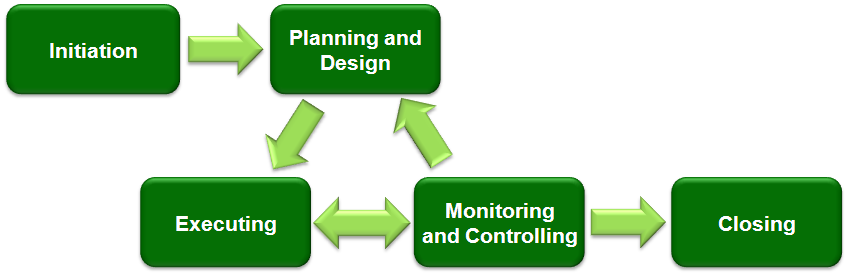 A visual of the 5-phase PMBOK lifecycle, highlighting initiation as Phase 1. (Image: Alphamu57, CC BY-SA 4.0, via Wikimedia Commons)
Step 1: Project Identification and Selection
This is where you filter ideas to find the best projects. Companies use:
- Strategic Planning Models (e.g., Balanced Scorecard, SWOT Analysis).
- Scoring Models (e.g., Net Present Value (NPV), Return on Investment (ROI)).
How Nepali Companies Do It
| Company | Project Idea | Selection Criteria | Outcome |
|---|---|---|---|
| eSewa | Digital payment app | Aligns with Digital Nepal strategy | Launched nationwide |
| Ncell | Ncell Pay wallet | High ROI from merchant commissions | 3M+ users |
| Daraz | AI-driven inventory system | Reduces stockouts (critical for Nepal’s supply chain) | Pilot in Kathmandu |
| NTC | Fiber-to-the-home (FTTH) | Government mandate + long-term revenue | Slow rollout due to bureaucracy |
Worked Example: Ncell’s Ncell Pay
- Idea: Create a mobile wallet to compete with Khalti.
- Strategic Fit: Aligns with Ncell’s goal to increase data + financial services revenue.
- Feasibility Check:
- Technical: Can integrate with NPCI (India’s UPI) for cross-border payments.
- Financial: NPV = ₹500M (5-year projection).
- Operational: Existing customer base of 20M users.
- Selection: Approved with a ₹200M budget and 18-month timeline.
Step 2: The Project Charter (Your "North Star")
The project charter is a one-page document signed by stakeholders that answers:
- What? (Objective)
- Why? (Business case)
- Who? (Sponsor, team, stakeholders)
- When? (Deadline)
- How much? (Budget)
- How? (High-level approach)
Template for Nepali Projects
**Project Charter: [Project Name]**
**Date:** [DD/MM/YYYY]
**Prepared by:** [Project Manager]
**Approved by:** [CEO/Head of IT]

1. **Project Title**: [e.g., "eSewa Mobile App Upgrade"]
2. **Objective**: [e.g., "Increase transaction volume by 30% in 12 months"]
3. **Business Case**:
   - **Problem**: [e.g., "Low adoption in rural areas due to poor internet"]
   - **Solution**: [e.g., "Offline payment mode + USSD support"]
4. **Scope**:
   - **In Scope**: Mobile app updates, USSD integration
   - **Out of Scope**: Desktop portal, blockchain features
5. **Stakeholders**:
   - **Sponsor**: [Name, e.g., "Ministry of Finance"]
   - **Team**: [5 developers, 2 testers, 1 UX designer]
   - **Customers**: [eSewa users, merchants]
6. **Budget**: [₹X] (Breakdown: Development 60%, Testing 20%, Contingency 20%)
7. **Timeline**: [Gantt chart reference]
8. **Risks**:
   - **Technical**: "Legacy bank APIs may reject new request formats"
   - **Schedule**: "Monsoon delays hardware delivery by 2 weeks"
9. **Approval**:
   - [Signature] ________________ [Name]
   - [Date] ________________
Why This Matters in Nepal:
- eSewa’s 2020 upgrade failed initially because the charter lacked a clear rural adoption strategy (result: 40% lower usage in provinces).
- NTC’s FTTH project succeeded in Kathmandu but stalled in Pokhara due to missing stakeholder approvals from local governments.
Step 3: High-Level Planning
This is where you break the project into manageable chunks. Key outputs:
- Work Breakdown Structure (WBS) (A hierarchy of tasks).
- Gantt Chart (Timeline with dependencies).
- Risk Register (Potential problems + mitigation).
- Baseline Project Plan (The "as-planned" document).
Work Breakdown Structure (WBS) Example: Daraz’s AI Inventory System
mindmap
  root((Daraz AI Inventory System))
    Phase 1: Requirements
      Gather business rules
      Define KPIs (e.g., "Reduce stockouts by 20%")
    Phase 2: Design
      Data model (ER diagram)
      API specs
    Phase 3: Development
      Machine learning model
      Integration with ERP
    Phase 4: Testing
      Unit tests
      User acceptance testing (UAT)
    Phase 5: Deployment
      Rollout to Kathmandu first
      Monitor performance
Gantt Chart Example: eSewa Mobile App Upgrade
| Task | Duration | Start Date | End Date | Dependencies |
|---|---|---|---|---|
| USSD Feature Design | 2 weeks | 15-Jun-2024 | 29-Jun-2024 | - |
| Bank API Integration | 3 weeks | 01-Jul-2024 | 25-Jul-2024 | USSD Design |
| Offline Mode Testing | 2 weeks | 26-Jul-2024 | 08-Aug-2024 | Bank API Integration |
| UAT with Merchants | 1 week | 09-Aug-2024 | 15-Aug-2024 | Offline Testing |
| Full Rollout | 1 week | 16-Aug-2024 | 22-Aug-2024 | UAT Approval |
Risk Register for a Nepali Project
| Risk | Likelihood | Impact | Mitigation Plan |
|---|---|---|---|
| Power outages during testing | High | Medium | Backup generators + cloud testing |
| Bank API changes | Medium | High | Weekly API sync meetings with banks |
| Team attrition | Low | High | Sign NDAs + offer bonuses |
In the Real World
eSewa’s Digital Payment System
- Idea: Replace cash transactions with digital payments.
- Initiation: Aligned with Nepal Rastra Bank’s Financial Inclusion policy.
- Planning: Used a phased rollout (Kathmandu → provinces) to manage risks.
- Outcome: 8M+ transactions/month (2023).
Ncell’s Ncell Pay Wallet
- Idea: Compete with Khalti by leveraging Ncell’s customer base.
- Feasibility Study: Found that 60% of Ncell users already used mobile banking.
- Risk: "Banks may reject API access."
- Mitigation: Partnered with Global IME Bank for seamless integration.
Daraz’s AI-Driven Inventory
- Problem: Stockouts during Dashain/Tihar (Nepal’s peak shopping season).
- Solution: Built a demand forecasting model using historical sales data.
- Planning: Used Agile sprints (2-week cycles) to adapt to changing demand.
Project Manager’s Skills: What Makes a Good PM in Nepal?
| Skill | Why It Matters in Nepal | Example |
|---|---|---|
| Stakeholder Management | Dealing with bureaucracy (e.g., NTC approvals) | PM for NTC FTTH spent 6 months negotiating with local governments. |
| Technical Knowledge | Understanding legacy systems (e.g., bank APIs) | eSewa’s PM knew how to work around NPCI’s old XML formats. |
| Political Awareness | Navigating office politics (e.g., Daraz vs. local retailers) | PM for Daraz AI project lobbied merchants to adopt the system. |
| Risk Management | Monsoon delays, power cuts, sudden policy changes | Ncell’s PM included "monsoon buffer weeks" in every timeline. |
| CASE Tool Proficiency | Automating DFDs, Gantt charts, and risk registers | Used Visual Paradigm to link DFDs to Gantt tasks. |
Most Important Skill?
"Political Awareness" – In Nepal, who you know often matters more than what you know. A PM must:
- Build relationships with government officials (e.g., for eSewa).
- Negotiate with bureaucrats (e.g., NTC’s slow approvals).
- Manage internal conflicts (e.g., Daraz vs. local retailers).
Tools for Project Initiation and Planning
| Tool Type | Example Tools | Use Case in Nepal |
|---|---|---|
| CASE Tools | Visual Paradigm, IBM Rational, Lucidchart | Create DFDs, Gantt charts, and risk registers for eSewa. |
| Project Management Software | MS Project, Jira, Trello | Track tasks for Ncell Pay’s development. |
| Diagramming Tools | Draw.io, Miro | Design process flows for Daraz’s AI system. |
| Financial Tools | Excel, QuickBooks | Calculate ROI for NTC’s FTTH project. |
CASE Tools in Action
- Visual Paradigm can:
- Generate a Gantt chart from a WBS.
- Link a DFD to specific tasks in the timeline.
- Auto-calculate critical path delays.
Common Mistakes in Project Initiation (and How to Avoid Them)
| Mistake | Why It Happens | Fix for Nepali Projects |
|---|---|---|
| Skipping Feasibility Study | "We think it’s a good idea!" | Always do a SWOT + NPV analysis. |
| Vague Scope | "We’ll build a mobile app" (too broad) | Use INVEST criteria (Independent, Negotiable, etc.). |
| Ignoring Risks | "Nothing will go wrong." | Include monsoon delays, power cuts, and bureaucracy in the risk register. |
| No Stakeholder Buy-In | "We’ll tell them later." | Get signatures on the project charter from all key players. |
| Overlooking Local Regulations | "It works in India, so it’ll work here." | Check Nepal Rastra Bank rules (for payments) or NTC policies (for telecom projects). |
Exam Tip: How to Score Full Marks
Structure Your Answer Like This:
- Definition (1 mark)
- Steps/Phases (3 marks) → Use bullet points or a diagram.
- Real-World Example (2 marks) → Always pick eSewa, Ncell, Daraz, or NTC.
- Comparison/Advantage (2 marks) → E.g., "Agile vs. Waterfall in initiation."
- Conclusion (1 mark) → Summarize key takeaways.
Diagrams Are Worth 3+ Marks:
- Draw a state diagram for project phases.
- Show a Gantt chart snippet (even a simple one).
- Include a risk register table.
Avoid These Pitfalls:
- ❌ Generic answers like "Project initiation is important."
- ❌ Forgetting Nepali context (e.g., monsoon, bureaucracy).
- ❌ Not linking to SDLC phases (e.g., "This is part of the Planning phase in SDLC").
Memorize These Key Terms:
- Project Charter (1-page document)
- Feasibility Study (Technical, Operational, Financial, Legal)
- WBS (Work Breakdown Structure)
- Gantt Chart (Timeline with dependencies)
- Risk Register (Likelihood + Impact + Mitigation)
- Stakeholder Analysis (Power/Interest Matrix)
For Short Notes (e.g., "CASE Tools"):
- Definition: "Software that automates system analysis tasks (e.g., DFDs, Gantt charts)."
- Examples: Visual Paradigm, IBM Rational.
- Use in Nepal: "eSewa used CASE tools to link DFDs to their Gantt timeline."
- Advantages: Saves time, reduces errors, improves documentation.
Worked Exam Answer: "Describe the steps in project initiation and planning."
Answer Structure:
- Introduction (1 mark)
- Steps with Details (4 marks) → Use bullet points + diagram.
- Real-World Example (2 marks)
- Conclusion (1 mark)
Step-by-Step Answer: Project initiation and planning is the first phase of the SDLC where the project’s feasibility, scope, and high-level plan are defined. The key steps are:
Project Identification and Selection
- Align the project with business goals (e.g., eSewa’s Digital Nepal strategy).
- Use scoring models (NPV, ROI) to prioritize projects.
- Example: Ncell selected Ncell Pay because it had a ₹500M NPV over 5 years.
Feasibility Study
- Technical: Can the project be built? (e.g., "Can we integrate with NPCI APIs?")
- Operational: Will users adopt it? (e.g., "Will merchants accept digital payments?")
- Financial: Is it profitable? (e.g., "Will Ncell Pay’s commissions cover costs?")
- Legal: Does it comply with regulations? (e.g., "Does it meet Nepal Rastra Bank’s rules?")
Project Charter Creation
- Define objective, scope, stakeholders, budget, and timeline.
- Example: eSewa’s charter included:
- Objective: "Increase digital transactions by 30% in 12 months."
- Scope: Mobile app + USSD support (no desktop portal).
- Budget: ₹150M (60% development, 20% testing, 20% contingency).
High-Level Planning
- WBS: Break the project into tasks (e.g., "USSD design," "Bank API integration").
- Gantt Chart: Set timelines with dependencies (e.g., "Bank API integration depends on USSD design").
- Risk Register: List risks like "monsoon delays" and mitigation plans.
- Example: Daraz’s AI inventory project had a 3-month risk buffer for monsoon-related supply chain issues.
Stakeholder Analysis
- Identify who has power/interest (e.g., NTC for telecom projects, banks for payments).
- Example: For Ncell Pay, stakeholders included:
- High Power/High Interest: Ncell CEO, Nepal Rastra Bank.
- Low Power/High Interest: Merchants (needed training).
Baseline Project Plan
- The "as-planned" document that becomes the reference for future changes.
- Includes scope, schedule, budget, and quality standards.
Real-World Example: eSewa’s Digital Payment Rollout
- Step 1: Identified the need for digital payments to reduce cash transactions.
- Step 2: Feasibility study confirmed technical viability (APIs with banks) and user demand (60% of Nepalis had smartphones).
- Step 3: Created a project charter with a ₹100M budget and 12-month timeline.
- Step 4: Planned a phased rollout (Kathmandu → provinces) to manage risks.
- Outcome: 8M+ transactions/month (2023), proving the initiation and planning were successful.
Conclusion: Project initiation and planning ensures that only viable projects proceed and sets the foundation for success. In Nepal, stakeholder management and risk planning (e.g., monsoon delays) are critical due to the unique business environment.
Final Checklist for Exam Day
✅ Define the term clearly (1 mark). ✅ List steps with details (3 marks). ✅ Include a diagram (Gantt, state diagram, or risk register table) (2 marks). ✅ Use a Nepali example (eSewa, Ncell, Daraz, NTC) (2 marks). ✅ Compare if asked (e.g., "Agile vs. Waterfall in initiation"). ✅ Conclude with key takeaways (1 mark).
Based on the TU BSc CSIT syllabus for System Analysis and Design (CSC315), unit 3.
Discussion
Loading…