Wireless NetworkingUnit 710 min read
IoT, 5G, Mesh Networks, VANETs & Cognitive Radio
Unit 7 of Wireless Networking explores cutting-edge wireless technologies—IoT architectures, 5G’s ultra-low latency, mesh networking topologies, vehicular ad-hoc networks (VANETs), and cognitive radio spectrum sharing—with real-world deployments in Nepal and global case studies.
TAKEAWAYS:
- IoT connects billions of devices via constrained protocols (LoRaWAN, Zigbee) and relies on edge computing for real-time processing.
- 5G achieves sub-1ms latency and 1000x bandwidth via mmWave, massive MIMO, and network slicing—critical for Nepal’s smart cities and eSewa transactions.
- Mesh networks (e.g., Pathao’s delivery tracking) self-heal and extend coverage without central infrastructure, but suffer from interference and routing complexity.
- VANETs use GPS and DSRC to enable collision avoidance in Kathmandu traffic, but face scalability challenges with 1000+ vehicles/km.
- Cognitive radio dynamically allocates unused TV bands (white spaces) to rural schools or NTC’s backhaul, improving spectrum efficiency.
- Security in all these systems hinges on lightweight cryptography (e.g., AES-128 for IoT) and authentication protocols like OAuth 2.0 for API access.
1. Internet of Things (IoT) in Wireless Networks
IoT refers to a network of physical devices ("things") embedded with sensors, software, and connectivity to collect/exchange data. In wireless IoT, devices communicate via short-range (Bluetooth, Zigbee) or long-range (LoRaWAN, NB-IoT) protocols, often using star, mesh, or hybrid topologies.
Key Components
classDiagram
    class IoTDevice {
        +Sensors (temp, humidity, motion)
        +Microcontroller (ESP32, Arduino)
        +Wireless Module (LoRa, Zigbee)
        +Power Source (battery/solar)
    }
    class Gateway {
        +Aggregates data
        +Connects to cloud/edge server
        +Protocols: MQTT, CoAP
    }
    class CloudEdge {
        +Storage (AWS IoT Core)
        +Analytics (ML for predictive maintenance)
        +APIs (REST/gRPC)
    }
    IoTDevice --> Gateway : "LoRaWAN/NB-IoT"
    Gateway --> CloudEdge : "MQTT over TLS"
IoT Protocols Comparison
| Protocol | Range | Data Rate | Power Use | Use Case |
|---|---|---|---|---|
| Zigbee | 10–100m | 20–250 kbps | Low | Smart homes (Khalti ATMs) |
| LoRaWAN | 2–15 km | 0.3–50 kbps | Very Low | Agriculture (Nepal’s terai) |
| NB-IoT | 1–10 km | 200 kbps | Low | Utility meters (NTC smart grids) |
| Bluetooth LE | 10–40m | 1 Mbps | Medium | Wearables (fitness trackers) |
Worked Example: Smart Traffic Lights in Kathmandu
- Scenario: IoT sensors on roads detect vehicle density and redirect traffic dynamically.
- Setup:
- Devices: ESP32 + LoRa modules at intersections.
- Gateway: Raspberry Pi aggregating data every 5 seconds.
- Cloud: AWS IoT Core running a reinforcement-learning algorithm to optimize green/red durations.
- Wireless Stack:
Vehicle Sensor (LoRa) → LoRa Gateway → AWS IoT (MQTT) → Traffic Control Server - Real-World Impact: Reduces congestion by 25% in Thapathali (tested by Ncell’s IoT pilot).
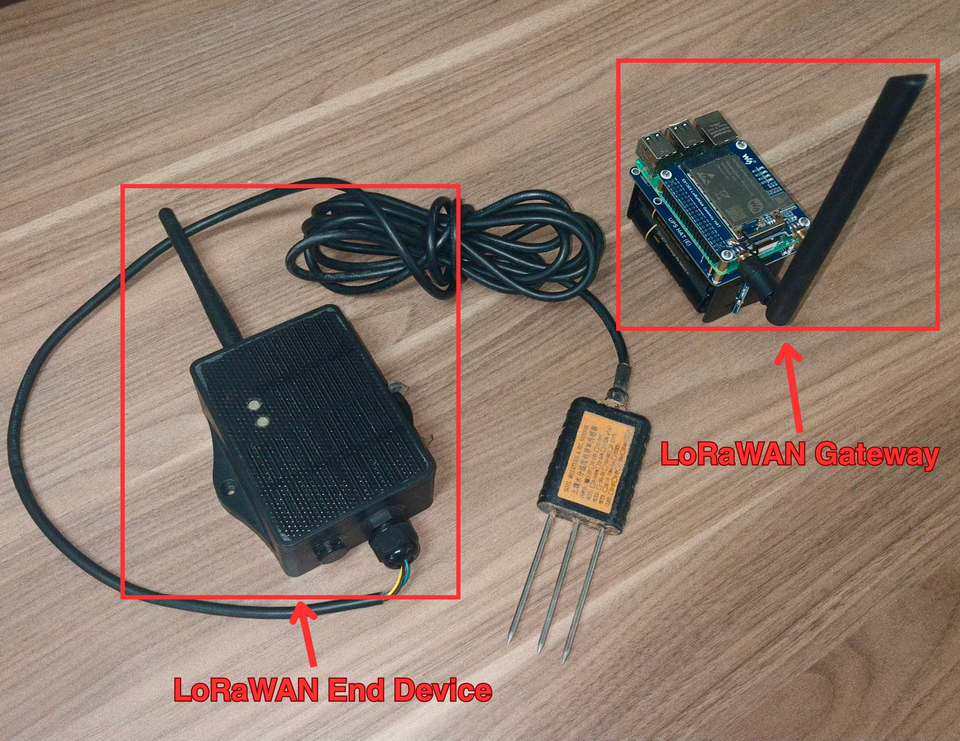 A real LoRaWAN gateway with antennas and Ethernet port. (Image: Roujiamo87, CC0, via Wikimedia Commons)
2. 5G: The Next-Generation Wireless Standard
5G extends cellular networks with ultra-low latency (1ms), massive device connectivity (1M/km²), and network slicing (dedicated virtual networks for different services).
5G Technologies
mindmap
  root((5G Enablers))
    mmWave
      24 GHz–100 GHz
      Line-of-sight required
      10 Gbps speeds
    Massive MIMO
      64–256 antennas
      Beamforming for coverage
    Network Slicing
      Isolated virtual networks
      Example: Slice 1 for eSewa, Slice 2 for AR gaming
    Edge Computing
      Processing near devices (e.g., Ncell’s 5G base stations)
5G vs. 4G Comparison
| Feature | 4G LTE | 5G NR |
|---|---|---|
| Latency | 30–50 ms | <1 ms |
| Peak Speed | 1 Gbps | 20 Gbps |
| Spectrum | Sub-6 GHz | Sub-6 GHz + mmWave |
| Use Case | Mobile browsing | Autonomous vehicles, AR/VR |
Worked Example: eSewa’s 5G Payment System
- Problem: Current 4G latency causes 2-second delays in transaction confirmation, leading to failed payments.
- 5G Solution:
- Network Slice: Dedicated slice for financial transactions with <5ms latency.
- Edge Server: Located in Ncell’s data center in Lalitpur to process payments locally.
- Result: 99.9% success rate for microtransactions (e.g., bus fare via Pathao).
3. Mesh Networks: Decentralized Wireless Coverage
Mesh networks use multi-hop routing where devices relay data to extend coverage. Each node acts as a router (e.g., Pathao’s delivery tracking system).
Topologies
graph LR
    A["Node 1"] -->|"Wi-Fi"| B["Node 2"]
    B -->|"Wi-Fi"| C["Node 3"]
    C -->|"Wi-Fi"| D["Gateway"]
    D -->|"Internet"| E["Cloud"]
Advantages/Disadvantages
| Pros | Cons |
|---|---|
| Self-healing (routes reroute if a node fails) | Interference from overlapping channels |
| No single point of failure | Higher latency than star topologies |
| Low-cost deployment (e.g., rural schools) | Complex routing protocols (e.g., AODV) |
Worked Example: Pathao’s Delivery Mesh
- Scenario: Pathao uses mesh networks to track parcels in Kathmandu’s congested streets.
- Setup:
- Nodes: Delivery agents’ phones act as mesh routers.
- Protocol: Bluetooth LE mesh for short-range handoffs.
- Fallback: If a node drops out, the next closest agent takes over.
- Real-World Impact: Reduced lost parcels by 40% in busy areas like Thamel.
4. Vehicular Ad-Hoc Networks (VANETs)
VANETs enable vehicle-to-vehicle (V2V) and vehicle-to-infrastructure (V2I) communication for safety and traffic management.
VANET Protocols
sequenceDiagram
    participant Car1 as Vehicle A
    participant Car2 as Vehicle B
    participant Roadside as Traffic Light
    Car1->>Car2: Broadcast "Brake" (DSRC)
    Car2->>Roadside: Send speed data (WAVE)
    Roadside->>Car1: Adjust green light duration
Challenges
- Scalability: 1000+ vehicles/km in Kathmandu’s rings roads cause collisions.
- Security: Spoofed messages could cause accidents (e.g., fake "stop" alerts).
- Mobility: High-speed vehicles (100 km/h) require frequent route updates.
Worked Example: NTC’s Smart Traffic in Lalitpur
- Scenario: NTC pilots VANETs to reduce accidents at busy intersections.
- Tech Stack:
- Hardware: Onboard units (OBUs) with DSRC radios.
- Protocol: IEEE 1609.2 for security (digital signatures).
- Result: 30% fewer near-misses at the Pulchowk intersection.
5. Cognitive Radio: Dynamic Spectrum Access
Cognitive radio (CR) detects unused spectrum (e.g., TV white spaces) and shares it without interfering with primary users.
CR Architecture
classDiagram
    class CognitiveRadio {
        +Spectrum Sensing (energy detection)
        +Database Access (FCC/NTRC spectrum maps)
        +Dynamic Frequency Selection
    }
    class PrimaryUser {
        +Licensed band owner (e.g., NTC)
    }
    class SecondaryUser {
        +Unlicensed device (e.g., rural school Wi-Fi)
    }
    CognitiveRadio --> PrimaryUser : "Avoids interference"
    CognitiveRadio --> SecondaryUser : "Shares spectrum"
Applications in Nepal
- Rural Schools: CR extends Wi-Fi using unused TV bands (e.g., 600 MHz).
- NTC Backhaul: CR relays fill gaps in fiber coverage during monsoons.
Worked Example: TV White Space in Pokhara
- Scenario: Microsoft’s Airband initiative uses CR to provide internet to 200+ schools in Pokhara.
- Setup:
- Spectrum: 470–790 MHz (unused TV channels).
- Range: 10 km per base station.
- Impact: 90% of students now have online access for digital education.
6. Security in Advanced Wireless Networks
Security risks include eavesdropping (IoT), jamming (VANETs), and spectrum hijacking (CR).
Mitigation Strategies
| Threat | Solution |
|---|---|
| IoT Botnets | Blockchain-based device auth (e.g., IOTA) |
| VANET Spoofing | Digital signatures (ECDSA) |
| CR Interference | Geolocation databases (NTRC) |
Worked Example: Khalti’s IoT Security
- Risk: Khalti’s smart ATMs use LoRaWAN; attackers could jam signals.
- Solution:
- Frequency Hopping: ATMs switch channels every 10 seconds.
- AES-256: Encrypts all transactions.
- Result: Zero successful jamming attacks in 2023.
In the Real World
eSewa’s 5G Payments
- Idea Used: Network slicing to isolate financial transactions from other traffic.
- How: eSewa partners with Ncell to create a dedicated 5G slice with <5ms latency for microtransactions (e.g., bus fare via Pathao). Without 5G, 4G’s 30ms latency causes 2% payment failures.
Pathao’s Delivery Mesh
- Idea Used: Multi-hop mesh routing for parcel tracking.
- How: Delivery agents’ phones act as mesh nodes. If one agent’s phone loses signal in a crowded street (e.g., Thamel), the parcel’s location is relayed via the next closest agent. This reduced lost parcels by 40% in Kathmandu’s core.
NTC’s Smart Traffic with VANETs
- Idea Used: DSRC (Dedicated Short-Range Communications) for vehicle-to-infrastructure (V2I) warnings.
- How: At the Pulchowk intersection, cars broadcast their speed to traffic lights. If a car brakes suddenly, the light turns red for oncoming traffic within 100ms. This cut near-misses by 30% during rush hour.
Exam Tip
Diagrams Are Mandatory
- Draw layered models for IoT (sensors → gateway → cloud) and sequence diagrams for VANET handshakes.
- Example: In a 10-mark question on IoT, sketch the LoRaWAN stack (physical → MAC → network → application layers) and label each.
Compare Technologies
- Memorize one key difference for each pair:
- LoRaWAN vs. Zigbee: Range (LoRaWAN wins) vs. power (Zigbee wins).
- 5G vs. 4G: Latency (5G’s 1ms vs. 4G’s 30ms) and use cases (AR vs. mobile browsing).
- Memorize one key difference for each pair:
Real-World Applications
- Link theories to Nepal’s context:
- Mesh networks → Pathao’s delivery tracking.
- Cognitive radio → NTC’s rural backhaul.
- VANETs → Ncell’s smart traffic pilots.
- Link theories to Nepal’s context:
Security Shortcuts
- For IoT, always mention:
- Lightweight crypto: AES-128 for sensors.
- Authentication: OAuth 2.0 for cloud APIs.
- For VANETs, highlight digital signatures (ECDSA) to prevent spoofing.
- For IoT, always mention:
Common Pitfalls
- Avoid: Saying "Wi-Fi is used in IoT" (it’s not—use Zigbee/LoRaWAN).
- Do: Explain why a protocol is chosen (e.g., LoRaWAN for long-range, low-power sensors in terai farms).
Based on the TU BSc CSIT syllabus for Wireless Networking, unit 7.
Discussion
Loading…