Cognitive ScienceUnit 113 min read
Cognitive Science: Foundations, Scope & Core Paradigms
Unit 1 of Cognitive Science introduces the field’s definition, historical roots, key paradigms (symbolic vs. connectionist), and its interdisciplinary scope across psychology, neuroscience, AI, and linguistics—with real-world applications in tech and daily life.
TAKEAWAYS:
- Cognitive Science is the interdisciplinary study of mind using tools from psychology, neuroscience, computer science, linguistics, and philosophy.
- Its three core paradigms (symbolic, connectionist, and embodied) explain cognition differently—symbolic systems use rules (like programming), while neural networks mimic brain-like learning.
- The mind-body problem (dualism vs. materialism) and AI’s role (can machines think?) are central debates.
- Real-world impact: From WhatsApp’s chatbots (symbolic rules) to Google’s recommendation systems (neural networks), cognitive science shapes technology.
- Key methods: Introspection, behavioral experiments, brain imaging (fMRI), and computational modeling.
- Exam focus: Define terms precisely, compare paradigms, and link theories to real-world examples (e.g., how Ncell’s customer service uses symbolic AI).
1. What Is Cognitive Science?
Cognitive Science is the scientific study of the mind, blending insights from multiple disciplines to understand how humans (and machines) perceive, think, learn, and solve problems. It asks:
- What is cognition? (Memory, attention, reasoning, language, decision-making.)
- How does the brain enable cognition? (Neuroscience + computation.)
- Can machines replicate or simulate cognition? (AI and artificial intelligence.)
1.1. Core Disciplines
Cognitive Science integrates:
| Discipline | Contribution | Example |
|---|---|---|
| Psychology | Studies mental processes (perception, memory, problem-solving). | How humans recognize faces. |
| Neuroscience | Maps brain structures and neural activity to cognitive functions. | fMRI scans showing language areas (Broca’s area). |
| Computer Science | Models cognition using algorithms (symbolic AI, neural networks). | Chatbots like eSewa’s customer service bot. |
| Linguistics | Analyzes language acquisition and processing. | Chomsky’s theory of universal grammar. |
| Philosophy | Debates mind-body, consciousness, and AI ethics. | "Can a robot have free will?" |
| Anthropology | Examines cultural influences on cognition (e.g., counting systems). | How different cultures represent numbers. |
1.2. Key Questions
- Nature vs. Nurture: Is cognition hardwired (innate) or shaped by experience?
- Modularity: Are cognitive functions (e.g., vision, language) independent "modules" or interconnected?
- Representation: How are thoughts/knowledge stored in the brain? (Symbols? Distributed patterns?)
- Consciousness: Can we scientifically explain subjective experience ("qualia")?
2. Historical Roots
Cognitive Science emerged from three revolutions:
- Cognitive Revolution (1950s–60s):
- Shift from behaviorism (only observable actions matter) to studying mental processes.
- Key figures: Noam Chomsky (critiqued Skinner’s behaviorism with language), Allen Newell & Herbert Simon (developed AI programs like the Logic Theorist).
- AI Boom (1956–):
- Dartmouth Conference (1956) coined "AI." Early goals: Could machines think?
- Turing Test (1950): A machine passes if its responses are indistinguishable from a human’s.
- Neuroscience Advances:
- Tools like EEG, PET scans, and fMRI revealed brain activity during cognition.
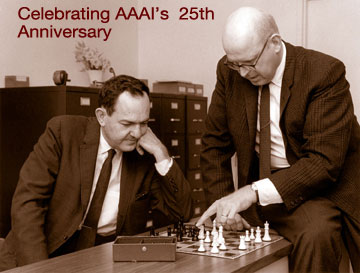 Pioneers of AI and cognitive modeling. (Image: Paolo Massa, Public domain, via Wikimedia Commons)
3. Core Paradigms
Cognitive Science uses three main approaches to explain the mind:
3.1. Symbolic (Computational) Paradigm
- Idea: The mind is a symbol-manipulating system (like a computer program).
- How it works:
- Knowledge is represented as symbols (e.g., words, numbers, logical rules).
- Production rules (IF-THEN statements) drive cognition (e.g., "IF hungry THEN eat").
- Example: A GPS app uses symbolic rules to navigate (e.g., "IF at junction THEN turn left").
- Strengths:
- Explains logical reasoning (e.g., math, chess).
- Underlies expert systems (e.g., medical diagnosis software).
- Weaknesses:
- Struggles with unconscious processes (e.g., intuition, creativity).
- Assumes discrete symbols, but the brain may use distributed patterns.
3.2. Connectionist (Neural Network) Paradigm
- Idea: The mind is a network of interconnected nodes (like neurons), where knowledge emerges from patterns of activation.
- How it works:
- Input layer → Hidden layers → Output layer (e.g., recognizing a face).
- Learning occurs via weight adjustments (backpropagation).
- Example: WhatsApp’s image recognition (identifying faces in photos).
- Strengths:
- Handles fuzzy, noisy data (e.g., handwriting recognition).
- Mimics brain plasticity (adapting to new information).
- Weaknesses:
- Black-box problem: Hard to interpret how decisions are made.
- Requires massive data (unlike symbolic rules).
graph TD
    A["Input Layer\n(Features: edges, colors)"] --> B["Hidden Layer 1\n(Feature detectors)"]
    B --> C["Hidden Layer 2\n(Pattern recognition)"]
    C --> D["Output Layer\n(Label: 'Cat')"]
3.3. Embodied (Situated) Paradigm
- Idea: Cognition is shaped by the body and environment—thinking is not just in the head.
- How it works:
- Embodied cognition: Knowledge is tied to physical actions (e.g., counting on fingers).
- Situated cognition: Context matters (e.g., a chef’s spatial memory in a kitchen).
- Example: Pathao’s delivery drivers rely on embodied navigation (memory of routes, not just maps).
- Strengths:
- Explains how babies learn (e.g., grasping objects).
- Accounts for cultural differences in thinking.
- Weaknesses:
- Hard to test experimentally (requires real-world scenarios).
- Less focus on internal mental processes.
COMPARISON TABLE:
| Paradigm | Representation | Learning Mechanism | Example Application | Weakness |
|---|---|---|---|---|
| Symbolic | Discrete symbols | Rule-based (programmed) | eSewa’s chatbot (FAQ rules) | Poor at handling ambiguity. |
| Connectionist | Distributed patterns | Weight adjustment (training) | Google Photos (image tags) | Black-box, data-hungry. |
| Embodied | Body-environment interaction | Experience-based | Traffic navigation in Kathmandu | Hard to model mathematically. |
4. The Mind-Body Problem
A centuries-old debate: How are mind and body related?
| Position | View | Example |
|---|---|---|
| Dualism (Descartes) | Mind and body are separate (mind = non-physical; body = physical). | "I think, therefore I am." |
| Materialism (Modern) | Mind is just the brain (no soul/spirit). | fMRI scans show brain activity during thought. |
| Functionalism | Mind is defined by functions, not physical stuff (could run on a computer). | A robot passing the Turing Test. |
5. Artificial Intelligence and the Mind
- Strong AI: Machines can truly think (conscious, self-aware).
- Weak AI: Machines simulate thinking (e.g., Siri, self-driving cars).
- Turing Test: If a machine’s responses are indistinguishable from a human’s, does it "think"?
- Example: Ncell’s virtual assistant uses weak AI (rule-based + NLP) to answer queries.
5.1. Can Machines Be Conscious?
- Chinese Room Argument (Searle, 1980):
- A person follows symbolic rules to manipulate Chinese characters without understanding them.
- Implication: Symbolic AI may simulate understanding but not have it.
- Counterpoint: Neural networks (e.g., Google’s DeepMind) show emergent behavior (e.g., AlphaGo learning strategy).
6. Methods in Cognitive Science
| Method | How It Works | Example |
|---|---|---|
| Introspection | Self-reporting thoughts/feelings. | "Describe how you solved this math problem." |
| Behavioral Experiments | Measure responses to stimuli (reaction time, accuracy). | Stroop Test: Naming ink colors of words. |
| Brain Imaging (fMRI) | Maps brain activity by detecting blood flow. | Studying memory by showing images. |
| Computational Modeling | Simulates cognition with code (symbolic or neural networks). | NEPSE stock prediction models. |
| Lesion Studies | Observes cognitive changes after brain damage. | Patient H.M. lost memory after hippocampus damage. |
7. Real-World Applications
7.1. WhatsApp’s Chatbots (Symbolic AI)
- How it works: Uses rule-based NLP (e.g., "IF user says ‘order status’ THEN check database").
- Example: eSewa’s automated replies for bill payments.
- Limitations: Struggles with slang or complex queries (e.g., "Why is my internet slow?").
7.2. Google’s Recommendation System (Connectionist AI)
- How it works: Neural networks analyze user behavior (clicks, searches) to predict preferences.
- Example: YouTube’s "Recommended" videos use collaborative filtering.
- Why it matters: Personalizes content without explicit rules.
7.3. Pathao’s Delivery Routes (Embodied Cognition)
- How it works: Drivers rely on spatial memory + real-time adjustments (e.g., avoiding traffic jams).
- Example: A driver in Kathmandu might take a shortcut known only to locals.
- Challenge: Hard to program this into an AI without embodied experience.
7.4. Ncell’s Customer Service (Hybrid Approach)
- Symbolic: Predefined FAQs for common issues (e.g., "How to recharge?").
- Connectionist: Machine learning to detect sentiment in voice calls (e.g., "I’m angry about my bill!").
- Result: Faster resolution for routine problems.
WORKED EXAMPLE: Symbolic vs. Connectionist in a Bank Loan Scenario: A bank decides whether to approve a loan.
- Symbolic Approach:
- Rules:
- IF income > 50,000 AND credit score > 700 THEN approve.
- IF debt/income > 0.4 THEN reject.
- Pros: Fast, explainable.
- Cons: Misses subtle patterns (e.g., a young professional with high potential but low credit history).
- Rules:
- Connectionist Approach:
- Neural network trained on 10,000 past loan applications.
- Inputs: income, age, credit score, employment history.
- Output: probability of default (0–1).
- Pros: Catches non-linear patterns (e.g., "Young + stable job = low risk").
- Cons: Black-box; hard to justify a rejection.
8. Criticisms and Challenges
- Reductionism: Can cognition be fully explained by neurons + algorithms? (Embodied paradigm argues no.)
- Ethics: AI bias (e.g., Khalti’s loan approval favoring certain demographics).
- Consciousness: No paradigm explains subjective experience (e.g., "redness" of red).
- Data Hunger: Neural networks require millions of examples (e.g., Daraz’s recommendation system).
Exam Tip
- Define terms precisely:
- Cognitive Science: "The interdisciplinary study of mind using methods from psychology, neuroscience, AI, etc."
- Turing Test: "A machine passes if its responses are indistinguishable from a human’s in text-based interaction."
- Compare paradigms:
- Use the table above to contrast symbolic, connectionist, and embodied approaches.
- Example answer:
"Symbolic AI uses rules (e.g., eSewa’s chatbot), while connectionist AI relies on training data (e.g., Google Photos). Embodied cognition explains how Pathao drivers navigate without GPS."
- Link to real-world examples:
- Ncell: Symbolic (FAQ) + connectionist (sentiment analysis).
- WhatsApp: Connectionist (image recognition) + symbolic (text responses).
- Debate questions:
- "Can a machine be conscious?" → Discuss Turing Test, Chinese Room, and neural networks.
- "Is cognition purely biological?" → Compare materialism vs. dualism.
- Diagrams:
- Draw a neural network for connectionist examples.
- Sketch a symbolic rule flowchart (e.g., loan approval).
- Label an fMRI scan for brain-mapping questions.
Final Visual Summary:
mindmap
  root((Cognitive Science))
    Paradigms
      Symbolic["Rules (eSewa bot)"]
      Connectionist["Neural Networks (Google Photos)"]
      Embodied["Body + Environment (Pathao drivers)"]
    Methods
      Introspection
      fMRI
      Computational Models
    Debates
      Mind-Body Problem
      AI Consciousness
    Applications
      Tech: WhatsApp, Ncell
      Daily Life: Navigation, Learning
Based on the TU BSc CSIT syllabus for Cognitive Science, unit 1.
Discussion
Loading…