Cognitive ScienceUnit 311 min read
Psychological Perspectives of Cognition: Models, Theories & Applications
Unit 3 of Cognitive Science explores the foundational psychological theories of cognition—information processing, memory, perception, and problem-solving—through the lenses of structuralism, functionalism, Gestalt psychology, and cognitive psychology. It examines how mental processes are studied experimentally, with re
TAKEAWAYS:
- Cognitive psychology treats the mind as an information processor, analyzing perception, memory, and decision-making through experiments and models.
- Gestalt principles explain how humans perceive whole patterns (e.g., proximity, similarity, closure) rather than isolated elements.
- Schemas and scripts organize knowledge to interpret new information efficiently (e.g., recognizing a "restaurant" scene from fragments).
- Problem-solving theories (e.g., means-end analysis, heuristics) describe how humans tackle complex tasks, with trade-offs between speed and accuracy.
- Memory models (sensory, short-term, long-term) explain how information is encoded, stored, and retrieved, with real-world implications for education and technology.
- Applications span AI (e.g., natural language processing), UX design (e.g., intuitive interfaces), and psychology (e.g., cognitive behavioral therapy).
Core Theories of Cognition
Cognitive psychology views the mind as a system that processes information, inspired by computer science metaphors. Three key perspectives dominate:
1. Structuralism (Wundt, Titchener)
- Definition: Focused on breaking down mental experiences into basic sensory elements (e.g., analyzing a melody into individual notes).
- Method: Introspection (self-reporting of mental states).
- Limitation: Subjective and unreliable; ignored higher-level processes like problem-solving.
- Visual:
flowchart TD
  A["Mental Experience"] --> B["Sensory Elements"]
  B --> C["Basic Components\n(e.g., color, sound)"]
  C --> D["Introspection\n(Subjective Report)"]
- Real-world tie: Early psychology labs used introspection to study perception, though modern science rejects it as a primary method.
2. Functionalism (James, Dewey)
- Definition: Studied how mental processes function to adapt to the environment (e.g., how attention helps survival).
- Key idea: "Stream of consciousness"—thoughts flow continuously, not as discrete units.
- Example: Recognizing a predator triggers a fight-or-flight response (adaptive function).
- Visual:
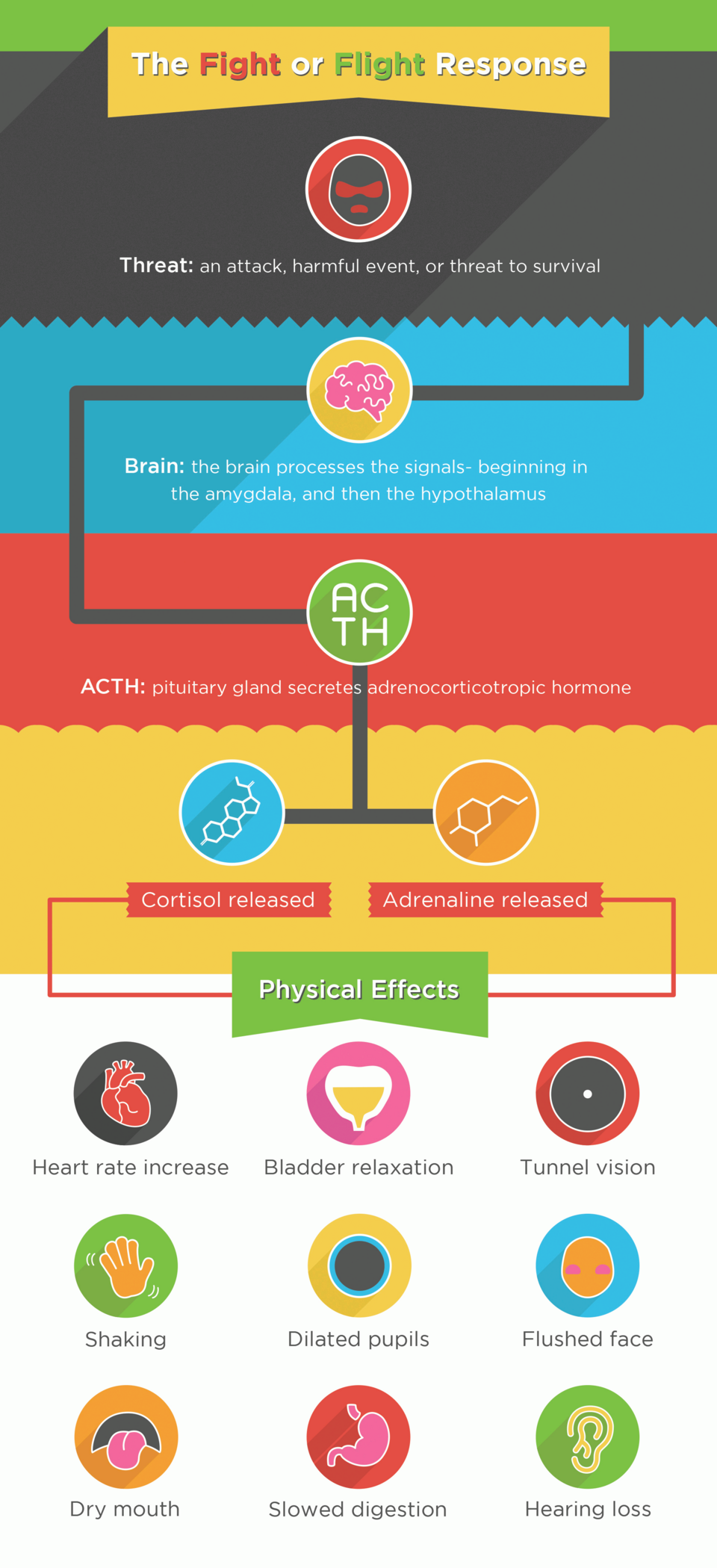 A labeled diagram of the physiological and cognitive responses to threats, highlighting how attention and memory aid survival. (Image: Jvnkfood (original), converted to PNG and reduced to 8-bit b, CC BY-SA 4.0, via Wikimedia Commons)
3. Gestalt Psychology (Wertheimer, Köhler)
- Core principle: The whole is greater than the sum of its parts. Humans perceive organized patterns, not isolated stimuli.
- Gestalt Laws:
- Proximity: Nearby objects are grouped (e.g., seeing pairs of dots as lines).
- Similarity: Similar objects are grouped (e.g., alternating colors in a grid).
- Closure: Gaps are "filled in" (e.g., recognizing a circle with missing arcs).
- Figure-ground: Distinguishing objects from backgrounds (e.g., Rubin’s vase).
- Worked Example:
Consider this ambiguous figure (describe a Rubin’s vase or a Necker cube):
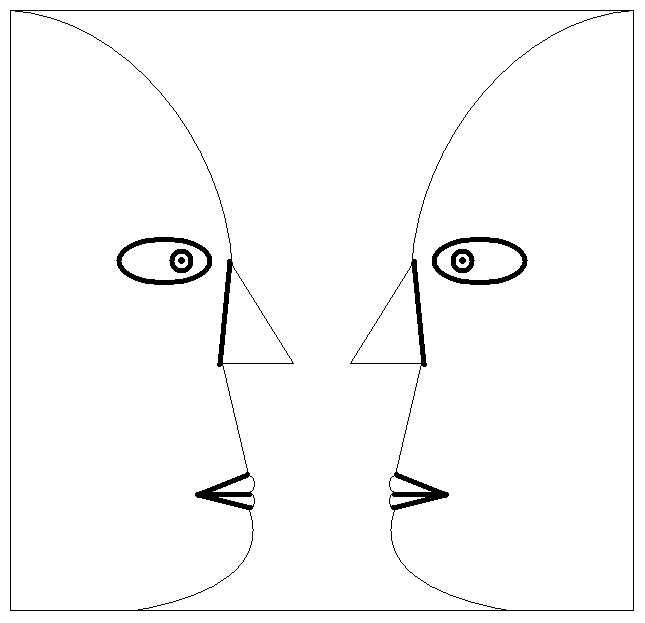 A black-and-white vase/faces illusion showing figure-ground perception. (Image: Περίεργος, Public domain, via Wikimedia Commons)
- **Step 1**: Observe the image. Do you see a vase or two faces?
- **Step 2**: The brain alternates between interpreting the dark area as the vase (figure) and the light area as the vase (ground).
- **Application**: Used in UI design (e.g., icons that stand out against backgrounds) and optical illusions in art.

---

### **Information Processing Model**
Cognitive psychologists model the mind as a computer-like system with stages:

#### **1. Sensory Memory (Iconic/Echoic)**
- **Duration**: <1 second.
- **Capacity**: High (e.g., a full visual scene or 2–4 seconds of sound).
- **Example**: Sperling’s partial report experiment showed participants could recall a brief flash of letters if cued immediately.
- **Visual**:
```mermaid
flowchart LR
  A["Sensory Input\n(e.g., light/sound)"] --> B["Iconic Memory\n(Visual)\n~0.5s"]
  A --> C["Echoic Memory\n(Auditory)\n~2-4s"]
  B --> D["Attention\n(Selects for STM)"]
2. Short-Term Memory (STM)
- Duration: ~20–30 seconds (without rehearsal).
- Capacity: 7±2 items (Miller’s Law).
- Encoding: Acoustic (sound-based) or visual.
- Worked Example: Remembering a phone number (e.g.,
9842013759).- Chunking: Break it into meaningful groups:
984-201-3759(now 3 chunks). - Rehearsal: Repeating the number aloud maintains it in STM.
- Chunking: Break it into meaningful groups:
- Real-world tie: Khalti’s OTP system uses STM limits—users must enter a 6-digit code within ~30 seconds before it expires.
3. Long-Term Memory (LTM)
- Duration: Permanent (though retrieval may fail).
- Capacity: Unlimited.
- Types:
- Declarative: Facts and events (e.g., "Nepal’s capital is Kathmandu").
- Semantic: General knowledge.
- Episodic: Personal experiences.
- Procedural: Skills (e.g., riding a bike).
- Declarative: Facts and events (e.g., "Nepal’s capital is Kathmandu").
- Encoding: Semantic (meaning-based) is strongest for LTM.
- Visual:
flowchart TD
  A["STM\n(7±2 items)"] -->|"Rehearsal/Elaboration"| B["LTM"]
  B --> C["Declarative\n(Semantic/Episodic)"]
  B --> D["Procedural\n(Skills)"]
Memory Processes: Encoding, Storage, Retrieval
| Process | Definition | Example | Real-World Link |
|---|---|---|---|
| Encoding | Converting info into a usable format. | Memorizing a shopping list by visualizing it. | eSewa’s "Save for Later" feature encodes payment details for quick access. |
| Storage | Retaining encoded info. | Storing a friend’s birthday in LTM. | WhatsApp’s cloud backup stores messages in LTM-like servers. |
| Retrieval | Accessing stored info. | Recalling the birthday during the month. | Google’s search algorithm retrieves relevant info from a "memory" of web pages. |
Problem-Solving Theories
How do humans solve problems? Three key approaches:
1. Means-End Analysis (Newell & Simon)
- Process: Compare current state to goal, then reduce the difference.
- Steps:
- Identify the goal (e.g., "cross the river").
- Find obstacles (e.g., "no bridge").
- Apply operators (e.g., "build a raft" or "find a ferry").
- Worked Example: Pathao’s route optimization.
- Goal: Deliver food from Thapathali to Lakshmi Path in 15 minutes.
- Current state: Traffic jam on Ring Road.
- Operators:
- Option 1: Take Ring Road (risk: delay).
- Option 2: Use side streets (slower but avoids jam).
- Decision: Pathao’s algorithm (like means-end analysis) picks Option 2 if historical data shows it’s faster.
- Visual:
flowchart LR
  A["Start: Thapathali"] -->|"Traffic Jam"| B["Ring Road\n(Slow)"]
  A -->|"Side Streets"| C["Lakshmi Path\n(Faster)"]
  C --> D["Goal: Delivery\n<15 mins"]
2. Heuristics (Rules of Thumb)
- Definition: Mental shortcuts for quick (but not always optimal) solutions.
- Types:
- Availability: Judging probability by ease of recall (e.g., fearing plane crashes after media coverage).
- Representativeness: Matching to stereotypes (e.g., assuming a quiet person is shy).
- Anchoring: Relying too heavily on the first piece of info (e.g., negotiating salary based on initial offer).
- Disadvantage: Can lead to biases (e.g., Daraz’s "limited stock" urgency tactic exploits scarcity heuristic).
- Visual:
flowchart TD
  A["Heuristic\n(Quick Decision)"] --> B["Availability\n(Ease of Recall)"]
  A --> C["Representativeness\n(Stereotypes)"]
  A --> D["Anchoring\n(First Impression)"]
  B --> E["Biases\n(e.g., Fear of Flying)"]
3. Insight (Köhler’s "Aha!" Moment)
- Definition: Sudden realization of a solution after unconscious processing.
- Example: Archimedes’ "Eureka!" moment in the bathtub (displacing water to measure volume).
- Real-world tie: NTC’s network optimization—engineers may suddenly see a solution to a routing problem after days of work.
Perception and Attention
Selective Attention (Broadbent’s Filter Model)
- Process: The brain filters irrelevant info to focus on one task.
- Example: Cocktail party effect—hearing your name in a noisy room.
- Visual:
flowchart LR
  A["Sensory Input\n(All Sounds)"] --> B["Filter"]
  B -->|"Attended Channel"| C["Higher Processing\n(e.g., Your Name)"]
  B -->|"Ignored"| D["Suppressed\n(Other Conversations)"]
- Real-world tie: WhatsApp’s notification sounds use selective attention—your phone rings, but you ignore it unless it’s a message from a specific contact.
Change Blindness
- Definition: Failing to notice changes in a visual scene.
- Example: In a video, if a person in a doorway changes, observers often miss it.
- Application: Used in magic tricks and security (e.g., Ncell’s fraud detection may rely on spotting unusual "changes" in call patterns).
Applications in Technology and Design
| Field | Cognitive Principle Applied | Example |
|---|---|---|
| AI/NLP | Memory models, heuristics | Chatbots use LTM-like databases to answer questions. |
| UX/UI Design | Gestalt laws, chunking | Daraz’s "Add to Cart" button stands out (figure-ground). |
| Cybersecurity | Heuristics, change blindness | Banks detect fraud by spotting unusual "changes" in transactions. |
| Education | Schemas, elaborative encoding | Teachers use analogies (e.g., "STM is like a phone’s RAM") to aid learning. |
| Traffic Systems | Means-end analysis | NTC’s traffic light timings optimize routes like a problem-solving algorithm. |
Exam Tip
- Theories > Names: Know what structuralism/functionalism/Gestalt propose, not just who founded them. Examiners test concepts, not biographies.
- Memory Models: Compare STM vs. LTM in a table (capacity, duration, encoding). Use Khalti/OTP or eSewa’s saved cards as examples.
- Problem-Solving: For means-end analysis, show a step-by-step trace (like Pathao’s route). For heuristics, critique biases with real-world apps (e.g., Daraz’s scarcity tactics).
- Diagrams: Draw Gestalt laws, memory flowcharts, or attention models in exams. Label every box/arrow.
- Critical Thinking: Discuss limitations (e.g., introspection is unreliable, heuristics cause biases). Link to Nepali contexts (e.g., traffic chaos due to poor means-end planning).
Final Visual Summary:
mindmap
  root((Cognitive Psychology))
    Structuralism
      Introspection
      Limitations
    Functionalism
      Stream of Consciousness
      Adaptive Processes
    Gestalt
      Proximity
      Closure
      Figure-Ground
    Memory
      Sensory --> STM --> LTM
      Chunking
    Problem-Solving
      Means-End
      Heuristics
      Insight
    Attention
      Selective Filter
      Change Blindness
    Applications
      AI
      UX Design
      Security
Based on the TU BSc CSIT syllabus for Cognitive Science, unit 3.
Discussion
Loading…