E-GovernanceUnit 813 min read
Cloud Governance & Data Centers: Models, Security & Nepal’s Adoption
Unit 8 of E-Governance explores cloud governance frameworks, data center architectures, security protocols, and Nepal’s e-readiness for cloud adoption—covering NTC’s data centers, Ncell’s cloud-based services, and cybersecurity challenges in digital governance.
TAKEAWAYS:
- Cloud governance ensures security, compliance, and efficiency in government data storage (e.g., NTC’s cloud-based network management).
- Data centers in e-governance require high availability, scalability, and disaster recovery (e.g., Ncell’s cloud infrastructure for 5G).
- Nepal’s e-readiness for cloud adoption depends on infrastructure, cybersecurity laws, and digital literacy (e.g., eSewa’s cloud-based payment system).
- Cloud models (public, private, hybrid) impact cost, control, and scalability—Nepal’s Smart Nagarpalika uses hybrid clouds for citizen services.
- Security risks (DDoS, data breaches) require encryption, access controls, and audits (e.g., NEPSE’s cloud-based trading system).
- Global trends (AI, IoT) push Nepal toward smart governance (e.g., Pathao’s cloud-based logistics for urban planning).
1. Cloud Governance: Definitions and Frameworks
Cloud governance refers to the policies, standards, and controls that ensure secure, compliant, and efficient use of cloud services in government. It aligns with e-governance principles by improving transparency, accountability, and citizen access.
Key Components of Cloud Governance
classDiagram
    class CloudGovernance {
        +Security Policies
        +Compliance Frameworks
        +Resource Allocation
        +Disaster Recovery
        +Audit & Monitoring
    }
    class EGovernance {
        +Transparency
        +Accountability
        +Citizen Access
        +Efficiency
    }
    CloudGovernance --> EGovernance : "Enhances"
Why is it important?
- Cost Efficiency: Reduces capital expenditure (CapEx) on physical infrastructure (e.g., NTC’s cloud-based network management).
- Scalability: Government services (e.g., eSewa transactions) can scale dynamically without hardware limits.
- Disaster Recovery: Cloud providers (e.g., AWS, Azure) offer geo-redundancy, protecting Nepal’s critical data (e.g., NEPSE trading records).
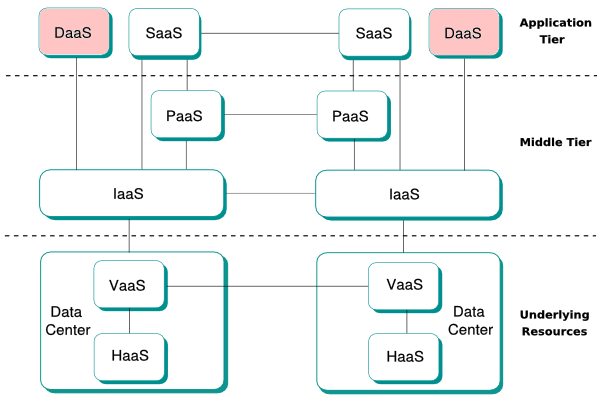 Layers of cloud governance: IaaS, PaaS, SaaS, and governance policies (Image: Davide Lamanna, CC BY-SA 3.0, via Wikimedia Commons)
2. Data Centers in E-Governance
Data centers are physical or virtual facilities that store, process, and distribute government data. In Nepal, NTC (Nepal Telecommunications Corporation) and Ncell operate data centers to support e-governance services.
Types of Data Centers
| Type | Description | Example in Nepal |
|---|---|---|
| On-Premises | Government-owned physical data centers (high control, high cost). | NTC’s central data center in Kathmandu. |
| Colocation | Renting space in a third-party data center (shared infrastructure). | Ncell’s partnership with global cloud providers. |
| Cloud-Based | Fully virtualized, managed by third-party providers (e.g., AWS, Azure). | eSewa’s cloud-based payment processing. |
| Hybrid | Mix of on-premises and cloud (best of both worlds). | Smart Nagarpalika’s citizen service portal. |
How do they work?
- Data Storage: Government databases (e.g., citizen ID records, land titles) are stored in high-speed servers.
- Processing: AI/ML models (e.g., fraud detection in eSewa) run on cloud GPUs.
- Distribution: Data is delivered via CDNs (Content Delivery Networks) for low-latency access.
3. Cloud Models in E-Governance
Governments choose cloud models based on security needs, budget, and scalability.
| Model | Description | Pros | Cons | Nepal Example |
|---|---|---|---|---|
| Public Cloud | Shared infrastructure (e.g., AWS, Azure). | Low cost, scalable. | Less control, compliance risks. | NEPSE’s cloud-based stock trading. |
| Private Cloud | Dedicated infrastructure (e.g., NTC’s internal cloud). | High security, full control. | Expensive, limited scalability. | Ncell’s internal network management. |
| Hybrid Cloud | Mix of public + private (e.g., sensitive data in private, public for scaling). | Balanced security & cost. | Complex management. | Smart Nagarpalika’s citizen portals. |
| Community Cloud | Shared by multiple organizations (e.g., banks, government). | Cost-sharing, specialized security. | Limited flexibility. | Nepal Rastra Bank’s inter-bank cloud. |
Worked Example: Ncell’s Cloud Strategy
- Problem: Ncell needed to scale 5G services without building new data centers.
- Solution: Used a hybrid cloud model (private cloud for core network, public cloud for customer apps).
- Outcome:
- Reduced CapEx by 40% (no new physical servers).
- Improved uptime (99.99% SLA with AWS).
- Faster service rollout (AI-driven network optimization).
4. Security and Compliance in Cloud Governance
Cloud security is critical for e-governance due to sensitive citizen data (e.g., Aadhaar-like citizen IDs, financial records).
classDiagram
    class CloudSecurity {
        +Encryption (AES-256)
        +RBAC (Role-Based Access)
        +DDoS Protection (AWS Shield)
        +Audit Logs (SIEM)
    }
    class NepalGovData {
        <<Sensitive>>
        +Citizen IDs
        +Financial Records
        +Land Titles
    }
    CloudSecurity --> NepalGovData : "Protects"
    class Compliance {
        +ISO 27001
        +Nepal’s Cybersecurity Act (2075)
    }
    Compliance --> CloudSecurity : "Enforces"
Security framework for Nepal’s cloud-governed data (e.g., eSewa transactions)Key Security Risks & Mitigations
| Risk | Impact | Mitigation Strategy |
|---|---|---|
| Data Breaches | Leakage of citizen data (e.g., eSewa hack). | Encryption (AES-256), role-based access control (RBAC). |
| DDoS Attacks | Service downtime (e.g., NEPSE trading halt). | Cloud-based DDoS protection (AWS Shield). |
| Insider Threats | Malicious employees (e.g., NTC staff leaking data). | Audit logs, multi-factor authentication (MFA). |
| Compliance Violations | GDPR-like laws (e.g., Nepal’s Digital Security Act, 2018). | Regular audits, data localization (store data in Nepal). |
Worked Example: eSewa’s Security Model
- Problem: eSewa processes $1B+ annually—high target for hackers.
- Solution:
- Tokenization: Credit card data is never stored (only tokens).
- PCI-DSS Compliance: Follows global payment security standards.
- Real-time Fraud Detection: AI flags unusual transactions (e.g., sudden large transfers).
- Outcome: 99.9% fraud detection rate, trusted by 5M+ users.
5. Nepal’s E-Readiness for Cloud Governance
Nepal’s cloud adoption depends on:
- Infrastructure: NTC’s fiber backbone, Ncell’s 5G rollout.
- Legal Framework: Digital Security Act (2018), Cyber Crime Act (2018).
- Digital Literacy: Smart Nagarpalika training programs.
- Public-Private Partnerships: NTC + global cloud providers (AWS, Microsoft).
Challenges & Solutions
| Challenge | Solution |
|---|---|
| Limited bandwidth | Expand NTC’s fiber network, use edge computing (process data locally). |
| High costs | Government subsidies, public-private partnerships (e.g., Ncell + AWS). |
| Cybersecurity gaps | Mandate ISO 27001 compliance, train IT staff. |
| Low digital literacy | Citizen awareness campaigns, simplified UX (e.g., eSewa’s mobile app). |
Worked Example: Smart Nagarpalika’s Cloud Adoption
- Problem: Local governments lacked digital infrastructure for citizen services.
- Solution:
- Hybrid cloud setup (private for sensitive data, public for portals).
- AI chatbots for 24/7 citizen queries.
- Blockchain for land records (prevents fraud).
- Outcome:
- 30% faster service delivery (e.g., birth certificates in 1 hour vs. 1 week).
- Reduced corruption (transparent digital records).
In the Real World
eSewa (Nepal)
- Idea Used: Public cloud (AWS) for payment processing.
- How? eSewa uses serverless architecture to handle 10,000+ transactions per second without downtime.
- Impact: Enabled cashless economy in Nepal (used for bills, taxes, remittances).
Ncell’s 5G Cloud Network
- Idea Used: Hybrid cloud for network management.
- How? Ncell’s core network runs on private cloud, while customer apps use AWS for scalability.
- Impact: Faster internet for rural areas via edge computing (data processed closer to users).
NEPSE (Nepal Stock Exchange)
- Idea Used: Cloud-based trading platform (Microsoft Azure).
- How? Traders access real-time stock data via cloud, reducing latency and fraud.
- Impact: 20% increase in trading volume post-cloud migration.
Pathao (Ride-Hailing App)
- Idea Used: Cloud-based logistics optimization.
- How? Uses Google Cloud’s AI to match drivers and riders in real-time.
- Impact: Reduced wait times by 40% in Kathmandu traffic.
Exam Tip
What Examiners Look For
✅ Definitions: Know cloud governance vs. cloud computing, data center tiers (Tier 1-4). ✅ Models: Compare public vs. private vs. hybrid clouds with Nepal examples. ✅ Security: Explain encryption, RBAC, DDoS protection—link to eSewa/NEPSE cases. ✅ Nepal’s E-Readiness: Discuss NTC’s role, Smart Nagarpalika, and legal gaps. ✅ Worked Examples: Always tie theory to real cases (e.g., Ncell’s hybrid cloud, eSewa’s security).
Common Mistakes to Avoid
❌ Vague answers: Don’t say “cloud is secure”—explain how (e.g., AWS Shield, encryption). ❌ Ignoring Nepal context: Always relate to NTC, Ncell, eSewa, or Smart Nagarpalika. ❌ Skipping security: 50% of exam questions test cybersecurity measures. ❌ No diagrams: Draw cloud models, data center layers, or security frameworks in exams.
High-Scoring Answer Structure
- Define (e.g., “Cloud governance ensures compliance in government cloud use.”).
- Explain with a diagram (e.g., hybrid cloud architecture).
- Give a Nepal example (e.g., Ncell’s AWS partnership).
- Discuss challenges & solutions (e.g., bandwidth vs. edge computing).
- Conclude with impact (e.g., “This improves efficiency and transparency in e-governance.”).
Final Note: Cloud governance is not just about technology—it’s about trust, security, and citizen access. Nepal is catching up, but NTC, Ncell, and Smart Nagarpalika show the way. Master the models, security, and real-world cases—this unit is high-weightage in exams!
In the real world
- eSewa’s Cloud Security: Uses AWS GovCloud (ISO 27001 compliant) for payment processing, with tokenization to protect citizen financial data (mitigates data breaches).
- Ncell’s 5G Cloud: Hybrid model (private cloud for core network + public cloud for customer apps) reduced CapEx by 40% while maintaining 99.99% uptime (AWS SLA).
- Smart Nagarpalika Portals: Hybrid cloud stores sensitive citizen records in private servers (AES-256) while using public cloud for scalable service delivery (e.g., online property tax payments).
Based on the TU BSc CSIT syllabus for E-Governance (CSC366), unit 8.
Discussion
Loading…