Digital System DesignUnit 99 min read
Fault Detection & IC Manufacturing: Testing, Defects & Fabrication
Unit 9 of Digital System Design explores fault detection techniques (parity, Hamming codes, redundancy), IC manufacturing processes (photolithography, doping, testing), and real-world applications in error correction (eSewa transactions) and semiconductor production (Intel chips). Learn how to identify faults in digita
TAKEAWAYS:
- Fault detection uses parity bits, Hamming codes, and redundancy to correct errors in data transmission (e.g., WhatsApp message integrity).
- IC manufacturing follows 5 key steps: wafer preparation, oxidation, photolithography, doping, and metallization (used in Ncell SIM cards).
- Parity bits detect single-bit errors but cannot correct them (e.g., Daraz order checksums).
- Hamming codes enable single-bit error correction by adding redundant bits (e.g., NEPSE stock data validation).
- Redundancy (triple modular redundancy) ensures fault tolerance in critical systems (e.g., aircraft control systems).
- Testing includes stuck-at faults, short circuits, and open circuits, detected via logic analyzers or automated test equipment (ATE).
1. Fault Detection in Digital Systems
Faults in digital circuits arise from hardware defects, noise, or aging. Detection methods include:
- Parity bits: Simple error detection using an extra bit (even/odd parity).
- Hamming codes: Advanced error correction with redundant bits.
- Redundancy techniques: Duplicate or triplicate circuits to mask faults.
1.1 Parity Bit for Error Detection
A parity bit is added to a binary word to detect single-bit errors.
- Even parity: Sum of bits (including parity) is even.
- Odd parity: Sum of bits (including parity) is odd.
Example: Detect an error in the word 10110 (even parity).
- Count
1s: 3 (odd). - Add parity bit
1→110110(even). - If received as
110100, parity fails → error detected.
Real-world use:
- WhatsApp messages: Uses checksums (parity-like) to detect corrupted data during transmission.
- eSewa transactions: Parity checks ensure payment details (e.g., account number) are error-free.
1.2 Hamming Codes for Error Correction
Hamming codes add redundant bits to correct single-bit errors.
- Formula: For
ndata bits, user = ⌈log₂(n + r + 1)⌉parity bits. - Steps:
- Assign parity bits to positions that are powers of 2 (e.g., 1, 2, 4, 8).
- Calculate parity for each bit position covered by the parity bit.
- If an error occurs, the parity bits form a binary number indicating the faulty bit.
Example: Encode 1011 (4 bits) with Hamming code.
- Need
r = 3parity bits →7-bitcode. - Assign parity bits to positions 1, 2, 4.
- Calculate:
- P₁ (covers 1,3,5,7):
1 ⊕ 1 ⊕ 0 ⊕ 0 = 0 - P₂ (covers 2,3,6,7):
0 ⊕ 1 ⊕ 0 ⊕ 0 = 1 - P₄ (covers 4,5,6,7):
1 ⊕ 0 ⊕ 0 ⊕ 0 = 1
- P₁ (covers 1,3,5,7):
- Final code:
P₄ P₂ P₁ D₁ D₂ D₃ D₄ = 1 1 0 1 0 1 1
Error correction:
- Received word:
1101101(error in D₃). - Calculate syndrome:
- P₁:
1 ⊕ 0 ⊕ 1 ⊕ 1 = 1 - P₂:
1 ⊕ 0 ⊕ 0 ⊕ 1 = 0 - P₄:
1 ⊕ 1 ⊕ 0 ⊕ 1 = 1
- P₁:
- Syndrome
101(binary 5) → D₃ is faulty. Correct to1.
Real-world use:
- NEPSE stock data: Hamming codes ensure stock prices (e.g.,
1011) are transmitted without errors. - Bank transactions (e.g., Nabil Bank ATMs): Use error-correcting codes to validate card swipes.
1.3 Redundancy Techniques
- Triple Modular Redundancy (TMR): Three identical circuits vote on output.
- If two outputs match, the third is faulty.
- N-Modular Redundancy (NMR): Generalized for
Ncircuits. - Spare circuits: Standby circuits activate if primary fails.
Example: TMR in a traffic light controller (Kathmandu traffic).
- Three identical controllers run in parallel.
- If one fails (due to power surge), the other two override it.
2. IC Manufacturing Basics
Integrated Circuits (ICs) are fabricated in semiconductor foundries (e.g., Intel, TSMC). Key steps:
2.1 Wafer Preparation
- Silicon ingot is grown via Czochralski process.
- Sliced into wafers (thin circular disks).
- Polished to atomic smoothness.
2.2 Oxidation
- Wafers are heated in oxygen to grow a SiO₂ (silicon dioxide) layer.
- Acts as an insulator for gates.
2.3 Photolithography
- Pattern transfer using light and photoresist.
- Steps:
- Coat wafer with photoresist.
- Expose to UV light through a mask (contains circuit pattern).
- Develop: exposed resist washes away, leaving the pattern.
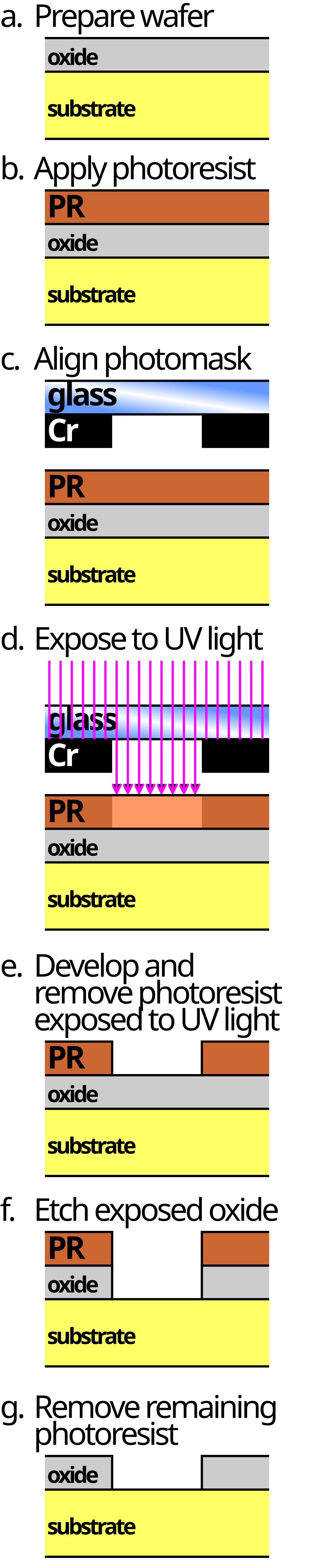 UV light exposes photoresist through a mask (Image: Cmglee, CC BY-SA 3.0, via Wikimedia Commons)
2.4 Doping
- Impurities (boron, phosphorus) are added to silicon to create p-type or n-type regions.
- Forms PN junctions (diodes, transistors).
Example: Creating an NMOS transistor:
- Start with p-type silicon.
- Doping with phosphorus creates an n-type source/drain.
- Gate oxide is grown, and a polysilicon gate is deposited.
2.5 Metallization
- Aluminum/copper layers are deposited to connect transistors.
- Forms interconnects (wires) between components.
2.6 Testing and Packaging
- Probing: Test each die on the wafer.
- Packaging: Dies are cut, mounted on a lead frame, and encapsulated in plastic.
Real-world use:
- Ncell SIM cards: Contain ICs manufactured via these steps for signal processing.
- Intel/AMD CPUs: Fabricated in foundries using 7nm or smaller processes.
3. Fault Detection in ICs
Faults in ICs include:
| Fault Type | Cause | Detection Method |
|---|---|---|
| Stuck-at-0/1 | Defective transistor | Logic testing (e.g., stuck-at-0 test) |
| Short circuit | Misaligned metal layers | Current measurement |
| Open circuit | Broken interconnects | Continuity test |
| Bridging fault | Two wires touching | Scan chain testing |
Example: Testing a 74LS00 NAND gate IC.
- Apply inputs
A=0, B=0→ Expected output1. - If output is
0, the gate is stuck-at-0. - Repeat for all input combinations.
Real-world use:
- Pathao driver apps: Use fault-tolerant ICs in GPS modules to handle signal drops.
- NTC electricity meters: ICs with built-in self-test to detect tampering.
4. Comparison: Fault Detection Methods
| Method | Error Detection | Error Correction | Overhead | Use Case |
|---|---|---|---|---|
| Parity bit | ✅ Yes | ❌ No | Low | Simple data transmission |
| Hamming code | ✅ Yes | ✅ Yes | Medium | Critical data (banks, NEPSE) |
| TMR | ✅ Yes | ✅ Yes | High | Aerospace, medical devices |
| CRC | ✅ Yes | ❌ No | Medium | Network packets (Internet) |
5. Real-World Applications
eSewa Payment System
- Problem: Transaction data (e.g.,
10110101) must be error-free. - Solution: Uses CRC (Cyclic Redundancy Check) for error detection.
- How it works:
- Sender computes CRC for payment details.
- Receiver recomputes CRC; if mismatch → fraud alert.
Ncell Network
- Problem: Radio signals may corrupt data.
- Solution: Uses Hamming codes in base stations.
- How it works:
- Data is encoded with Hamming (7,4).
- If a bit flips during transmission, the code corrects it.
Bank ATMs (e.g., Global IME)
- Problem: Card swipes may have noise.
- Solution: Redundant sensors + parity checks.
- How it works:
- Three magnetic stripe readers verify card data.
- If two agree, the third is ignored (TMR).
Exam Tip
- Parity/Hamming: Always show the syndrome calculation step-by-step.
- IC Manufacturing: Memorize the 5 key steps (wafer → oxidation → lithography → doping → metallization).
- Fault Types: Know stuck-at, short, open faults and how to test them.
- Real-world links: Connect parity to eSewa, Hamming to NEPSE, and TMR to aircraft systems.
- Diagrams: Draw Hamming code tables, photolithography steps, and fault detection flowcharts.
Visual Summary:
In the real world
- WhatsApp messages: Uses parity-like checksums to detect corrupted data during transmission, ensuring message integrity (e.g., when sending a payment request via WhatsApp Pay).
- eSewa transactions: Employs Hamming codes to validate transaction details (e.g., merchant ID, amount) before processing, preventing errors in financial data.
- NEPSE stock data: Relies on Hamming codes to correct single-bit errors in real-time stock price updates (e.g.,
1011→1101101), ensuring accurate trading decisions.
Based on the TU BSc CSIT syllabus for Digital System Design (CSC417), unit 9.
Discussion
Loading…