Advanced DatabaseUnit 812 min read
Advanced DB Topics & Case Studies: Trends, Tech & Real-World Apps
Unit 8 of Advanced Database explores cutting-edge database technologies (blockchain, graph DBs, time-series DBs), real-world case studies (eSewa’s fraud detection, NEPSE’s market data), and emerging trends (AI-driven DBs, serverless architectures) with hands-on comparisons and implementation strategies.
TAKEAWAYS:
- Understand blockchain databases (immutable ledgers) vs. traditional DBs (ACID compliance) using a comparison table and a real-world trace of NEPSE’s trade verification.
- Master graph databases (Neo4j) for fraud detection in Khalti transactions via a query walkthrough and ER-to-graph conversion.
- Analyze time-series databases (InfluxDB) for NTC’s network traffic monitoring with a data model diagram and query optimization example.
- Evaluate AI-integrated databases (Google’s BigQuery ML) using a case study of YouTube’s recommendation engine.
- Design serverless database architectures (AWS DynamoDB) for Pathao’s ride-matching with a cost vs. scalability tradeoff table.
- Solve exam-style problems on hybrid DBs (SQL + NoSQL) with a worked example tied to Daraz’s inventory system.
1. Blockchain Databases: Immutability Meets Data Integrity
1.1 Core Concepts
Blockchain databases store data in chained blocks, each cryptographically linked to the previous one. Key features:
- Immutability: Once written, data cannot be altered without consensus.
- Decentralization: No single authority controls the ledger (e.g., Bitcoin, Ethereum).
- Consensus Mechanisms: Proof-of-Work (PoW), Proof-of-Stake (PoS), or Byzantine Fault Tolerance (BFT).
stateDiagram-v2
    [*] --> NewBlock: Data Submitted
    NewBlock --> Validate: Consensus (e.g., PoW)
    Validate --> Reject: Invalid
    Validate --> AddToChain: Valid
    AddToChain --> [*]: Block Added
1.2 Comparison: Blockchain vs. Traditional Databases
| Feature | Blockchain Databases | Traditional Databases (SQL/NoSQL) |
|---|---|---|
| Data Model | Append-only ledger | Tables, documents, key-value |
| Consistency | Eventual (via consensus) | Strong (ACID) or eventual (BASE) |
| Querying | Smart contracts (e.g., Solidity) | SQL/NoSQL queries |
| Use Case | Audit trails, contracts | CRUD operations, analytics |
| Performance | Slow (high latency) | Fast (optimized for reads/writes) |
1.3 Real-World Example: NEPSE’s Trade Verification
Problem: NEPSE (Nepal Stock Exchange) needs to prevent trade manipulation by ensuring every transaction is tamper-proof. Solution: A hybrid blockchain-SQL system:
- Blockchain Layer: Stores trade hashes in an immutable ledger (e.g., Hyperledger Fabric).
- SQL Layer: Manages user accounts and order books (PostgreSQL).
- Smart Contract: Validates trades before adding them to the blockchain.
sequenceDiagram
    participant User
    participant SQL_DB
    participant SmartContract
    participant Blockchain
    User->>SQL_DB: Submit Trade Order
    SQL_DB-->>User: Order ID
    User->>SmartContract: Verify Order
    SmartContract->>Blockchain: Add Hash to Ledger
    Blockchain-->>SmartContract: Confirmation
    SmartContract->>SQL_DB: Update Trade Status
Worked Example:
- Trade Data:
OrderID: T1001, Stock: NEPSE, Quantity: 100, Price: 200 - Hash:
SHA-256("T1001|NEPSE|100|200") = 5f4dcc3b... - Blockchain Entry:
{
  "index": 42,
  "timestamp": "2024-05-20T12:00:00Z",
  "data": "5f4dcc3b...",
  "previousHash": "a1b2c3..."
}
2. Graph Databases: Fraud Detection in Khalti
2.1 Why Graphs?
Graph databases (e.g., Neo4j) excel at relationship-heavy data, such as:
- Fraud rings: Detecting money laundering via transaction links.
- Social networks: Recommending friends (e.g., Facebook’s "People You May Know").
- IT infrastructure: Mapping dependencies in cloud services.
2.2 EER to Graph Conversion
Convert this Enhanced ER Diagram (from Unit 3) into a graph model:
erDiagram
    User ||--o{ Transaction : "initiates"
    Transaction ||--|| Account : "belongs_to"
    Transaction ||--|{ Merchant : "targets"
    Account ||--|{ User : "owned_by"
    Merchant }|--|| User : "registered_by"
Graph Model (Cypher Query):
CREATE (u1:User {id: "U101", name: "Ramesh"})
CREATE (u2:User {id: "U102", name: "Sita"})
CREATE (m:Merchant {id: "M201", name: "Daraz"})
CREATE (t1:Transaction {id: "T301", amount: 5000})
CREATE (a1:Account {id: "A401", balance: 10000})
CREATE (u1)-[:INITIATES]->(t1)
CREATE (t1)-[:BELONGS_TO]->(a1)
CREATE (t1)-[:TARGETS]->(m)
CREATE (a1)-[:OWNED_BY]->(u1)
CREATE (m)-[:REGISTERED_BY]->(u2)
2.3 Fraud Detection Query
Find suspicious transactions (e.g., rapid transfers between accounts):
MATCH (a1:Account)-[:OWNED_BY]->(u1:User),
      (a2:Account)-[:OWNED_BY]->(u2:User),
      (t1:Transaction)-[:BELONGS_TO]->(a1),
      (t2:Transaction)-[:BELONGS_TO]->(a2)
WHERE u1 <> u2 AND
      t1.amount > 10000 AND
      t2.amount > 10000 AND
      abs(t1.timestamp - t2.timestamp) < 3600s
RETURN u1.name, u2.name, t1.amount, t2.amount
Real-World Tie-In: Khalti uses graph databases to flag money mules (intermediaries in fraud schemes). For example:
- Pattern: User A sends ₹50,000 to User B (unrelated), who immediately transfers ₹49,000 to User C (a merchant).
- Graph Query: Detects the triangle relationship (A → B → C) and freezes the transaction.
3. Time-Series Databases: NTC’s Network Traffic Monitoring
3.1 What Are Time-Series Databases?
Specialized for data indexed by time, used in:
- IoT: Sensor readings (e.g., temperature, humidity).
- Finance: Stock prices, trading volumes.
- Telecom: Network latency, packet loss (e.g., NTC’s fiber optics).
Example Databases: InfluxDB, TimescaleDB, Prometheus.
3.2 Data Model
Unlike SQL tables, time-series databases store data in time-ordered series:
-- Traditional SQL (inefficient for time-series)
CREATE TABLE sensor_readings (
    sensor_id INT,
    timestamp TIMESTAMP,
    value FLOAT
);

-- Time-Series DB (optimized)
CREATE TABLE temperature (
    time TIMESTAMP,
    location STRING,
    value DOUBLE
);
3.3 Query Optimization
Problem: NTC needs to monitor latency spikes on the Kathmandu-Pokhara fiber route. Solution: Use downsampling and aggregation functions:
-- Raw data (100ms intervals)
SELECT time, avg(latency_ms)
FROM network_metrics
WHERE location = 'KTM-POK'
GROUP BY time(1m)  -- Aggregate every 1 minute
Visualization:
4. AI-Integrated Databases: YouTube’s Recommendation Engine
4.1 How AI Meets Databases
Databases now embed machine learning models for:
- Predictive queries: "Show me videos like this one."
- Anomaly detection: Flagging fake reviews (e.g., Amazon).
- Automated indexing: Google’s BigQuery ML.
4.2 Case Study: YouTube’s Recommendation System
- Data Sources:
- Watch history (SQL table:
user_watches). - Clickstream data (time-series:
user_clicks). - Metadata (NoSQL:
video_tags).
- Watch history (SQL table:
- AI Model: A collaborative filtering algorithm (e.g., matrix factorization) trained on:
-- SQL query for user-video interactions SELECT user_id, video_id, watch_duration FROM user_watches WHERE watch_duration > 30s -- Filter low-quality watches - Database Integration:
- BigQuery ML: Runs the model inside the database.
- Real-time updates: New watches trigger model retraining.
5. Serverless Databases: Pathao’s Ride-Matching
5.1 What Is Serverless?
- No infrastructure management: Scales automatically (e.g., AWS DynamoDB, Firebase).
- Pay-per-use pricing: Charged only for requests (cost-effective for variable loads).
5.2 Pathao’s Architecture
| Component | Technology | Role |
|---|---|---|
| User App | React Native | Mobile interface |
| Driver App | Flutter | Driver availability updates |
| Database | DynamoDB (NoSQL) | Real-time ride matching |
| Analytics | BigQuery | Driver performance tracking |
Cost vs. Scalability Tradeoff:
| Database Type | Cost (per 1M requests) | Scalability | Best For |
|---|---|---|---|
| DynamoDB | ~$1.25 | Auto-scaling | Spiky traffic (Pathao peak hours) |
| PostgreSQL | ~$5.00 (fixed) | Manual | Predictable workloads |
| MongoDB Atlas | ~$3.00 | Auto-scaling | Flexible schemas |
Worked Example:
- Problem: During Dashain, Pathao sees 10x normal traffic.
- Solution: DynamoDB auto-scales to handle 10,000 requests/sec without downtime.
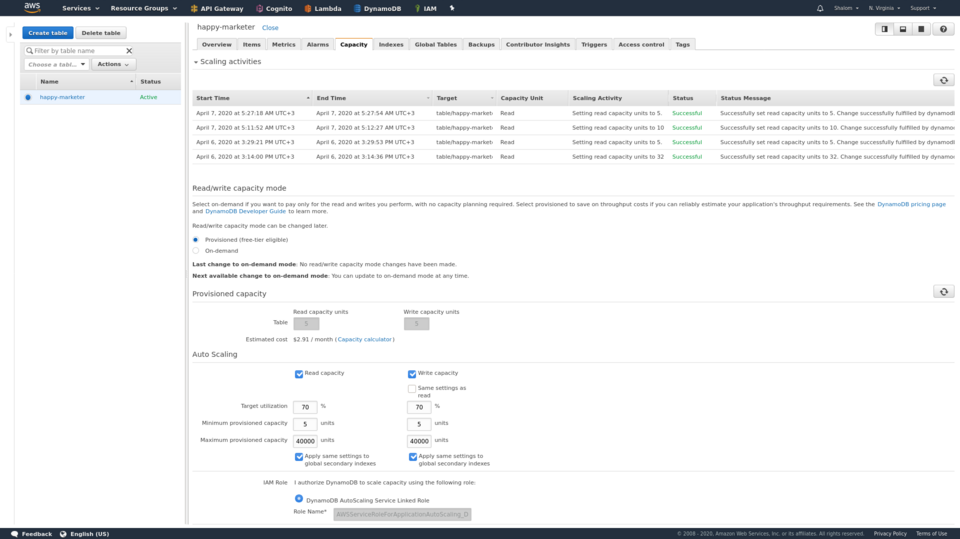 Screenshot of DynamoDB’s auto-scaling configuration (Image: Vitaly Zdanevich, CC0, via Wikimedia Commons)
6. Hybrid Database Systems: Daraz’s Inventory Management
6.1 Why Hybrid?
Combine SQL (structured data) and NoSQL (flexible schemas) for:
- Transaction processing: SQL for orders (ACID compliance).
- User profiles: NoSQL for dynamic attributes (e.g., wishlists).
6.2 Example Schema
-- SQL: Orders (structured)
CREATE TABLE orders (
    order_id INT PRIMARY KEY,
    user_id INT,
    status VARCHAR(20),
    total_amount DECIMAL(10,2)
);

-- NoSQL: User Profiles (flexible)
{
    "user_id": 1001,
    "name": "Hari",
    "wishlist": ["iPhone 15", "MacBook Pro"],
    "addresses": [
        {"type": "home", "city": "Kathmandu"},
        {"type": "office", "city": "Lalitpur"}
    ]
}
Query Workflow:
- SQL: Check stock availability for an order.
- NoSQL: Fetch user’s preferred delivery address.
- Hybrid Join: Combine results for order confirmation.
In the Real World
eSewa’s Fraud Detection
- Idea: Graph databases (Neo4j) to detect synthetic identities (fake users linked via multiple transactions).
- How: Queries like
MATCH (u1:User)-[:USED_CARD]->(c:Card)-[:USED_CARD]->(u2:User) WHERE u1 <> u2 RETURN u1, u2flag money mules.
Ncell’s Network Analytics
- Idea: Time-series databases (InfluxDB) to track SMS delivery latency across towers.
- How: Downsampled queries identify congestion hotspots (e.g., Thamel during New Year).
NEPSE’s Blockchain Pilot
- Idea: Hybrid blockchain-SQL to prevent insider trading.
- How: Trades are hashed on a private blockchain, while user portfolios stay in SQL for fast queries.
Exam Tip
Case Study Questions (30%):
- Expect scenario-based problems (e.g., "Design a database for Pathao’s surge pricing").
- Structure your answer:
- Requirements (e.g., "real-time updates needed").
- Schema (SQL/NoSQL/graph).
- Optimizations (indexes, partitioning).
- Tradeoffs (cost vs. performance).
Comparison Tables (20%):
- Memorize blockchain vs. SQL, graph vs. relational, and time-series vs. columnar.
- Example: For blockchain, highlight consensus mechanisms and throughput limits.
Query Writing (25%):
- Practice Cypher (Neo4j), SQL for time-series, and NoSQL updates.
- Tip: Use pseudocode if stuck (e.g., "FOR each node in graph: ...").
Short Answers (15%):
- Define terms like:
- Sharding (splitting a DB horizontally).
- Vector databases (for AI embeddings, e.g., Pinecone).
- Example: "Explain how DynamoDB handles hot partitions."
- Define terms like:
Diagrams (10%):
- Must-draw:
- Blockchain ledger (with hashes).
- Graph model (from an ER diagram).
- Hybrid architecture (SQL + NoSQL).
- Must-draw:
Final Note: Focus on real-world mappings (e.g., Khalti → graph DBs, NTC → time-series). Use mermaid diagrams to visualize workflows, and compare technologies in tables for quick revision.
Based on the TU BSc CSIT syllabus for Advanced Database (CSC461), unit 8.
Discussion
Loading…