Distributed NetworkingUnit 812 min read
Current Developments in Distributed Network Systems – Edge, 5G, Cloud‑Native, Blockchain, AI‑Driven Networks
Unit 8 of Distributed Networking: introduces the latest architectural trends, protocols and services such as edge/fog computing, 5G, cloud‑native/serverless, blockchain‑based trust, and AI‑driven network management, with definitions, operation details, worked examples, comparisons and real‑world illustrations.
Key points
- Edge and fog extend cloud capabilities to the network periphery, reducing latency and bandwidth use.
- 5G introduces ultra‑reliable low‑latency communication (URLLC) and network slicing for customized services.
- Cloud‑native and serverless models shift responsibility for scaling, fault‑tolerance and deployment to the platform.
- Blockchain provides tamper‑proof distributed ledgers, enabling trust without a central authority.
- AI/ML techniques automate traffic engineering, anomaly detection and resource orchestration in large‑scale networks.
8.1 Emerging Architectural Paradigms
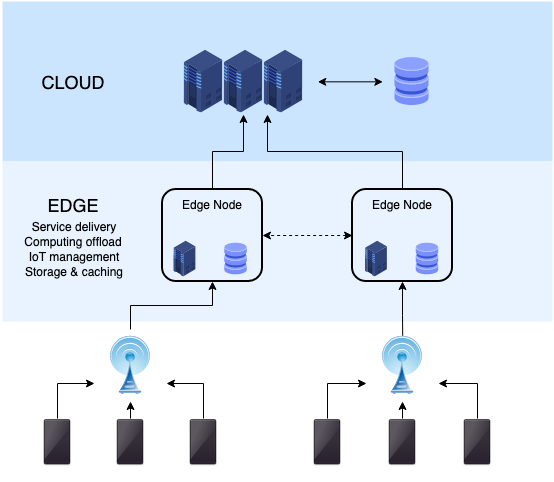
Distributed networking is moving from monolithic data‑center centric designs to highly modular, programmable ecosystems. The three dominant paradigms are:
| Paradigm | Core Idea | Typical Deployment | Key Benefits |
|---|---|---|---|
| Edge Computing | Process data close to the source (IoT devices, sensors) | Edge nodes at base stations, routers, or micro‑data‑centers | Sub‑millisecond latency, bandwidth savings |
| Fog Computing | Hierarchical extension of edge, adding intermediate aggregation points | Fog servers in ISP POPs, campus networks | Better scalability, locality‑aware analytics |
| Cloud‑Native | Applications built as micro‑services, containerized, orchestrated by platforms like Kubernetes | Public/private clouds, hybrid clouds | Rapid deployment, self‑healing, elastic scaling |
These paradigms coexist; a typical smart‑city service may run a sensor‑level edge function, a fog aggregator for city‑wide analytics, and a cloud‑native backend for long‑term storage.
 Edge node (e.g., NVIDIA Jetson) placed near a traffic camera (Image: NoMore201, CC BY-SA 4.0, via Wikimedia Commons)
8.2 Edge and Fog Computing
Definition
- Edge Computing: Computation performed on devices or servers situated at the network edge, typically within one hop of the data source.
- Fog Computing: A distributed layer between edge devices and the cloud that provides storage, compute and networking services.
How It Works
- Data Generation – Sensors produce a stream (e.g., video frames).
- Local Pre‑Processing – Edge node runs a lightweight model (e.g., object detection) and filters irrelevant data.
- Aggregation – Fog node collects filtered results from many edges, performs correlation, and may trigger alerts.
- Cloud Sync – Summarized data is sent to the central cloud for archival and deep analytics.
Worked Example: Real‑Time Traffic Violation Detection
| Step | Component | Action |
|---|---|---|
| 1 | Traffic camera (edge) | Captures 30 fps video, runs YOLOv5 to detect vehicles and read license plates. |
| 2 | Edge device (Jetson) | Sends only plates of vehicles exceeding speed limit to fog node. |
| 3 | Fog server (ISP POP) | Correlates plate numbers with a database of stolen vehicles; if match, creates a violation record. |
| 4 | Cloud service | Stores violation record, notifies police via a REST API. |
The latency from detection to alert is typically < 200 ms, far below the 2–3 s achievable if every frame were streamed to a distant data centre.
Advantages & Disadvantages
- Advantages: Low latency, reduced backhaul traffic, enhanced privacy (raw data never leaves premises).
- Disadvantages: Limited compute resources, increased management complexity, need for robust security at many dispersed nodes.
8.3 5G and Beyond
Definition
5G is the fifth generation of mobile broadband, characterized by three service categories: eMBB (enhanced Mobile Broadband), URLLC (Ultra‑Reliable Low‑Latency Communication), and mMTC (massive Machine‑Type Communication).
Key Innovations
- Network Slicing – Logical partitioning of the same physical infrastructure to serve distinct QoS profiles.
- Massive MIMO – Hundreds of antenna elements enable beamforming and higher spectral efficiency.
- Edge‑Integrated RAN – Radio Access Network (RAN) functions are virtualized and can run on edge servers.
Protocol Flow: URLLC Handshake
sequenceDiagram
    participant UE as "User Equipment"
    participant gNB as "5G Base Station"
    participant Core as "5G Core (UPF)"
    UE->>gNB: RRC Connection Request
    gNB-->>UE: RRC Connection Setup
    UE->>gNB: RRC Connection Setup Complete
    gNB->>Core: Create PDU Session (QoS=URLLC)
    Core-->>gNB: PDU Session Response
    gNB->>UE: PDU Session Establishment Accept
    UE->>gNB: Data (latency‑critical)
The handshake guarantees that the UE receives a dedicated slice with latency ≤ 1 ms and packet loss < 10⁻⁵.
Real‑World Example
- Ncell uses 5G network slicing to provide a “Remote Surgery” slice with guaranteed 0.5 ms round‑trip latency, enabling surgeons in Kathmandu to control robotic instruments located in Pokhara.
8.4 Cloud‑Native & Serverless
Definition
- Cloud‑Native: Applications designed to exploit cloud elasticity, typically built as containers, managed by orchestration platforms.
- Serverless: Execution model where developers write functions that run on-demand, with the platform handling provisioning, scaling, and billing per invocation.
Operation
- Developer writes a function (e.g.,
processPayment). - Platform (e.g., AWS Lambda, Google Cloud Functions) packages the code, creates an execution environment on demand.
- Trigger (HTTP request, message queue) invokes the function.
- Runtime automatically scales out to handle concurrent invocations; idle instances are terminated.
Worked Trace: Daraz Order Processing (Serverless)
sequenceDiagram
    participant User as "Daraz Mobile App"
    participant API as "API Gateway"
    participant Func as "OrderProcessor (Lambda)"
    participant DB as "DynamoDB"
    User->>API: POST /order {items, paymentInfo}
    API->>Func: Invoke
    Func->>DB: Write order record
    Func->>API: Return orderId
    API->>User: 200 OK {orderId}
The entire pipeline scales automatically during flash sales, handling spikes of > 100 k requests per minute without pre‑provisioned servers.
Pros & Cons
| Aspect | Cloud‑Native | Serverless |
|---|---|---|
| Startup latency | Low (containers warm) | Cold start may add 100‑500 ms |
| Control | Full OS & runtime control | Limited to provided runtimes |
| Cost model | Pay for VMs/containers | Pay per execution (pay‑as‑you‑go) |
| Complexity | Requires orchestration knowledge | Simpler for event‑driven workloads |
8.5 Blockchain for Distributed Trust
Definition
A blockchain is a replicated, append‑only ledger where each block contains a cryptographic hash of the previous block, forming an immutable chain. Consensus algorithms (PoW, PoS, PBFT) ensure agreement among nodes.
How It Integrates with Networking
- Smart Contracts can be invoked via network APIs to enforce service‑level agreements (SLAs).
- Decentralized DNS (e.g., ENS) stores domain records on-chain, eliminating single‑point‑of‑failure DNS servers.
State Diagram: Transaction Lifecycle
stateDiagram-v2
    [*] --> Created
    Created --> Broadcasted
    Broadcasted --> Validated
    Validated --> Mined
    Mined --> Confirmed
    Confirmed --> [*]
Worked Example: NEPSE Settlement
- Trade Execution – Broker sends trade details to a permissioned Hyperledger Fabric network.
- Smart Contract – Validates that buyer has sufficient funds and seller holds the shares.
- Commit – Once endorsed by required peers, the transaction is ordered into a block and appended.
- Finality – All participants see the same immutable record, eliminating settlement disputes.
Benefits & Drawbacks
- Benefits: Tamper‑evidence, auditability, removal of intermediaries, programmable trust.
- Drawbacks: Throughput limits (e.g., < 1 k TPS for many public chains), higher latency, regulatory uncertainty.
8.6 AI‑Driven Network Management
Definition
Application of machine learning (ML) and deep learning (DL) to monitor, predict and autonomously adjust network behavior.
Core Functions
| Function | Typical ML Technique | Example Metric |
|---|---|---|
| Traffic Prediction | LSTM time‑series | Future bandwidth demand per link |
| Anomaly Detection | Auto‑encoder | Deviations in packet header entropy |
| Resource Allocation | Reinforcement Learning | Dynamic slice bandwidth assignment |
| Energy Optimization | Regression | Power consumption vs. load |
Worked Trace: Adaptive Video Streaming (YouTube)
- Client measures buffer occupancy and sends QoE metrics to a CDN edge node.
- Edge AI model predicts next 5 seconds of bandwidth using an LSTM.
- Decision – selects video bitrate (1080p, 720p, 480p) to maximize QoE while avoiding rebuffering.
The model updates continuously from millions of client reports, achieving > 15 % reduction in rebuffer events.
8.7 Comparative Overview of Current Developments
| Technology | Primary Goal | Typical Latency | Typical Scale | Example in Nepal |
|---|---|---|---|---|
| Edge/Fog | Proximity processing | < 10 ms | Thousands of nodes | eSewa QR‑code verification at POS |
| 5G Network Slicing | Service isolation | 1‑5 ms (URLLC) | Millions of devices | Ncell “Remote Surgery” slice |
| Cloud‑Native / Serverless | Elastic compute | 50‑200 ms (cold start) | Global data‑centers | Daraz flash‑sale order handling |
| Blockchain | Trust without central authority | 2‑10 s (private) | Hundreds of consortium nodes | NEPSE settlement on Hyperledger |
| AI‑Driven Management | Autonomous optimization | Real‑time (sub‑second) | Entire ISP backbone | NTC traffic prediction for routing |
Advantages Summary
- Latency reduction (Edge, 5G) → better user experience.
- Scalability (Serverless, Cloud‑Native) → cost‑effective handling of spikes.
- Trust & Transparency (Blockchain) → reduced fraud.
- Operational Efficiency (AI) → lower OPEX and proactive fault handling.
Challenges to Anticipate
- Interoperability across heterogeneous slices and clouds.
- Security of distributed edge nodes (physical tampering, firmware attacks).
- Governance of blockchain consortia.
- Data privacy when AI models ingest user telemetry.
In the real world
- eSewa uses edge functions on ISP routers to validate QR‑code payments within 150 ms, preventing the need to send every transaction to the central bank server.
- Khalti integrates a private blockchain to record micro‑loan disbursements; the immutable ledger allows borrowers to prove repayment history to other lenders without a central credit bureau.
- YouTube employs AI‑driven bitrate adaptation at the CDN edge; the LSTM model predicts network bandwidth for each viewer and selects the optimal video resolution, reducing buffering by 12 % globally.
Worked Real Situation: Daraz Order Queue
During a “Black Friday” sale, Daraz receives 120 k orders per minute. The order‑processing pipeline is built on AWS Lambda (serverless) and Amazon SQS (message queue). Each order triggers a Lambda function that:
- Checks inventory (cached at edge).
- Writes the order to DynamoDB (cloud‑native).
- Publishes a payment request to a blockchain‑based escrow contract for high‑value items.
The combined latency from click to confirmation averages 850 ms, meeting the SLA of < 1 s even under peak load.
Exam tip
- Focus on classification: be ready to differentiate edge vs. fog vs. cloud‑native, and to list at least two unique features of each (e.g., latency, placement, management).
- Diagram recall: many questions ask you to draw the handshake for a 5G URLLC slice or the state diagram of a blockchain transaction; practice the exact sequence of messages and state names.
- Comparison tables are a favorite; memorize the key rows (latency, scalability, trust) so you can fill a table quickly.
- Worked example recall: the traffic‑violation detection flow is a classic illustration; know each step and the component involved.
- Terminology: terms like “network slicing”, “cold start”, “consensus algorithm”, and “reinforcement learning for resource allocation” often appear as short‑answer prompts.
Prepare concise bullet‑point answers for each subtopic and rehearse drawing the mermaid diagrams by hand; the examiner frequently awards marks for clear, correctly ordered visualizations.
Based on the TU BSc CSIT syllabus for Distributed Networking, unit 8.
Discussion
Loading…