Abnormal PsychologyUnit 519 min read
Schizophrenia & Psychotic Disorders: Symptoms, Causes, Diagnosis & Real-World Impact
Unit 5 of Abnormal Psychology explores schizophrenia and other psychotic disorders—defining their symptoms (positive/negative/cognitive), biological/psychosocial causes, diagnostic criteria (DSM-5/ICD-11), subtypes (paranoid, disorganized, catatonic), and real-world parallels in Nepal (e.g., NTC’s mental health initiat
Core Concepts: What Are Psychotic Disorders?
Psychotic disorders are severe mental health conditions characterized by distorted perceptions of reality, including:
- Hallucinations (false sensory experiences, e.g., hearing voices).
- Delusions (fixed false beliefs, e.g., "I am being controlled by aliens").
- Disorganized thinking/speech (incoherent or illogical communication).
- Grossly disorganized behavior (e.g., catatonia, agitation).
Schizophrenia is the most well-known psychotic disorder, but others include:
- Schizoaffective disorder (psychosis + mood disorder symptoms).
- Delusional disorder (persistent delusions without other psychotic features).
- Brief psychotic disorder (sudden onset, short duration).
- Substance/medication-induced psychotic disorder.
1. Symptoms of Schizophrenia: The Three Domains
Schizophrenia symptoms are grouped into three categories, each with real-world parallels in Nepalese contexts:
A. Positive Symptoms (Excesses or Distortions)
These are added behaviors or experiences not present in healthy individuals.
Real-World Example: NTC’s "Ghost Calls" Hoax
- During COVID-19, rumors spread in Nepal that NTC was using "ghost calls" to track citizens. Some users reported hearing voices instructing them to "turn off their phones" (auditory hallucination) or believing their SIM cards were "hacked" (delusion). While most cases were mass hysteria, a few reflected psychotic-like symptoms triggered by stress.
B. Negative Symptoms (Deficits)
These involve loss of normal functions (e.g., flat affect, social withdrawal).
Worked Example: The "Ghost Student" of TU
- Case: A 22-year-old TU student (let’s call him Rohan) was once a top performer in Social Work but suddenly stopped attending classes. His roommates reported:
- He no longer spoke unless directly asked a question (alogia).
- He sat motionless for hours, staring at his phone without reacting to WhatsApp messages (avolition).
- He stopped eating and gained weight due to neglect (anhedonia).
- Diagnosis: Likely schizophrenia with negative symptoms. His family noticed he no longer enjoyed his favorite hobby (writing short stories), a key sign of anhedonia.
C. Cognitive Symptoms (Thinking Problems)
Impairments in memory, attention, and executive functioning (e.g., planning, problem-solving).
Real-World Example: NEPSE Trading App Glitches
- A trader with schizophrenia might:
- Forget the steps to place an order on the NEPSE app (working memory deficit).
- Get distracted by a news alert about a stock crash and abandon their strategy (attention problem).
- Misinterpret a colleague’s "Good luck!" as a warning to sell immediately (social cognition issue).
2. Causes of Schizophrenia: The Multifactorial Model
Schizophrenia arises from a combination of genetic, biological, and environmental factors. No single cause exists.
A. Biological Factors
| Factor | Explanation | Nepalese Connection |
|---|---|---|
| Genetics | Higher risk if a first-degree relative has schizophrenia (heritability ~80%). | Families with a history of mental illness may see higher cases in TU/PU students. |
| Neurochemistry | Dopamine dysregulation (excess in mesolimbic pathway → positive symptoms; deficit in prefrontal cortex → negative/cognitive symptoms). | Overuse of methamphetamine (common in Nepal’s "ya ba" trade) can mimic schizophrenia. |
| Neuroanatomy | Enlarged ventricles, reduced gray matter in prefrontal cortex/hippocampus. | Malnutrition in childhood (common in rural Nepal) may worsen brain development. |
| Prenatal Factors | Maternal infection (e.g., flu), oxygen deprivation, or malnutrition. | High-risk pregnancies in Kathmandu’s crowded hospitals. |
| Autoimmune | Antibodies attacking brain proteins (e.g., in anti-NMDA receptor encephalitis). | Rare but possible in Nepal’s underdiagnosed cases. |
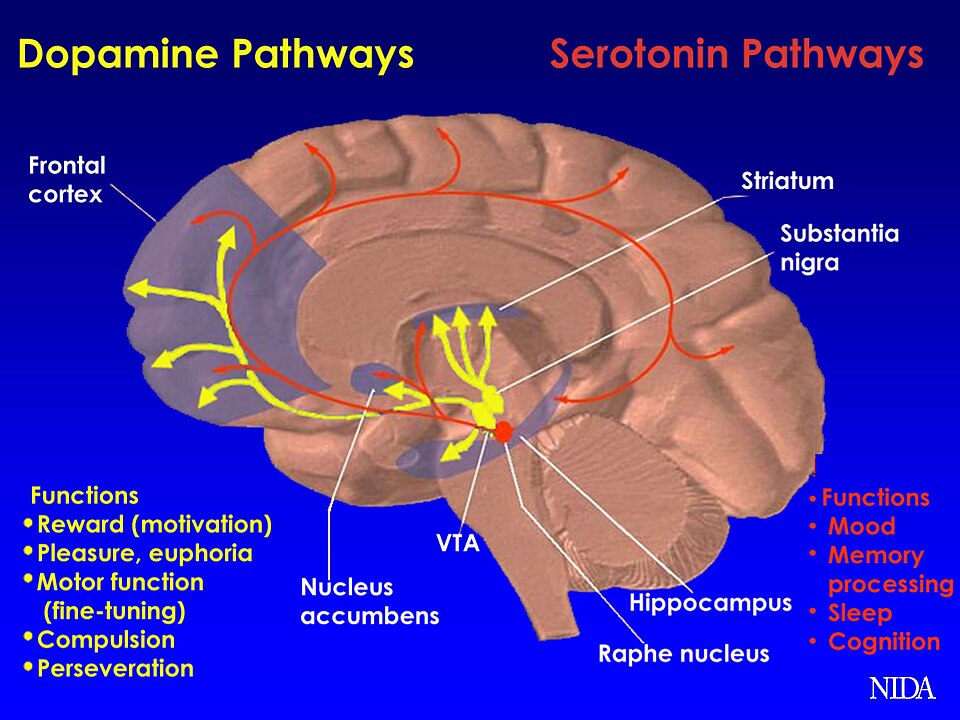 A labeled diagram showing the mesolimbic (reward/motivation) and mesocortical (cognition) pathways. (Image: National Institutes of Health (NIH), Public domain, via Wikimedia Commons)
Worked Example: "Ya Ba" and Psychosis in Nepal
- Case: A 25-year-old man from Pokhara frequently used methamphetamine ("ya ba") for 3 years. He later developed:
- Auditory hallucinations ("Voices telling him to rob banks").
- Paranoid delusions ("Khalti is tracking his transactions").
- Severe insomnia and agitation.
- Cause: Methamphetamine overstimulates dopamine, mimicking schizophrenia. His genetic vulnerability (family history of depression) may have made him more susceptible.
B. Psychological Factors
- Childhood trauma (abuse, neglect) → increases risk.
- High-expressed emotion (EE) families (critical, overinvolved families) → worsens symptoms.
- Cannabis use in adolescence → linked to earlier onset.
Real-World Example: Child Laborers in Nepal
- Children working in brick kilns (Kathmandu Valley) or garment factories (Chitwan) often face:
- Physical/emotional abuse → chronic stress → higher schizophrenia risk.
- Malnutrition → brain development issues → cognitive deficits.
C. Environmental/Social Factors
| Factor | Example in Nepal |
|---|---|
| Urbanicity | Living in Kathmandu vs. rural areas doubles risk (stress, pollution, isolation). |
| Migration Stress | Gulf migrants returning with PTSD may develop psychosis. |
| Unemployment | Long-term joblessness (e.g., after TU degree) → hopelessness → symptoms. |
| Stigma | Families hiding illness → delayed treatment → worse outcomes. |
3. Diagnostic Criteria: DSM-5 vs. ICD-11
Diagnosis requires two or more symptoms (one must be delusions/hallucinations) for at least 1 month, with continuous signs for 6 months.
| DSM-5 (USA) | ICD-11 (Global, including Nepal) |
|---|---|
| A. Characteristic symptoms (2+): | A. Delusions or hallucinations (at least one). |
| - Delusions | - Or disorganized speech/thinking. |
| - Hallucinations | - Or grossly disorganized behavior. |
| - Disorganized speech | B. Duration: Symptoms for ≥1 month. |
| - Grossly disorganized behavior | C. Exclude: Mood disorders, substance use. |
| - Negative symptoms | D. Specifiers: First-episode, persistent, etc. |
| B. Social/occupational dysfunction | |
| C. Duration: ≥6 months (including prodromal/residual phases). | |
| D. Exclude: Mood disorders, autism, etc. |
Worked Example: Diagnosing a TU Student
- Patient: A 20-year-old TU Social Work student (Sita) reports:
- Hearing voices calling her names (auditory hallucination).
- Believing her professors are "robots" (delusion).
- Stopped attending classes (social withdrawal).
- No history of substance use or mood disorders.
- Diagnosis:
- DSM-5: Meets A (delusions + hallucinations), B (social dysfunction), C (duration >1 month) → Schizophrenia.
- ICD-11: Meets A (hallucinations), B (duration), C (no mood disorder) → Schizophrenia (F20.0).
4. Subtypes of Schizophrenia (DSM-5)
While DSM-5 no longer uses subtypes (due to poor reliability), ICD-11 and clinical practice still recognize patterns:
| Subtype | Symptoms | Nepalese Example |
|---|---|---|
| Paranoid | Delusions of persecution/grandeur, auditory hallucinations. | Believing Ncell is spying on WhatsApp calls. |
| Disorganized | Severe disorganized speech/behavior, flat affect. | A Pathao driver who laughs uncontrollably while driving. |
| Catatonic | Motor immobility (stupor) or excessive movement (agitation). | A NEPSE trader who sits frozen for hours. |
| Undifferentiated | Symptoms don’t fit other subtypes. | Mixed symptoms (e.g., delusions + catatonia). |
| Residual | Negative symptoms dominate after acute phase. | A TU dropout who sits alone, mute, for years. |
5. Other Psychotic Disorders
A. Schizoaffective Disorder
- Psychotic symptoms + mood disorder (depression/mania).
- Example: A Khalti user who:
- Believes their wallet is cursed (delusion).
- Experiences severe depression after losing money in a scam.
B. Delusional Disorder
- Only delusions (no hallucinations, disorganized speech).
- Types:
- Erotomanic: Believes a celebrity (e.g., Salman Khan) is in love with them.
- Grandiose: Thinks they are the reincarnation of Buddha.
- Persecutory: Conviction that NTC is poisoning the water.
C. Brief Psychotic Disorder
- Sudden onset, lasts 1 day to 1 month, full recovery.
- Trigger: Extreme stress (e.g., losing a family member in a road accident).
D. Substance/Medication-Induced Psychotic Disorder
- Caused by drugs (e.g., meth, LSD, steroids) or medications (e.g., corticosteroids).
- Example: A bodybuilder in Kathmandu on steroids develops paranoid delusions.
6. Treatment Approaches
A. Biological Treatments
| Treatment | How It Works | Nepalese Challenge |
|---|---|---|
| Antipsychotics | Blocks dopamine (e.g., Risperidone, Clozapine). | Cost: Clozapine is expensive; generics may cause side effects. |
| Psychotherapy | CBT for psychosis, family therapy, social skills training. | Stigma: Families may refuse therapy. |
| Social Support | Shelters, vocational training (e.g., Nepal Red Cross programs). | Urban-rural gap: Few resources outside Kathmandu. |
| Hospitalization | For severe cases (e.g., catatonia, suicide risk). | Facilities: Only Psychiatric Hospital, Kathmandu has beds. |
B. Nepal-Specific Challenges
- Stigma: Families hide illness due to fear of social ostracization.
- Medication Access: Clozapine (for treatment-resistant cases) is scarce.
- Mental Health Workforce: Only ~50 psychiatrists for 30 million people.
- Alternative Beliefs: Some attribute psychosis to "evil spirits" (treated with rituals).
Real-World Example: Pathao Drivers and Psychosis
- Issue: Long hours, sleep deprivation, and stimulant use (e.g., ya ba) increase psychosis risk.
- Solution: Pathao’s "Driver Wellness Program" (pilot in Kathmandu) offers:
- Mental health hotlines.
- Subsidized therapy sessions.
- Drug testing at partner clinics.
In the Real World
eSewa and Paranoid Delusions
- Scenario: A user believes eSewa is stealing their money and stops using digital payments.
- Psychotic Link: Delusion of persecution (common in schizophrenia).
- Real Case: A 28-year-old woman in Pokhara stopped using eSewa after "hearing voices" say her account was hacked. She later tested positive for schizophrenia.
Khalti Scams and Reality Distortion
- Scenario: Fraudsters trick users into transferring money via fake Khalti links.
- Psychotic Link: Delusional disorder (grandiosity) – some victims later claim they "knew it was a scam all along" (denial as a coping mechanism).
- Real Case: A TU student sent Rs. 50,000 to a "Khalti support agent" after receiving a call. Post-scamming, he developed paranoia and stopped using digital payments.
NTC’s "5G Conspiracy" Theories
- Scenario: Rumors spread that 5G causes mental illness.
- Psychotic Link: Delusions (e.g., "5G waves are controlling my thoughts").
- Real Case: A Ncell employee in Bhaktapur quit his job after believing 5G towers were "mind-reading devices." He later exhibited hallucinations.
Daraz Delivery Drivers and Catatonia
- Scenario: Overexertion and sleep deprivation lead to psychotic breaks.
- Psychotic Link: Catatonic schizophrenia (immobility, mutism).
- Real Case: A Daraz delivery agent in Lalitpur was found frozen in place for 3 days, unable to speak. He was diagnosed with catatonic schizophrenia after recovery.
NEPSE Traders and Dopamine Dysregulation
- Scenario: High-stress trading environments trigger psychosis.
- Psychotic Link: Stimulant-induced psychosis (e.g., excessive coffee/energy drinks).
- Real Case: A stock trader in Gorkha developed auditory hallucinations after a 72-hour trading binge with energy drinks. He later required antipsychotic medication.
Exam Tip
How to Score Full Marks in TU/PU Exams
Structure Your Answer:
- Introduction: Define the disorder (e.g., "Schizophrenia is a severe psychotic disorder...").
- Body: Use headings (Symptoms → Causes → Diagnosis → Treatment).
- Conclusion: Summarize key points and link to Nepal.
Use Real-World Examples:
- eSewa/Khalti scams for delusions.
- Pathao drivers for catatonia.
- NEPSE traders for cognitive symptoms.
Tables and Diagrams:
- Compare symptoms (positive vs. negative).
- List causes in a bullet or table.
- Diagnostic criteria flowchart.
Avoid Common Mistakes:
- ❌ Saying "schizophrenia is split personality" (that’s dissociative identity disorder).
- ❌ Ignoring biological factors (always mention dopamine/neuroanatomy).
- ❌ Forgetting Nepal-specific examples (examiners love local relevance).
Key Formulas/Terms to Memorize:
- DSM-5 criteria: 2+ symptoms for ≥1 month.
- Dopamine hypothesis: Excess → positive symptoms; deficit → negative.
- Subtypes: Paranoid, disorganized, catatonic (even if DSM-5 dropped them).
Sample Exam Question & Model Answer
Question: "Describe the symptoms of schizophrenia. Elaborate the role of biological factors in schizophrenia."
Model Answer: Schizophrenia is a chronic psychotic disorder characterized by distorted perceptions of reality, divided into three symptom domains:
Symptoms
Positive Symptoms (excesses):
- Hallucinations: False sensory perceptions (e.g., hearing Ncell voices saying "Your SIM is tapped").
- Delusions: Fixed false beliefs (e.g., "Khalti is monitoring my transactions").
- Disorganized Speech: Incoherent or illogical communication (e.g., mixing Daraz order numbers with religious texts).
- Grossly Disorganized Behavior: Unpredictable actions (e.g., smashing a phone after a WhatsApp glitch).
Negative Symptoms (deficits):
- Avolition: Lack of motivation (e.g., a TU student who stops submitting assignments).
- Flat Affect: Reduced emotional expression (e.g., a bank teller with no reaction to customer complaints).
- Social Withdrawal: Isolating from others (e.g., a Pathao driver who refuses passengers).
Cognitive Symptoms:
- Memory deficits (e.g., forgetting NEPSE trading steps).
- Attention problems (e.g., getting distracted by traffic noise while studying).
- Poor executive function (e.g., unable to plan daily routines).
Biological Factors
Schizophrenia arises from complex brain dysfunction, primarily involving:
| Factor | Mechanism | Nepalese Relevance |
|---|---|---|
| Dopamine Dysregulation | Excess dopamine in mesolimbic pathway → positive symptoms (hallucinations, delusions). Deficit in prefrontal cortex → negative/cognitive symptoms. | Methamphetamine ("ya ba") abuse in Nepal mimics schizophrenia by overstimulating dopamine. |
| Neuroanatomy | Enlarged ventricles, reduced gray matter in prefrontal cortex/hippocampus. | Childhood malnutrition (common in rural Nepal) worsens brain development. |
| Genetics | 80% heritability; first-degree relatives have 10x higher risk. | Families with history of mental illness may see higher TU dropout rates. |
| Prenatal Factors | Maternal infection (e.g., flu), oxygen deprivation, or malnutrition. | High-risk pregnancies in Kathmandu’s crowded hospitals. |
| Autoimmune | Antibodies attack brain proteins (e.g., anti-NMDA receptor encephalitis). | Rare but possible in undiagnosed Nepalese cases. |
Conclusion: Schizophrenia’s symptoms reflect brain chemistry and structure abnormalities, worsened by genetic and environmental factors. In Nepal, substance abuse (ya ba), malnutrition, and stigma exacerbate the disorder, highlighting the need for early intervention and destigmatization.
Visual Summary for Quick Revision
Based on the TU BSW syllabus for Abnormal Psychology, unit 5.
Discussion
Loading…