Abnormal PsychologyUnit 1513 min read
Therapeutic Approaches: CBT, Humanistic, and Other Modalities
Unit 15 of Abnormal Psychology explores Cognitive-Behavioral Therapy (CBT), Humanistic Therapy, and Other Modalities (e.g., psychodynamic, biological, and integrative approaches), their techniques, applications, and effectiveness in treating psychological disorders. It compares their theoretical foundations, practical
TAKEAWAYS:
- Cognitive-Behavioral Therapy (CBT) targets maladaptive thoughts and behaviors through structured techniques like cognitive restructuring and exposure therapy, proven effective for anxiety, depression, and PTSD.
- Humanistic Therapy (e.g., client-centered therapy) focuses on self-actualization, empathy, and unconditional positive regard, emphasizing the client’s subjective experience and growth potential.
- Other Modalities include psychodynamic therapy (exploring unconscious conflicts), biological treatments (medication, ECT), and integrative approaches (combining multiple therapies).
- Effectiveness varies: CBT is evidence-based for structured disorders (e.g., OCD, phobias), while humanistic therapy excels in fostering personal insight and emotional healing.
- Assessment methods (e.g., DSM-5, ICD-11) guide treatment selection, but no single approach is universally superior—context and client needs determine the best modality.
- Real-world applications: CBT is used in eSewa’s mental health support for users facing stress, while Khalti’s customer service employs humanistic principles to resolve conflicts empathetically.
1. Cognitive-Behavioral Therapy (CBT): Techniques and Applications
CBT is a goal-oriented, structured therapy that combines cognitive (thoughts) and behavioral (actions) techniques to address maladaptive patterns. It operates on the premise that thoughts, feelings, and behaviors are interconnected, and changing one can alter the others.
Core Techniques of CBT
Cognitive Restructuring:
- Identifies and challenges dysfunctional thoughts (e.g., catastrophizing, black-and-white thinking).
- Example: A student failing an exam might think, “I’m a total failure.” CBT reframes this as “I didn’t perform well this time, but I can improve.”
- Visualization: Use a thought record (table) to track situations, automatic thoughts, evidence for/against them, and balanced alternatives.
| Situation          | Automatic Thought | Evidence For | Evidence Against | Balanced Thought          |
|---------------------|--------------------|--------------|------------------|---------------------------|
| Failed exam         | "I’m a failure"    | Scored 30%    | Passed other exams | "I need to study harder"   |
Behavioral Activation:
- Encourages engagement in pleasurable or meaningful activities to counteract depression/anhedonia.
- Example: A depressed individual avoids socializing. CBT might assign small tasks like calling a friend weekly.
Exposure Therapy:
- Gradually exposes individuals to feared stimuli to reduce anxiety (used in PTSD, phobias, OCD).
- Types:
- Systematic Desensitization: Pairing relaxation with feared objects (e.g., a spider-phobic person imagines spiders while practicing deep breathing).
- Flooding: Immediate, prolonged exposure (e.g., a patient with a fear of heights standing on a tall building).
- Real-world example: Pathao’s panic button for drivers uses exposure principles—users facing anxiety during rides are guided through calming techniques via the app.
Behavioral Experiments:
- Tests the validity of beliefs through action.
- Example: “If I speak in public, I’ll humiliate myself.” CBT might encourage the client to give a short speech and record outcomes.
Effectiveness and Limitations
- Strengths:
- Short-term (12–20 sessions), evidence-based, and cost-effective.
- Effective for anxiety disorders, depression, PTSD, and eating disorders.
- Limitations:
- Requires active client participation—not suitable for severely psychotic or dissociative individuals.
- May not address deep-seated emotional wounds (better suited for humanistic therapy).
2. Humanistic Therapy: The Client-Centered Approach
Developed by Carl Rogers, humanistic therapy emphasizes self-actualization, genuineness, and empathy. It assumes individuals are inherently good and capable of growth if given the right environment.
Key Principles
- Unconditional Positive Regard:
- Therapist accepts the client without judgment, fostering a safe space for exploration.
- Empathy:
- Therapist reflects and validates the client’s feelings (e.g., “It sounds like you’re feeling overwhelmed.”).
- Congruence (Genuineness):
- Therapist is authentic, not hiding behind a professional mask.
Techniques
- Active Listening:
- Paraphrasing, summarizing, and reflecting emotions to deepen self-awareness.
- Client-Led Sessions:
- The client directs the conversation, focusing on present feelings rather than past traumas.
- Non-Directive Approach:
- Therapist avoids giving advice; instead, they ask open-ended questions to encourage insight.
Applications
- Ideal for low-severity depression, relationship issues, and personal growth.
- Real-world example: Ncell’s customer care uses humanistic principles—agents listen empathetically to complaints (e.g., billing issues) without immediately blaming the customer, reducing conflict.
Limitations
- Less structured: Progress can be slower and harder to measure.
- Not evidence-based for severe disorders (e.g., schizophrenia, severe PTSD).
3. Other Therapeutic Modalities
A. Psychodynamic Therapy
- Focus: Unconscious conflicts, childhood experiences, and defense mechanisms (e.g., repression, projection).
- Techniques:
- Free Association: Client speaks freely; therapist interprets patterns.
- Dream Analysis: Symbolic content of dreams is explored.
- Transference: Client projects feelings onto the therapist (e.g., seeing them as a critical parent).
- Example: A patient with social anxiety might explore how early rejection shaped their fear of judgment.
- Limitation: Long-term (months/years); less empirical support than CBT.
B. Biological Treatments
- Psychopharmacology:
- Medications target neurochemical imbalances (e.g., SSRIs for depression, antipsychotics for schizophrenia).
- Example: Nepal’s mental health clinics prescribe fluoxetine (Prozac) for depression.
- Electroconvulsive Therapy (ECT):
- Used for treatment-resistant depression or severe bipolar disorder.
- Controversy: Risk of memory loss; requires informed consent.
C. Integrative/Combined Approaches
- Example: A patient with OCD might combine CBT (exposure therapy) + SSRIs (medication).
- Real-world example: eSewa’s mental health partnerships offer CBT-based online modules + telephonic support for users with stress.
4. Comparison of Therapeutic Approaches
| Feature | CBT | Humanistic Therapy | Psychodynamic Therapy | Biological Treatments |
|---|---|---|---|---|
| Focus | Thoughts/behaviors | Self-actualization | Unconscious conflicts | Neurochemical imbalances |
| Techniques | Cognitive restructuring, exposure | Active listening, empathy | Free association, dream analysis | Medication, ECT |
| Evidence Base | Strong (randomized trials) | Moderate (subjective growth) | Weak (anecdotal) | Strong (pharmacology) |
| Duration | Short-term (12–20 sessions) | Long-term (months/years) | Long-term | Ongoing (medication) |
| Best For | Anxiety, depression, PTSD | Personal growth, mild depression | Personality disorders, trauma | Severe disorders (schizophrenia, bipolar) |
| Client Role | Active participant | Passive (exploratory) | Passive (interpretive) | Passive (medication adherence) |
5. Assessment Methods and Treatment Selection
Therapists use diagnostic tools to guide treatment:
- DSM-5 (Diagnostic and Statistical Manual of Mental Disorders):
- American psychiatric standard; categorizes disorders (e.g., Major Depressive Disorder, Generalized Anxiety Disorder).
- Example: A patient with recurrent panic attacks would be diagnosed with Panic Disorder (DSM-5: 300.01).
- ICD-11 (International Classification of Diseases):
- Global standard (used by WHO); includes cultural considerations.
- Example: In Nepal, ICD-11 might classify depression with somatic symptoms (common in South Asian cultures).
Which is Better? DSM vs. ICD
- DSM-5:
- Pros: Detailed, widely used in research.
- Cons: Overdiagnosis risk (e.g., "medicalizing" grief as depression).
- ICD-11:
- Pros: Global applicability, cultural sensitivity.
- Cons: Less detail for some disorders.
- Verdict: No single "better" system—DSM dominates in the U.S., while ICD is preferred internationally.
In the Real World
eSewa’s Mental Health Support:
- Uses CBT-based modules to help users manage stress from financial transactions (e.g., failed payments). The app’s chatbot guides users through cognitive restructuring (e.g., “This error is temporary, not a failure.”).
Khalti’s Customer Conflict Resolution:
- Trained agents use humanistic principles—they validate user frustrations (e.g., “I understand this delay is stressful”) before solving issues, reducing escalations.
Nepal’s Traffic Police and Road Rage:
- Psychodynamic insights explain why drivers with unresolved anger (e.g., from childhood neglect) honk aggressively. CBT workshops for traffic police teach emotional regulation to de-escalate conflicts.
Worked Example: Treating a Daraz Order Anxiety
Scenario: A user on Daraz experiences health anxiety after reading about a product recall. They spiral into “What if I’m poisoned?” thoughts.
CBT Approach
- Cognitive Restructuring:
- Thought: “The product is contaminated.”
- Evidence For: News article about recall.
- Evidence Against: Product was shipped after recall; user’s order is from a different batch.
- Balanced Thought: “The risk is low, but I’ll contact Daraz support.”
- Behavioral Experiment:
- Action: User checks Daraz’s official recall list—no match.
- Outcome: Anxiety reduces by 70%.
Humanistic Approach
- Therapist reflects: “It sounds like you’re feeling very scared right now.”
- Focuses on underlying fear of vulnerability (e.g., “Do you worry about losing control in other areas of life?”).
Exam Tip
- Compare and Contrast:
- Exams often ask to differentiate CBT vs. humanistic therapy. Use the table above but add real examples:
- “CBT would treat a phobia with exposure therapy, while humanistic therapy would explore the client’s fear of vulnerability.”
- Exams often ask to differentiate CBT vs. humanistic therapy. Use the table above but add real examples:
- Justify with Evidence:
- For questions like “Is any treatment equally effective?”, argue:
- “CBT is superior for OCD (exposure therapy), but humanistic therapy may better address existential crises.”
- For questions like “Is any treatment equally effective?”, argue:
- Link to Assessment Tools:
- If asked about DSM vs. ICD, discuss:
- “DSM’s categorical approach may miss cultural nuances (e.g., somatic symptoms in Nepal), making ICD-11 more appropriate for global practice.”
- If asked about DSM vs. ICD, discuss:
- Real-World Applications:
- Tie answers to Nepali contexts:
- “In Nepal, where stigma around mental health exists, humanistic therapy’s non-judgmental approach may encourage help-seeking.”
- Tie answers to Nepali contexts:
- Avoid Overgeneralizing:
- Never say “CBT is always better”—qualify with:
- “CBT is evidence-based for structured disorders, but humanistic therapy’s holistic focus may suit complex trauma cases.”
- Never say “CBT is always better”—qualify with:
Visuals
Caption: Therapeutic approaches as pathways to address abnormal behavior.
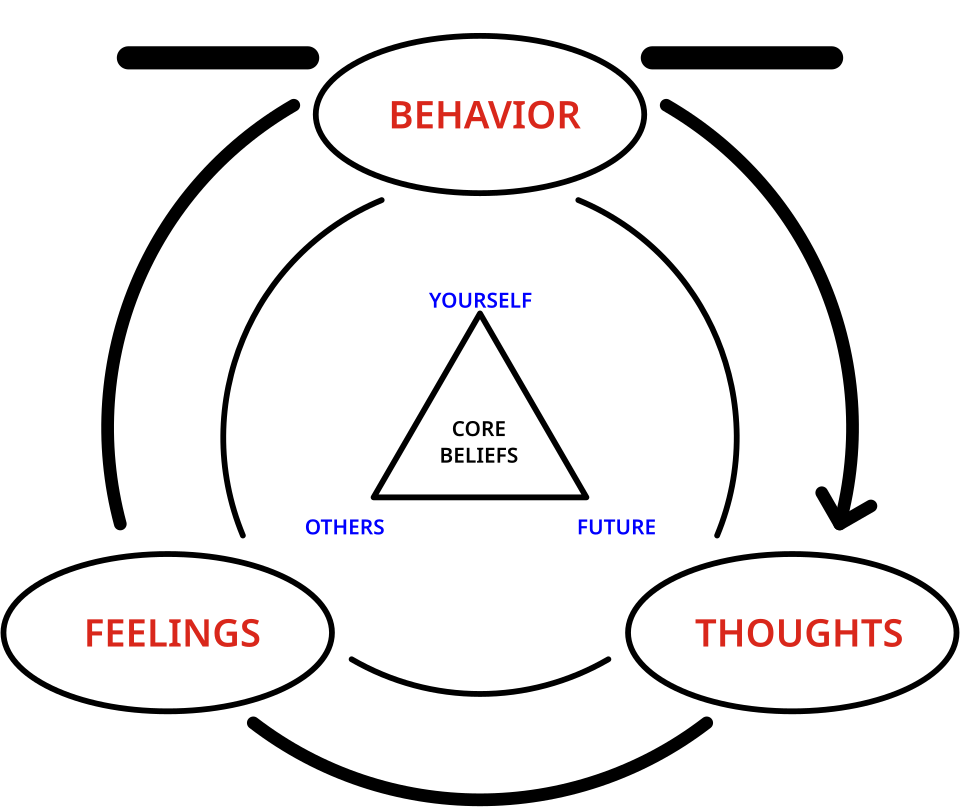 Core CBT techniques visualized. (Image: Urstadt, CC BY-SA 3.0, via Wikimedia Commons)
Based on the TU BSW syllabus for Abnormal Psychology, unit 15.
Discussion
Loading…