Psychology For Social WorkUnit 112 min read
Psychology’s Core Theories & Social Work’s Role
Unit 1 of Psychology For Social Work: Defines psychology’s scope, theories (biological, cognitive, psychodynamic), and its intersection with social work—covering mental health, emotions, and applied fields like clinical and developmental psychology.
TAKEAWAYS:
- Psychology is the scientific study of human behavior and mental processes, bridging biology, cognition, and environment.
- Three major theories (biological, cognitive, psychodynamic) explain behavior differently—biological focuses on brain/genes, cognitive on thought processes, and psychodynamic on unconscious drives.
- Social work applies psychology to address mental health, trauma, and societal challenges (e.g., poverty, discrimination).
- Positive psychology shifts focus from pathology to well-being, happiness, and resilience—critical for community empowerment.
- Key concepts like motivation, emotions, and perception are tools for assessing clients’ needs in social work practice.
- Branches of psychology (clinical, developmental, industrial-organizational) provide frameworks for interventions in social work.
1. Defining Psychology: Science of the Mind and Behavior
Psychology is the scientific study of human behavior, mental processes (thinking, emotions, perception), and interactions with the environment. It seeks to explain, predict, and influence behavior through research and applied practice.
Key Subfields Relevant to Social Work
mindmap
  root((Psychology in Social Work))
    branches["1. Clinical Psychology"]
      details["Diagnosis & treatment of mental disorders (e.g., depression, PTSD)"]
    branches["2. Developmental Psychology"]
      details["Life stages: infancy, adolescence, adulthood (e.g., child abuse, aging)"]
    branches["3. Social Psychology"]
      details["Group dynamics, prejudice, social influence (e.g., community conflicts)"]
    branches["4. Industrial-Organizational Psychology"]
      details["Workplace stress, employee well-being (e.g., NTC/Ncell employee burnout)"]
    branches["5. Health Psychology"]
      details["Behavior change (e.g., addiction, chronic illness management)"]
    branches["6. Positive Psychology"]
      details["Strengths-based approaches (e.g., happiness programs in schools)"]
How Psychology Differs from Other Sciences
| Field | Focus | Example in Social Work |
|---|---|---|
| Biology | Brain structures, hormones | Understanding trauma’s impact on the amygdala |
| Sociology | Social structures, cultures | Analyzing poverty’s effect on family dynamics |
| Psychology | Individual behavior, emotions | Assessing a client’s coping mechanisms |
2. Major Theoretical Orientations in Psychology
Three dominant theories shape psychological practice, each offering unique insights for social workers.
A. Biological Theory
Definition: Behavior is influenced by genetics, brain chemistry, and physiology. Key Concepts:
- Neurotransmitters (e.g., serotonin, dopamine) regulate mood.
- Heredity plays a role in personality traits (e.g., temperament).
- Brain structures (e.g., prefrontal cortex for decision-making) affect behavior.
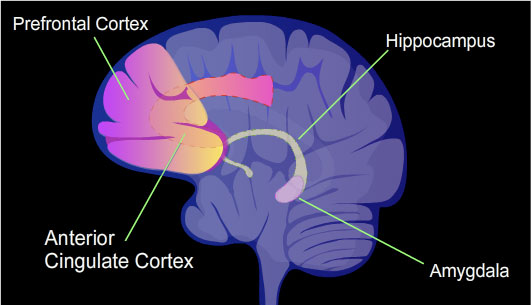 A cross-section of the human brain highlighting the amygdala, hippocampus, and prefrontal cortex. (Image: This work has been identified as being free of known restric, Public domain, via Wikimedia Commons)
Worked Example: A social worker notices a client with ADHD struggles to focus during sessions. Using biological theory, the worker might:
- Assess neurotransmitter imbalances (e.g., low dopamine).
- Recommend therapy + medication (e.g., Ritalin) to regulate focus.
- Collaborate with a psychiatrist for a holistic approach.
B. Cognitive Theory
Definition: Behavior is shaped by thoughts, perceptions, and interpretations of events. Key Concepts:
- Schemas: Mental frameworks that influence how we process information (e.g., "Money = happiness").
- Cognitive distortions: Irrational thought patterns (e.g., catastrophizing, overgeneralization).
- Behavioral change through reframing thoughts (e.g., CBT for anxiety).
Worked Example: A client believes, “I failed my exam because I’m stupid.” A cognitive social worker would:
- Challenge the thought: “Is there evidence you’re incapable? Or did you not study enough?”
- Reframe: “Everyone makes mistakes. Let’s plan for next time.”
- Use behavioral experiments: “What’s one small step to improve?”
C. Psychodynamic Theory
Definition: Behavior is driven by unconscious conflicts, early childhood experiences, and defense mechanisms. Key Concepts:
- Id, Ego, Superego: Freud’s model of personality (impulses vs. morality).
- Defense mechanisms: Unconscious strategies to cope (e.g., repression, projection).
- Transference: Clients projecting emotions onto the social worker.
Worked Example: A client avoids eye contact and frequently cancels sessions. A psychodynamic approach might explore:
- Unconscious fear of vulnerability (e.g., past trauma).
- Defense mechanism: Avoidance to protect self-esteem.
- Intervention: Gradual trust-building through consistent, non-judgmental interactions.
Comparison Table: Theories in Social Work
| Theory | Focus | Strengths | Limitations | Social Work Application |
|---|---|---|---|---|
| Biological | Brain, genes, hormones | Explains physiological causes | Ignores environment/social factors | Medication management, neurodiversity support |
| Cognitive | Thoughts, perceptions | Practical, actionable (CBT) | Overlooks unconscious motives | Trauma counseling, addiction recovery |
| Psychodynamic | Unconscious conflicts | Deepens self-awareness | Time-consuming, subjective | Long-term therapy for deep-seated issues |
3. Psychology’s Relationship with Social Work
Social work applies psychological principles to address human needs, promote well-being, and advocate for systemic change.
A. Core Overlaps
- Mental Health: Psychology diagnoses disorders (e.g., depression); social work provides community support.
- Behavior Change: Cognitive-behavioral techniques (e.g., goal-setting) are used in both fields.
- Trauma-Informed Care: Understanding PTSD helps social workers design safe interventions.
- Policy Advocacy: Psychological research informs laws (e.g., child labor bans).
B. How Social Workers Use Psychological Theories
flowchart TD
  A["Client Presents Issue"] --> B["Assess Using Theory"]
  B --> B1["Biological: Is it medical?"]
  B --> B2["Cognitive: What’s their mindset?"]
  B --> B3["Psychodynamic: Past experiences?"]
  B --> C["Develop Intervention"]
  C --> C1["Therapy (CBT, psychodynamic)"]
  C --> C2["Referrals (psychiatrist, support groups)"]
  C --> C3["Systemic Change (policy, education)"]
  C --> D["Evaluate & Adjust"]
Real-World Example: eSewa and Psychological Principles
- Cognitive Theory: eSewa’s user interface is designed for ease of perception (clear buttons, minimal steps) to reduce frustration (a cognitive load).
- Behavioral Psychology: The app uses reinforcement (success messages, discounts) to encourage repeat use.
- Social Work Application: A social worker helping a client with digital literacy might use eSewa as a tool for empowerment, teaching transaction skills to reduce isolation.
4. Positive Psychology: Beyond Pathology to Well-Being
Definition: The study of happiness, strengths, and flourishing—not just fixing problems. Key Concepts:
- Subjective Well-Being: Personal satisfaction and life evaluation.
- PERMA Model (Seligman): Positive emotion, Engagement, Relationships, Meaning, Accomplishment.
- Gratitude Interventions: Writing thank-you notes to boost happiness.
Worked Example: A community in Kathmandu lacks social cohesion. A positive psychology approach might:
- Assess strengths: Identify local leaders, skills, and resources.
- Intervention: Organize gratitude circles where residents share appreciation.
- Outcome: Reduced loneliness, increased trust, and collective problem-solving.
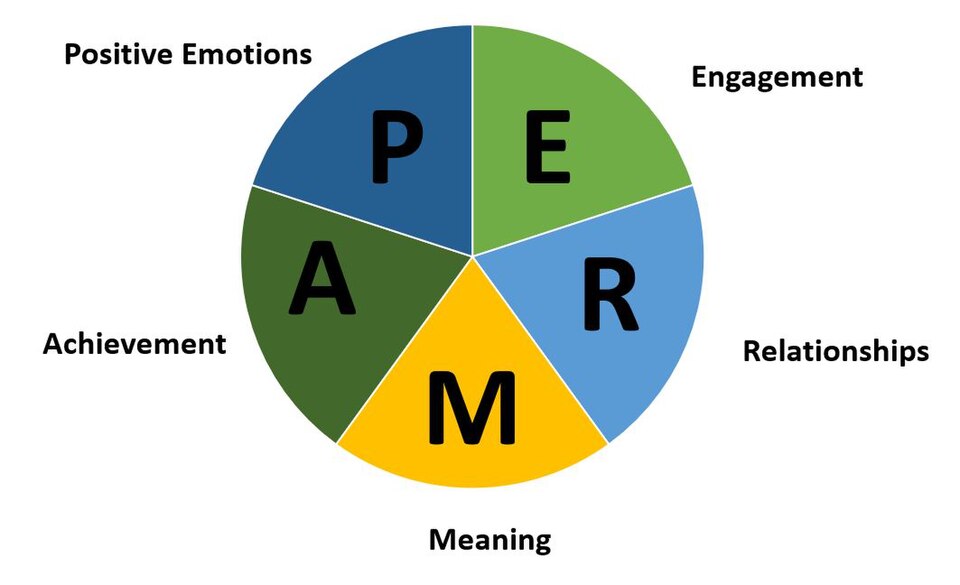 A labeled wheel showing the 5 elements of well-being. (Image: U3170318, CC BY-SA 4.0, via Wikimedia Commons)
5. Key Psychological Concepts for Social Workers
A. Motivation
Definition: The drive to act toward a goal. Theories:
- Maslow’s Hierarchy of Needs: Physiological → Safety → Love → Esteem → Self-Actualization.
- Intrinsic vs. Extrinsic Motivation: Internal satisfaction (e.g., helping others) vs. external rewards (e.g., money).
Worked Example: A client is unmotivated to attend job training. A social worker might:
- Assess needs: Are they hungry? Unsafe? (Maslow’s lower levels).
- Reframe goals: “This training will help you provide for your kids” (extrinsic) + “You’ll feel proud of your progress” (intrinsic).
B. Emotions
Definition: Subjective experiences (e.g., joy, anger) that influence behavior. Functions:
- Adaptive: Fear protects us; joy bonds us.
- Social Signals: Emotions communicate needs (e.g., crying signals distress).
Worked Example: A child in a shelter acts aggressively. A social worker might:
- Observe triggers: Is it hunger? Loneliness? (Biological + Social Psychology).
- Teach emotional regulation: Deep breathing (biological) + naming feelings (cognitive).
C. Sensation and Perception
Definition:
- Sensation: Raw input from senses (e.g., seeing a red light).
- Perception: Interpretation of sensation (e.g., “That light means stop”).
Social Work Application:
- Trauma survivors may misperceive safety (e.g., hearing footsteps = threat).
- Intervention: Grounding techniques (e.g., “Name 5 things you see”) to correct distorted perceptions.
6. Branches of Psychology Applied in Social Work
classDiagram
  class Psychology {
    +Clinical
    +Developmental
    +Social
    +Health
    +Positive
  }
  class SocialWork {
    +Mental Health
    +Child Welfare
    +Community Development
    +Policy Advocacy
  }
  Psychology --> SocialWork : "Applies to"
  Clinical "1. Diagnoses disorders" --> SocialWork "1. Provides therapy"
  Developmental "2. Studies life stages" --> SocialWork "2. Supports families"
  Social "3. Explores group dynamics" --> SocialWork "3. Mediates conflicts"
  Health "4. Promotes well-being" --> SocialWork "4. Runs health campaigns"
  Positive "5. Focuses on strengths" --> SocialWork "5. Builds resilience"
Real-World Example: NTC and Workplace Psychology
- Industrial-Organizational Psychology helps NTC address:
- Burnout: Long hours → stress management workshops.
- Job Satisfaction: Clear roles → reduced turnover.
- Social Work Role: Advocate for mental health days and employee assistance programs.
7. Exam Tip: How to Score Full Marks
- Define Clearly: Always start with precise definitions (e.g., “Psychology is the scientific study of…”).
- Use Examples: Link theories to real-world scenarios (e.g., eSewa, Ncell, Kathmandu traffic).
- Compare Theories: Tables or flowcharts help organize biological vs. cognitive vs. psychodynamic approaches.
- Apply to Social Work: Show how psychology solves problems (e.g., CBT for addiction, psychodynamic for trauma).
- Positive Psychology: Mention PERMA or gratitude interventions—examiners love practical applications.
- Visuals: Draw mindmaps, flowcharts, or labeled diagrams (e.g., brain regions, Maslow’s hierarchy) to stand out.
Common Pitfalls to Avoid:
- Vague answers (e.g., “Psychology helps people” → How?).
- Ignoring social work’s systemic perspective (e.g., poverty’s role in mental health).
- Overlooking cultural context (e.g., stigma around therapy in Nepal).
Final Note: Psychology is the toolkit for social work. Master the theories, see their applications in daily life (eSewa, Daraz, community centers), and connect them to client well-being. Visuals and examples will elevate your answers from good to exam-topping.
Based on the TU BSW syllabus for Psychology For Social Work, unit 1.
Discussion
Loading…