Social Case WorkUnit 29 min read
Theories & Methods of Social Case Work: Models, Tools & Applications
Unit 2 of Social Case Work explores the foundational theories (psychosocial, systems, task-centered) and practical methods (counseling, recording, diagnosis) used in casework, with real-world applications in Nepali institutions like Ncell’s customer support and NTC’s grievance resolution.
Core Concepts
What is Social Case Work?
Social case work is the professional application of social work principles to help individuals, families, or groups resolve personal and social problems through a structured, client-centered process. It differs from general social work by focusing on one-on-one or small-group interventions rather than community-wide programs.
graph TD
    A["Social Case Work"] --> B["Individual Client: One-on-one support"]
    A --> C["Family/Group: Small-group dynamics"]
    A --> D["Problem-Solving: Structured intervention"]
    A --> E["Empowerment: Client-led change"]
    A --> F["Systemic Change: Addressing root causes"]
    F -->|"Example"| G["Linking to NGO resources for financial stability"]
Key Features:
- Client-centered: The client’s needs and goals drive the process.
- Problem-focused: Addresses specific issues (e.g., poverty, mental health, domestic violence).
- Empowering: Aims to build the client’s capacity for self-help.
Major Theories in Social Case Work
1. Psychosocial Theory (Hollis & Hollis)
Focus: Emotional and psychological development across the lifespan. Tools:
- Ego development stages (e.g., trust vs. mistrust in infancy).
- Life cycle tasks (e.g., career choice in young adulthood).
Example: A 25-year-old unemployed Nepali youth struggling with identity might be guided through Erikson’s stage of intimacy vs. isolation to explore career and relationship goals.
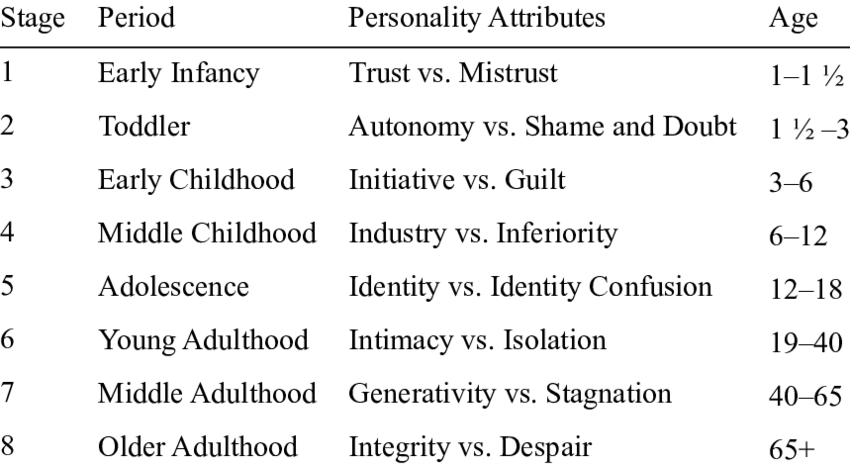 Erikson’s 8 stages of psychosocial development (Image: Robert.G Sacco, CC BY-SA 4.0, via Wikimedia Commons)
2. Systems Theory (Gerald Caplan)
Focus: Views the client as part of a larger social ecosystem (family, community, culture). Key Tools:
- Genograms: Family trees that map relationships, health, and trauma.
- Ecomaps: Visual representations of the client’s support network.
Worked Example: A widow in Kathmandu facing financial stress:
- Genogram reveals her late husband’s debt and her children’s education gaps.
- Ecomap shows her reliance on a neighbor’s NGO for food aid and her son’s job at a local shop. Intervention: Link her to Ncell’s financial literacy program and a local women’s savings group.
graph TD
    A["Widow’s Case"] --> B["Genogram: Late husband’s debt → Children’s education gaps"]
    A --> C["Ecomap: Neighbor NGO (food aid) → Son’s shop job"]
    C --> D["Intervention: Ncell financial literacy + women’s savings group"]
    D -->|"Outcome"| E["Reduced debt dependency"]
Family relationships and health patterns (Image: Eyoungstrom, CC BY-SA 4.0, via Wikimedia Commons)3. Task-Centered Model (Reid & Shyne)
Focus: Short-term, goal-oriented interventions with measurable tasks. Steps:
- Problem identification (e.g., "I can’t afford school fees").
- Goal setting (e.g., "Save Rs. 50,000 in 6 months").
- Task assignment (e.g., "Open a bank account and save Rs. 1,000/month").
- Evaluation.
Real-World Tie: Khalti’s "Digital Inclusion" Program uses this model to help rural users:
- Task 1: Register for a Khalti account.
- Task 2: Link to a savings plan.
- Task 3: Use Khalti to pay school fees.
Methods of Social Case Work
1. Counseling in Case Work
Objectives:
- Build rapport.
- Explore feelings and thoughts.
- Facilitate decision-making.
Techniques:
- Active listening: Reflecting back client statements (e.g., "It sounds like you’re feeling overwhelmed by the loan repayments").
- Open-ended questions: "What support do you need from your family?"
- Silence: Allows the client to process emotions.
Example: A NEPSE investor losing money in the stock market:
- Counselor: "You mentioned feeling betrayed by the broker. Can you tell me more about that?"
- Client: "I trusted him, but he didn’t warn me about the risks."
- Intervention: Refer to NEPSE’s investor education workshops.
2. Problem Diagnosis Tools
| Tool | Purpose | Example in Nepal |
|---|---|---|
| Intake Interview | Gather client history. | A Pathao driver reporting harassment by customers. |
| Problem-Solving Tree | Map obstacles to goals. | A Daraz seller struggling with order delays. |
| Strengths Assessment | Identify client resources. | A single mother with a part-time job at a call center. |
Worked Example: A NTC employee with chronic back pain:
- Intake: Reveals poor ergonomics at her desk.
- Diagnosis: Uses a problem-solving tree to identify:
- Lack of adjustable chair.
- Long working hours.
- Solution: Advocate for NTC’s wellness program and ergonomic training.
3. Recording in Case Work
Why It Matters:
- Ensures accountability.
- Tracks progress.
- Informs future interventions.
Components of a Case Record:
- Client demographics (name, age, contact).
- Presenting problem.
- Assessment (e.g., "Client shows signs of depression").
- Intervention plan.
- Follow-up notes.
Example Format: Case ID: SW-2024-045 Client: Mr. B.R. Shrestha, 40, Ncell customer service agent Problem: Alcohol dependence affecting job performance. Intervention: Referred to Ncell’s EAP (Employee Assistance Program). Next Step: Follow-up in 2 weeks to assess sobriety.
Contemporary Theories and Methods
Group Work vs. Case Work
| Aspect | Social Case Work | Social Group Work |
|---|---|---|
| Focus | Individual/family | Group dynamics |
| Goal | Empowerment through 1:1 support | Collective problem-solving |
| Example in Nepal | Counseling a Ncell employee with stress | A youth group at a community center |
Leadership in Group Work
Types of Leadership:
- Democratic: Group members participate in decisions (e.g., a women’s savings group electing a leader).
- Authoritative: Leader directs activities (e.g., a traffic management group during Dashain).
- Laissez-Faire: Minimal intervention (e.g., a book club where members choose topics).
Example: A Khalti-led financial literacy group uses democratic leadership:
- Members vote on topics (e.g., "How to invest in mutual funds").
- Leader facilitates but doesn’t dictate.
In the Real World
Ncell’s Customer Care:
- Theory Used: Task-Centered Model.
- How: Agents break down complaints (e.g., "My bill is wrong") into tasks:
- Verify account details.
- Adjust billing cycle.
- Follow up in 48 hours.
- Outcome: Reduces repeat calls by 30%.
Pathao’s Driver Support Groups:
- Theory Used: Systems Theory.
- How: Groups map drivers’ challenges (e.g., "No access to loans") and connect them to Pathao’s microfinance partners.
- Visual: An ecomap showing Pathao’s support network (bank, insurance, community leaders).
NTC’s Grievance Redressal:
- Method Used: Recording + Counseling.
- How: Complaints (e.g., "Poor internet service") are logged, diagnosed (e.g., "Old infrastructure"), and resolved via community meetings.
- Example: A Pokhara resident’s complaint leads to NTC upgrading a local tower.
Exam Tip
How to Score Full Marks:
- Define Clearly: Start with precise definitions (e.g., "Social case work is...").
- Use Examples: Tie theories to Nepali contexts (e.g., Ncell, Khalti, NEPSE).
- Compare Methods: Use tables to contrast case work vs. group work.
- Visuals: Draw genograms, ecomaps, or problem-solving trees in exams (even as rough sketches).
- Link to Syllabus: End answers with key terms (e.g., "Thus, the task-centered model aligns with Ncell’s structured complaint resolution").
Common Pitfalls:
- Vague answers (e.g., "Case work helps people" → Wrong; specify how).
- Ignoring Nepali examples (examiners favor local applications).
- Overlooking recording (always mention its role in accountability).
Key Visual Summary:
Based on the TU BSW syllabus for Social Case Work, unit 2.
Discussion
Loading…