Psycho Social CounsellingUnit 413 min read
Counselling Skills & Techniques: Methods, Models & Applications
Unit 4 of Psycho Social Counselling explores core counselling skills (active listening, empathy, reflection) and techniques (cognitive restructuring, role-play, narrative reframing) across theoretical approaches (client-centered, CBT, Gestalt). It covers specialized applications (substance dependence, grief, couples) a
TAKEAWAYS:
- Counselling skills (e.g., active listening, empathy) are the foundation of therapeutic relationships, while techniques (e.g., cognitive restructuring, paradoxical intention) target specific problems.
- Theoretical approaches (client-centered, CBT, Gestalt) dictate how skills/techniques are applied—e.g., CBT uses homework assignments, Gestalt employs empty-chair dialogues.
- Assessment (e.g., DSM-5 criteria, genograms) informs case formulation and treatment planning, directly impacting effectiveness.
- Specialized counselling (family, group, crisis) requires adapted skills—e.g., reframing in narrative therapy vs. behavioral contracts in substance dependence.
- Ethics (confidentiality, cultural competence) and emerging issues (digital counselling, trauma-informed care) shape modern practice in Nepal.
- Real-world tie-ins: eSewa’s chatbot counselling (CBT techniques), NTC’s stress management workshops (mindfulness), and Pathao’s driver support groups (group counselling for PTSD).
Core Counselling Skills: The Building Blocks
Counselling skills are non-judgmental, intentional interactions that create safety and clarity. Mastery of these skills distinguishes effective counsellors from passive listeners. Below are the three pillars of counselling competence, visualized in their interactive cycle:
flowchart TD
    A["Empathy: 'I hear your pain'"] --> B["Active Listening: 'Tell me more'"]
    B --> C["Reflection: 'So you feel...'"]
    C --> D["Open Questions: 'What happened next?'"]
    D --> A
1. Empathy: The Heart of Connection
Definition: Empathy is the ability to understand and communicate the client’s emotional experience from their perspective, not yours. It includes:
- Cognitive empathy: Grasping the client’s thoughts/logic.
- Emotional empathy: Feeling with the client (not for them).
- Compassionate empathy: Combining understanding with a desire to help.
How it works:
- Verbal cues: "It sounds like you’re feeling overwhelmed by..."
- Nonverbal cues: Nodding, leaning forward, mirroring body language.
- Avoid: False empathy ("I know how you feel") or over-identifying ("That’s exactly what happened to me!").
Worked Example: A student (Rohan) confides in you about failing exams due to anxiety. Instead of saying: ❌ "Don’t worry, it’s not the end of the world." ✅ "It must feel devastating to put in so much effort and still fall short. The fear of letting your family down is weighing on you, isn’t it?" Why it works: You validate Rohan’s emotional + contextual struggle (family pressure), not just the academic failure.
2. Active Listening: The Art of Attentiveness
Definition: A focused, non-evaluative listening style that encourages clients to explore their thoughts. Key techniques:
- Minimal encouragers: "Mhm," "Go on," silence.
- Paraphrasing: "So you’re saying your boss’s criticism triggered old feelings of inadequacy?"
- Summarizing: "Let me check if I’ve got this: you feel stuck because you can’t afford therapy and your job is stressful."
Common Pitfalls:
- Premature advice-giving: "You should just move to a new city."
- Distractions: Checking your phone, planning your next question.
- False reassurance: "Everything will be fine."
Real-World Link: eSewa’s Chatbot Counsellor uses active listening scripts to guide users through stress (e.g., after failed transactions). Example: User: "I can’t stop thinking about the money I lost." Bot: "That sounds incredibly frustrating. How long has this been bothering you?" → Paraphrased + open-ended.
3. Reflection: The Mirror of Understanding
Definition: Restating the client’s words/emotions to clarify and deepen their message. Types:
- Content reflection: "You mentioned your parents disapproved of your career choice."
- Feeling reflection: "You felt betrayed when your friend didn’t support you."
- Meaning reflection: "So this experience made you question whether you can trust people?"
Why it’s powerful:
- Shows the client you’re truly listening.
- Helps them organize chaotic thoughts.
- Reveals unspoken emotions (e.g., anger beneath sadness).
Worked Example: Client: "I just don’t know what to do. My marriage is falling apart." Counsellor: "It sounds like you’re at a crossroads, torn between fixing things and walking away. The uncertainty is paralyzing you." → Combines content + feeling + meaning.
Counselling Techniques: Tools for Change
Techniques are specific interventions tied to theoretical approaches. Below is a comparison table of key techniques across models:
| Approach | Key Technique | How It Works | Example in Nepal |
|---|---|---|---|
| Client-Centered | Unconditional Positive Regard | Creates a safe space for self-exploration without judgment. | A grieving widow shares her guilt over her husband’s death; the counsellor reflects without judging her feelings. |
| CBT | Cognitive Restructuring | Identifies and challenges irrational thoughts (e.g., "I’m a failure"). | A Daraz delivery person with PTSD reframes "I can’t handle traffic" → "I’ll take breaks and use deep breathing." |
| Gestalt | Empty-Chair Dialogue | Clients "converse" with absent figures (e.g., a parent) to resolve unfinished business. | A student confronts their imaginary "critical parent" to express repressed anger. |
| Narrative | Externalizing the Problem | Separates the client from their issue (e.g., "Anxiety" vs. "You are anxious"). | A Ncell employee says, "My anxiety is like a shadow that follows me to work." |
| Behavioral | Behavioral Contracts | Agreements to replace harmful behaviors (e.g., substance use) with rewards. | A heroin user in Pokhara agrees: "If I attend 3 NGO meetings/week, I get a stipend." |
Specialized Applications: Tailoring Skills to Needs
1. Substance Dependence Counselling (Behavioral Approach)
Key Skills/Techniques:
- Motivational Interviewing (MI): Enhances client’s readiness to change.
- Relapse Prevention: Identifies triggers (e.g., stress, social circles).
- Behavioral Contracts: Rewards sobriety milestones.
Worked Example: Client: "I keep promising myself I’ll quit, but I always relapse." Counsellor (MI):
- Open-ended question: "What’s been the hardest part about quitting?"
- Reflection: "It sounds like the cravings hit you when you’re with old friends."
- Behavioral contract: "Let’s track your progress: 30 days clean = a bus pass to your support group."
Real-World Link: Nepal’s "De-addiction Centers" (e.g., Shree Birendra Hospital) use behavioral contracts and MI to treat opioid addiction. Example: A patient earns phone credit for attending group therapy.
2. Grief Counselling (Existential Approach)
Key Skills/Techniques:
- Normalizing grief: "There’s no ‘right’ way to grieve."
- Meaning-making: "How has this loss changed your view of life?"
- Rituals: Creating memorials or letters to the deceased.
Worked Example: Client: "I don’t know how to go on without my child." Counsellor (Existential):
- Validation: "Your pain is unbearable. No one should have to lose a child."
- Meaning-making: "What’s one thing your child taught you about love?"
- Ritual suggestion: "Would it help to write a letter to them, or visit their favorite place?"
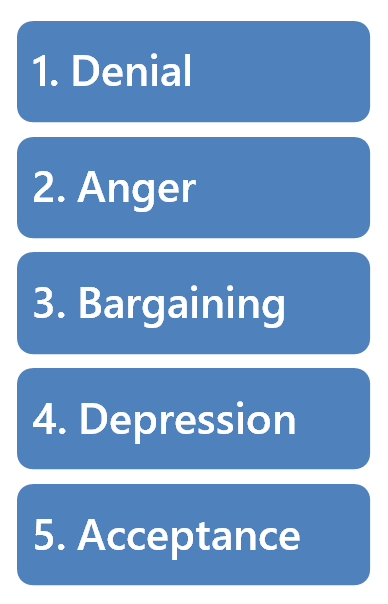 Kubler-Ross model (denial, anger, bargaining, depression, acceptance) with Nepal-specific examples (e.g., anger at NTC for traffic accidents). (Image: Kurtis Pallathana, CC0, via Wikimedia Commons)
3. Couples Counselling (Narrative Approach)
Key Skills/Techniques:
- Reframing: "Your arguments might be attempts to connect, not fight."
- Externalizing the Problem: "The conflict isn’t you two—it’s the ‘distance’ between you."
- Genograms: Family trees to identify patterns (e.g., generational trauma).
Worked Example: Couple: "We never communicate anymore." Counsellor (Narrative):
- Externalize: "It’s like an invisible wall has grown between you."
- Reframe: "Maybe your silence is a way to protect each other from hurt."
- Homework: "Try writing down one positive thing about your partner daily."
Assessment and Case Formulation: The Roadmap to Success
Why it matters: Assessment ensures counselling is targeted, measurable, and ethical. Steps:
- Initial Assessment: Gather data (interviews, scales like PHQ-9 for depression).
- Case Formulation: Link symptoms to causes (e.g., anxiety → childhood neglect).
- Goal Setting: SMART goals (Specific, Measurable, Achievable, Relevant, Time-bound).
- Treatment Planning: Choose techniques (e.g., CBT for OCD).
Example Assessment Tool:
classDiagram
    class Assessment {
        +Interview
        +Psychometric Tests (e.g., MMPI)
        +Collateral Info (Family, Medical)
    }
    class Formulation {
        +Hypothesis: "Client’s anger stems from unmet childhood needs."
        +Risk Factors: "Low social support"
    }
    class Goals {
        +Short-term: "Reduce panic attacks by 50% in 4 weeks"
        +Long-term: "Improve self-esteem"
    }
    Assessment --> Formulation
    Formulation --> Goals
Real-World Link: NTC’s Employee Counselling Program uses assessment scales to identify stress among traffic police. Example:
- Goal: Reduce burnout by 30% in 6 months.
- Technique: Mindfulness training (CBT-inspired).
Ethics and Challenges in Counselling
Core Ethical Principles (Nepal Council for Psychology):
- Confidentiality: Except in cases of harm to self/others (e.g., child abuse).
- Cultural Competence: Avoid imposing Western models (e.g., individualism vs. collectivism in Nepal).
- Informed Consent: Clients must understand risks/benefits.
- Dual Relationships: Avoid friendships with clients.
Challenges in Nepal:
- Stigma: Clients fear being labeled "mad."
- Resource Limits: Few trained counsellors in rural areas.
- Digital Divide: eCounselling (e.g., Sano Sansar) excludes those without smartphones.
In the Real World
eSewa’s Mental Health Chatbot
- Idea Used: CBT techniques (e.g., thought challenging).
- How: After a failed transaction, users are prompted: "You’re upset because you lost money. What’s one smaller step you can take to feel better?" → Behavioral activation.
Pathao’s Driver Support Groups
- Idea Used: Group counselling for PTSD (from accidents/violence).
- How: Drivers share experiences in peer-led sessions, using normalization ("Others feel the same fear") and stress-management techniques.
Nepal’s "Mental Health Hotline" (1166)
- Idea Used: Psychosocial first aid (immediate crisis intervention).
- How: Trained volunteers use active listening and safety planning (e.g., "Do you have a support person nearby?").
Exam Tip
How to Score Full Marks
Define + Distinguish: For questions like "Differentiate between family and group counselling," use a table with columns:
Family Counselling Group Counselling Focus: Systemic dynamics (e.g., roles, boundaries) Focus: Peer interaction (e.g., shared experiences) Technique: Genograms Technique: Role-play Use Real Examples: Tie theories to Nepal. Example for CBT: "A Kathmandu traffic policeman with OCD washes his hands 50 times/day. The counsellor uses exposure therapy: ‘Let’s start with 10 washes, then gradually reduce.’"
Structure Counselling Plans: For "Develop a plan for grief counselling," follow this template:
- Phase 1: Assessment (e.g., Grief Inventory).
- Phase 2: Techniques (e.g., letter-writing ritual).
- Phase 3: Evaluation (e.g., "Client reports 20% reduction in intrusive thoughts").
Visuals = Extra Marks: Always draw a diagram for processes (e.g., active listening cycle, CBT triangle). Example:
flowchart TD
    A["Situation"] --> B["Thoughts: 'I’ll fail'"]
    B --> C["Emotions: Anxiety"]
    C --> D["Behaviors: Avoid studying"]
    D --> A
Ethics Questions: Use the 5-step ethical decision-making model:
- Identify the dilemma (e.g., client wants to harm themselves).
- Gather info (e.g., severity of risk).
- Consult guidelines (e.g., Nepal Council for Psychology).
- Brainstorm options (e.g., hospitalize vs. voluntary safety plan).
- Justify choice (e.g., "Voluntary plan respects autonomy while ensuring safety.").
Common Pitfalls to Avoid
- Over-theorizing: Don’t just list CBT steps—explain how they apply to a Nepali context (e.g., Khalti scams causing anxiety).
- Ignoring Culture: Avoid Western examples unless you adapt them. Example: ❌ "Like in the U.S., use journaling for self-reflection." ✅ "In Nepal, where writing is less common, try oral storytelling with a trusted elder."
- Skipping Assessment: Always start with "First, the counsellor would conduct a..." before jumping to techniques.
Based on the TU BSW syllabus for Psycho Social Counselling, unit 4.
Discussion
Loading…