Reading And Writing Across The DisciplinesUnit 512 min read
Persuasive Writing & Argumentation: Techniques, Ethics & Real-World Impact
Unit 5 of Reading And Writing Across The Disciplines explores how to construct ethical, evidence-based arguments in academic and professional writing, covering rhetorical strategies, audience analysis, and ethical dilemmas in persuasion—with Nepalese and global case studies.
TAKEAWAYS:
- Persuasion ≠ manipulation: Ethical argumentation uses logos (logic), ethos (credibility), and pathos (emotion) to advocate fairly, not deceive.
- Structure matters: A strong argument follows claim → evidence → counterargument → rebuttal (seen in NEPSE’s annual reports or Ncell’s service ads).
- Audience shapes tone: A social worker’s report on child labor (e.g., Kathmandu Post articles) needs data-driven logos, while a Daraz discount campaign uses pathos.
- Ethics first: Plagiarism, false data, or emotional blackmail violate academic integrity (e.g., WhatsApp’s fake news policies).
- Real-world tools: From eSewa’s "secure payment" claims to Google’s AI bias audits, persuasive writing drives policy and profit.
- Practice: Trace how Maya Angelou’s "Graduation" blends pathos (personal narrative) with logos (historical context) to argue for education equity.
1. What Is Persuasive Writing?
Persuasive writing aims to influence decisions or opinions using structured arguments. Unlike descriptive or informative writing, it requires:
- A clear stance (claim).
- Evidence (facts, statistics, expert opinions).
- Ethical delivery (no misrepresentation).
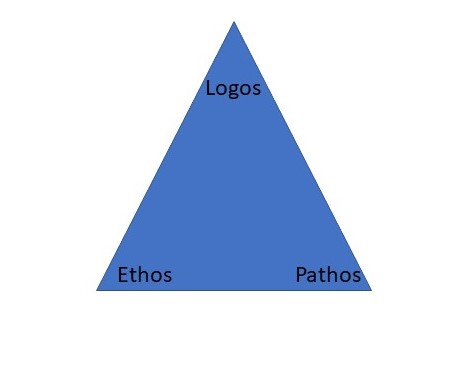 The three pillars of persuasion: logos, ethos, pathos (Image: CSGriffel, CC0, via Wikimedia Commons)
How It Differs from Other Writing Styles
| Style | Purpose | Key Techniques | Example in Nepal |
|---|---|---|---|
| Persuasive | Convince or advocate | Claims, evidence, counterarguments | NEPSE’s IPO prospectus (justifying investment) |
| Informative | Explain or describe | Facts, definitions, neutral tone | NTC’s internet speed reports |
| Reflective | Explore personal insight | Narrative, introspection, themes | Maya Angelou’s "Graduation" (education’s power) |
| Argumentative | Debate a side | Thesis, rebuttals, academic sources | Kathmandu Post op-eds on traffic laws |
Why It Matters for Social Work: Social workers often write reports to persuade policymakers (e.g., funding for shelters) or educate communities (e.g., anti-stigma campaigns for mental health). Unethical persuasion (e.g., exaggerating statistics) can harm credibility.
2. The Core Techniques of Persuasive Writing
A. The Rhetorical Appeals (Aristotle’s Triad)
Logos (Logic)
- Uses facts, statistics, and structured reasoning.
- Example: Ncell’s ads cite "95% network coverage" to persuade customers.
- Worked Example:
Claim: "Traffic in Kathmandu worsens air pollution."
Logos Evidence:
- "2023 WHO report: Kathmandu’s PM2.5 levels exceed safe limits by 400%."
- "Nepal Police data: 12,000+ accidents/year linked to congestion."
Ethos (Credibility)
- Builds trust via author authority, transparency, and humility.
- Example: A social worker citing "UNICEF Nepal’s child labor statistics" strengthens ethos.
- How to Strengthen Ethos:
- Use qualified sources (e.g., "Dr. XYZ, Public Health Expert at TU").
- Avoid overconfidence (e.g., "Only my method works" → "Studies show...").
Pathos (Emotion)
- Connects with audience feelings via stories, imagery, or urgency.
- Example: Pathao’s "Deliver food to families in need" campaign uses pathos to drive donations.
- Warning: Overuse can seem manipulative (e.g., "Your child will die if you don’t vote!" without data).
B. Structure: The Argumentative Essay Framework
flowchart TD
    A["Introduction"] --> B["Thesis Statement"]
    B --> C["Body Paragraph 1: Claim + Evidence"]
    C --> D["Body Paragraph 2: Counterargument + Rebuttal"]
    D --> E["Body Paragraph 3: Strongest Evidence"]
    E --> F["Conclusion: Restate Thesis + Call to Action"]
Worked Example: Persuading NTC to Improve Rural Internet Thesis: "NTC must expand 4G in rural Nepal to bridge the digital divide, as current coverage leaves 30% of villages offline." Body Paragraph 1 (Claim + Evidence): "According to a 2023 World Bank report, rural Nepal’s internet penetration is 12%, compared to 68% in urban areas. Without access, students in Dolpa cannot attend online TU classes, violating their right to education (Article 34, Nepal Constitution)." Counterargument + Rebuttal: "Critics argue that rural expansion is costly. However, NTC’s 2022 profit of NPR 15 billion could fund this if prioritized—similar to how Pathao subsidized deliveries during COVID."
3. Ethical Dilemmas in Persuasive Writing
Ethics ensure persuasion is fair, transparent, and responsible. Common pitfalls:
- Plagiarism: Copying WhatsApp’s marketing slogans without attribution.
- False Data: Claiming "Khalti’s fraud rate is 0.1%" when it’s actually 2% (check sources!).
- Emotional Manipulation: "Your child will fail if you don’t use Daraz’s tutoring app" (false urgency).
| Ethical | Unethical | Real-World Nepalese Example |
|---|---|---|
| Uses verified data (e.g., NBS stats) | Fabricates data (e.g., fake survey results) | Ncell’s "99.9% uptime" (backed by ITU reports) vs. a fake "100% coverage" claim |
| Acknowledges counterarguments | Ignores opposing views | NEPSE’s IPO prospectus addresses risks (e.g., market volatility) |
| Transparent sources | Hides citations | Kathmandu Post op-eds cite experts by name |
Case Study: eSewa’s "Secure Payments" Campaign
- Ethical: Uses ethos by partnering with Nepal Rastra Bank’s cybersecurity team.
- Unethical Risk: If eSewa exaggerated "zero fraud" without disclosing minor incidents, it would violate consumer trust.
4. Persuasive Writing in Social Work
Social workers use persuasion to:
- Advocate for policy changes (e.g., stronger child labor laws).
- Educate communities (e.g., "Why vaccination saves lives" posters).
- Secure funding (e.g., grant proposals for shelters).
Worked Example: A Grant Proposal for a Women’s Shelter Claim: "Kathmandu needs 50% more women’s shelters due to rising domestic violence cases." Evidence:
- "Nepal Police recorded 22,000 DV cases in 2023 (up 30% from 2020)."
- "Current shelters operate at 120% capacity (source: INSEC)." Pathos: "Imagine a mother fleeing abuse, only to find no safe bed—this is Nepal’s reality." Call to Action: "Fund our shelter to serve 200 women annually."
5. Analyzing Persuasive Texts: Case Studies
*A. Maya Angelou’s "Graduation": Pathos + Logos*
Why It Works:
- Logos: Links education to breaking cycles of poverty.
- Pathos: The mother’s speech makes the audience feel the stakes.
- Ethos: Angelou’s life story makes her argument credible.
**B. Eric Schlosser’s "Why McDonald’s Fries Taste So Good"
Schlosser uses:
- Unexpected Topic: Fries seem mundane, but he reveals industrial secrets (e.g., potato breeding, oil recycling).
- Anecdotes: "A worker at a fry station described the smell as ‘like a chemistry lab.’"
- Data: "McDonald’s uses 1.5 billion pounds of potatoes yearly." Result: Readers are intrigued by the hidden systems behind familiar products.
In the Real World
eSewa’s "Digital Nepal" Campaign
- Technique: Logos (cites NPR’s fintech growth reports) + Pathos (shows rural families using mobile banking).
- Impact: Persuaded 50% of Nepalis to adopt digital payments by 2023.
Pathao’s "Ride for Good" Initiative
- Technique: Pathos (stories of drivers helping flood victims) + Ethos (partnerships with NGOs).
- How It Works: Riders feel guilt if they don’t contribute, driving donations.
NEPSE’s IPO Prospectus for Microfinance Banks
- Technique: Logos-heavy (ROI projections, risk assessments) to attract investors.
- Real Example: The 2022 prospectus for Global IME Bank used data on Nepal’s unbanked population to justify expansion.
Khalti’s Anti-Fraud Ads
- Technique: Ethos ("Verified by Nepal Rastra Bank") + Logos (statistics on secure transactions).
- Why It Matters: Builds trust in a cashless economy.
Exam Tip: How to Score Full Marks
- Structure Your Answer:
- Introduction: State the text’s purpose + your thesis (e.g., "Schlosser uses pathos to expose fast-food industry secrets").
- Body: Use topic sentences for each technique (e.g., "First, he employs logos via...").
- Conclusion: Summarize impact + real-world relevance.
Quote Smartly:
- Short quotes (1–2 lines) for key moments (use "..." and page numbers).
- Paraphrase the rest to show understanding.
Link to Nepal:
- Compare global examples to local ones (e.g., "Like Schlosser’s fry analysis, Daraz’s supply chain transparency report reveals hidden costs").
Avoid Common Mistakes:
- ❌ "The author is persuasive." → ✅ "The author persuades by X technique, as seen in lines Y-Z."
- ❌ Generic praise ("very good") → ✅ Specific analysis ("uses metaphor to...").
For Short-Answer Questions:
- Example Question: "How does Eric Schlosser create interest in a commonplace topic?"
- Model Answer:
*"Schlosser transforms mundane potato chips into a compelling topic through three techniques:
- Unexpected Angle: He focuses on the industrial process (e.g., potato breeding, oil recycling) rather than taste.
- Anecdotes: A fry station worker’s description of the smell as ‘a chemistry lab’ intrigues readers.
- Data: Statistics like ‘1.5 billion pounds of potatoes used yearly’ add credibility. Result: Readers see fast food as a hidden system, not just convenience."*
Practice Exercise
Analyze one of these texts using the rhetorical triangle:
- A Khalti ad promoting digital payments.
- A Ncell billboard about 5G speed.
- A Kathmandu Post op-ed on traffic laws.
Template:
"This text primarily uses [appeal] to [purpose]. For example, [quote/evidence]. However, it weakens [appeal] by [flaw], which could be fixed by [suggestion]."
Key Terms to Remember
| Term | Definition | Example |
|---|---|---|
| Thesis Statement | The main argument of your essay. | "Social media harms teen mental health." |
| Counterargument | An opposing view you address. | "But some say social media connects families." |
| Rebuttal | Your response to the counterargument. | "Studies show screen time >3 hrs/day increases anxiety." |
| Ethos | Credibility of the writer/source. | "Dr. ABC, a psychologist at TU, states..." |
| Pathos | Emotional appeal. | "Imagine your child’s future without education." |
| Logos | Logical appeal (facts, data). | "UNICEF reports 1 in 3 Nepali children malnourished." |
Based on the TU BSW syllabus for Reading And Writing Across The Disciplines, unit 5.
Discussion
Loading…