Reading And Writing Across The DisciplinesUnit 818 min read
Philosophical & Ethical Writing: Frameworks, Dilemmas & Social Work
Unit 8 of Reading And Writing Across The Disciplines explores how philosophical traditions (utilitarianism, deontology, virtue ethics) and ethical frameworks (human rights, justice, care ethics) shape academic writing, with case studies from social work, activism, and policy. Learn to analyze bias, apply ethical lenses
TAKEAWAYS:
- Philosophical frameworks (utilitarianism, deontology, virtue ethics) act as "lenses" to critique texts, and each prioritizes different values (outcomes vs. rules vs. character).
- Ethical dilemmas in writing arise when balancing truth, audience needs, and professional responsibility (e.g., anonymizing case studies in social work reports).
- Bias in texts can be structural (omissions), linguistic (loaded terms), or ideological (hidden assumptions)—tools like critical discourse analysis expose these.
- Social work writing must navigate confidentiality vs. advocacy, client autonomy vs. paternalism, and cultural relativism vs. universal rights.
- Persuasive ethical writing uses narrative, evidence, and moral reasoning (e.g., MLK’s "just laws" argument) to challenge unjust systems.
- Global vs. local ethics: Nepali contexts (e.g., migrant worker remittances, caste-based discrimination) require contextual ethical reasoning beyond Western models.
1. Philosophical Foundations of Ethical Writing
Ethical writing is not just about "being good"—it’s about explicitly engaging with philosophical questions about truth, justice, and responsibility. Three key traditions shape academic and professional writing:
A. Utilitarianism: The "Greatest Good" Principle
Definition: Utilitarianism (e.g., Bentham, Mill) judges actions by their outcomes: what maximizes happiness or minimizes suffering for the greatest number of people. How it works in writing:
- Goal: Persuade readers to support policies/programs that benefit the majority.
- Tools:
- Cost-benefit analyses (e.g., "Should Ncell subsidize internet for rural schools?").
- Data-driven arguments (e.g., "Remittances reduce poverty: Rs1 trillion sent home last year").
- Trade-off framing (e.g., "Short-term privacy risks vs. long-term public health benefits in contact-tracing apps like Swasthya Sathi").
Worked Example: Pathao’s Gig Worker Ethics Pathao’s delivery model relies on low wages for drivers to keep prices affordable for customers. A utilitarian analysis might argue:
"Pathao’s model benefits 10M+ users daily, reducing food waste and supporting small businesses—even if drivers earn Rs300/day. The net happiness gain justifies the system." Critique: Ignores exploitation of vulnerable workers (deontological concern) and long-term harm (e.g., driver burnout).
graph TD
A["Utilitarian Writing Goal"] --> B["Maximize happiness/social good"]
B --> C["Focus on outcomes"]
C --> D["Use data, statistics, surveys"]
C --> E["Justify trade-offs"]
E --> F["Example: 'Traffic congestion hurts 500K commuters daily—this flyover saves 2 hours for 80% of them.'"]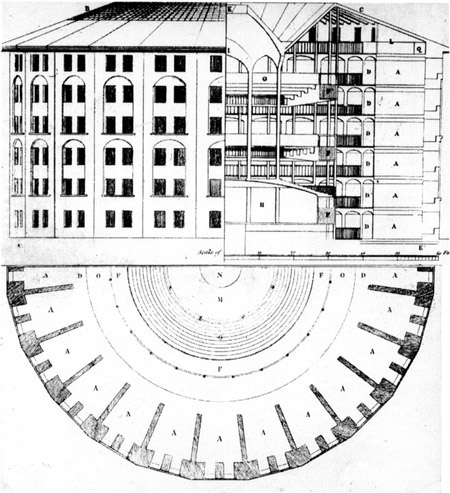 A metaphor for utilitarian systems: visibility and control to maximize good outcomes. (Image: Jeremy Bentham, Public domain, via Wikimedia Commons)
B. Deontological Ethics: Duty and Rules
Definition: Deontology (Kant, Ross) argues that some actions are inherently right/wrong, regardless of consequences. Key principles:
- Universalizability: "Act only on maxims you’d will to be universal laws" (e.g., "Never lie" → can’t lie even to save a life).
- Duty: Respect for persons, truth-telling, keeping promises.
How it works in writing:
- Goal: Uphold moral consistency and rights (e.g., client confidentiality in social work).
- Tools:
- Principle-based arguments (e.g., "Whistleblowing is a duty when corruption harms public trust").
- Rights frameworks (e.g., "Nepali migrant workers have the right to safe working conditions under ILO conventions").
- Hypothetical scenarios to test moral rules (e.g., "Would you publish a client’s story without consent?").
Worked Example: Ncell’s Ethical Dilemma Ncell’s Digital Seva program provides free internet to schools but tracks user data. A deontological critique would ask:
"Is data collection a violation of users’ right to privacy, even if it funds education? Kant would say yes—tracking is a means to an end, not a universalizable rule."
Comparison Table: Utilitarianism vs. Deontology
| Aspect | Utilitarianism | Deontology |
|---|---|---|
| Focus | Outcomes (happiness/suffering) | Rules and duties |
| Key Question | "What produces the best result?" | "What is the right thing to do?" |
| Example in Writing | "This policy reduces crime by 30%." | "This policy violates due process rights." |
| Strength | Practical, data-driven | Protects individual rights |
| Weakness | Can justify harm to minorities | Rigid; may ignore real-world consequences |
C. Virtue Ethics: Character and Moral Habits
Definition: Virtue ethics (Aristotle, Nussbaum) shifts focus to who we are as writers and professionals. A "good" writer embodies virtues like:
- Integrity (honesty, consistency)
- Compassion (empathy in advocacy)
- Courage (challenging power structures)
- Humility (acknowledging limitations)
How it works in writing:
- Goal: Develop moral character through practice (e.g., "How would a compassionate social worker describe this client’s struggle?").
- Tools:
- Narrative voice: Write with authenticity (e.g., MLK’s "Letter from Birmingham Jail" blends anger and moral clarity).
- Role modeling: Cite writers who embody virtues (e.g., Arundhati Roy’s fearless journalism).
- Self-reflection: "Did I write this report with care for the marginalized, or just to meet deadlines?"
Worked Example: eSewa’s Ethical Branding eSewa markets itself as "Nepal’s trusted digital platform", but its fees on remittances (up to 1.5%) exploit poor migrants. A virtue ethics critique asks:
"Does eSewa act with justice (fairness) or greed? A virtuous alternative would be transparent pricing and worker advocacy."
2. Ethical Frameworks in Social Work Writing
Social work writing must navigate competing ethical obligations. Three frameworks dominate:
A. Human Rights Framework
Core Idea: All individuals have inalienable rights (e.g., dignity, non-discrimination, participation). Applications in Writing:
- Advocacy reports: Frame issues as rights violations (e.g., "Child labor in brick kilns violates Article 32 of the UN Convention on the Rights of the Child").
- Policy briefs: Use legal language to demand accountability (e.g., "Nepal’s Migrant Workers Act 2007 must be enforced").
- Case studies: Highlight systemic barriers (e.g., "Dalit women face triple discrimination: caste, gender, poverty").
Worked Example: Kathmandu Traffic Police’s Ethical Failure Traffic police often extort drivers under the guise of "fines." A human rights analysis would argue:
"This violates Article 9 (arbitrary detention) and Article 26 (equal protection) of the Nepali Constitution. Police must be trained in procedural justice."
B. Justice and Equity
Key Concepts:
- Distributive justice: Fair allocation of resources (e.g., "Why do 80% of health budgets go to Kathmandu hospitals?").
- Procedural justice: Fair processes (e.g., "Did this client have a voice in their welfare plan?").
- Restorative justice: Repairing harm (e.g., "How can we reintegrate ex-convicts into society?").
Tool: Equity audit of texts (e.g., "Does this NTC policy serve rural or urban users better?").
C. Care Ethics
Core Idea: Ethics is about relationships and responsiveness (Nel Noddings, Carol Gilligan). Applications in Writing:
- Client-centered reports: Focus on emotional needs (e.g., "This widow’s grief is compounded by financial instability").
- Intersectional analysis: Acknowledge multiple identities (e.g., "A LGBTQ+ Dalit youth faces layered discrimination").
- Collaborative writing: Co-create narratives with clients (e.g., "Here’s how Sita described her abuse—her words, not mine").
Worked Example: Daraz’s Customer Service Ethics Daraz’s chatbots often ignore complaints from rural buyers. A care ethics critique would ask:
"Does Daraz’s service reflect compassion? A caring approach would prioritize human agents for disputes and local language support."
3. Bias in Texts: How to Spot and Challenge It
Bias isn’t just "being unfair"—it’s systematic distortion in language, structure, or assumptions. Three types:
A. Structural Bias
Definition: Omissions or framing that excludes certain perspectives. Examples:
- Missing voices: A report on "youth unemployment" ignores rural women or informal workers.
- False universality: "Nepalis love festivals" ignores migrant workers who can’t celebrate.
- Deficit framing: "Dalit communities are lazy" vs. "Dalits face systemic barriers."
Tool: Perspective mapping (Who is included? Who is silent? Who benefits from this text?).
B. Linguistic Bias
Definition: Word choices that reinforce stereotypes or limit agency. Examples:
- Passive voice: "Mistakes were made" (by whom?) vs. "The bank exploited clients."
- Loaded terms:
- "Illegal immigrants" vs. "Undocumented workers"
- "Beneficiaries" vs. "Clients" (who has power?)
- Gendered language: "Firefighter" (neutral) vs. "fireman" (excludes women).
Worked Example: NTC’s "Road Safety" Campaign NTC ads show young men speeding, not women commuters or motorcycle taxi drivers. This genders risk and ignores real accident data.
C. Ideological Bias
Definition: Hidden assumptions that favor certain worldviews. Examples:
- Neoliberal bias: "Poverty is caused by laziness" (ignores structural inequality).
- Developmentalist bias: "Villages need 'modernization'" (ignores indigenous knowledge).
- Colorblindness: "We don’t see race" (erases racism’s impact).
Tool: Critical discourse analysis (CDA)—examine:
- What’s included/excluded?
- Whose authority is cited?
- What emotions does the text evoke?
4. Writing Ethically: Techniques for Social Work
A. Anonymizing Case Studies
Why? Protect client confidentiality while illustrating issues. How?
- Change names, locations, details.
- Use composite characters (e.g., "Rama, 35, a Dalit woman from Chitwan").
- Never include:
- Full names, photos, or voices.
- Unique identifiers (e.g., "the only HIV+ person in the village").
Example: ❌ "Gita, a 22-year-old from Bhaktapur, was raped by her uncle." ✅ "A 22-year-old woman from the Kathmandu Valley reported sexual abuse by a family member. She described feeling trapped due to economic dependence."
B. Advocacy Without Exploitation
Risk: Using clients’ stories for personal gain (e.g., "I helped a Dalit woman—look at me!"). Ethical Approach:
- Get informed consent: "Your story will be used to advocate for policy change—is that okay?"
- Share benefits: "This report will push for better shelters—here’s how."
- Acknowledge limitations: "We couldn’t include all voices due to time constraints."
C. Balancing Truth and Sensitivity
Dilemma: Some truths are painful (e.g., "Your child was abused"). Strategies:
- Frame with care: "Research shows that 1 in 3 girls in Nepal experiences sexual violence by age 18."
- Offer agency: "Many survivors find strength in collective healing groups."
- Avoid sensationalism: Don’t use graphic details unless necessary for impact.
## In the Real World
1. eSewa and the Ethics of Financial Inclusion
Idea Used: Deontology (duty to protect users) vs. Utilitarianism (maximizing transactions)
- eSewa’s biometric authentication reduces fraud but excludes elderly users who lack fingerprints.
- Ethical dilemma: Should eSewa prioritize security (deontological) or access (utilitarian)?
- Real-world impact: 20% of rural transactions fail due to tech barriers, disproportionately affecting women.
2. Pathao’s Gig Worker Exploitation
Idea Used: Virtue ethics (justice and compassion) vs. Corporate utilitarianism
- Pathao’s algorithm penalizes drivers for "slow deliveries," pushing them to risk accidents.
- Ethical critique: A virtuous company would cap working hours and share profits.
- Worked example: A social work report on Pathao drivers could use care ethics to argue for:
"Drivers describe fear and exhaustion—their well-being must be central to the business model."
3. NTC’s Traffic Management and Distributive Justice
Idea Used: Justice frameworks (who bears the burden of congestion?)
- Data: 60% of Kathmandu’s traffic is private vehicles, but public transport users (often poor) suffer most.
- Ethical question: Is NTC’s road expansion a just use of funds, or does it favor car owners?
- Persuasive writing: Frame traffic policies as redistributive justice:
"If NTC invested in metro expansion, 500,000 daily commuters would save Rs200/month—funding could come from congestion taxes on SUVs."
4. Daraz and Algorithmic Bias
Idea Used: Structural bias (who does the algorithm serve?)
- Daraz’s recommendation algorithm prioritizes urban, high-income buyers, pushing rural products to the bottom.
- Ethical failure: Excludes small farmers from the digital market.
- Solution: A social work intervention could advocate for "rural merchant boosts" in the algorithm.
5. Ncell’s Digital Seva: Human Rights vs. Surveillance
Idea Used: Human rights (privacy) vs. utilitarian outcomes (education access)
- Ncell’s free school Wi-Fi requires SIM registration, raising concerns about child data collection.
- Ethical debate: Is this a just trade-off, or a violation of children’s rights?
- Persuasive angle: Use MLK’s "Letter from Birmingham Jail" style:
"We must protest unjust systems—even if they seem beneficial. Children’s data is not a price for education."
## Exam Tip: How to Score Full Marks
This unit tests application, not just theory. Follow this structure for 10–15 mark questions:
Step 1: Identify the Philosophical/Ethical Lens
- Utilitarian? → Look for outcomes, data, trade-offs.
- Deontological? → Look for rules, rights, duties.
- Virtue ethics? → Look for character, narrative voice, care.
- Human rights? → Look for legal frameworks, advocacy.
- Justice? → Look for fairness, distribution, systemic analysis.
Step 2: Apply to the Text
Use direct quotes + analysis. Example for MLK’s "Letter":
"MLK uses deontological reasoning when he argues that ‘just laws’ must align with moral principles (e.g., ‘A law is unjust if it degrades human personality’). His virtue ethics shines in his courageous tone—he risks arrest to challenge injustice, modeling moral leadership."
Step 3: Link to Social Work
Always connect to practice, policy, or advocacy. Example for a news item on migrant workers:
"The article reflects a utilitarian framing of remittances as ‘economic lifelines,’ but a care ethics lens would highlight the emotional labor of migrant families. Social workers must advocate for safer migration policies (deontological duty) while ensuring remittances reach families without exploitation (justice)."
Step 4: Use Real-World Examples
Examiners love local/global ties. Example for bias:
"Like NTC’s traffic ads, this text exhibits structural bias by focusing on young men while ignoring women commuters. A critical discourse analysis would reveal how this naturalizes male risk-taking as the norm."
Common Pitfalls to Avoid
- ❌ Vague statements: "This is ethical" → Why? Use a framework.
- ❌ Ignoring context: "MLK was right" → How? Compare to Nepali activists like Hira Bahadur Thapa.
- ❌ Overgeneralizing: "All utilitarianism is bad" → Nuance: It’s useful for policy cost-benefit analyses.
## Practice Question with Model Answer
Question: "Examine how Eric Schlosser’s Fast Food Nation uses philosophical and ethical perspectives to critique the fast-food industry. How might a social worker apply these lessons to advocate for gig workers like Pathao drivers?"
Model Answer: Schlosser’s Fast Food Nation employs multiple ethical lenses to expose the dark side of capitalism:
Utilitarian Critique:
- Schlosser highlights how McDonald’s maximizes profits by exploiting workers (low wages) and consumers (addictive food).
- Example: The book’s cost-benefit analysis of fast food shows long-term health costs (obesity, diabetes) outweigh short-term convenience.
- Social work link: A report on Pathao drivers could use utilitarian data to argue:
"Pathao’s algorithm increases driver stress and accidents, costing the economy Rs500M/year in healthcare—a net loss for society."
Deontological Violations:
- Schlosser details worker rights abuses: child labor, unsafe conditions, wage theft.
- Key argument: Fast food violates Kantian duties like truth-telling (hiding ingredients) and respect for persons (treating workers as disposable).
- Social work link: Gig workers face similar deontological violations:
"Pathao’s non-disclosure agreements silence drivers about harassment—violating their right to speak out."
Virtue Ethics Deficit:
- Schlosser contrasts greedy CEOs (lack compassion) with whistleblowers (courage).
- Social work application: Advocate for virtuous business models, such as:
- Transparent algorithms (Pathao sharing driver earnings data).
- Worker cooperatives (e.g., Nepal’s Swasthya Sathi drivers who unionized).
Justice and Care Ethics:
- The book reveals systemic injustice: rural poverty → low-wage jobs → urban food deserts.
- Care ethics angle: Schlosser centers the suffering of workers (e.g., 18-year-old meatpacking employees with chronic injuries).
- Social work strategy: Use narrative reports to humanize gig workers:
"Instead of calling them ‘deliverymen,’ we must recognize them as families’ breadwinners—their struggles are ours."
Conclusion: Schlosser’s multi-layered ethics—utilitarian harms, deontological violations, and care for the marginalized—provide a blueprint for social work advocacy. For Pathao drivers, this means:
- Policy: Demand living wages (utilitarian).
- Law: Enforce labor rights (deontological).
- Culture: Build worker solidarity (virtue ethics).
- Narrative: Amplify drivers’ voices (care ethics).
Based on the TU BSW syllabus for Reading And Writing Across The Disciplines, unit 8.
Discussion
Loading…