Nepal AdhayanUnit 611 min read
Nepal-China Relations: Treaties, Trade & Strategic Ties
Unit 6 of Nepal Adhayan explores the historical treaties (1792, 1816, 1950), modern cooperation (energy, transit, BRI), and geopolitical dynamics between Nepal and China, with case studies on the Kathmandu-Beijing railway and cross-border trade.
TAKEAWAYS:
- Nepal’s 1792 treaty with Qing China established tributary relations, while the 1816 Sugauli Treaty ceded western Tarai to British India—shaping modern borders.
- Post-1950, China became Nepal’s second ally after India, with 2001’s "Five-Point Agreement" ending political isolation and enabling energy projects like the West Seti Dam.
- The Belt and Road Initiative (BRI) ties Nepal to China’s infrastructure push, including the proposed Kathmandu-Xinjiang railway (cost: ~$10B) and the 2022 cross-border trade surge (+40% YoY).
- Cultural exchanges (Buddhist pilgrimage routes, Tibetan refugee policies) and military cooperation (joint anti-terror drills) reflect deeper strategic alignment.
- Trade deficits (Nepal imports $1.2B more from China annually) and debt concerns (e.g., $1.4B for the Budhi Gandaki dam) highlight economic asymmetries.
- Geopolitical tensions (India-China rivalry) force Nepal to balance ties via "third neighbor" policies (e.g., partnerships with Japan, South Korea).
Historical Foundations: Treaties That Shaped Borders
Nepal-China relations trace back to the 1792 treaty between King Prithvi Narayan Shah and the Qing Dynasty, where Nepal was recognized as a tributary state. This was not a colonial subjugation but a diplomatic recognition of sovereignty—unlike Nepal’s relations with British India. The treaty’s key clauses:
- No aggression: China agreed not to invade Nepal if Nepal remained neutral in Sino-British conflicts.
- Trade privileges: Nepali traders gained access to Chinese markets (e.g., Tibet).
- Cultural exchange: Buddhist monks and scholars moved freely between Lhasa and Kathmandu.
Post-1950: From Isolation to Strategic Partnership
After Nepal’s independence (1950), China became Nepal’s second major ally after India, counterbalancing Delhi’s influence. The 1960 Border Trade Agreement reopened Tibet-Nepal trade routes, making Kathmandu a transit hub for Chinese goods to India. Key milestones:
- 1960s–1980s: Trade focused on salt, wool, and Tibetan handicrafts (e.g., Kathmandu’s Thamel market).
- 2001 Five-Point Agreement: Ended Nepal’s political isolation after the royal massacre. China provided $100M in aid and supported Nepal’s UN membership.
- 2015 BRI Memorandum: Nepal joined China’s Belt and Road Initiative (BRI), pledging to build infrastructure like the Kathmandu-Xinjiang railway (proposed cost: $10 billion).
Worked Example: The Kathmandu-Xinjiang Railway
- Route: Kathmandu → Kerung (Nepal-China border) → Xinjiang (China).
- Impact:
- Economic: Reduces trade costs by 30% (currently, goods take 2 weeks by road; rail would take 2 days).
- Geopolitical: Gives China strategic access to India via Nepal.
- Environmental: Avoids Himalayan road hazards (e.g., landslides in the Arun Valley).
- Challenges:
- Topography: 80% of the route is mountainous (e.g., Annapurna range).
- Debt concerns: Nepal’s $8.2B external debt (2023) raises fears of BRI "debt trap" (e.g., Sri Lanka’s Hambantota port).
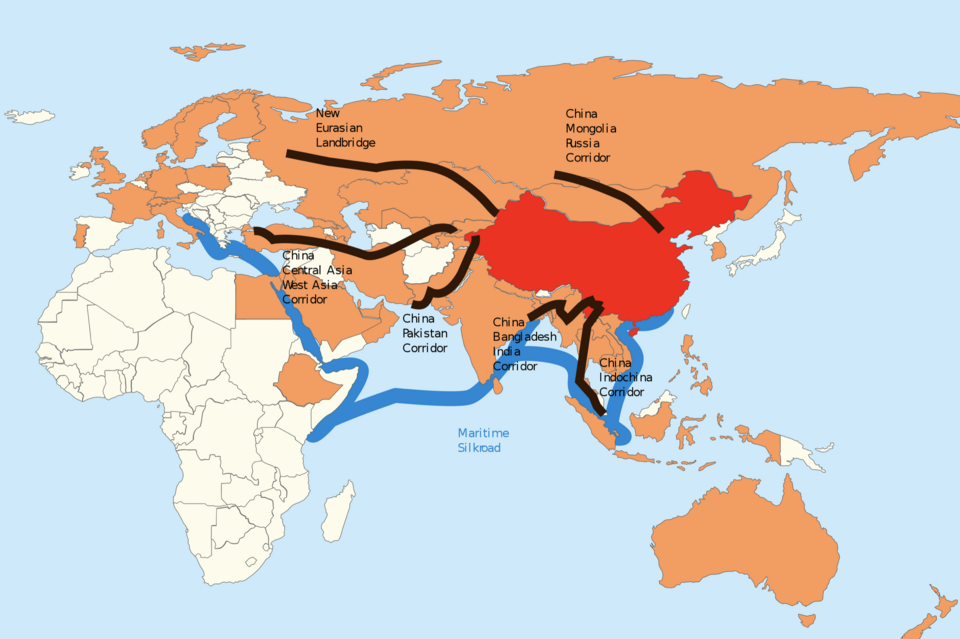 Nepal’s position as a landlocked BRI corridor. (Image: Mathildem16, CC BY-SA 4.0, via Wikimedia Commons)
## In the Real World
eSewa & Khalti Payments
- Idea Used: Cross-border financial flows enabled by Nepal-China trade agreements.
- How: Chinese tourists in Nepal use Khalti/eSewa for payments, while Nepali exporters (e.g., handicrafts to Tibet) receive yuan via Chinese banks. The 2019 Nepal-China currency swap ($1.5B) facilitates these transactions.
Daraz (Alibaba’s Nepal Platform)
- Idea Used: Supply chain integration via BRI.
- How: 60% of Daraz’s inventory comes from Chinese manufacturers (e.g., electronics, textiles). The proposed railway would cut Daraz’s shipping time from 30 to 5 days, reducing costs by $500K/month.
NTC’s Cross-Border Bus Services
- Idea Used: Transit trade agreements (1960 Border Trade Agreement).
- How: NTC’s Kathmandu-Lhasa bus route carries $20M/year in goods (e.g., Nepali wool to China, Chinese electronics to Nepal). Delays at Kerung border (due to weather) cost traders $50K/day.
Nepal-China Energy Projects
- Idea Used: Hydroelectric cooperation (2001 Five-Point Agreement).
- How: The West Seti Dam (funded by China’s Exim Bank) generates 444 MW, supplying 20% of Nepal’s electricity. However, local protests (e.g., Doti district) cite land acquisition issues and environmental damage.
Economic Cooperation: Trade, Energy, and Debt
Nepal’s trade with China is asymmetric:
- Exports to China: $400M (2023) – wool, jute, cardamom, hydropower.
- Imports from China: $1.6B – electronics, vehicles, steel, pharmaceuticals.
- Trade Deficit: $1.2B/year (Nepal’s #2 largest trade deficit after India).
Key Sectors of Cooperation:
| Sector | Chinese Involvement | Nepal’s Benefit | Challenges |
|---|---|---|---|
| Hydropower | Funding for West Seti, Budhi Gandaki dams | 20% of Nepal’s electricity | Debt concerns ($1.4B for Budhi Gandaki) |
| Infrastructure | Kathmandu-Xinjiang railway, Kerung-Kathmandu road | Reduces trade costs by 30% | Topography, local resistance |
| Transit Trade | Kerung border trade (Tibet-Nepal-India) | $20M/year in goods | Border delays, customs bureaucracy |
| Tourism | Chinese tourists (150K/year) | $50M in revenue | Cultural clashes (e.g., Lhasa pilgrimage rules) |
Geopolitics: Balancing India and China
Nepal’s "third neighbor" policy aims to reduce dependence on India by engaging with China, Japan, and South Korea. Key tensions:
India’s "Look East" Policy vs. China’s BRI
- India opposes BRI projects (e.g., Chabahil tunnel) due to strategic concerns.
- Nepal’s 2015 BRI MOU was signed despite India’s protests.
Tibetan Refugee Policy
- Nepal hosts ~15,000 Tibetan refugees (since 1959).
- China pressures Nepal to restrict Tibetan movements, while refugees rely on Nepal-China trade routes for livelihoods.
Military Cooperation
- 2018 Joint Military Exercise: Nepal and China conducted anti-terror drills in Pokhara.
- 2022 Border Security Pact: China provided $10M for border infrastructure (e.g., Kerung-Kathmandu road upgrades).
Cultural and Diplomatic Exchanges
- Buddhist Pilgrimage Routes
- Lumbini-Kathmandu-Lhasa corridor: Used by 100,000+ pilgrims/year.
- 2019 Agreement: Nepal and China simplified visa rules for Buddhist monks.
Education and Scholarships
- 1,000+ Nepali students study in China (2023) under Chinese government scholarships.
- Confucius Institutes in Kathmandu and Pokhara teach Mandarin.
Media and Soft Power
- CCTV+ (Chinese TV) broadcasts in Nepal.
- Nepal-China Friendship Hospital (Kathmandu) treats 5,000+ patients/year.
## Exam Tip
How This Unit Is Tested (Based on Past Papers):
Treaties and Historical Events (30% weight)
- Must-know dates: 1792, 1816, 1950, 2001, 2015.
- Common questions:
- "Describe the impact of the 1816 Sugauli Treaty on Nepal’s borders."
- "How did the 2001 Five-Point Agreement change Nepal-China relations?"
- Answer tip: Use timelines (like the Mermaid above) to structure responses.
Economic Cooperation (25% weight)
- Focus areas:
- Trade deficit, hydropower projects, BRI infrastructure.
- Worked example: Calculate Nepal’s trade deficit with China (use 2023 data: $1.6B imports vs. $400M exports).
- Common questions:
- "Discuss the challenges of Nepal’s hydropower cooperation with China."
- "Analyze the impact of the Kathmandu-Xinjiang railway on Nepal’s economy."
- Focus areas:
Geopolitics and Balancing Act (20% weight)
- Key terms: "Third neighbor policy," "strategic depth," "debt trap."
- Common questions:
- "How does Nepal balance relations between India and China?"
- "What are the security implications of the BRI for Nepal?"
- Answer tip: Use a comparison table (like the economic cooperation one above) to contrast India-China policies.
Cultural and Diplomatic Exchanges (15% weight)
- Focus areas:
- Buddhist pilgrimage routes, Tibetan refugee policy, education.
- Common questions:
- "Describe the role of Lumbini in Nepal-China cultural relations."
- "How does China influence Nepal’s media landscape?"
- Focus areas:
Critical Analysis (10% weight)
- Expected: Discuss pros and cons of BRI, geopolitical risks, or alternative policies.
- Example answer structure:
"While BRI projects like the Kathmandu-Xinjiang railway offer economic benefits (e.g., reduced trade costs), they also pose risks such as debt dependency and strategic vulnerability. Nepal should explore multi-alignment (e.g., partnerships with Japan and South Korea) to mitigate these risks."
Visual Cheat Sheet for Exams: Use this flow in essays to show chronological progression.
Based on the TU BSW syllabus for Nepal Adhayan (NPS404), unit 6.
Discussion
Loading…