Fundamentals of Travel and TourismUnit 511 min read
Economic Impact & Benefits of Tourism: Leakage, Multiplier, MICE, Sustainability
Unit 5 of Fundamentals of Travel and Tourism explores how tourism generates economic value—through direct/indirect employment, foreign exchange, and infrastructure—but also faces challenges like leakage and seasonality. Learn the multiplier effect, MICE tourism, economic benefits vs. costs, and real-world cases from Ne
Core Concepts: How Tourism Drives the Economy
Tourism is not just about travel; it is a multi-billion-dollar industry that fuels economic growth, creates jobs, and transforms communities. Economists measure its impact using three key metrics:
- Direct Economic Impact: Revenue from hotels, flights, restaurants, and attractions.
- Indirect Economic Impact: Jobs and businesses supported by tourism (e.g., local artisans, transport services).
- Induced Economic Impact: Spending by tourism employees (e.g., a tour guide buying groceries).
1. The Multiplier Effect: How Tourism Money Circulates
The multiplier effect explains why tourism dollars keep circulating in an economy. For every Nepalese Rupee (NPR) 100 spent by a tourist:
- Direct spending (hotels, flights) = NPR 100
- Indirect spending (local suppliers, transport) = NPR 30–50
- Induced spending (employees spending wages) = NPR 15–30 Total impact = 2.5x to 4x the original spending!
Worked Example: Pokhara’s Tourism Boom
- In 2023, Pokhara received 1.5 million tourists, generating NPR 20 billion in direct revenue.
- Assuming a multiplier of 3, the total economic impact was NPR 60 billion.
- This funded:
- 5,000+ new jobs (guides, homestays, restaurants).
- Road repairs (e.g., Sarangkot–Pokhara highway).
- Schools and hospitals (e.g., Pokhara’s new tourism training center).
2. Economic Benefits of Tourism
Tourism provides tangible and intangible benefits to host countries. Below is a comparison table:
| Benefit Type | Example (Nepal) | Example (Global) | How It Works |
|---|---|---|---|
| Foreign Exchange | Tourists spend USD 1 billion/year in Nepal. | Dubai’s MICE tourism brings USD 40 billion/year. | Tourists bring hard currency, boosting exports (e.g., handicrafts, trekking permits). |
| Job Creation | 1 in 10 Nepalis works in tourism-related jobs. | 1 in 5 jobs in Maldives is tourism-linked. | Creates direct jobs (guides, pilots) and indirect jobs (farmers supplying hotels). |
| Infrastructure | Kathmandu’s Tribhuvan International Airport expansion. | Singapore’s Changi Airport (a global hub). | Governments invest in roads, airports, and utilities to attract tourists. |
| Cultural Preservation | Lumbini’s UNESCO status protects Buddhist heritage. | Machu Picchu’s conservation in Peru. | Tourism funds heritage sites, preventing decay. |
| Rural Development | Mustang’s homestay tourism lifts local incomes. | Costa Rica’s eco-tourism in Monteverde. | Remote areas gain income without urban migration. |
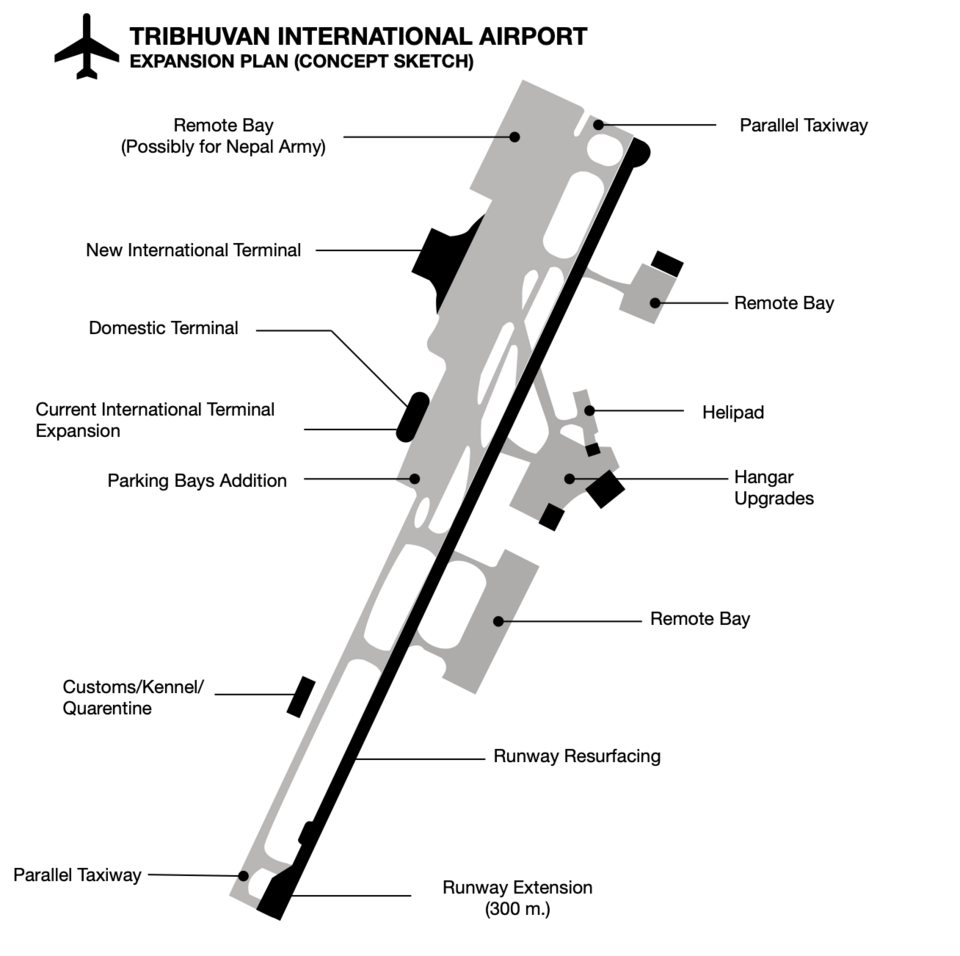 A labelled diagram showing how tourism-driven infrastructure (new terminals, roads) improves connectivity. (Image: Chomolungma8848, CC BY-SA 4.0, via Wikimedia Commons)
3. Challenges: Leakage and Seasonality
Not all tourism revenue stays in the local economy. Leakage occurs when money flows out to foreign companies (e.g., international hotel chains, flight operators).
| Type of Leakage | Example in Nepal | Impact |
|---|---|---|
| Foreign Ownership | Marriott, Hilton hotels in Kathmandu. | Profits go abroad; locals get fewer jobs. |
| Imported Goods | Tourists buy foreign-branded cameras, phones. | Local shops lose sales; money leaves Nepal. |
| Flight Costs | Nepal Airlines charges high fares; tourists fly via Dubai or Singapore. | Revenue from tickets goes to foreign airlines. |
Solution: Supporting Local Businesses
- eSewa & Khalti promote digital payments to local guides.
- Nepal Tourism Board’s "Stay Local" campaign encourages tourists to buy from Nepali artisans.
4. MICE Tourism: The High-Value Segment
MICE stands for:
- Meetings
- Incentives (company rewards)
- Conferences
- Exhibitions
Why MICE is Lucrative:
- High spending: A single corporate event can generate USD 50,000–500,000.
- Year-round demand: Unlike leisure tourism (seasonal), MICE happens 365 days.
- Multiplier effect: Every USD 1 spent on MICE generates USD 3–5 in local economy.
Real-World Example: Dubai’s MICE Dominance
- Dubai hosts 1,200+ MICE events/year, contributing 20% of its tourism revenue.
- How it works:
- A Swiss pharmaceutical company holds a global conference in Dubai.
- 5,000 attendees stay in 5-star hotels (e.g., Burj Al Arab).
- Local caterers, transport, and AV companies benefit.
- Government earns tax revenue from event permits.
Nepal’s MICE Potential:
- Kathmandu’s IT Park hosts ITAR (Information Technology Association of Nepal) events.
- Pokhara’s Lakeside could attract wellness retreats for corporate teams.
- Challenge: Nepal lacks world-class conference venues (e.g., no Dubai Convention Centre-sized halls).
5. Economic Costs of Tourism (The Dark Side)
While tourism brings benefits, it also has negative economic impacts:
| Cost | Example in Nepal | Mitigation Strategy |
|---|---|---|
| Seasonality | Peak season (Oct–Nov): Hotels at 100% capacity; off-season (Dec–Feb): 30% occupancy. | Develop year-round attractions (e.g., indoor adventure parks, cultural festivals). |
| Overdependence | 70% of Pokhara’s economy relies on tourism. | Diversify with agriculture, IT, and manufacturing. |
| Inflation | Rent in Thamel rises 30% in peak season. | Tourist tax to regulate prices. |
| Resource Strain | Water shortages in Kathmandu during peak season. | Sustainable tourism policies (e.g., water recycling in hotels). |
6. Sustainability: Balancing Growth and Conservation
Sustainable tourism ensures long-term benefits without harming the environment or culture.
Three Pillars of Sustainable Tourism:
- Economic Sustainability
- Example: Community-based tourism in Annapurna region (homestays, local guides).
- Environmental Sustainability
- Example: Nepal’s "Clean Himalaya" campaign (reducing plastic in trekking routes).
- Sociocultural Sustainability
- Example: Limiting tourist numbers in Lumbini to protect Buddhist sites.
In the Real World
1. eSewa & Khalti: Digital Payments Reduce Leakage
- How it works: Tourists pay for trekking permits, homestays, and guides via eSewa/Khalti.
- Impact:
- Nepali businesses (e.g., Pokhara’s homestays) get direct payments (no foreign bank fees).
- Government earns more tax from digital transactions.
- Example: A foreign backpacker books a homestay in Kathmandu via Khalti → NPR 5,000 stays in Nepal (vs. leaking to Booking.com).
2. Daraz & Pathao: Tech-Driven Tourism Growth
- Daraz (Alibaba-owned) sells Nepali handicrafts, trekking gear, and souvenirs to tourists.
- Impact: Local artisans (e.g., Newari woodcarvers) get global exposure.
- Pathao (ride-hailing) provides cheap, reliable transport for tourists.
- Impact: Reduces reliance on taxis, cutting costs for visitors.
3. NTC & Ncell: Infrastructure for Tourist Connectivity
- NTC (Nepal Telecom) expanded 4G in remote areas (e.g., Mustang, Dolpo) to help tourists stay connected.
- Ncell’s "Tourist SIM" offers free data for 7 days to international visitors.
- Impact: More tourists visit off-the-beaten-path destinations (e.g., Upper Mustang).
4. NEPSE & Tourism Stocks
- Nepal’s stock market (NEPSE) includes hotel and travel companies like:
- Hotel Yak & Yeti (trekking gear)
- Nepal Airlines
- Investors track tourism stocks to predict economic growth.
- Example: After Pokhara’s airport expansion, hotel stocks rose by 15%.
Exam Tip: How to Score Full Marks
Define Key Terms Clearly
- Multiplier Effect: "The process where tourism spending generates additional economic activity beyond the initial expenditure."
- Leakage: "The loss of tourism revenue to foreign-owned businesses."
Use Real Examples from Nepal & Global
- Nepal: Pokhara’s multiplier, eSewa’s role in reducing leakage.
- Global: Dubai’s MICE, Costa Rica’s eco-tourism.
Compare Benefits vs. Costs in Tables
- Always structure answers with pro/con columns (e.g., economic benefits vs. costs).
Link to Current Issues
- Climate change: "Nepal’s tourism faces risks from melting glaciers (e.g., Everest base camp closures in 2023)."
- Tech disruption: "Pathao and Daraz are replacing traditional tour operators."
Diagrams = Extra Marks
- Draw flowcharts (multiplier effect), graphs (seasonality), or Venn diagrams (sustainability pillars).
Common Mistakes to Avoid:
- ❌ Vague answers: "Tourism helps the economy." → Wrong. Say "Tourism contributes 8% to Nepal’s GDP via direct spending (NPR 200 billion/year)."
- ❌ Ignoring leakage: Always mention how much money leaves Nepal (e.g., "60% of tourism revenue leaks to foreign airlines").
- ❌ No examples: "MICE tourism is important." → Add: "Dubai earns USD 40 billion/year from MICE events like the World Government Summit."
Final Checklist for Exam Answers: ✅ Define the concept (1 mark). ✅ Explain with mechanisms (2 marks). ✅ Give 2–3 Nepal/global examples (3 marks). ✅ Discuss pros/cons or challenges (2 marks). ✅ Suggest solutions (1 mark). ✅ Use 1 diagram/table (1 mark).
Good luck! 🚀
Based on the TU BTTM syllabus for Fundamentals of Travel and Tourism (TTM315), unit 5.
Discussion
Loading…