Travel Service Operations Management IIUnit 49 min read
Trekking & Mountaineering: Operations, Safety & Logistics
Unit 4 of Travel Service Operations Management II covers the technical and managerial aspects of trekking and mountaineering operations, including route planning, permit systems, safety protocols, equipment requirements, and crisis response—essential for designing and executing high-altitude tourism services in Nepal.
Core Concepts
1. Trekking vs. Mountaineering: Definitions and Scope
Trekking and mountaineering are two distinct but related activities in the tourism sector, each requiring specialized operational management.
mindmap
  root((Trekking & Mountaineering))
    Trekking
      Definition: "Non-technical hiking in natural terrain"
      Altitude: "Below 5,000m (e.g., Annapurna Circuit, Langtang Valley)"
      Permits: "TIMS (Trekkers' Information Management System)"
      Equipment: "Basic gear (boots, trekking poles, warm clothing)"
    Mountaineering
      Definition: "Technical climbing requiring ropes, ice axes, and fixed lines"
      Altitude: "Above 5,000m (e.g., Everest, Manaslu, Dhaulagiri)"
      Permits: "Special Climbing Permits (e.g., Sagarmatha National Park)"
      Equipment: "Advanced gear (oxygen tanks, crampons, harnesses)"
Key Differences:
| Feature | Trekking | Mountaineering |
|---|---|---|
| Technical Skill | Minimal (navigation, endurance) | High (ropes, ice climbing, rescue) |
| Altitude | Below 5,000m | Above 5,000m (Himalayan peaks) |
| Permits | TIMS (mandatory for foreigners) | Special permits (e.g., Everest) |
| Duration | Days to weeks | Weeks to months |
| Risk Level | Moderate (weather, terrain) | Extreme (avalanches, altitude) |
2. Trekking Operations: Planning and Execution
Trekking operations involve meticulous planning to ensure safety, sustainability, and customer satisfaction.
A. Route Planning
- Factors Considered:
- Terrain difficulty (e.g., steep ascents in Annapurna vs. flat trails in Pokhara).
- Altitude gain/loss (e.g., Everest Base Camp requires acclimatization stops).
- Weather patterns (monsoon vs. winter treks).
- Cultural sensitivity (e.g., restricted areas like Upper Mustang).
Example: Annapurna Circuit Trek
- Distance: 160–230 km
- Duration: 14–21 days
- Highest Point: Thorong La Pass (5,416m)
- Key Stops: Besi Sahar, Manang, Muktinath
- Challenges: High altitude, unpredictable weather, remote villages.
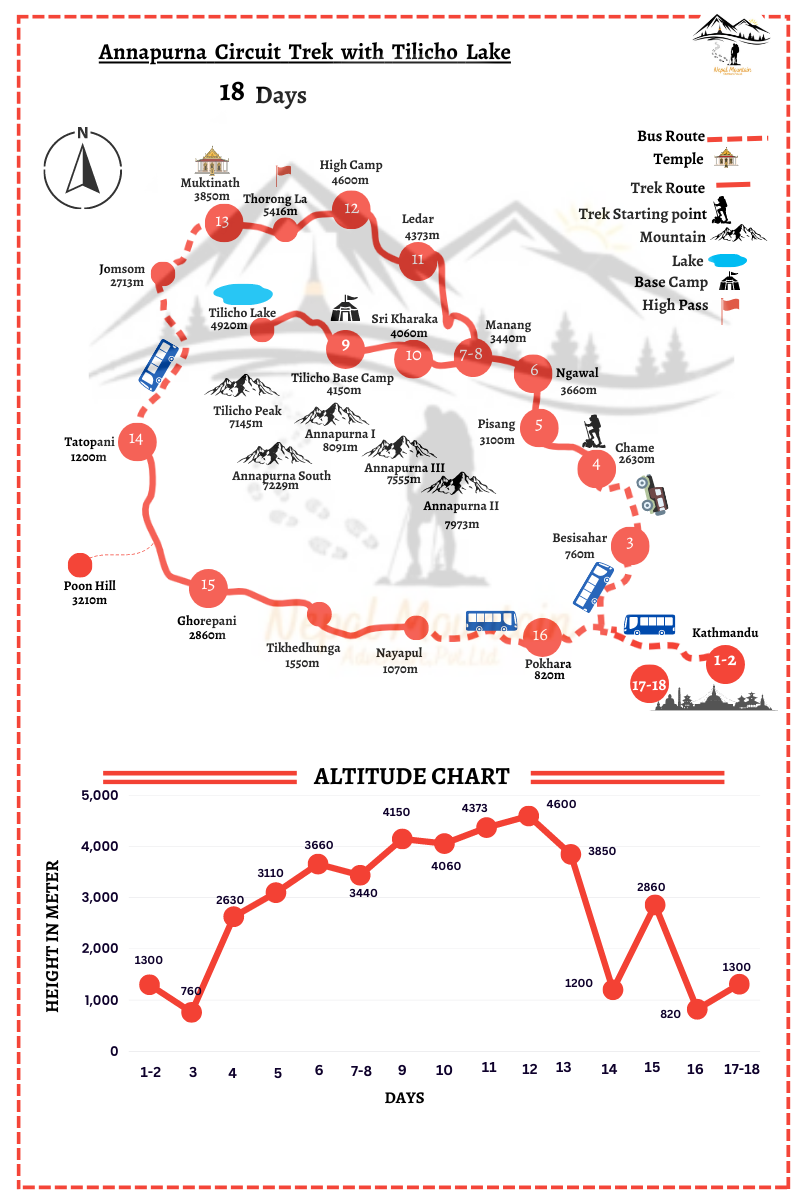 A labelled map showing key stops, altitude profile, and permit zones. (Image: Avishekkhadka111, CC BY-SA 4.0, via Wikimedia Commons)
B. Permits and Regulations
- TIMS (Trekkers' Information System):
- Mandatory for all foreign trekkers in Nepal.
- Issued by the Nepal Tourism Board (NTB).
- Types:
- Group TIMS: For treks with a guide (valid for 15 days).
- Individual TIMS: For independent trekkers (valid for 10 days).
- Cost: ~USD 20–30 (varies by season).
- National Park Fees:
- Required for treks passing through protected areas (e.g., Sagarmatha, Langtang, Annapurna).
- Example: Everest Base Camp requires a Sagarmatha National Park permit (~USD 30).
Worked Example: Permit Costs for Everest Base Camp Trek
| Permit Type | Cost (USD) | Validity |
|---|---|---|
| Sagarmatha National Park | 30 | Single entry |
| TIMS (Group) | 20 | 15 days |
| Total | 50 |
3. Mountaineering Operations: Technical and Logistical Challenges
Mountaineering requires advanced planning due to technical risks and extreme conditions.
A. Permit System for Mountaineering
- Special Climbing Permits:
- Issued by the Nepal Mountaineering Association (NMA) or NTB.
- Required for all peaks above 6,500m (e.g., Island Peak, Lobuche East).
- Everest Permit: ~USD 11,000 (foreign climbers) + USD 4,000 (sherpa support).
- Cost Breakdown for Everest:
- Base Camp Fee: USD 11,000
- Garbage Deposit: USD 4,000 (refundable if no waste left)
- TIMS: USD 20
B. Equipment and Logistics
- Essential Gear:
- Technical: Ropes, ice axes, crampons, harnesses, carabiners.
- Safety: Oxygen tanks (above 8,000m), satellite phone, first aid kit.
- Clothing: Layered system (base, insulating, outer shell), gloves, balaclava.
- Logistics:
- Caching System: Pre-positioning supplies at camps (e.g., Everest’s "death zone" caches).
- Sherpa Support: 1 sherpa per 2 climbers (mandatory for peaks above 6,500m).
- Weather Windows: Climbing seasons (spring: March–May; autumn: September–November).
Example: Everest Expedition Logistics
flowchart TD
  A["Base Camp: 5,364m"] -->|"Week 1"| B["Acclimatization: 6,065m (North Col)"]
  B -->|"Week 2"| C["Camp 2: 6,500m"]
  C -->|"Week 3"| D["Camp 3: 7,200m"]
  D -->|"Week 4"| E["Camp 4: 7,950m (Death Zone)"]
  E -->|"Final Push"| F["Summit: 8,848m"]
  F --> G["Descent to Camp 4"]
  G --> H["Return to Base Camp"]
4. Safety Protocols and Crisis Management
Safety is paramount in trekking and mountaineering due to high-risk environments.
A. Altitude Sickness (AMS)
- Symptoms: Headache, nausea, dizziness, fatigue.
- Prevention:
- Gradual ascent (300–500m/day above 3,000m).
- Hydration (4–5L water/day).
- Diamox (acetazolamide) medication (consult a doctor).
- Treatment:
- Descend immediately if symptoms worsen.
- Oxygen supplementation (for severe cases).
B. Emergency Response
- Rescue Teams:
- Nepal Army (for high-altitude rescues).
- Helicopter Evacuation: Costly (~USD 5,000–10,000) but critical for life-threatening cases.
- Communication:
- Satellite phones (e.g., Garmin inReach) for remote areas.
- Emergency contacts: Nepal Tourism Board (NTB) or local trekking agencies.
Case Study: 2014 Everest Avalanche
- Incident: 16 sherpas killed in avalanche at Camp 4.
- Response:
- Immediate evacuation of climbers.
- Suspension of climbing permits for 2015.
- Lessons Learned:
- Stricter safety briefings.
- Mandatory use of helmets and fixed ropes.
5. Sustainable Trekking and Mountaineering
Nepal emphasizes eco-friendly tourism to preserve the Himalayas.
A. Waste Management
- Rules:
- "Pack out what you pack in" (no littering).
- Garbage deposit system (e.g., USD 4,000 for Everest, refunded if waste is carried down).
- Challenges:
- Human waste (composting toilets in high camps).
- Plastic bottles (banned in some areas; use reusable bottles).
B. Community Involvement
- Homestays: Trekkers stay with local families (e.g., Langtang Valley).
- Fair Wages: Sherpas and guides earn USD 40–60/day (vs. USD 1,000+ for foreign climbers).
- Cultural Preservation: Respect for local traditions (e.g., no photography in monasteries).
Example: Eco-Trekking in Langtang
- Practices:
- Solar-powered lodges.
- Guides trained in Leave No Trace principles.
- Impact: Reduced deforestation and wildlife disturbance.
In the Real World
eSewa and Online Permit Bookings
- How it works: eSewa allows trekkers to book TIMS and national park permits online, reducing queues at NTB offices.
- Example: A tourist planning an Annapurna Circuit trek can purchase TIMS and permits via eSewa in minutes, avoiding last-minute hassles at Pokhara’s NTB office.
Pathao’s Role in Trekking Logistics
- How it works: Pathao partners with trekking agencies to transport gear and supplies to remote bases (e.g., Lukla for Everest expeditions).
- Example: A mountaineering company uses Pathao’s cargo service to ship oxygen tanks and climbing equipment from Kathmandu to Namche Bazaar, cutting transit time by 30%.
Nabil Bank’s Travel Insurance for Trekkers
- How it works: Nabil Bank offers specialized insurance covering altitude sickness, helicopter rescues, and trip cancellations for trekkers.
- Example: A solo trekker on the Manaslu Circuit buys a USD 50,000 medical evacuation policy from Nabil Bank. If they suffer AMS at 4,500m, the policy covers a helicopter transfer to Pokhara Hospital.
Exam Tip
This unit is heavily tested on:
- Permit Systems: Know the difference between TIMS, national park fees, and special climbing permits. Memorize costs for Everest, Annapurna, and Langtang.
- Route Planning: Be able to sketch a trek (e.g., Everest Base Camp) with key stops and altitude profiles. Highlight challenges like the Khumbu Icefall or Thorong La Pass.
- Safety Protocols: Define AMS symptoms, treatment, and prevention. Compare rescue options (Nepal Army vs. helicopter).
- Logistics: Explain the caching system for Everest or the role of sherpas. Calculate total permit costs for a trek (e.g., TIMS + park fee).
- Case Studies: Be ready to discuss real incidents (e.g., 2015 Everest earthquakes, 2014 avalanche) and their impact on regulations.
- Sustainability: List 3 eco-friendly practices in trekking (e.g., waste management, homestays) and their benefits.
Common Pitfalls:
- Confusing TIMS with park permits (they are separate).
- Ignoring altitude sickness as a major risk (always mention prevention steps).
- Forgetting to include sherpa ratios or oxygen requirements in mountaineering operations.
Visual Summary for Quick Revision:
mindmap
  root((Trekking & Mountaineering Operations))
    Permits
      TIMS: "Mandatory for all trekkers"
      National Park Fees: "Required for protected areas"
      Special Permits: "For peaks above 6,500m"
    Safety
      AMS: "Prevent with Diamox, hydration"
      Rescue: "Nepal Army or helicopter"
    Logistics
      Trekking: "Guide-to-trekker ratio 1:6"
      Mountaineering: "Sherpa ratio 1:2, oxygen above 8,000m"
    Sustainability
      Waste: "Pack out system"
      Community: "Homestays, fair wages"
    Real-World Links
      eSewa: "Online permit booking"
      Pathao: "Gear transportation"
      Nabil Bank: "Trekking insurance"
Based on the TU BTTM syllabus for Travel Service Operations Management II, unit 4.
Discussion
Loading…