Culture And Social Psychology For TourismUnit 811 min read
Tourist Typologies & Consumer Needs: Segmentation & Motivation
Unit 8 of Culture and Social Psychology for Tourism dissects how tourists are classified (typologies) and why they choose destinations, blending Maslow’s hierarchy, cultural dimensions, and real-world segmentation strategies like those used by Daraz or Pathao.
TAKEAWAYS:
- Tourists are categorized into 8+ typologies (e.g., adventure, cultural, heritage) based on behavior, needs, and motivations.
- Maslow’s hierarchy (physiological → self-actualization) explains why tourists prioritize safety (e.g., NTC’s flight safety ads) or cultural experiences (e.g., Kathmandu’s heritage walks).
- Consumer needs (physiological, safety, social, esteem, self-actualization) directly influence purchase decisions (e.g., Pathao’s surge pricing for safety needs).
- Segmentation (demographic, psychographic, behavioral) helps businesses like Daraz tailor promotions (e.g., family vs. solo travelers).
- Cross-cultural differences (e.g., Nepali vs. Indian tourists’ expectations) affect satisfaction and repeat visits.
- Real-world tools: SWOT analysis, perceptual mapping, and consumer decision models (e.g., Ncell’s loyalty programs for data plans).
1. Defining Tourist Typologies
Tourist typologies classify visitors based on behavior, motivations, and consumption patterns. These categories help tourism businesses (hotels, tour operators, transport) design products and marketing strategies.
Key Typologies
mindmap
  root((Tourist Typologies))
    Adventure["Adventure Seekers\n• Thrill-seeking (e.g., trekking in Annapurna)\n• High-risk tolerance\n• Example: Solo backpackers"]
    Cultural["Cultural Tourists\n• Heritage/art lovers\n• Example: Kathmandu’s Durbar Square visits"]
    Heritage["Heritage Seekers\n• Historical sites (e.g., Lumbini, Chitwan)\n• Low-risk, high-curiosity"]
    Ecotourists["Ecotourists\n• Nature conservation\n• Example: Chitwan’s jungle safaris"]
    Business["Business Travelers\n• Work-related trips\n• Example: Ncell’s corporate clients"]
    Leisure["Leisure Seekers\n• Relaxation (e.g., Pokhara lakeside stays)\n• High discretionary income"]
    VFR["Visiting Friends/Family\n• Social bonds\n• Example: Nepali diaspora returning home"]
    Mass["Mass Tourists\n• Budget-driven (e.g., budget hotels in Pokhara)\n• Low engagement with local culture"]
Why it matters:
- Daraz segments shoppers into new buyers, repeat buyers, and high-value customers to personalize discounts.
- Pathao targets adventure typologies with off-peak discounts for solo riders.
2. Consumer Needs in Tourism
Tourists’ needs are hierarchical, as per Maslow’s Pyramid, but adapted for tourism contexts:
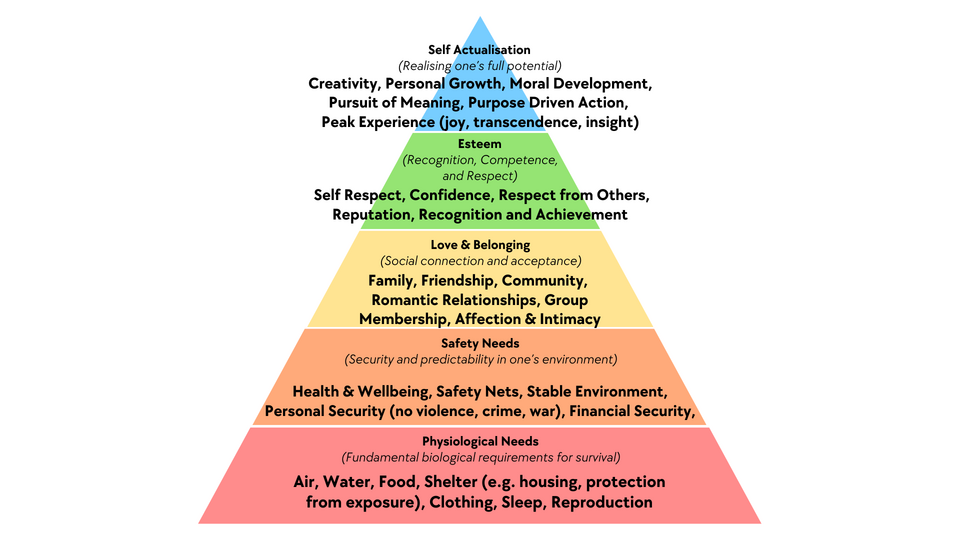 Adapted for tourism: physiological needs (food, shelter) → safety (security) → social (group activities) → esteem (luxury experiences) → self-actualization (personal growth). (Image: Hamish.croker, CC BY-SA 4.0, via Wikimedia Commons)
Worked Example: A Tourist’s Needs in Pokhara
| Need Level | Tourist’s Experience | Tourism Product Example |
|---|---|---|
| Physiological | Needs food, water, rest | Local dhabas (e.g., Thamel’s cafes) |
| Safety | Wants secure transport | NTC’s flight safety ads, Pathao’s app |
| Social | Seeks group activities | Group treks to Sarangkot |
| Esteem | Desires luxury or prestige | The Great Himalaya Hotel |
| Self-Actualization | Pursues personal growth | Yoga retreats in Pokhara |
Real-world tie:
- Nepal Tourism Board prioritizes safety needs in ads (e.g., "Safe Travels" campaigns) to reduce risks for mass tourists.
- Khalti uses social needs in its group payment features for family trips.
3. Segmentation in Tourism
Segmentation divides tourists into groups for targeted marketing. Common methods:
A. Demographic Segmentation
| Segment | Example | Tourism Application |
|---|---|---|
| Age | 18–25 (backpackers) | Hostels, budget treks |
| Gender | Female solo travelers | Safe-tour packages |
| Income | High-income (luxury) | The Himalaya Hotel |
| Occupation | Retirees | Slow travel, cultural tours |
B. Psychographic Segmentation
Focuses on lifestyle, values, and personality:
| Psychographic Trait | Tourist Type | Example in Nepal |
|---|---|---|
| Adventure-loving | Thrill-seekers | Paragliding in Pokhara |
| Culture-oriented | Heritage tourists | Lumbini pilgrimage |
| Eco-conscious | Sustainable travelers | Homestays in rural villages |
C. Behavioral Segmentation
Classifies tourists by usage patterns:
| Behavioral Segment | Description | Nepal Example |
|---|---|---|
| Frequency | Repeat vs. first-time visitors | Loyalty programs for repeat tourists |
| Loyalty | Brand advocates | Ncell’s data plans for frequent users |
| Occasion | Seasonal travelers | Winter tourists to Pokhara |
Real-world example:
- Daraz uses behavioral segmentation to send:
- First-time buyers: Discount coupons.
- Repeat buyers: Exclusive flash sales.
- High-value buyers: VIP customer service.
4. Cross-Cultural Perspectives in Tourist Behavior
Cultural differences shape expectations, satisfaction, and behavior:
Comparison Table: Nepali vs. Indian Tourists
| Factor | Nepali Tourists | Indian Tourists |
|---|---|---|
| Budget | Often limited; prefers budget stays | Higher spending power |
| Cultural Sensitivity | More open to local customs | May avoid certain rituals (e.g., cremation) |
| Transport Preference | Trekking, buses | Domestic flights (e.g., Kathmandu–Delhi) |
| Safety Concerns | Trust local guides | Prefer organized tours |
Worked Example: Kathmandu Traffic
- Nepali tourists: Accept chaotic traffic (e.g., microbuses) as part of the experience.
- Indian tourists: May prefer taxis or ride-hailing (Pathao) for safety.
5. Consumer Decision-Making in Tourism
Tourists follow a 5-step decision process:
- Need Recognition (e.g., "I need a break").
- Information Search (e.g., Google, word-of-mouth).
- Evaluation of Alternatives (e.g., comparing hotels).
- Purchase Decision (e.g., booking via Daraz or directly).
- Post-Purchase Evaluation (e.g., reviews on TripAdvisor).
Three Ways to Analyze Decisions
| Method | Description | Tourism Example |
|---|---|---|
| Rational Model | Logical, cost-benefit analysis | Booking a flight via NTC’s price comparison |
| Emotional Model | Impulse-driven (e.g., Instagram-worthy spots) | Spontaneous Pokhara lake visit |
| Habitual Model | Repeat purchases (e.g., annual treks) | Ncell’s data plan subscriptions |
6. Tourist Satisfaction and Challenges
Satisfaction depends on expectations vs. reality:
- Overfulfillment: Exceeds expectations (e.g., luxury stay in Pokhara).
- Underfulfillment: Falls short (e.g., poor service at a budget hotel).
- Delight: Surpasses expectations (e.g., unexpected homestay experience).
Challenges:
- Cultural clashes (e.g., Indian tourists offended by Nepali customs).
- Over-tourism (e.g., Pokhara’s lakeside congestion).
- Safety concerns (e.g., road accidents on treks).
In the Real World
Pathao’s Ride Segmentation:
- Uses psychographic segmentation to target:
- Adventure typologies: Off-peak discounts for solo riders.
- Family typologies: Child-friendly routes and safety features.
- Real example: Pathao’s "Safe Ride" campaign addresses safety needs for female solo travelers.
- Uses psychographic segmentation to target:
Daraz’s Loyalty Programs:
- Segments buyers into demographic (age, income) + behavioral (purchase frequency) groups.
- Real example: "First-time buyer" discounts vs. "VIP member" perks for high spenders.
Nepal Tourism Board’s SWOT Analysis:
- Strengths: Rich cultural heritage (Lumbini, Kathmandu).
- Weaknesses: Infrastructure gaps (e.g., Pokhara’s traffic).
- Opportunities: Eco-tourism in Chitwan.
- Threats: Political instability affecting safety perceptions.
- Real example: Adjusted marketing to highlight safety needs post-earthquake.
Exam Tip
How to score full marks:
- Define typologies clearly: Use 8+ examples (e.g., adventure, cultural, mass tourists) with real Nepali cases.
- Link Maslow’s hierarchy to tourism: Always pair needs (e.g., safety) with products/services (e.g., NTC ads).
- Compare cross-cultural behaviors: Pick Nepali vs. Indian tourists or domestic vs. foreign tourists and give specific examples.
- Apply segmentation models: Show how Daraz, Pathao, or Ncell use demographic/psychographic segmentation.
- Analyze decision-making: Use the 5-step model and pick one method (rational/emotional/habitual) with a worked example.
- Discuss challenges: Mention over-tourism, safety, or cultural clashes with solutions (e.g., SWOT analysis).
Common mistakes to avoid:
- Ignoring real-world examples (examiners love Nepali cases like Daraz or Pathao).
- Overgeneralizing typologies (e.g., "all adventure tourists are young"—specify age/gender).
- Forgetting to tie theory to practice (e.g., Maslow’s needs → hotel amenities).
Sample high-scoring answer structure:
"Tourist typologies classify visitors based on behavior and motivations. For example, adventure tourists seek thrill (e.g., Annapurna treks), while heritage tourists prioritize cultural sites (e.g., Lumbini). Maslow’s hierarchy explains why safety needs (e.g., NTC’s flight safety ads) are critical for mass tourists. Daraz segments buyers into first-time and repeat customers, offering discounts to each group. Cross-culturally, Nepali tourists accept chaotic traffic, whereas Indian tourists prefer Pathao for safety. The 5-step decision model applies when a tourist books a flight via NTC’s price comparison tool, balancing cost and safety."
Visual Recap:
mindmap
  root((Unit 8 Key Concepts))
    Typologies["8+ Types: Adventure, Cultural, Mass, etc."]
    Needs["Maslow’s Pyramid → Tourism Products"]
    Segmentation["Demographic, Psychographic, Behavioral"]
    CrossCulture["Nepali vs. Indian Tourist Behaviors"]
    DecisionMaking["5-Step Process: Need → Purchase → Evaluation"]
    Challenges["Over-tourism, Safety, Cultural Clashes"]
Based on the TU BTTM syllabus for Culture And Social Psychology For Tourism (TTM343), unit 8.
Discussion
Loading…