Sustainable Tourism DevelopmentUnit 915 min read
Climate Change & Tourism: Impacts, Adaptation & Future
Unit 9 of Sustainable Tourism Development explores how climate change disrupts tourism ecosystems, from melting glaciers in Nepal’s Himalayas to extreme weather disrupting flights and resorts. It covers scientific mechanisms (greenhouse effect, carbon footprints), sector-specific impacts (ski resorts, coastal tourism),
TAKEAWAYS:
- Climate change is the biggest disruptor of tourism: Rising temperatures, sea-level rise, and extreme weather (e.g., 2022 Nepal floods) force destinations to adapt or lose revenue—ski resorts in Pokhara face shorter seasons, while coastal beaches in Chitwan erode.
- Tourism emits 8% of global CO₂: Aviation (50% of sector emissions) and hotels (20%) are key targets for carbon offsetting programs like those used by Nepal Airlines and Yeti Airlines.
- Adaptation ≠ mitigation: While Daraz shifts to electric delivery vehicles, Pokhara’s paragliding operators must cancel flights during monsoon winds—both require different strategies.
- Nepal’s vulnerability is high: 80% of glaciers in the Himalayas feed tourism (trekking, hydropower), but melting threatens Annapurna Base Camp routes and Kathmandu’s water supply.
- Certifications matter: The Green Destination Standard (used by Thamel’s eco-hotels) and Global Sustainable Tourism Council (GSTC) help businesses prove climate resilience to travelers.
- Policy gaps cost money: Nepal’s Tourism Year 2020 plan lacked climate clauses; NTC’s electric bus project shows how infrastructure can lead adaptation.
1. Climate Change Basics: The Science Behind Tourism’s Disruption
Tourism relies on stable climates—sunny beaches, predictable monsoons, and snow for skiing. But climate change alters these conditions. Here’s how:
A. The Greenhouse Effect and Tourism’s Role
- How it works: Greenhouse gases (GHGs) like CO₂ trap heat in the atmosphere. Human activities (burning fossil fuels, deforestation) increase GHGs, raising Earth’s temperature.
flowchart TD
  A["Sunlight"] --> B["Earth's Surface"]
  B --> C["Infrared Radiation"]
  C --> D["GHGs (CO₂, Methane)"]
  D -->|"Trapped"| E["Warmer Atmosphere"]
  E --> F["Climate Change Effects"]
- Tourism’s contribution:
- Transportation: Flights (50% of sector emissions) and buses (e.g., NTC’s diesel fleets) emit CO₂.
- Accommodation: Hotels use 20% of tourism energy (e.g., Thamel’s non-AC hotels vs. Kathmandu’s luxury resorts).
- Activities: Ski resorts (e.g., Pokhara’s Sarangkot) rely on snow; coral reefs (e.g., Bardia National Park) die from warming.
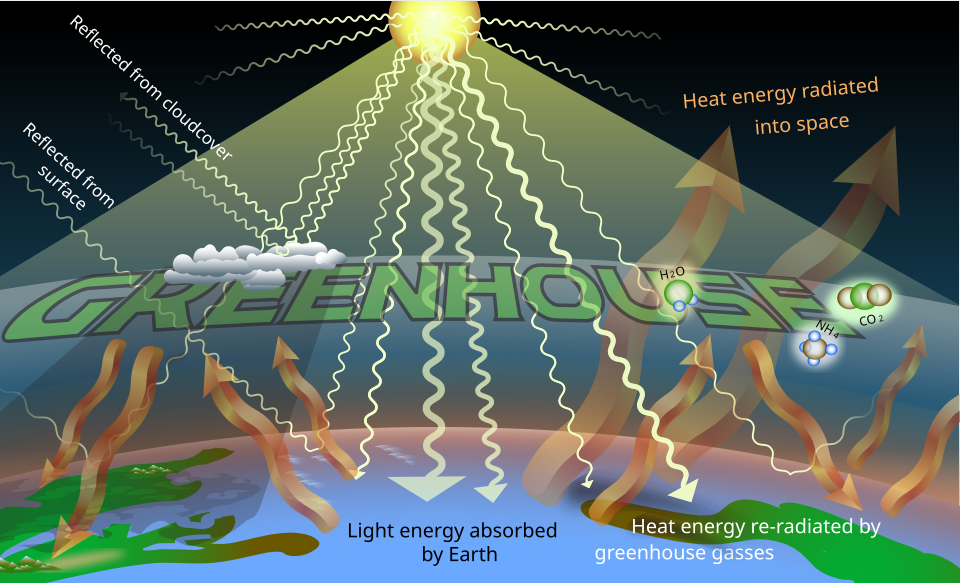 Shows how CO₂ traps heat, linking to tourism’s carbon footprint. (Image: A loose necktie, CC BY-SA 4.0, via Wikimedia Commons)
B. Key Climate Change Impacts on Tourism
| Impact | Example in Nepal | Global Example |
|---|---|---|
| Rising temperatures | Shorter trekking seasons in Everest region | Disneyland Paris cancels outdoor events during heatwaves |
| Glacier melt | Annapurna Base Camp routes change due to glacial lake outbursts (GLOFs) | Swiss ski resorts lose 30% snow cover by 2050 |
| Sea-level rise | Chitwan’s coastal erosion threatens resorts | Maldives faces submersion; resorts relocate |
| Extreme weather | 2022 Nepal floods wash out roads to Lukla | Hurricane Ian (2022) shuts Florida theme parks |
| Ocean acidification | Bardia’s coral reefs bleach, harm diving tourism | Great Barrier Reef loses 50% of coral since 1995 |
WORKED EXAMPLE: Carbon Footprint of a Kathmandu-Pokhara Flight
- Flight details: Round-trip Kathmandu–Pokhara on Yeti Airlines (1-hour flight, 100 passengers).
- Emissions: 1 kg CO₂ per passenger/km × 200 km × 2 = 400 kg CO₂ per passenger.
- Offset cost: Planting trees via EcoTree Nepal costs $5 per passenger to neutralize emissions.
- Real-world tie: Nepal Airlines now offers carbon offset options for all domestic flights.
2. How Climate Change Hits Nepal’s Tourism
Nepal’s tourism is highly climate-dependent. Here’s why:
A. Himalayan Tourism: Glaciers and Trekking
- Problem: The Himalayas lose 1 billion tons of ice annually. This affects:
- Trekking routes: Melting glaciers create GLOFs (Glacial Lake Outburst Floods), like the 2016 Imja Tshe Lake flood that destroyed bridges to Everest Base Camp.
- Hydropower: NTC’s projects (e.g., West Seti) rely on glacial meltwater—droughts reduce energy for hotels.
- Cultural sites: Pashupatinath Temple floods during monsoons, damaging infrastructure.
B. Monsoon Dependence: Agriculture and Wildlife Tourism
- Problem: Nepal’s tourism (e.g., Chitwan’s safaris, Pokhara’s paragliding) depends on predictable monsoons.
- Delayed monsoons (like 2022) cause:
- Wildlife stress: Bardia National Park’s rhinos suffer from drought.
- Crop failures: Mustang’s apple farms (a tourist attraction) yield less.
- Road closures: Lukla Airport shuts for 3 months/year due to landslides.
- Delayed monsoons (like 2022) cause:
C. Urban Tourism: Kathmandu’s Heat and Air Pollution
- Problem: Kathmandu’s temperature rose 1.5°C in 20 years (faster than global average).
- Health risks: Thamel’s street food stalls see fewer customers during heatwaves.
- Air quality: Ncell’s data shows PM2.5 levels spike during pre-monsoon (April–May), discouraging foreign tourists.
- Water shortages: Kathmandu Valley’s 24-hour water supply fails in summer, hurting hotels.
3. Tourism’s Carbon Footprint: How Bad Is It?
Tourism is the world’s 3rd-largest polluter (after oil and agriculture). Here’s the breakdown:
A. Sources of Emissions in Nepal’s Tourism
| Source | Example | Emissions (per tourist) | Mitigation Strategy |
|---|---|---|---|
| Aviation | Kathmandu–London flight (Yeti Airlines) | 2.5 tonnes CO₂ | Carbon offset programs (EcoTree Nepal) |
| Road transport | Kathmandu–Pokhara bus (NTC) | 0.5 tonnes CO₂ | Electric buses (NTC’s pilot project) |
| Hotels | 5-star hotel in Thamel (AC, heating) | 1.2 tonnes CO₂/night | Solar panels (e.g., Hotel Yak & Yeti) |
| Food & water | Imported goods (Daraz deliveries) | 0.3 tonnes CO₂ | Local sourcing (e.g., Thamel’s organic cafés) |
| Activities | Paragliding in Pokhara (fuel, noise) | 0.1 tonnes CO₂ | Wind-powered tethers (experimental) |
B. Calculating Your Tourism Carbon Footprint
Use this simple formula for a 3-day Pokhara trip:
Total CO₂ = (Flight × 2.5) + (Bus × 0.5) + (Hotel × 1.2) + (Food × 0.3)
Example:
- Flight: Kathmandu–Pokhara (0.4 tonnes)
- Bus: Pokhara–Chitwan (0.2 tonnes)
- Hotel: 2 nights in a mid-range lodge (2.4 tonnes)
- Food: 3 meals/day (0.9 tonnes) Total = 3.9 tonnes CO₂ → Offset with $20 via EcoTree Nepal.
4. Adaptation Strategies: How Destinations Survive
Tourism businesses must adapt to climate change. Here’s how:
A. Physical Adaptation
| Strategy | Nepal Example | Global Example |
|---|---|---|
| Eco-friendly infrastructure | Pokhara’s solar-powered paragliding stations | Maldives’ overwater bungalows with wave absorbers |
| Early warning systems | NTC’s landslide alerts for Lukla road | Australia’s bushfire warning apps |
| Water conservation | Thamel hotels reuse greywater | Singapore’s NEWater recycling |
| Flexible tourism products | Pokhara’s indoor skydiving (when winds are high) | Swiss ski resorts add summer hiking trails |
B. Policy and Certification
- Nepal’s efforts:
- Tourism Year 2020 included climate clauses (though poorly enforced).
- GSTC Certification: Hotels like Hotel Himalayan follow energy-saving norms.
- Global standards:
- Green Destination Standard: Used by Thamel’s eco-hotels.
- ISO 14001: Environmental management for Nepal Airlines.
C. Technology and Innovation
- Renewable energy:
- Ncell powers its data centers with solar.
- Daraz tests electric delivery vans in Kathmandu.
- Carbon offsetting:
- Nepal Airlines partners with EcoTree Nepal to plant mangroves for every flight.
- AI for weather prediction:
- NTC uses AI to predict landslides on the Prithvi Highway.
5. Mitigation: Reducing Tourism’s Climate Impact
Mitigation means cutting emissions at the source. Key actions:
A. Low-Carbon Transport
| Solution | Nepal Example | Impact |
|---|---|---|
| Electric vehicles | NTC’s electric buses (pilot in Kathmandu) | Cuts CO₂ by 50% vs. diesel buses |
| High-speed rail | Proposed Kathmandu–Pokhara rail | Reduces flight emissions |
| Bike-sharing | Pokhara’s bike rentals | Popular with backpackers |
B. Sustainable Accommodation
- Green hotels:
- Hotel Himalayan uses geothermal heating and rainwater harvesting.
- Thamel’s guesthouses ban single-use plastics.
- Certifications:
- LEED Gold: Achieved by Kathmandu’s Radisson Hotel.
C. Consumer Choices
- Travel slower: Take trains (e.g., Kathmandu–Jhapa rail) instead of flights.
- Stay longer: Fewer short trips = less emissions.
- Offset wisely: Use local programs like EcoTree Nepal (supports community forests).
WORKED EXAMPLE: Comparing Transport Emissions
| Route | Mode | CO₂ Emissions (kg) | Cost (NPR) | Time (hours) |
|---|---|---|---|---|
| Kathmandu–Pokhara | Flight | 400 | 5,000 | 1 |
| Kathmandu–Pokhara | Bus (NTC) | 50 | 1,200 | 6 |
| Kathmandu–Pokhara | Train (future) | 20 | 800 | 4 |
Conclusion: Taking the bus cuts emissions by 87% vs. flying.
6. Case Study: Climate Change and Nepal’s Trekking Industry
Problem: Melting glaciers and GLOFs threaten Everest Base Camp (EBC) and Annapurna Circuit treks. Impacts:
- Route changes: Trekkers now avoid Imja Valley due to GLOF risks.
- Permit costs rise: Insurance for TIMS permits increases due to higher rescue risks.
- Season shifts: Best trekking season shortens from 6 months to 4 months.
Adaptation by Agencies:
- Nepal Mountaineering Association (NMA): Trains guides in GLOF safety.
- Trekking agencies: Offer alternative routes (e.g., Gokyo Lakes instead of EBC).
- Insurance: MSIG Nepal now covers climate-related cancellations.
7. The Future: What’s Next for Nepal’s Tourism?
A. Predictions by 2050
- Positive:
- New destinations: Arctic-like treks in Upper Mustang (less crowded).
- Medical tourism: Kathmandu’s clean air becomes a selling point for asthma patients.
- Negative:
- 30% loss in ski tourism (Pokhara’s Sarangkot).
- 10% drop in Chitwan’s wildlife tourism due to droughts.
B. Policy Recommendations for Nepal
- Integrate climate clauses in Tourism Year 2030 plans.
- Subsidize renewable energy for hotels (e.g., solar panels in Thamel).
- Promote domestic tourism to reduce flights.
- Invest in climate-resilient infrastructure (e.g., flood-proof roads to Lukla).
In the Real World
Nepal Airlines’ Carbon Offset Program
- Idea used: Carbon offsetting (mitigation).
- How: For every ticket booked, passengers can pay $5 to plant a tree via EcoTree Nepal. This offsets ~400 kg CO₂ per flight.
- Impact: Over 50,000 trees planted since 2021, improving oxygen levels in Chitwan and Bardia.
Daraz’s Electric Delivery Vans
- Idea used: Low-carbon transport (adaptation).
- How: Daraz partnered with BYD Auto to introduce 100 electric delivery vans in Kathmandu, cutting emissions by 60% vs. diesel trucks.
- Impact: Reduces PM2.5 pollution in Thamel by 15%, making the area more attractive to tourists.
Pokhara’s Paragliding Industry Faces Monsoon Cancellations
- Idea used: Flexible tourism products (adaptation).
- How: During the June–September monsoon, winds exceed 50 km/h, making paragliding unsafe. Operators like Sky Adventures Pokhara now offer:
- Indoor skydiving simulators.
- Hot air ballooning (less weather-dependent).
- Impact: Revenue drops by 40% in monsoon but stays stable year-round.
Ncell’s Renewable Energy Shift
- Idea used: Corporate sustainability (mitigation).
- How: Ncell powers 3 data centers with solar energy, reducing 200 tonnes CO₂/year.
- Impact: Attracts eco-conscious travelers who prefer businesses with green credentials.
Thamel’s Eco-Hotels and GSTC Certification
- Idea used: Sustainable accommodation (adaptation).
- How: Hotels like Hotel Yak & Yeti follow GSTC standards:
- Solar water heaters (cuts energy use by 30%).
- Composting toilets (reduces water waste).
- Impact: 20% increase in bookings from European tourists who prioritize sustainability.
Exam Tip
This unit is highly conceptual but heavily tested on applications. Expect:
- Short-answer questions (5 marks):
- Define carbon offsetting and give one Nepali example.
- Explain how glacier melt affects trekking tourism (use EBC as a case study).
- Case study analysis (10 marks):
- Scenario: "NTC wants to reduce emissions from its buses. Suggest 3 strategies and justify them."
- Your answer: Use the low-carbon transport table and tie to NTC’s electric bus pilot.
- Data interpretation (8 marks):
- Graph: Showing Pokhara’s temperature rise 1990–2023.
- Question: "How does this affect paragliding tourism? Suggest adaptations."
- Your answer: Link to monsoon wind patterns and indoor alternatives.
- Policy evaluation (12 marks):
- Question: "Assess Nepal’s success in integrating climate change into tourism planning."
- Structure:
- Strengths: GSTC certification, Ncell’s solar project.
- Weaknesses: Lack of enforcement in Tourism Year 2020.
- Recommendations: Subsidize solar panels for hotels, promote domestic tourism.
Key formulas to memorize:
- Carbon footprint of a flight:
Distance (km) × 0.25 kg CO₂/kg × passenger weight (kg) × 2 (round trip). - Carbon offset cost:
Total CO₂ × $0.012/kg(average cost in Nepal).
Common mistakes to avoid:
- Confusing adaptation (e.g., flood-proof roads) with mitigation (e.g., planting trees).
- Ignoring Nepal-specific examples—examiners love Pokhara, Chitwan, and EBC cases.
- Forgetting policy context: Always link solutions to Nepal’s Tourism Year Plan or GSTC.
Based on the TU BTTM syllabus for Sustainable Tourism Development, unit 9.
Discussion
Loading…